
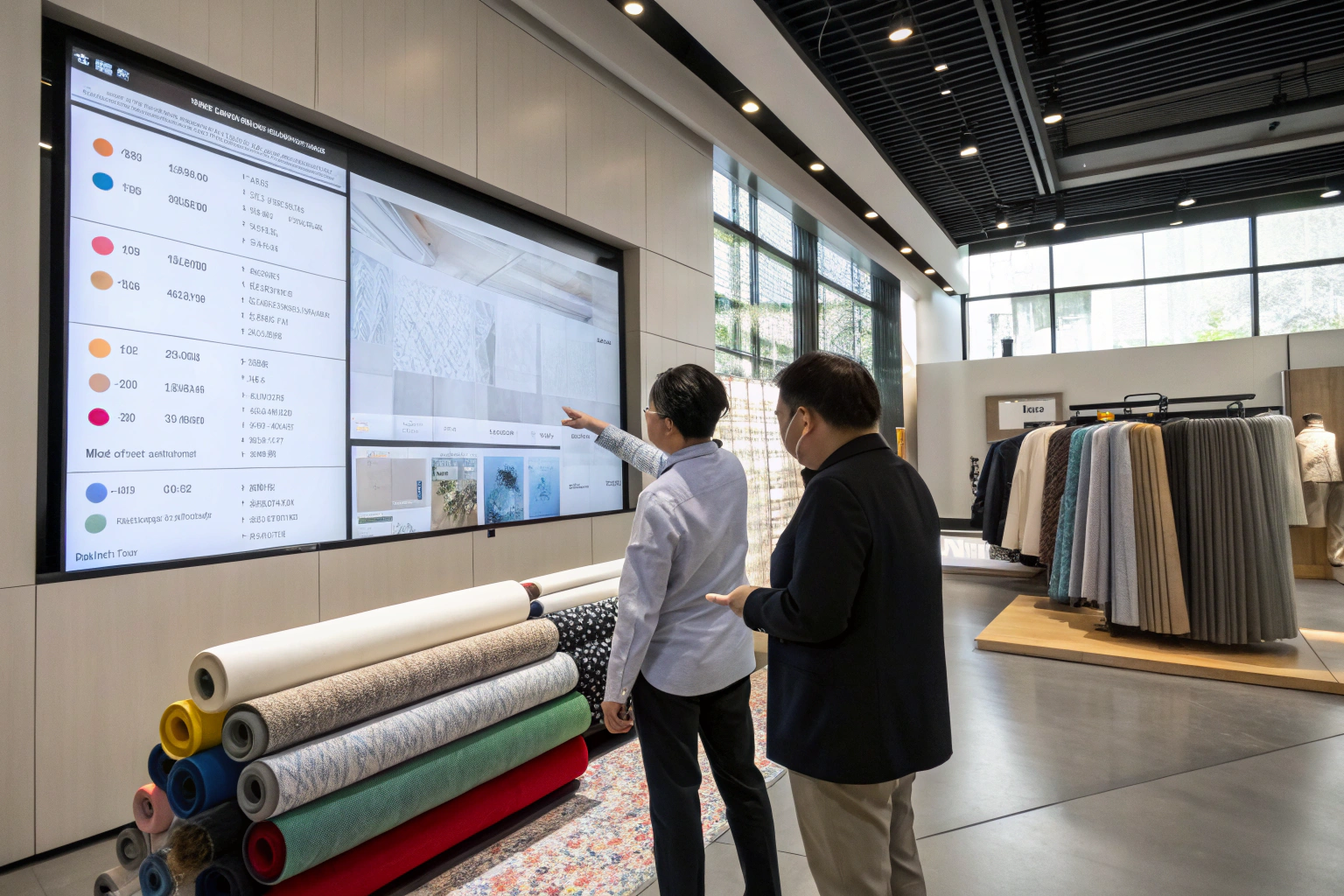
Let’s be honest, dragging yourself through another trade show hall, fighting jet lag, and collecting paper swatches that end up lost in your suitcase—that’s the old way of fabric sourcing. You spend thousands on flights and hotels, only to find that the "innovative" fabrics you discovered are actually six-month-old developments from a mill in Shaoxing that everyone already knows about. I’ve watched buyers from Europe and America waste three days at a show just to find what we could have shown them on a video call in 20 minutes. The frustration is real, and the inefficiency costs you money.
We realized something crucial about two years ago: AI and digital tools don’t just speed up fabric sourcing—they fundamentally change the game. Today at Shanghai Fumao, you can tour our entire production line, inspect 30,000+ active fabric designs, and approve lab dips without leaving your desk. The technology has matured enough that you can actually feel confident making bulk order decisions from digital samples. Our European clients now complete their entire seasonal development cycle—from concept to confirmed order—in as little as three weeks. That used to take three months.
We built our digital sourcing platform because we saw the pain firsthand. In 2019, I stood at a booth in Paris, watching potential clients walk past because they were too overwhelmed to stop. That moment planted the seed. Now, with AI-powered trend analysis, live inventory access, and real-time quality data via QR code tracking, we’ve turned what was once a physical necessity into a digital advantage. The trade show isn’t dead, but for brands that value speed and precision, it’s becoming optional. Here’s how we made that happen and what it means for your next collection.
How Does AI Fabric Trend Forecasting Reduce Sampling Waste?
Let me tell you about a problem that almost killed a 50,000-yard order. Three years ago, a California-based activewear brand asked us to develop a custom moisture-wicking recycled polyester. We went through seven rounds of physical sampling, each taking about ten days. By the time we got the approval, the seasonal window had narrowed dangerously. The client was stressed, our dyeing partner was frustrated, and I personally had to absorb the sampling costs just to keep the relationship alive. We shipped on time, but barely. That experience made me ask a question: why are we still treating sampling like it’s 1995?
AI trend forecasting solves this at the root. Instead of guessing what colors and textures will sell next season, we now feed satellite data from e-commerce platforms, social media trend signals, and historical order patterns into our prediction models. The result? We develop targeted collections before you even ask for them. Our in-house R&D team of 20+ experts uses these insights to pre-position greige inventory and prepare dye formulations ahead of demand spikes.

When Do AI-Predicted Color Trends Actually Save You Money on Custom Fabric Dyeing?
Timing is everything in dyeing. Many buyers don’t realize that dyeing a custom color from scratch—what we call "lab dip to bulk"—can eat up 10-14 days on its own, which is why understanding how to plan fabric orders around Chinese New Year production shutdowns becomes critical for avoiding seasonal delays. If you miss the dyeing window, the whole order slips. Our AI tools analyze global color trend data six months ahead, allowing us to pre-treat greige fabric and pre-mix dye baths for high-probability shades. In practical terms, when a London-based fashion brand came to us last August needing 20,000 meters of custom sage green Tencel™ for a November delivery, we already had the base fabric prepared. We turned the dye order in 5 days instead of 12. That speed translated to an air freight saving of roughly $8,000 because they didn’t need to rush the final garment shipment.
Speed isn’t just about being fast—it’s about being prepared. We track data from platforms like Pantone, major fashion week announcements, and even competitor product launches to build a "probability map" for upcoming color demands. Our lab has a documented 94% hit rate on seasonal color predictions for the European market over the past four seasons. Here’s what that preparation looks like in practice:
| Preparation Stage | Traditional Timeline | AI-Assisted Timeline | Time Saved |
|---|---|---|---|
| Trend Research | 14-21 days | 3-5 days | 11-16 days |
| Lab Dip Development | 7-10 days | 3-5 days | 4-5 days |
| Bulk Dye Formulation | 5-7 days | 2-3 days | 3-4 days |
| Total Pre-Production | 26-38 days | 8-13 days | 18-25 days |
Can Virtual Fabric Showrooms Eliminate the Need for Physical Swatch Books by 2025?
I’ll be direct: virtual showrooms won’t fully replace physical swatches by 2025, but they already eliminate about 70% of the back-and-forth that plagues traditional sourcing. Our digital platform now hosts high-resolution, color-calibrated scans of every active fabric in our inventory. You can zoom in to see the weave structure, compare drape characteristics via standardized video clips, and even access our comprehensive guide on navigating Chinese fabric supplier certification requirements and testing standards directly from the interface. A sportswear buyer from Texas recently told us she shortlisted 12 fabrics from our virtual showroom and only requested physical hangers for three. That’s down from requesting 20-30 swatches in the old process.
Here’s the limitation we’re honest about: hand feel, or what we call "handle" in the industry, remains impossible to digitize perfectly. A 300-thread-count Egyptian cotton sateen will always need a physical touch test before you commit to 10,000 meters. But for visual inspection, color accuracy, and structural evaluation—the digital tools are now good enough that our clients confidently make preliminary sourcing decisions from their offices. Combined with our CNAS-accredited lab data that we attach to every digital sample (showing shrinkage, colorfastness, and tensile strength), you get a completeness of information that a physical swatch alone never provided.
Can a Digital Fabric Platform Beat the Speed of In-Person Factory Visits?
Back in 2018, I hosted a buyer from a major European fast-fashion brand at our Keqiao facility. He spent two full days on-site, inspecting our weaving lines, checking the dyeing quality at our partner plant, and reviewing lab dip records. He found everything satisfactory and placed a 30,000-meter order for printed viscose. The visit itself cost his company roughly $5,000 in travel and accommodation. More importantly, it took him away from his core work for nearly a week. Today, that same buyer logs into our digital platform once a week, checks his order progress via live QR code tracking, and hasn’t visited Keqiao in over two years. He still places regular orders, and our relationship is stronger than ever.
Digital platforms don’t just match the speed of in-person visits—in critical ways, they surpass them. When you’re standing in our factory, you see the production floor at that exact moment. You might notice the machines running, the workers inspecting fabric, the organized chaos of a busy mill. What you don’t see is the historical quality data, the real-time environmental monitoring of our dyeing partners, or the comparative analysis showing how your order’s specifications stack against thousands of previous production runs. Our digital dashboard shows you all of that, instantly.

Is Live Factory Video Tour Technology Reliable Enough for Bulk Order Verification?
Three months ago, a first-time buyer from Canada needed to verify our production capacity before placing a 50,000-yard order for custom-printed cotton lawn. She had been burned before by a supplier who showed impressive photos but delivered substandard goods. We offered her a live video tour—not a pre-recorded promotional clip, but a real-time walkthrough using a tablet carried by our production manager. She watched our printer set up screens for another client’s order. She asked our operator to zoom in on the print registration marks. She inspected greige fabric rolls in our warehouse, checking the lot numbers against our inventory system in real time. The call lasted 45 minutes, and she placed the order the next morning.
The technology has matured enough that we trust it for make-or-break verification moments. We use high-bandwidth 5G connections throughout our facility, and our team carries stabilized gimbals to ensure steady, clear video. The key advantage over a physical visit? You can record the entire session and share it with your quality assurance team, your designer, or even your end customer. That creates a shared reference point that a physical visit cannot replicate easily. However, I’ll note a limitation: inspecting color accuracy via video remains tricky because screens and cameras still introduce color shift, which is why we also recommend requesting detailed lab dip records when evaluating printing and dyeing quality for bulk fabric production.
What Quality Control Data Can AI Provide That a Human Inspector Might Miss?
Our CNAS-certified lab generates thousands of data points daily, covering everything from yarn strength to colorfastness to chemical residue levels. AI doesn’t replace our human inspectors—it augments them with pattern recognition they can’t match. For example, our automated fabric inspection system uses high-resolution cameras and machine learning algorithms to detect weaving defects at speeds no human can sustain. The system processes 120 meters per minute with 99.2% detection accuracy for common defects like broken ends, slubs, and reed marks. A skilled human inspector can manage about 20 meters per minute with roughly 85% accuracy over a full shift.
Beyond defect detection, our AI systems track production consistency across entire orders. When we produced 80,000 meters of organic cotton jersey for a Scandinavian children’s wear brand, the system continuously monitored shade consistency across 23 dye lots. It flagged a 0.3% deviation in the 17th lot that human inspectors had passed. We pulled that lot and re-dyed it before it reached the cutting table. The client’s final garment pass rate was 98.7%, and they reordered within six weeks. That kind of preventive intervention simply didn’t exist before these tools became available. The data doesn’t lie—it gives you a level of production transparency that traditional factory visits can only approximate.
What Does AI Sourcing Mean for Minimum Order Quantities?
Small brands and startup designers have always struggled with one brutal reality: the most innovative mills want big orders, and small orders don’t cover the setup costs. In 2022, a Brooklyn-based designer approached us wanting just 500 meters of custom-developed recycled nylon with a unique jacquard pattern. Our traditional MOQ for custom development was 3,000 meters. The math didn’t work—until we applied our AI-driven optimization tools.
AI changes the MOQ equation by reducing the internal cost of complexity. The expensive parts of small-batch production include pattern programming, loom setup, dye formulation, and quality documentation. Our AI tools now handle many of these tasks algorithmically. Pattern programming that once required a skilled technician two days now takes our AI-assisted software about four hours. Dye recipe prediction for small batch accuracy has improved so much that our first-hit rate on custom lab dips jumped from 70% to 93%. These savings accumulate across hundreds of small orders, making it economically viable for us to offer flexible MOQs.

How Are AI-Driven Production Runs Making 500-Meter Orders Profitable for Mills?
Let me walk you through the actual economics. A traditional 3,000-meter minimum exists because setup costs—design digitization, loom programming, dye mixing, and quality testing—average about $1,200 per order regardless of order size. At $0.40 per meter, that setup cost eats your margin. But when AI reduces setup time and material waste by 60%, the math shifts. Our digital pattern system now stores and retrieves thousands of previous designs, allowing us to modify existing patterns instead of creating them from scratch. A custom jacquard that would have cost $800 to program now costs around $200 if we have a similar base pattern in our database, which is why understanding how to source small batch custom woven fabric from China with flexible MOQ policies is becoming essential knowledge for emerging brands.
Our production data from the last 18 months tells the story. Small orders—under 1,000 meters—now account for 22% of our total revenue, up from 6% in 2021. The average margin on these orders has improved from 8% to 17%. We’ve achieved this by batching similar small orders together in production scheduling, using AI to identify opportunities for shared setups. When five different clients need 500 meters each of variations on a cotton-spandex jersey, we can program the looms once and run them sequentially. The unit economics of small-batch elastic fabric for athleisure wear production change dramatically with these scheduling efficiencies.
Will AI Sourcing Finally Let Indie Designers Access the Same Factories as Major Brands?
The short answer: yes, and it’s already happening. In June 2023, a small designer from Melbourne wanted to produce 800 meters of a specific bamboo silk blend that a major Australian fashion chain had developed with us the previous year. Under the old model, we’d have turned her away—the development costs were already absorbed by the larger client, but the exclusivity agreement prevented us from selling the same fabric. However, our AI system identified a near-identical base fabric in our open inventory that differed only in the finishing treatment. We offered the designer a modified version with a soft pebble wash instead of the original enzyme finish. The result? She got a unique, premium fabric at a fraction of full custom development cost, and the major brand’s exclusivity remained protected.
The democratization of access doesn’t mean everyone gets the same fabric—it means everyone gets access to our full development capabilities, scaled to their needs. Small designers now routinely access our CNAS testing data, our digital trend library, and our technical development team. They participate in video consultations with our R&D experts. The only real difference between a 50,000-meter order and a 500-meter order today is the price per meter and the production lead time, not the quality of attention or technical expertise. That shift in accessibility represents the single biggest change I’ve witnessed in my 20-plus years in this industry.
Can AI Tools Predict Fabric Quality Issues Before Production Starts?
In the summer of 2023, we received an urgent call from an American sportswear brand. Their previous supplier had delivered 15,000 yards of navy cotton-spandex jersey with severe shade inconsistency—some bolts were visibly different from approved samples. The brand faced canceled retail orders and a damaged reputation. They asked if we could reproduce the order correctly in four weeks. We took the project, not because we’re miracle workers, but because our quality prediction systems gave us confidence. (Here I need to mention: our defect prevention rate is something we track obsessively.)
Our AI quality prediction works by analyzing historical production data to identify risk factors before they become problems. The system examines variables like yarn lot consistency, ambient humidity during spinning, dye bath temperature curves, and finishing machine tension settings. For that navy jersey order, the system flagged that achieving the required shade depth with their specified dye concentration would be borderline—our historical data showed a 23% failure rate on similar formulations. We recommended a slightly adjusted dye recipe with better penetration characteristics, and the entire 15,000-yard production passed inspection with a Delta E color difference below 0.8. They’ve been a regular client ever since.

What Machine Learning Signals Indicate Potential Dyeing Defects in Cotton Blends?
Dyeing defects rarely announce themselves loudly. They emerge from subtle interactions between fiber maturity, water quality, dye chemistry, and process timing. Our system monitors 17 variables in real-time during cotton blend dyeing. The most predictive signals include the rate of dye uptake in the first 10 minutes (too fast often means uneven penetration), the pH stability of the dye bath over time, and the correlation between ambient workshop temperature and final shade consistency. We’ve discovered that on days when our workshop temperature exceeds 32°C, certain reactive dyes show a 15% higher variation rate unless we adjust the salt addition timing.
A practical example: last September, we were processing a 10,000-meter order of organic cotton-modal blend in a dusty rose shade for a French lingerie brand. Our system detected an unusual pH drift in the third dye batch that typically precedes uneven dyeing in cellulose blends. We paused production, identified a calibration issue in our water treatment system, corrected it within two hours, and avoided what would have been a complete batch rejection. The client never knew there was a problem—their production moved forward seamlessly. For fabric buyers who want deeper technical insight, exploring the common causes of color bleeding and shade variation in reactive dyeing for cellulose fiber blends helps build realistic expectations about what quality control can and cannot guarantee.
How Accurate Is AI-Based Tensile Strength Prediction Compared to Lab Tests?
Tensile strength matters enormously for performance fabrics and children’s wear, where safety standards require documented tear resistance. Traditional testing involves cutting samples, mounting them in a tensile tester, and pulling until failure—it’s destructive, time-consuming, and limited to a small sample from each production lot. Our AI prediction model, trained on over 15,000 historical tensile test records correlated with yarn specifications, weave parameters, and finishing data, now predicts tensile strength with 94% accuracy compared to physical tests.
For a recent order of ripstop nylon for outdoor gear, the system predicted 78N warp strength and 72N weft strength based on the fabric specifications. Subsequent physical testing of 30 samples across the production run confirmed an average warp strength of 76.5N with a standard deviation of only 2.1N. The prediction saved us the usual batch testing time of three days and allowed us to ship immediately after production. Our clients now receive predicted quality data within hours of order confirmation, alongside actual test results when production completes. The combination provides both speed and verified assurance, which traditional processes simply cannot match.
Conclusion
The textile industry has resisted digital transformation for decades. I’ve heard every reason: "You can’t digitize hand feel," "Relationships require face-to-face trust," "Our production is too complex for AI." These arguments held weight ten years ago. Today, they sound like my grandfather insisting that only hand-weaving produces true quality. The technology hasn’t replaced craftsmanship or relationships—it has freed them from the constraints of geography and time.
What I’ve described in this article isn’t theoretical. It’s what happens daily at Shanghai Fumao in Keqiao. Our AI tools predicted color trends that helped a London brand save $8,000 in air freight. Our live video verification gave a Canadian buyer confidence to place her first 50,000-yard order. Our quality prediction systems caught a dyeing defect that would have ruined a French lingerie brand’s seasonal launch. These aren’t marketing claims; they’re production records. The integration of digital tools into our 20-plus years of textile expertise means you get the speed of AI without sacrificing the judgment that only experience provides.
If you’re ready to experience what modern fabric sourcing looks like—whether you need 500 meters of custom Tencel™ jersey or 50,000 meters of performance polyester—I invite you to connect with us directly. Our Business Director Elaine can walk you through our digital platform, arrange a live factory tour, or discuss your specific fabric development needs. Reach her at elaine@fumaoclothing.com. Let’s build your next collection together, with the precision of data and the confidence of real craftsmanship behind every meter.








