Last November, a long-time buyer from a German sustainable fashion brand called me with panic in her voice. She’d just received her 2026 budget projections from her finance team, and they’d built in a 12% cost increase assumption for all Asian fabric imports based on anticipated EU carbon border taxes. "Is my organic cotton jersey really going to cost 12% more next year?" she asked. "Because if it is, I need to redesign my entire collection around fewer fabric SKUs and higher retail prices." I pulled up her order history while we talked. She’d been buying our GOTS-certified organic cotton and recycled polyester blends since 2021, roughly 40,000 meters annually. A 12% increase would add about €23,000 to her annual fabric spend—enough to force serious conversations with her own retail accounts. Her fear wasn’t theoretical. It was a spreadsheet cell with real consequences.
Shanghai Fumao’s fabric prices for European buyers will experience modest adjustments in 2026 related to carbon taxation, but the impact is far smaller than the alarming headlines suggest. The EU’s Carbon Border Adjustment Mechanism, which began its transitional phase in October 2023, does not currently apply to textile products. The CBAM focuses initially on cement, iron and steel, aluminum, fertilizers, electricity, and hydrogen—sectors with the highest carbon leakage risk. Textiles, including our fabric categories, remain outside CBAM scope through at least 2027, with the European Commission scheduled to evaluate sector expansion in late 2026. What European buyers are actually experiencing in 2026 isn’t a direct carbon border tax on fabric imports, but rather the indirect effects of China’s domestic carbon pricing, increased compliance documentation costs, and voluntary carbon offset investments that suppliers like us are making to prepare for eventual regulatory inclusion. The price impact ranges from 0.5% to 2.5% depending on fabric category, not the 10-15% that industry rumors sometimes suggest.
The confusion is understandable. The regulatory landscape combines actual Chinese domestic carbon policies, proposed EU extensions of CBAM to downstream products, and voluntary corporate sustainability commitments into a fog of overlapping requirements that even trade lawyers struggle to parse. I’ve spent more hours than I care to count in 2025 and 2026 reading European Commission working papers, China Ministry of Ecology and Environment policy notices, and textile industry association guidance documents. My conclusion: carbon taxation will eventually affect textile pricing, and suppliers who prepare early will gain competitive advantage. But the 2026 impact is evolutionary, not revolutionary. In this article, I’ll explain exactly which carbon-related costs are affecting your fabric prices now, which might affect them later, and what we’re doing at Shanghai Fumao to minimize the burden.
How Does the EU Carbon Border Adjustment Mechanism Actually Affect Textile Imports in 2026?
Let me state this clearly because I’ve seen misinformation circulating in sourcing forums and even in some consultants’ newsletters: as of May 2026, the EU CBAM does not cover textile products. The mechanism applies to imports of cement, iron and steel, aluminum, fertilizers, electricity, and hydrogen. During the transitional phase, which runs through December 2025 and has been extended through 2026, importers of these covered products must report embedded emissions quarterly but do not pay financial adjustments. The full financial phase begins in 2027 for the original six sectors, with CBAM certificates priced at the EU Emissions Trading System allowance price.
Why does textile CBAM confusion persist despite the clear regulatory scope? Two reasons. First, the European Commission has explicitly stated its intention to evaluate CBAM expansion to downstream products, including textiles, by 2026 with potential implementation by 2028-2030. The evaluation is real, the expansion intent is serious, and suppliers who ignore the trajectory will face a painful adjustment when textile products eventually enter scope. Second, some European brands have begun demanding CBAM-style emissions data from their textile suppliers voluntarily, either in anticipation of regulatory requirements or as part of their own Scope 3 emissions reporting obligations. These voluntary data requests feel like a carbon tax to suppliers who don’t understand the distinction between mandatory financial adjustments and voluntary supply chain transparency initiatives. The practical guide to EU Carbon Border Adjustment Mechanism scope and timeline for textile importers clarifies what’s happening now versus what’s proposed for later.

What Is the Difference Between CBAM Compliance and Voluntary Carbon Reporting Requirements?
CBAM compliance, when it eventually applies to textiles, will involve a specific financial mechanism: importers must purchase CBAM certificates corresponding to the embedded carbon emissions in their imported goods, at a price linked to the EU ETS allowance price. The certificate cost is a direct tax-equivalent on carbon content, payable to EU authorities at the border. This mechanism is mandatory, legally specified, and enforced by customs authorities.
What European brands are asking for in 2026 is fundamentally different. These are voluntary supply chain transparency initiatives where brands request Product Carbon Footprint data, Life Cycle Assessment documentation, or third-party verified emissions inventories from their suppliers. The requests vary enormously in format, methodology, and scope because no standardized textile carbon reporting framework has been adopted across the industry. A Swedish outdoor brand might request data following the Higg Index methodology, while a German workwear brand wants GHG Protocol Scope 3 category 1 data, and a French luxury house asks for a proprietary format developed by their sustainability consultant. Each request requires separate data compilation, different calculation methodologies, and occasionally different third-party verification. The administrative burden is real and costly—I estimate we spend roughly $45,000 annually on carbon data compilation and verification across all customer requests—but it is not a tax. Understanding the distinction between mandatory CBAM financial adjustments and voluntary brand-level carbon reporting requirements for textile suppliers prevents buyers from conflating compliance costs with customer service costs.
Which Fabric Categories Face the Highest Embedded Carbon Costs Under Future Scenarios?
When CBAM eventually extends to textiles, the carbon cost impact will vary dramatically by fiber type and production process. Synthetic fibers—polyester, nylon, acrylic, elastane—carry significantly higher embedded carbon than natural fibers because their raw material is petroleum-derived and their production is energy-intensive. Our internal carbon accounting, verified by a third-party auditor using ISO 14067 methodology, shows that conventional polyester yarn carries an embedded carbon footprint of approximately 5.5 kg CO2 equivalent per kilogram of fiber, compared to approximately 0.5 kg CO2e for conventional cotton, 0.3 kg CO2e for linen, and 1.8 kg CO2e for conventional viscose. At a hypothetical CBAM price of €80 per ton of CO2—roughly the EU ETS price in early 2026—the carbon cost differential between polyester and cotton would be approximately €0.40 per kilogram of fiber, or about €0.12 per meter for a typical 300 gsm fabric.
The calculations shift significantly for recycled and low-carbon fiber variants. Our recycled polyester, produced from post-consumer PET bottles through a mechanical recycling process, carries approximately 2.8 kg CO2e per kilogram—roughly half the footprint of virgin polyester. At €80 per ton CO2, the carbon cost drops from €0.44 to €0.22 per kilogram of fiber. Organic cotton, depending on cultivation practices, can range from 0.3 to 1.2 kg CO2e per kilogram, with soil carbon sequestration potentially creating carbon-negative scenarios that would generate CBAM credits rather than costs. The comparative embedded carbon analysis of synthetic versus natural textile fibers and implications for future CBAM costs demonstrates why we’ve invested heavily in recycled synthetics and organic natural fibers—not just for marketing appeal but for genuine carbon cost advantage when regulatory mechanisms eventually apply.
What Is China’s Domestic Carbon Pricing Doing to Keqiao Textile Production Costs?
While EU CBAM doesn’t yet touch textiles, China’s domestic carbon policies absolutely do, and their impact on production costs is real and measurable. China launched its national Emissions Trading System in 2021, initially covering the power generation sector. In 2024, the Ministry of Ecology and Environment announced plans to expand the ETS to include petrochemicals, chemicals, building materials, iron and steel, non-ferrous metals, paper, and domestic aviation by 2025-2026. Textile manufacturing—specifically dyeing, finishing, and synthetic fiber production—falls under the chemical and petrochemical expansion categories. Our dyeing partners in Shaoxing began receiving carbon quota allocations in January 2026, with formal inclusion in the compliance carbon market expected by 2027.
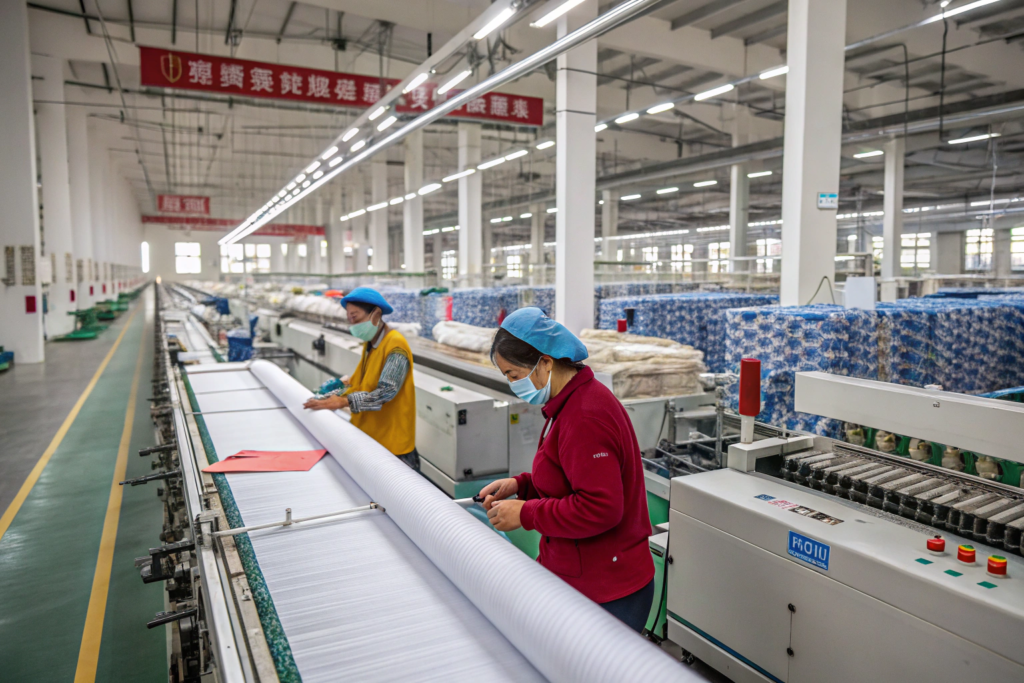
The practical impact on dyeing costs is already visible. Dyeing is an energy-intensive process requiring large volumes of heated water, steam for fixation, and electricity for machinery operation. When dye houses receive carbon quotas that limit their emissions, they face a choice: invest in energy efficiency and cleaner fuel sources to operate within their quota, purchase additional carbon allowances on the market at prevailing prices, or pay penalties for exceeding their allocation. All three options increase production costs. Our dyeing partners report that carbon-related cost increases—including energy efficiency investments amortized over production volume, carbon allowance purchases, and compliance administration—added approximately 3-5% to their processing costs in the first quarter of 2026 compared to the same period in 2025. This cost flows through to fabric pricing, but it’s absorbed across the entire production chain rather than appearing as a line-item carbon surcharge.
How Are Shaoxing Dye Houses Adapting to China’s Expanding Carbon Trading System?
The adaptation strategies I’m observing among our dyeing partners fall into three categories: fuel switching, process optimization, and vertical integration with renewable energy. Fuel switching from coal to natural gas has been the dominant strategy since 2020, driven by both carbon policy and local air quality regulations. Natural gas produces approximately 50-60% less CO2 per unit of energy than coal, immediately reducing a dye house’s carbon liability. The infrastructure cost is significant—roughly $2-4 million for a medium-sized facility—but the payback period has shortened as carbon allowance prices have risen. The Shaoxing municipal government has accelerated this transition by subsidizing natural gas pipeline connections and penalizing coal boiler operation within city limits.
Process optimization delivers lower capital requirements but requires technical expertise that many smaller dye houses lack. Low-liquor-ratio dyeing machines reduce water consumption by 30-50% compared to conventional equipment, simultaneously reducing the energy required to heat that water. Heat recovery systems capture thermal energy from wastewater and exhaust steam, recycling it to pre-heat incoming water. Automated chemical dosing systems eliminate overdosing that wastes chemicals and requires additional washing cycles. These optimizations typically reduce energy consumption by 15-25% with payback periods of 18-36 months. Our largest dyeing partner invested $1.2 million in process optimization in 2025 and reduced their per-kilogram carbon emissions by 19% while improving shade consistency—a rare win-win where environmental and quality metrics improved simultaneously.
Vertical integration with renewable energy represents the most ambitious adaptation strategy. Two of our dyeing partners have installed rooftop solar arrays covering 40-60% of their electricity consumption. One has signed a power purchase agreement with a wind farm developer for the remaining grid electricity, effectively operating on 100% renewable electricity. These investments don’t eliminate carbon exposure—thermal energy for water heating still typically comes from natural gas or coal—but they significantly reduce the carbon liability that the expanding ETS will price. The adaptation strategies for Chinese textile dyeing facilities responding to carbon trading system expansion and energy cost pressures demonstrate an industry in transition, with leaders separating from laggards based on willingness to invest before compliance deadlines force action.
Will Carbon Costs Vary Significantly Between Conventional and Recycled Fabric Production?
The carbon cost differential between conventional and recycled production is substantial and growing as carbon pricing mechanisms expand. Our internal carbon accounting quantifies this differential across major fabric categories. Recycled polyester produced through mechanical recycling carries approximately 50% of the carbon footprint of virgin polyester. At China’s current pilot carbon prices of approximately ¥60-80 per ton CO2 (roughly €8-11), the carbon cost differential between virgin and recycled polyester is approximately €0.04-0.06 per kilogram of fiber—too small to drive purchasing decisions independently. But at the EU ETS price of €80 per ton, the differential expands to €0.22 per kilogram, and at the €100-150 per ton that many analysts project for the late 2020s, the differential reaches €0.28-0.41 per kilogram. At that level, the carbon cost advantage of recycled polyester becomes a meaningful factor in fabric sourcing decisions, not just a sustainability marketing claim.
The analysis extends beyond polyester. Tencel™ lyocell, produced in a closed-loop process with solvent recovery exceeding 99%, carries approximately 1.1 kg CO2e per kilogram compared to 1.8 kg CO2e for conventional viscose. Organic cotton, depending on certification body and cultivation practices, can range from carbon-neutral to carbon-negative when soil sequestration is included in the accounting boundary. Our GOTS-certified organic cotton supplier in Xinjiang—verified through independent audit, not self-declaration—documents a carbon footprint of 0.3 kg CO2e per kilogram of lint cotton, approximately 40% lower than conventional cotton from the same region. The lifecycle carbon footprint comparison of virgin versus recycled polyester and conventional versus organic cotton production demonstrates that sustainable fabric choices increasingly align with carbon cost minimization as regulatory pricing mechanisms expand. This alignment between environmental performance and economic advantage is the most powerful driver of sustainable textile adoption I’ve observed in twenty years in this industry.
How Is Fumao Preparing for Carbon-Neutral Fabric Production Demands?
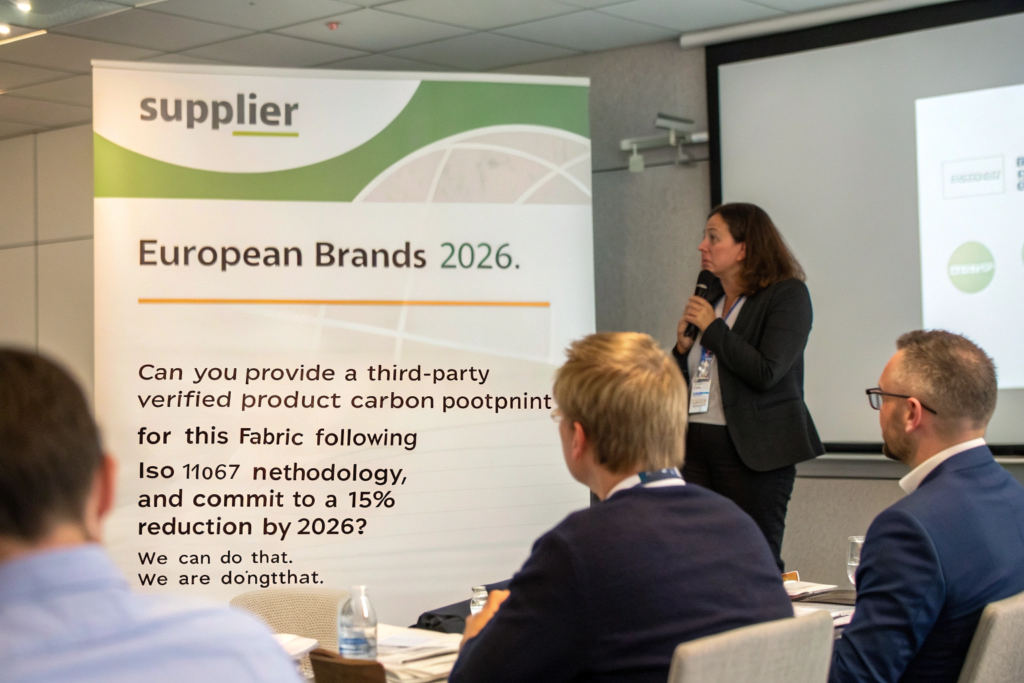
The carbon neutrality demands arriving from European brands in 2026 range from reasonable to impossible, and learning to distinguish between them has become an essential supplier capability. A reasonable request: "Can you provide a third-party verified Product Carbon Footprint for this fabric following ISO 14067 methodology, and commit to a 15% reduction by 2028?" We can do that. We are doing that. An impossible request: "Can you guarantee carbon-neutral fabric delivery by next season, with full offset documentation, at the same price as your standard product?" No. Carbon neutrality costs money—either through process changes that reduce emissions or through verified offset purchases that compensate for remaining emissions. Pretending otherwise is greenwashing.
Our preparation strategy operates on three timelines simultaneously. For immediate needs—the 2026-2027 seasons—we provide verified Product Carbon Footprint data for our top 100 SKUs, calculated using ISO 14067 methodology with third-party verification from an accredited auditor. For medium-term compliance—the 2027-2029 period when we expect CBAM expansion to textiles—we’re investing in production process changes that reduce our embedded carbon before regulatory costs make those reductions mandatory. These investments include the recycled polyester expansion I mentioned earlier, solar installation at our Keqiao weaving facility, and process optimization partnerships with our dyeing suppliers. For long-term positioning—2030 and beyond—we’re exploring carbon insetting models where we invest in carbon reduction within our own supply chain rather than purchasing external offsets that may face credibility challenges as carbon markets mature.
What Third-Party Carbon Verification Standards Does Fumao Use for European Clients?
Standardization has been the hardest part of carbon reporting, and I’ll be honest about the challenge. Different European clients demand different verification standards, and maintaining certifications across multiple frameworks is expensive and administratively burdensome. Our approach has been to adopt ISO 14067 as our baseline Product Carbon Footprint methodology because it’s internationally recognized, technically rigorous, and increasingly referenced in EU regulatory documents as an acceptable accounting standard. We supplement ISO 14067 with specific client-requested formats: Higg Index Facility Environmental Module data for brands using the Sustainable Apparel Coalition framework, GOTS and GRS certification documentation for organic and recycled content verification, and Oeko-Tex STeP certification for sustainable production process verification.
The verification is performed by TÜV Rheinland, a globally accredited third-party certification body with specific expertise in textile supply chain auditing. We chose TÜV because their certificates carry weight with European procurement departments and because their auditors understand textile manufacturing processes—a chemical industry generalist auditor cannot properly evaluate a dye house’s carbon accounting. The annual verification cost across all certifications runs approximately €38,000, which we treat as a compliance investment rather than a cost to be minimized. Incomplete or self-declared carbon data will become a competitive disadvantage as European brands tighten their Scope 3 reporting requirements. Understanding which third-party carbon verification standards for textile supply chains satisfy European brand procurement requirements helps buyers evaluate supplier claims and distinguish verified data from marketing assertions.
Can Fabric Buyers Expect Carbon-Neutral Shipping Options From Fumao in 2026?
Carbon-neutral shipping is available now, but I need to explain what "carbon-neutral" actually means in logistics because the term gets abused. Our ocean freight shipments from Shanghai to European ports—Hamburg, Rotterdam, Antwerp, Felixstowe—generate approximately 15-25 grams of CO2 equivalent per ton-kilometer, depending on vessel efficiency and route. For a 20-foot container carrying 8,000 meters of fabric from Shanghai to Hamburg, the voyage generates roughly 1.8-2.2 tons of CO2 equivalent. We offset these emissions through Gold Standard-certified carbon credits purchased from a portfolio of renewable energy and reforestation projects, at a cost of approximately €25-35 per container at current credit prices.
The offset cost is small enough that we’ve absorbed it into our standard freight pricing for European DDP shipments since January 2026. Every container we ship to Europe now arrives with carbon-neutral transport documentation, at no additional line-item charge to the buyer. This isn’t a permanent pricing decision—if carbon credit prices rise significantly or if regulatory requirements mandate specific offset types that cost more than current voluntary market credits, we may need to introduce a carbon-neutral shipping surcharge. But for 2026, European buyers receive carbon-neutral ocean freight as a standard service feature, not a premium add-on. The air freight situation is different because air freight emissions are 40-50 times higher per ton-kilometer than ocean freight. We offer carbon-neutral air freight as an option with the offset cost added to the shipping charge, and we’re transparent about both the emissions calculation and the offset cost. The availability and cost structure of carbon-neutral fabric shipping options from Asian suppliers to European markets is evolving rapidly as logistics providers develop their own carbon programs, and buyers should expect carbon-neutral shipping to transition from differentiator to baseline expectation within 2-3 years.
How Should European Buyers Budget for Carbon-Related Fabric Cost Changes?
Budgeting for carbon costs requires abandoning the single-number approach that worked when carbon wasn’t a factor in textile pricing. A buyer who asks "how much will carbon taxes increase my fabric costs in 2026?" wants a simple percentage they can plug into their spreadsheet. The honest answer is that the impact varies by fabric category, by production process, by supplier preparation level, and by the specific carbon accounting and offset choices the buyer and supplier make together. A single number would be misleading.
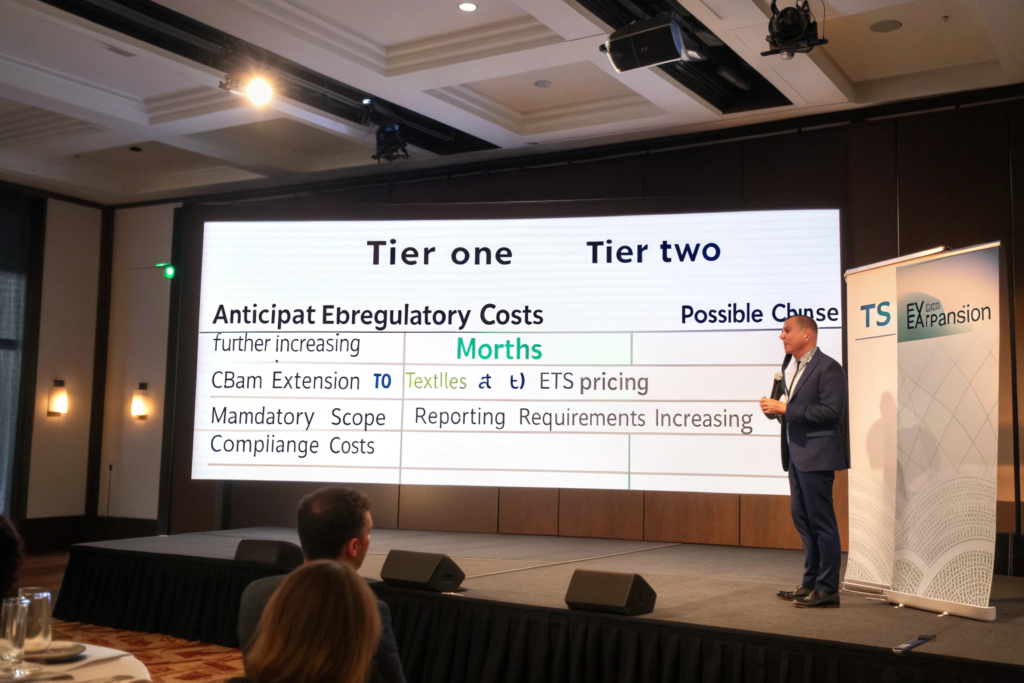
The budgeting framework I recommend to our European clients uses three cost tiers. Tier one covers current, measurable carbon costs: China’s domestic carbon pricing impacts on dyeing and finishing (0.5-1.5% on affected fabric categories), carbon data compilation and verification costs (0.2-0.5% spread across order volume), and voluntary carbon-neutral shipping (0.1-0.3%, currently absorbed in our standard pricing). Total tier one impact: approximately 0.7-2.3% on fabric pricing, with synthetic fabrics and heavily finished fabrics at the higher end and minimally processed natural fabrics at the lower end. Tier two covers anticipated regulatory costs expected within 18-36 months: potential CBAM extension to textiles at EU ETS pricing (1-4% depending on fabric category and carbon intensity), mandatory Scope 3 reporting requirements that increase compliance costs (0.3-0.8%), and possible Chinese ETS expansion that further increases energy costs for production (0.5-1.5%). Tier two costs are probable but not certain, and the ranges reflect regulatory and market uncertainty. Tier three covers voluntary premium options: carbon-neutral fabric through verified offset purchases (1-3% depending on offset type and certification standard), low-carbon material premiums for recycled or organic alternatives to conventional fibers (2-8% depending on material and market conditions), and full carbon-neutral supply chain certification (3-5%). Tier three costs are optional investments that support brand sustainability positioning rather than regulatory requirements.
Which Fabric Categories Will See the Smallest Carbon-Related Price Increases Through 2027?
Natural fibers with low processing intensity will experience the smallest carbon-related cost increases. Linen, hemp, and organic cotton in their minimally processed forms—greige fabric, simple dyeing, no chemical finishing—carry the lowest embedded carbon and will attract the smallest carbon costs under any regulatory scenario. These fibers are plant-based, requiring no petroleum extraction for raw material, and their cultivation can be carbon-neutral or carbon-sequestering under appropriate agricultural practices. Their processing—retting for linen, mechanical separation for hemp, ginning and spinning for cotton—is less energy-intensive than synthetic fiber extrusion or heavy chemical finishing.
Recycled natural fibers represent an interesting middle case. Recycled cotton and recycled wool carry lower carbon footprints than their virgin equivalents because they avoid the agricultural phase entirely, but their mechanical recycling processes add a processing step that virgin fibers avoid. The net carbon balance depends on the specific recycling technology and the counterfactual disposal scenario—recycled wool that would otherwise go to landfill shows stronger carbon advantage than recycled wool that would otherwise be incinerated with energy recovery. Our recycled cotton offerings, produced from post-industrial cutting waste, carry approximately 0.2 kg CO2e per kilogram—lower than conventional cotton at 0.5 kg but higher than organic cotton at 0.3 kg in our specific supply chain. The comparative carbon cost exposure of natural fiber textile categories under evolving carbon pricing mechanisms confirms what we’ve observed in buyer behavior: European brands are shifting their core basics toward linen, hemp, and organic cotton not just for sustainability marketing but for genuine carbon cost hedging.
Should European Buyers Accelerate Orders to Lock in Pre-Carbon-Tax Pricing?
The lock-in question comes up in every buyer conversation about carbon costs, and the answer is more nuanced than "yes, buy now before prices rise." For fabric categories with high carbon exposure—virgin polyester, conventional nylon, heavily finished synthetics—there is a rational case for securing 2026-2027 requirements at current pricing before regulatory carbon costs materialize. The CBAM evaluation timeline suggests that textile inclusion, if it occurs, would likely take effect in 2028 at the earliest, with a phase-in period that gradually increases the financial obligation. Ordering 2027 requirements now locks in pre-CBAM pricing for fabric delivered throughout next year, potentially avoiding 1-4% in carbon costs depending on the category.
However, the lock-in strategy carries its own risks that buyers should evaluate alongside the carbon cost savings. Committing to large volume orders now means forecasting demand 12-18 months forward with all the uncertainty that implies. It means tying up working capital in fabric inventory or asking suppliers to warehouse finished goods. It means accepting current color and finish specifications without the flexibility to adjust to market feedback from upcoming seasons. For stable, core-basic programs—black cotton jersey, navy twill, standard linings—these risks are manageable. For fashion-sensitive fabrics where color, texture, and finish trends shift seasonally, the lock-in risks may exceed the carbon cost savings.
The optimal approach for most European buyers is selective acceleration: identify the 20-30% of your fabric spend that represents high-carbon-exposure, low-fashion-risk basics, secure those volumes at current pricing with delivery scheduled across 2026-2027, and maintain flexible ordering for the fashion-sensitive portion of your range. This captures the majority of potential carbon cost savings while preserving the design flexibility that seasonal collections require. The strategic analysis of whether to accelerate fabric orders to lock in pre-carbon-tax pricing depends on fabric category carbon exposure, demand forecast confidence, and the cost of capital for inventory holding.
Conclusion
The carbon tax conversation in 2026 generates more heat than light, and my goal in this article has been to separate the two. The EU CBAM does not currently apply to textiles. The 12% cost increases that some European brands fear are not materializing in 2026. What is materializing—China’s domestic carbon pricing affecting dyeing and finishing costs, European brands’ voluntary carbon reporting requirements, and our own proactive investments in carbon measurement and reduction—is adding approximately 0.5% to 2.5% to fabric pricing depending on category and specification. This is real money on large orders, and buyers should budget for it, but it’s not the supply chain disruption that carbon tax alarmism sometimes suggests.
The more important story is the trajectory. Carbon costs in textile supply chains will increase, not decrease, over the next five years. CBAM expansion to textiles is probable, not speculative. China’s ETS will continue expanding its sector coverage and increasing its carbon price. European brands will continue tightening their Scope 3 reporting requirements and shifting procurement toward suppliers who can document low-carbon production. Suppliers who invest now in carbon measurement, process efficiency, renewable energy, and recycled material capabilities will gain cost advantages that compound as carbon pricing mechanisms strengthen. Suppliers who wait for compliance deadlines before acting will face a painful adjustment that their proactive competitors will have already absorbed.
At Shanghai Fumao, our carbon strategy reflects this long-term view. We’re investing in recycled polyester expansion, solar energy at our weaving facility, carbon accounting infrastructure, and third-party verification because these investments will pay for themselves as carbon costs rise. The modest 2026 price impacts are the beginning of a structural shift in textile economics, not a temporary compliance nuisance. European buyers who understand this trajectory can make smarter sourcing decisions—partnering with suppliers who are preparing for carbon pricing, selecting fabric categories with lower carbon exposure for core programs, and building realistic carbon cost assumptions into their multi-season planning.
If carbon pricing and sustainability compliance are affecting your European fabric sourcing strategy, I invite you to discuss your specific situation with our team. Our Business Director Elaine can provide Product Carbon Footprint data for your fabric categories, explain our carbon-neutral shipping options, and help you budget realistically for carbon-related costs in upcoming seasons. Reach her at elaine@fumaoclothing.com. The carbon transition is coming to textiles. The suppliers who prepare thoughtfully and communicate honestly will be the partners you want when it arrives.