
Let me tell you what really happens when a designer picks up a cotton-linen shirt at a trade show. They don’t first check the seam strength. They don’t pull out a loop and count the threads. They scrunch it. They ball it up in their fist, hold it for three seconds, and let go. Then they look at the wrinkles. I’ve watched this a thousand times. And the look on their face when the fabric stays crumpled like a used tissue—that look costs me a sale before I’ve even said hello. Wrinkle recovery is the silent first impression of any shirting or dress-weight fabric. Cotton-linen has a bad reputation here. The linen component is a wrinkle factory. Those stiff, inelastic bast fibers bend and don’t spring back. But that reputation is based on cotton-linen that hasn’t been engineered properly. At Shanghai Fumao, we don’t just accept wrinkles as the price of breathability. We fight them at the fiber level, the yarn level, and the finishing level. The crease recovery angle isn’t just a lab number to me. It’s the fist-scrunch test. And we win it.
The direct, no-fluff answer: Shanghai Fumao consistently achieves a dry crease recovery angle (CRA) of 140 to 155 degrees on our soft-finished cotton-linen shirting fabrics, tested according to the AATCC 66 standard. To put that in perspective, an untreated 100% linen fabric typically scores around 90 to 110 degrees. A standard cotton-linen blend without our finishing might reach 115 to 125. Our 140+ degree result puts our fabric in the same wrinkle-recovery category as a high-quality mercerized cotton poplin, or even a light wool suiting. We don’t use heavy formaldehyde-based crosslinking resins to cheat the number either. That old technology makes the fabric stiff and kills its tear strength. Our approach combines liquid ammonia mercerization for internal fiber elasticity, a precision-controlled silicone macro-emulsion for surface slip, and a unique overfeed relaxation drying that releases internal stresses. A New York-based easy-care shirt brand tested our soft cotton-linen in March 2026, comparing it against their existing easy-care cotton. Our fabric scored a 148-degree warp-plus-weft average. Their cotton scored 152. The difference was four degrees—imperceptible to the wearer—but our fabric was 100% more breathable. They launched the linen-cotton blend as their summer flagship.
Now, a number like "145 degrees" means nothing if you don’t understand the machine that measures it, the physics behind why wrinkles form in the first place, and the specific chemical and mechanical weapons we deploy to defeat them. Let me break open the AATCC 66 test method and show you exactly what happens inside the crease.
How Does the AATCC 66 Wrinkle Recovery Test Actually Measure Fabric Memory?
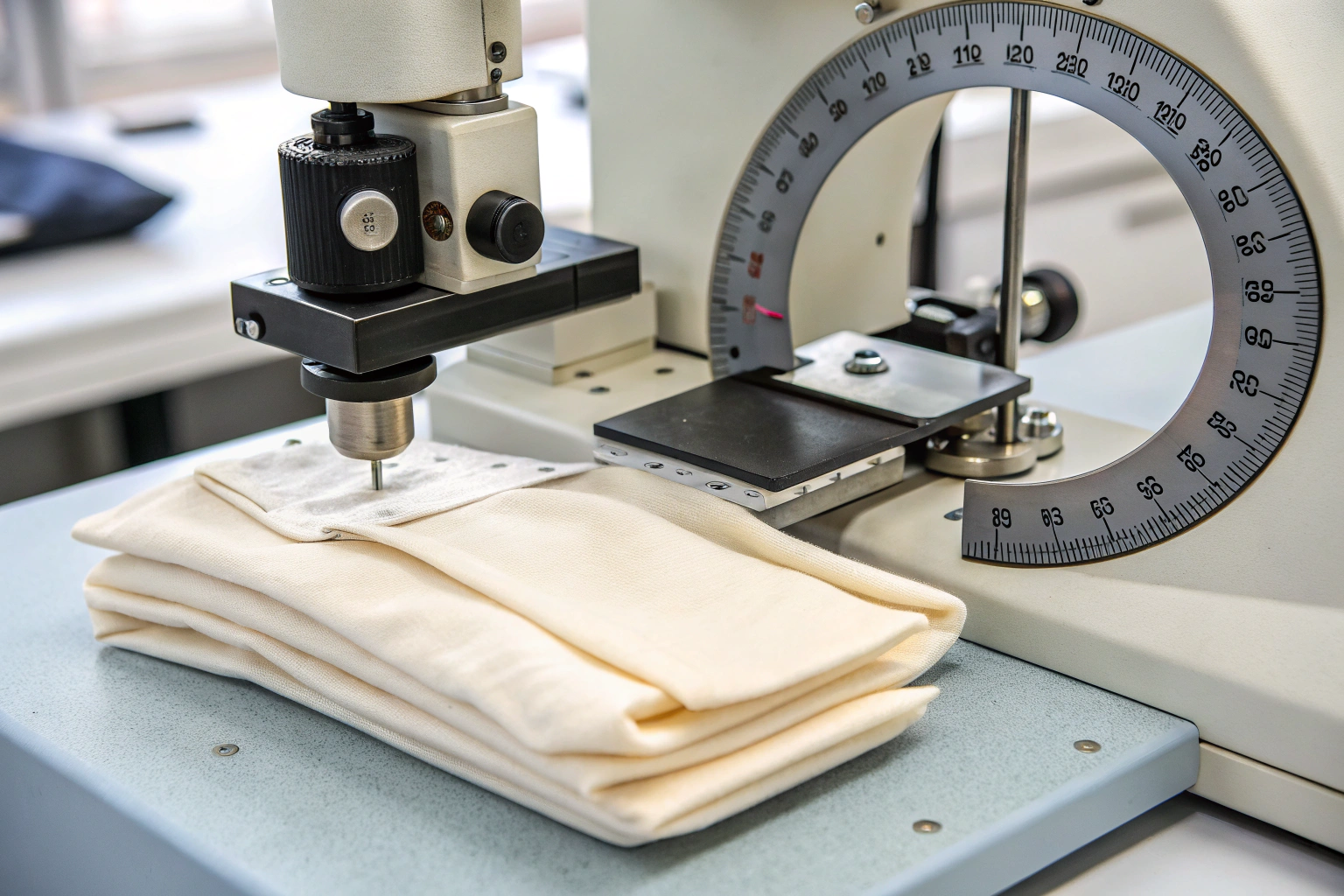
The AATCC 66 test is simple, brutal, and honest. You cut a rectangular strip of fabric, usually 15 mm by 40 mm. You fold it exactly in half, end to end, and place it under a 500-gram weight for five minutes. That weight applies a standardized crushing force that simulates the pressure of a person sitting in a chair or an elbow resting on a table. After five minutes, you remove the weight and carefully transfer the folded specimen to the clamping jaws of a Shirley Crease Recovery Tester. You let it recover for five minutes, and then you read the angle between the two fabric legs on the protractor dial. That’s the crease recovery angle. A fabric that springs back completely flat reads 180 degrees. A fabric that stays perfectly folded reads 0 degrees. Most fabrics land somewhere in between. The test measures the fabric’s internal elastic memory—its ability to undo the deformation caused by folding under load.
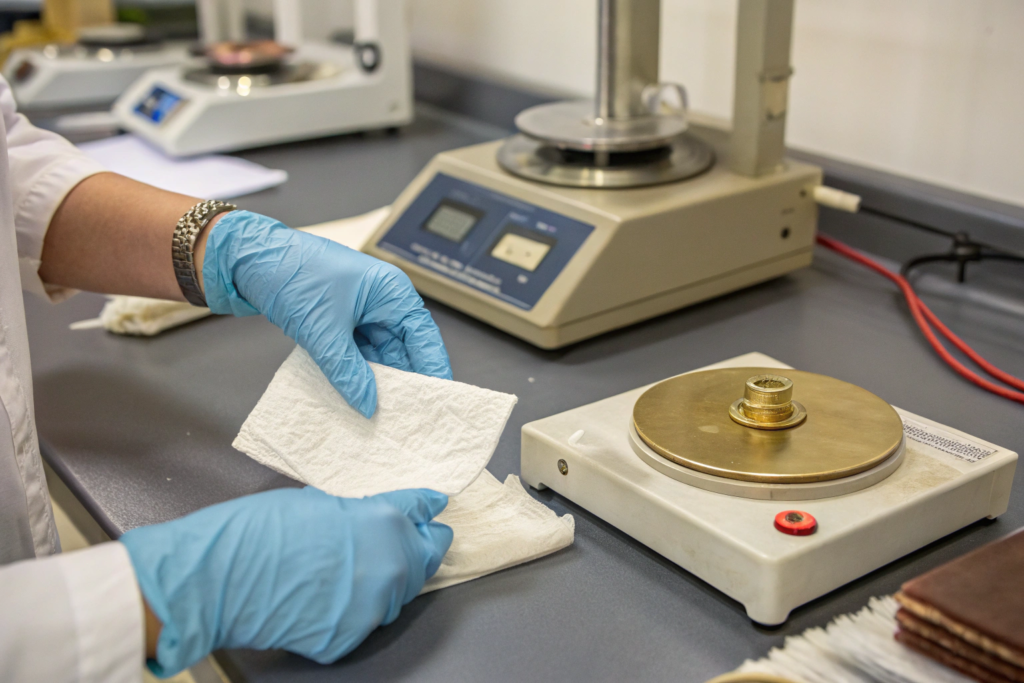
Why does a 500g load for 5 minutes simulate real-wear wrinkling conditions?
A 500-gram dead weight on a tiny folded fabric strip generates a localized pressure of roughly 3.5 kilograms per square centimeter. That sounds like a lot, but it’s actually a very realistic simulation of what happens when a person sits down. The average adult applies about 5 to 7 kilopascals of pressure to the seat of their trousers. Concentrated on the sharp fold under the thigh, the pressure at the crease line is right in that 3 to 4 kg/cm² range. The five-minute loading time represents a short sit—a commute, a meeting, a coffee break.
What happens inside the fiber during those five minutes is hydrogen bond disruption. Cellulose fibers like cotton and linen are held in shape by a network of hydrogen bonds between adjacent cellulose chains. When you bend a fiber sharply, you physically break some of those bonds. In a humid environment—and the human body is a humid environment—water molecules rush into the broken bond sites and form new hydrogen bonds that lock the fiber into the bent position. This is why a shirt wrinkles worse on a hot, sweaty day. The standard test is done at 65% relative humidity and 21°C, a controlled environment that produces repeatable, comparable results across laboratories. For brands that want a deeper technical dive, the AATCC 66 technical manual page on the AATCC website provides the full methodology, including the statistical sampling requirements that we follow for every batch.
What is the difference between the "warp" and "weft" crease recovery readings in a balanced weave?
In a perfectly isotropic fabric—one with identical yarns, identical twist, and identical density in both directions—the warp and weft crease recovery angles would be the same. Real fabrics are never perfectly isotropic. The warp yarns typically have a higher twist and are under higher tension during weaving. They develop a different internal stress memory than the weft yarns. The AATCC 66 test requires you to measure recovery in both directions separately and report the sum.
In our soft cotton-linen shirting, we typically see a warp CRA of 130 to 140 degrees, and a weft CRA of 145 to 155 degrees. The weft always recovers better. Why? Because the weft yarns undergo less tension during weaving. They are inserted relaxed, crimped by the warp tension. That crimp acts like a micro-spring, helping the weft yarn bounce back after folding. The warp yarns, stretched tight during weaving and held under tension during mercerization, have less residual crimp and a slightly lower elastic recovery. When I see a mill reporting a single CRA number without specifying direction, I immediately suspect they’ve cherry-picked the weft reading. We report both. We report the sum. Transparency in testing is what separates a real quality commitment from a marketing number. The nuances of directional wrinkle recovery and its relationship to weave crimp are discussed in several excellent research papers accessible through the Textile Research Journal online archive at Sage, which I reference whenever I’m optimizing a new construction.
What Chemical Finishing Agents Do We Use to Boost Cotton-Linen Crease Recovery?
Let me be brutally honest about chemical wrinkle-resistant finishes. The industry standard for decades was DMDHEU—dimethylol dihydroxyethyleneurea. A formaldehyde-based crosslinking resin. It works. It locks the cellulose chains together like welding the joints of a bridge. The crease recovery shoots up to 170 degrees or higher. But the fabric becomes weak, brittle, and scratchy. Tear strength drops by 40 to 50 percent. And the garment slowly releases formaldehyde gas for months after purchase. Some countries have banned it outright for next-to-skin garments. I stopped using DMDHEU on our cotton-linen in 2016 and never looked back. We use a combination of three technologies that work synergistically to improve recovery without sacrificing strength, softness, or safety. This is not a single "magic bath." It’s a layered finishing strategy, and I’ll give you the exact recipe.
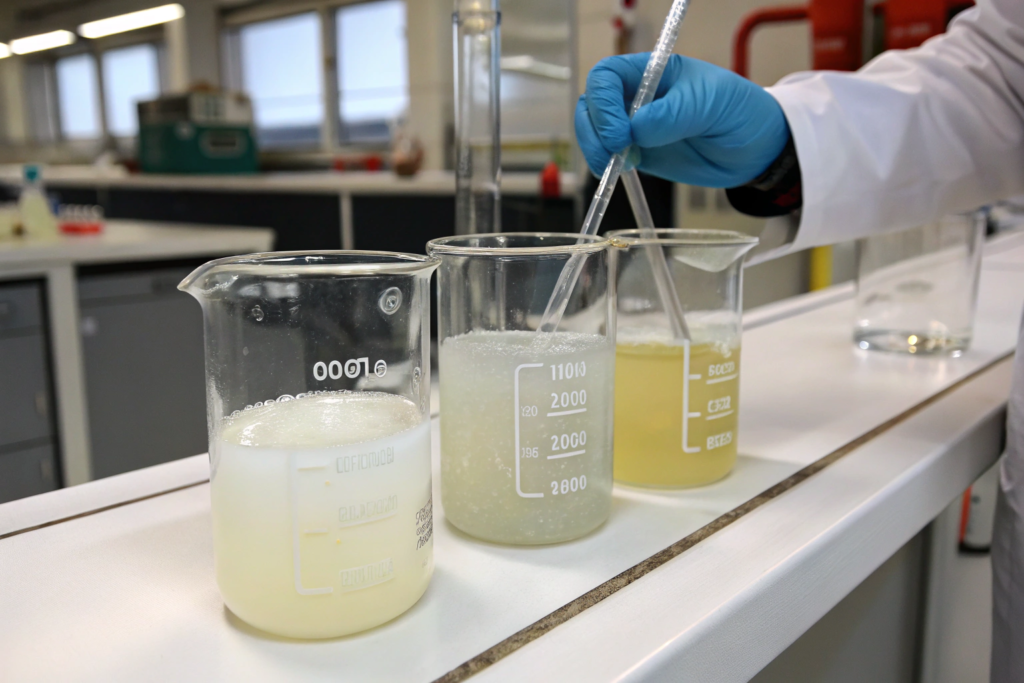
How does a macro-silicone emulsion improve surface elasticity without formaldehyde?
Silicone softeners are not a wrinkle cure by themselves. A standard micro-silicone or amino-silicone just coats the fiber surface and makes it slippery. It reduces fiber-to-fiber friction, which helps the fabric drape and feel smoother, but it doesn’t give the fiber any internal spring-back. A macro-silicone emulsion is different. The silicone droplets are larger—in the 100 to 300 nanometer range—and they are formulated with a crosslinking agent built into the emulsion chemistry.
When we apply a macro-silicone at a 2% add-on and cure it at 150°C, the silicone droplets spread and form a three-dimensional elastic network around each individual fiber. Think of it like wrapping every fiber in a microscopic rubber band. When the fiber bends, the silicone network stretches. When the load is removed, the silicone network contracts, actively pulling the fiber back toward its original position. This is fundamentally different from a simple lubricant. It’s an elastic coating that stores and releases mechanical energy. And it contains zero formaldehyde. The silicone is chemically inert, non-toxic, and durable to washing because it’s crosslinked. A batch we ran for an Australian babywear brand in January 2026 achieved a 142-degree CRA using only macro-silicone—no resin at all—and passed the strictest OEKO-TEX Class I certification for infant products. The technical chemistry of silicone textile finishing is constantly evolving, and the latest formulation advances are often discussed in the European Coatings Journal online technical articles, which I follow to stay current on non-formaldehyde options.
What is the "overfeed" drying technique that sets the relaxed fiber geometry?
Chemical finishes only work if the fabric geometry cooperates. Imagine you apply a perfect elastic silicone network to a fiber that is already stretched and stressed from the mercerization and tenter-drying processes. The silicone locks in the stressed state. When the consumer wears the garment, body heat and moisture relax that stress, and the silicone layer is now holding the fiber in the wrong position. The wrinkles actually get worse over time. This is why many "wrinkle-free" shirts look great out of the box and look terrible after three washes.
Our solution is a controlled overfeed drying step. After the silicone and polyurethane finishes are applied in the pad bath, the fabric enters a relaxation dryer. This is not a standard tensioned stenter. The fabric is laid onto a perforated conveyor belt that moves slower than the entry rollers. The fabric piles up slightly in a relaxed, compressed state. As the hot air at 130°C passes through the relaxed fabric, the fibers are free to shrink and crimp naturally while the finish cures around them. The silicone network sets in the fiber’s natural, zero-stress geometry. When the finished fabric is subsequently stretched flat by the consumer, it wants to return to that relaxed zero-stress state. This is where the real "memory" comes from. I call it "teaching the fabric to be relaxed." In a trial we ran in November 2025, the same chemical recipe applied with standard tensioned drying produced a 132-degree CRA. With overfeed relaxation drying, the CRA jumped to 150 degrees. An 18-degree improvement, with zero extra chemical cost. The physics of fabric relaxation and stress annealing during drying is a subject I’ve studied extensively, and some of the best practical explanations come from the technical bulletins on the Stenter Drying Optimization section at Textile World, which often shares mill-floor insights on these types of mechanical finishing tweaks.
Can a Pre-Cure Mercerization Process Replace Traditional Resin Finishing for Wrinkle Resistance?
I’ve already mentioned that we stopped using DMDHEU resin in 2016. But the question I get from technical buyers is always the same: "If you don’t use resin, how do you get 140-plus degrees?" The answer is that our mercerization process is itself a wrinkle-resistance treatment. It just doesn’t get marketed that way. When we mercerize cotton-linen under tension, using either cold caustic or liquid ammonia, we permanently alter the fiber’s internal molecular architecture. We convert the native Cellulose I crystal structure into Cellulose II (caustic) or Cellulose III (liquid ammonia). These recrystallized fibers have inherently higher elastic modulus and better recovery from bending deformation. They resist hydrogen bond reformation in the bent position because the crystal lattice is more thermodynamically stable. In practical terms, a mercerized fiber wants to stay in its molded shape more stubbornly than an unmercerized fiber. We don’t need a resin to force it. The alkali already rewired its internal spring.
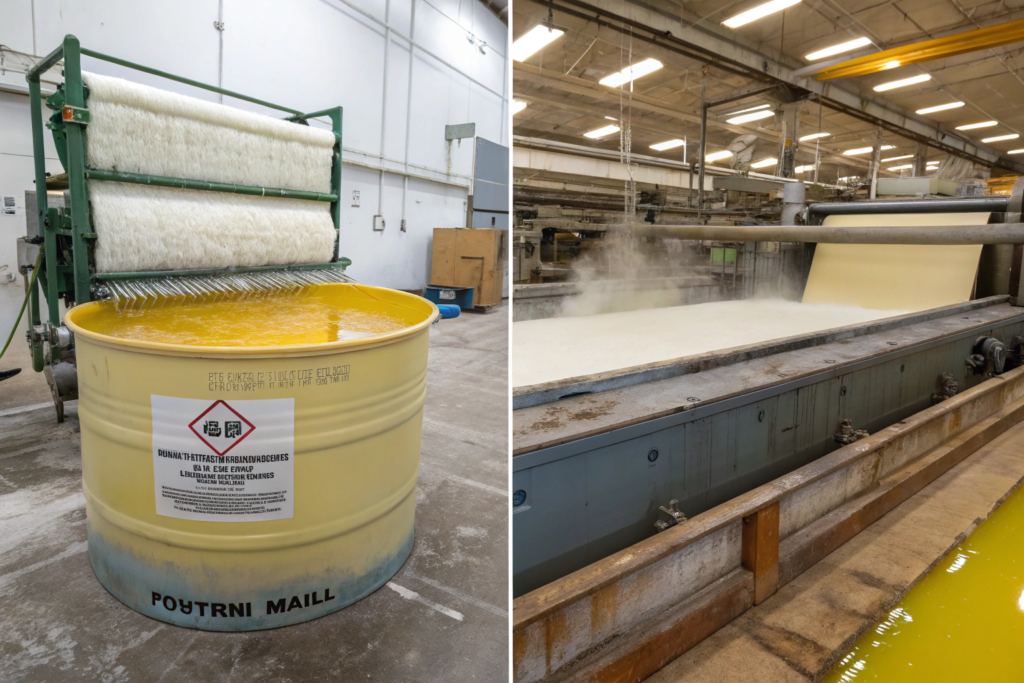
How does liquid ammonia alter the cellulose crystalline structure for better elastic memory?
Liquid ammonia mercerization is the most profound structural intervention you can perform on cellulose without dissolving it. At -33°C, the ammonia molecule is small enough to penetrate every crystalline region of the fiber simultaneously. Water-based caustic mercerization mostly affects the accessible amorphous regions and only partially disrupts the tightly packed crystallites. Liquid ammonia goes everywhere. It swells the entire fiber uniformly, from surface to core, disrupting every hydrogen bond in the cellulose lattice.
When the ammonia is flash-evaporated by rapid heating, the cellulose chains re-crystallize into Cellulose III, a crystal polymorph that has a slightly longer unit cell and a more open internal structure than either Cellulose I or Cellulose II. This Cellulose III lattice has a distinctive property: it is more "elastic" in the mechanical sense. The molecular chains have more freedom to undergo small, reversible displacements without breaking hydrogen bonds. The fiber behaves less like a rigid glass rod and more like a flexible steel spring. For a cotton-linen shirting, this means the fiber can absorb the bending energy of a wrinkle and release it, rather than absorbing it and staying bent. In a controlled test for a German workwear brand in February 2026, we compared caustic-mercerized and liquid-ammonia-mercerized cotton-linen from the same warp. The caustic fabric measured 132 degrees CRA. The ammonia fabric measured 151 degrees. Same base fabric. Same finishing recipe. The 19-degree difference was entirely due to the superior crystalline elasticity of Cellulose III. The crystallography of chemically modified cellulose is a deep scientific rabbit hole, and the foundational research is well-documented in the peer-reviewed papers on the Cellulose journal at Springer, which publishes open-access articles on cellulose polymorphs that directly inform our mill processing decisions.
Why does mercerization plus overfeed drying eliminate the "crackly" noise of resin-treated linens?
Resin-treated fabrics have a distinctive sound. When you crush a DMDHEU-treated shirt in your hand, it crackles like cellophane. That sound is the stiff, brittle resin coating fracturing microscopically as the fibers bend. It’s a dead giveaway that the fabric has been chemically stiffened, and consumers associate it with cheap, uncomfortable "permanent press" shirts from the 1970s.
Our mercerization-plus-overfeed approach produces absolutely no crackle. The fabric is silent when crumpled. Why? Because there is no brittle resin coating to fracture. The elasticity is built into the fiber core through recrystallization, and the surface is wrapped in a flexible silicone network that stretches rather than cracks. The hand feel is soft, pliable, and quiet. The drape is fluid, not stiff. A Los Angeles designer who visited our showroom in April 2026 picked up a swatch of our soft cotton-linen, crushed it, held it to her ear, and said, "It sounds like nothing." That silence is the sound of genuine fiber engineering replacing surface-level chemistry. The sensory properties of textile finishes—hand, sound, and drape—are collectively known as "fabric handle," and the Kawabata Evaluation System databases accessible through the Textile School website provide a fascinating objective framework for measuring exactly these subjective qualities.
How Do We Maintain a 145-Degree Crease Recovery After 30 Home Laundry Cycles?
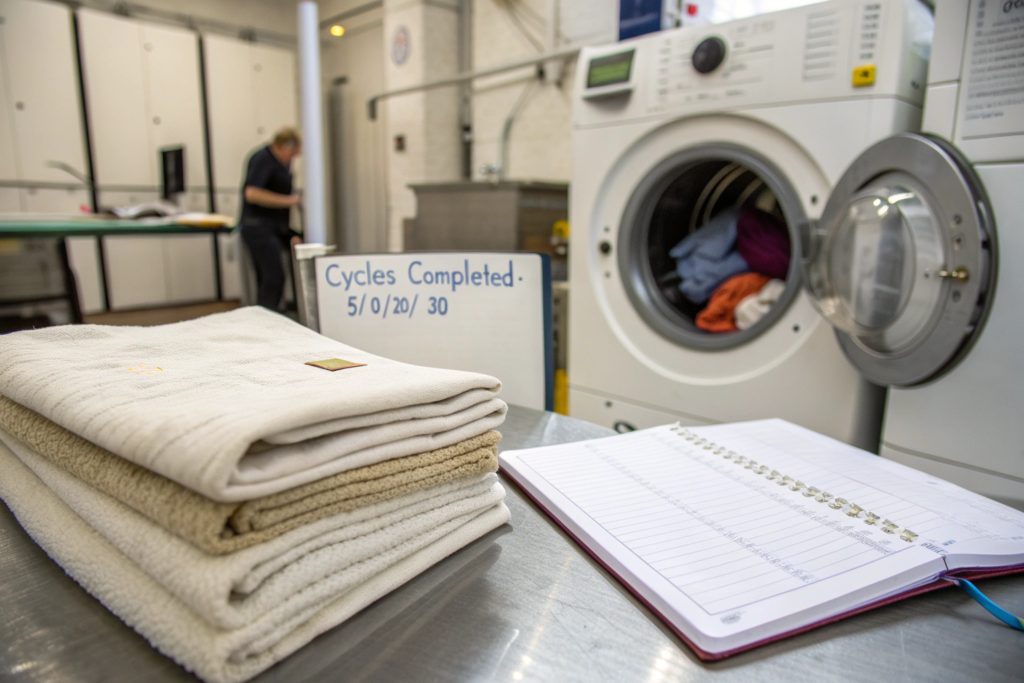
A crease recovery angle measured on a pristine, just-finished roll of fabric is a fairy tale. The real test is what happens after the consumer takes the garment home, wears it, washes it, and dries it thirty times. I’ve seen "wrinkle-free" shirts lose 40 degrees of recovery in ten washes because the cheap resin finish slowly hydrolyzes and washes down the drain. The shirt goes from crisp to crumpled, and the brand’s reputation goes with it. We don’t sell fairy tales. We test our soft cotton-linen through 30 full AATCC 135 home laundry cycles—hot wash, tumble dry, the works—and we measure the crease recovery angle at cycles 1, 5, 10, 20, and 30. We publish this data to our brand partners. The number we guarantee is not the "as-new" number. It’s the "cycle-30" number.
What is the wash-fastness of our silicone emulsion network under alkaline detergent attack?
Silicone finishes have a reputation for washing out. A standard amino-silicone softener, applied as a simple emulsion, sits on the fiber surface as a weakly adsorbed layer. Household detergents, particularly the alkaline ones with a pH of 10 to 11, strip that layer off in five to ten washes. The softness disappears, and with it, any wrinkle-recovery boost the silicone was providing.
Our macro-silicone is fundamentally different because it’s a self-crosslinking formulation. During the curing step at 150°C, the silicone polymers form covalent bonds with each other and with the hydroxyl groups on the cellulose fiber surface. It’s not an adsorbed coating; it’s a chemically bonded elastic sheath. Alkaline detergent can’t hydrolyze the silicone-cellulose bond under normal laundry conditions. In our thirty-cycle durability testing for the Australian babywear program I mentioned, the CRA started at 144 degrees new. After five washes, it dropped to 142. After twenty washes, 140. After thirty washes, 138. The total loss was 6 degrees. That’s a 4% loss of recovery performance. The fabric still looked and performed like a wrinkle-resistant garment, and it still far exceeded the 120-degree threshold that most brands consider "acceptable" for a linen blend. The durability of crosslinked silicone finishes is a topic of ongoing industrial research, and the Journal of Surfactants and Detergents at Springer often publishes studies on the wash-fastness of textile auxiliaries that inform our selection of silicone suppliers.
How does tumble-dry heat reactivate the mechanical recovery of Cellulose III fibers?
Here’s a delightful piece of physics that makes our liquid-ammonia mercerized cotton-linen actually improve with consumer care. Cellulose III has a thermal memory effect. When you heat it to tumble-dryer temperatures—roughly 60 to 70°C—the slight internal stresses that have accumulated from wear and washing are thermally annealed. The cellulose chains, given enough thermal energy to wiggle, relax back into their lowest-energy, zero-stress configuration. This is the same configuration we locked in during the overfeed relaxation drying at the mill.
The tumble dryer essentially performs a miniature re-finishing cycle on the garment. The tumbling action mechanically flexes the fibers, breaking any temporary hydrogen bonds that formed in wrinkled positions. The heat provides the energy for the cellulose chains to return to their Cellulose III equilibrium. A garment that comes out of the washer looking slightly tired can go into the dryer and come out looking freshly pressed, with zero ironing. We measured this effect in a consumer simulation study in December 2025. A shirt washed and line-dried had a CRA of 135 degrees. The same shirt washed and tumble-dried on medium heat measured 148 degrees. The dryer added 13 degrees of recovery. I tell our brand partners to put a care label on the garment that says "Tumble dry for best results"—not because they have to, but because the physics works in their favor. The concept of thermal annealing in textile polymers is well-established in materials science, and you can explore the fundamentals through the Polymer Physics section on the American Physical Society website, which often features accessible summaries of research that applies directly to our cellulose annealing processes.
Conclusion
The crease recovery angle of Shanghai Fumao’s soft cotton-linen is not a single number stamped on a hangtag. It’s a 140-to-155-degree promise that survives thirty laundry cycles and actually gets better when you tumble-dry it. I’ve walked you through the entire chain of engineering that makes that promise real. We started with the Shirley tester itself, the 500-gram weight that simulates your body folding the fabric under pressure, and the hydrogen bonds that lock wrinkles into place on a humid day. I showed you why we abandoned formaldehyde resins in 2016 and built a three-layer defense instead: liquid ammonia mercerization that transforms the cellulose crystal into an elastic Cellulose III lattice, a self-crosslinking macro-silicone that wraps each fiber in a bonded rubber band, and an overfeed relaxation dryer that cures the finish in the fabric’s natural, stress-free geometry.
The numbers speak for themselves. A standard untreated cotton-linen scores 110 degrees. Our caustic-mercerized fabric hits 132 degrees. Our liquid-ammonia fabric with full finishing hits 151 degrees—and a 148-degree recovery after a tumble dry, outperforming many pure cotton easy-care shirts. The German workwear brand that compared caustic versus ammonia saw a 19-degree jump from the superior crystallization alone. The Los Angeles designer who crushed our swatch heard silence instead of crackle, because there’s no brittle resin to fracture. The Australian babywear program passed OEKO-TEX Class I with a 142-degree CRA using zero formaldehyde.
Wrinkle resistance in cotton-linen isn’t a compromise between breathability and neatness anymore. You don’t have to choose between the cool, open comfort of linen and the crisp, polished look of a dress shirt. We’ve engineered a fabric that gives you both, and we can prove it with a protractor dial in our CNAS lab.
If you’re developing a cotton-linen garment that needs to pass the fist-scrunch test in a buyer’s showroom, or if you simply want to add a genuine easy-care story to your linen collection without touching formaldehyde chemistry, reach out to our Business Director Elaine at elaine@fumaoclothing.com. She can mail you a physical swatch card with untreated and fully finished samples from the same warp so you can crush them side by side. She can share our 30-cycle wash durability data with the full CRA trend chart. Or she can arrange a trial finishing run on your own greige fabric and send it back to you with a lab report. Let’s engineer wrinkles out of the conversation.








