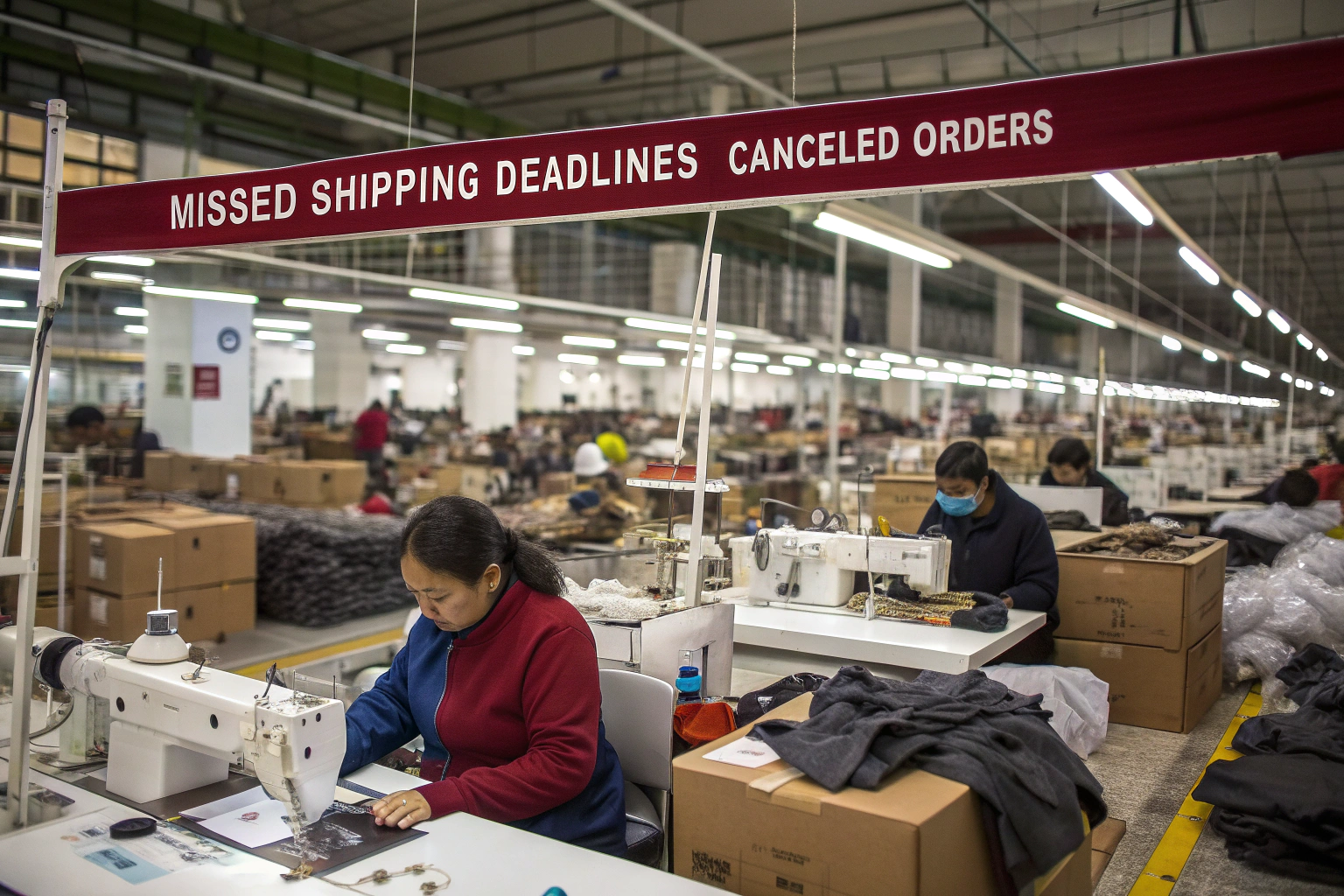
You placed a bulk order for 15,000 yards of cotton twill in August. Your production calendar is tight. The fabric needs to ship by mid-October to arrive in Los Angeles before Thanksgiving, so your cutting room can finish the spring collection samples by January. Then September rolls around, and your supplier goes silent. Emails get vague replies. The shipping date slips by one week, then two, then four. You miss your delivery window, your production line sits idle, and your retail buyer cancels the order. I have watched this disaster unfold for brands that chased a cheap price from a mill that overpromised capacity during peak season. The fear of a late shipment is not irrational. It is the single most expensive risk in apparel sourcing.
Shanghai Fumao avoids late shipments during the cotton peak season by using a hard capacity booking system, redundant parallel production lines, and a raw material buffer stock that we pre-purchase before the seasonal rush begins. We do not promise a delivery date based on hope. We promise a delivery date based on a locked production time slot on specific machines, backed by yarn inventory that is already sitting in our climate-controlled warehouse before you even sign the purchase order. When you book with us, you are buying guaranteed loom hours, not a vague promise of "around 35 days."
Peak season chaos is predictable. It happens every March through May and August through October. A mill that treats it like a surprise is a mill that will fail you. Let me show you the specific systems we use to make your ship date boring and reliable, even when every other factory in Asia is running behind schedule.
How Does A Capacity Booking System Prevent Peak Delays
The root cause of a late peak season shipment is almost always the same. The sales team sold capacity that does not exist. They took your order, and they took ten other orders, and they promised all of you the same loom time in October. When October arrives, the scheduling manager has to choose whose fabric gets woven first. Someone loses. Usually, it is the smaller brand, not the million-yard mega-client. We prevent this by selling only the capacity we physically have available.

What Is A Hard Booking Versus A Soft Booking In Textiles?
A soft booking is an email that says, "Yes, we can produce 15,000 yards for delivery in October." It is a conversation. It carries no legal weight and no operational commitment. A hard booking is a production time slot reserved on a specific machine, linked to a purchase order number, and protected by a penalty clause if we fail to deliver on time.
When you sign a contract with Shanghai Fumao, our production planning software, which runs on a real-time enterprise resource planning system, immediately deducts the required loom hours from our available capacity pool. Those hours are now coded with your purchase order number. They are not available for another salesperson to sell to another client. Our scheduling team cannot reallocate them without the general manager’s written approval, and that approval requires a documented reason, such as a force majeure event, not just a bigger client walking through the door. This system forces discipline on our sales team. They can only sell what the factory dashboard shows as available. If the dashboard shows zero available hours for October, they must quote November, even if that means losing the order. The alternative—overbooking and hoping for the best—destroys trust and costs more in the long run. For a deeper dive into this process, you can read about how hard capacity booking systems work in Chinese textile manufacturing for export orders. It explains the operational mechanics that turn a promise into a guaranteed slot.
How Do You Handle A Machine Breakdown During Peak Production?
Machines break. A loom motor burns out. A stenter chain snaps. In a normal factory, this triggers a cascading delay because there is no backup machine. The broken loom sits idle for three days while a technician repairs it, and your fabric just waits. We eliminated this risk by building parallel redundancy into our production layout.
We do not run one line. We run multiple identical lines. If one air-jet loom goes down, the fabric production shifts seamlessly to another identical loom that is running the same warp specification. Because we specialize in cotton and linen blends within a specific weight range, our looms are set up with similar parameters. The warp beam can be physically moved from the broken loom to the backup loom in under two hours. The maintenance team then repairs the broken machine without any pressure to rush, because production is still running on the backup line. This redundancy is not free. It means we maintain a slightly lower overall utilization rate than a mill that runs every machine at 100% capacity. We keep a "hot spare" ready. That spare capacity is an insurance policy you pay for invisibly in our pricing. It is the reason we do not call you with a panic story about a broken motor. For more on this operational model, explore how textile mills manage machine breakdown risk through parallel production redundancy during peak delivery periods. It is a capital-intensive choice, but it eliminates a major source of late shipments.
Why Does Raw Material Inventory Matter For On-Time Delivery
The second most common cause of a late shipment is a raw material shortage. The mill took your deposit but did not buy the yarn. When peak season hits, the yarn suppliers are also swamped. The lead time for cotton yarn stretches from two weeks to six weeks overnight. The mill cannot weave because it has nothing to weave with, and your order sits in limbo. We break this chain by buying yarn before we sell fabric.

How Much Yarn Stock Do You Hold Before Peak Season?
We call it the Peak Season Buffer Inventory. About six weeks before the August rush begins, we review our confirmed orders and our sales forecast, and we pre-purchase roughly 60% of the expected yarn demand for the season. This yarn is physically sitting in our climate-controlled warehouse, tagged with lot numbers, and ready to warp.
For our most popular counts, such as 21s and 30s cotton-linen blends in natural and black, we hold a standing inventory of 20 tons. This buffer means that when you confirm an order with a 35-day lead time, we spend day one pulling the yarn from our shelf, not day one ordering yarn from a supplier and hoping it arrives in time. The buffer also protects against a sudden price spike. If the raw cotton market jumps 10% in September due to a supply shock, your price is already locked because we bought the yarn at the August price. This is a financial discipline that requires working capital and storage space. Mills that operate on a shoestring budget cannot do it. They buy yarn after they receive your deposit, and they are at the mercy of the spot market. That is when delays happen. You can learn more about this critical pre-peak practice by reading about pre-peak season raw material buffer stock strategies for cotton textile manufacturers in Asia. It explains how inventory management directly controls delivery reliability.
What Happens If A Specific Yarn Shade Is Out Of Stock?
Custom colors require dyed yarn. If your order needs a specific shade of dusty blue in a 30s ring-spun cotton, we do not stock that color on the shelf. But we do stock the raw white yarn in volume. The day your order is confirmed, our in-house yarn dyeing department receives a work order. Because we control the dyeing, not an outside subcontractor, we can turn a custom yarn shade in 5 to 7 days instead of the 15 to 20 days it takes to send yarn to a third-party dye house.
This vertical integration of yarn dyeing under our own roof is a massive speed advantage during peak season. A mill that outsources yarn dyeing is competing with every other mill for the same limited capacity at the same subcontractors. The dye house gets backed up, and suddenly your "in-stock" yarn is stuck in a queue for three weeks. We schedule our yarn dyeing on our own machines, prioritized by the confirmed shipment date. If your order is due to ship on October 15th, your yarn gets dyed before another order that ships on November 1st. The queue is managed by delivery date, not by whichever client screams the loudest. Understanding the importance of vertical integration of yarn dyeing for controlling peak season lead times in cotton fabric production gives you a clear criterion for choosing a supplier who can keep their delivery promise.
How Does The Shipping Logistics Team Secure Container Space
You can weave fabric on time, but if there is no container to put it in, the fabric sits on the loading dock. During peak season, ocean freight capacity out of China tightens dramatically. Shipping lines cancel sailings, roll containers to the next vessel, and raise spot rates by 300%. A mill that does not have a serious logistics operation will strand your goods at the port for weeks. We built a logistics team specifically to fight this battle.

What Is A Blank Sailing And How Do You Avoid It?
A blank sailing is when a shipping line cancels a scheduled vessel departure. They do this to reduce capacity and push up freight rates during periods of lower demand or to rebalance their fleet. If your container was booked on that blanked sailing, it gets rolled to the next vessel, which might be a week later. The problem is, the next vessel is now overloaded with the rolled cargo from the blanked sailing plus its own booked cargo. Some containers get rolled again. The delay compounds.
We protect against blank sailings by booking with multiple carriers under a guaranteed container agreement. We have a block space agreement with COSCO and Maersk that reserves a fixed number of container slots per week during the peak season window. These slots are contractually guaranteed. If COSCO blanks a sailing, Maersk still has a slot, and we pivot the booking in hours. We also use the "Silk Road Keqiao" logistics consolidation program, which aggregates cargo from multiple mills in our district and negotiates priority loading with the port authority. This government-backed program gives us a slight edge in getting our containers onto a vessel when space is tight. For a wider perspective, you can explore how textile exporters mitigate blank sailing risks during China’s peak shipping season through block space agreements. It explains the contractual tools that serious shippers use to keep cargo moving.
How Do You Handle US Customs Documentation To Avoid Port Holds?
A container that arrives at Long Beach on time but gets held for a week because of a paperwork error is still a late shipment. The delay just happens on American soil instead of Chinese soil. The result is the same. You do not get your fabric when you need it.
Our documentation team prepares the full customs entry package before the vessel even departs Shanghai. The package includes the commercial invoice with the correct harmonized system code and fiber content breakdown, the packing list with roll-level detail, the certificate of origin, and any required test reports for flammability or fiber analysis. We transmit the documents electronically to your customs broker 72 hours before the vessel arrives. This pre-clearance process allows CBP to review the paperwork and flag any issues before the container is unloaded. If there is a question about the fiber composition, we can answer it with the CNAS lab report while the ship is still in the water, not when the container is accruing storage fees on the dock. This proactive approach eliminates the most frustrating type of delay: the shipment that crossed the ocean in two weeks and then sat in a warehouse for two more weeks because of a typo on the packing list. The process for this is detailed in guides on preparing US customs pre-clearance textile documentation to minimize port hold delays. It is a discipline that saves time and demurrage fees.
What Internal Penalty System Drives Our On-Time Performance
Systems and inventory are hardware. Accountability is software. A factory can have the best machines and the fullest yarn warehouse, but if the management team does not feel the pain of a missed deadline, complacency creeps in. We built an internal penalty system that makes on-time delivery a personal financial issue for every department head involved in your order.

Do You Offer A Late Delivery Compensation Clause?
Yes, and we put it in the contract. If we miss the agreed shipment date by more than 7 days due to a fault on our side, we credit you a percentage of the order value, typically 3% to 5%, on a future order, or we discount the current invoice if the delay exceeds 14 days. This is not a theoretical clause buried in fine print. It is a standard term we have activated voluntarily for clients on two occasions in the past three years when a typhoon closed the port of Ningbo for 72 hours.
The compensation is not the point. The point is that the production manager knows the clause exists. He knows that if his department causes a delay, the company writes a check, and that check is traced back to his quarterly performance bonus. This alignment of incentives is powerful. Suddenly, the weaving supervisor cares about the dyeing schedule because a bottleneck in dyeing affects weaving, which affects shipping, which affects his bonus. Silos break down. Departments communicate. The entire organization focuses on the single goal of shipping your container on the date we promised. This internal culture shift is difficult to replicate at a mill where the sales team promises dates the production team has never even seen. You can read about how textile export contracts include and enforce late delivery penalty clauses for bulk fabric orders. It is a sign of a supplier who is willing to put their money where their mouth is.
How Do You Measure And Track On-Time Delivery Rate?
We track it obsessively and we publish it internally. Our enterprise resource planning system generates a weekly on-time delivery dashboard that shows the percentage of orders shipped on time, grouped by customer, by product type, and by department. The dashboard is displayed on a large screen in the main office hallway. Everyone sees it. The general manager sees it. Visiting clients see it.
Our current rolling 12-month on-time delivery rate for export cotton linen orders is 96.8%. The 3.2% miss rate is almost entirely attributable to force majeure events such as port closures and extreme weather. I am not satisfied with 96.8%. I want 99%. Every quarter, we hold a "miss review" meeting where we dissect every late shipment, identify the root cause, and assign a corrective action with a deadline. The meeting is not a blame session. It is an engineering review. We treat a late shipment like a product defect. It is a failure of the system, and systems can be fixed. This continuous improvement loop means that every delay makes future delays less likely. A mill that does not measure its on-time performance cannot improve it. Asking a supplier for their on-time delivery rate before you place an order is a perfectly fair question. If they cannot answer with a specific number, they are not tracking it, which means they are not managing it. For more on this metric, you can explore how to calculate and benchmark on time delivery rate KPIs for textile export suppliers. It gives you a tool to evaluate any mill.
Conclusion
On-time delivery during cotton peak season is not luck. It is engineering. It starts with a hard capacity booking system that refuses to sell loom hours that do not exist. It runs on a raw material buffer of yarn that we pre-purchased before the seasonal rush drove lead times through the roof. It stays on track with parallel machines that absorb a breakdown without stopping your production. It reaches the water through block space agreements that protect your container from blank sailings. And it is enforced by a compensation clause that makes my production manager as invested in your ship date as you are. That is the system. It is boring, it is disciplined, and it works 96.8% of the time.
Do not gamble your spring collection launch on a supplier who treats peak season like a recurring surprise. Before you place your next bulk order, ask Elaine for our current capacity availability chart. It will show you exactly which production slots are still open for the weeks you need, and we will lock your slot within 24 hours of your deposit. Email elaine@fumaoclothing.com with your yardage, target ship date, and destination port. She will return a confirmed production schedule and a hard booking confirmation that puts your fabric on the looms and your mind at ease.