
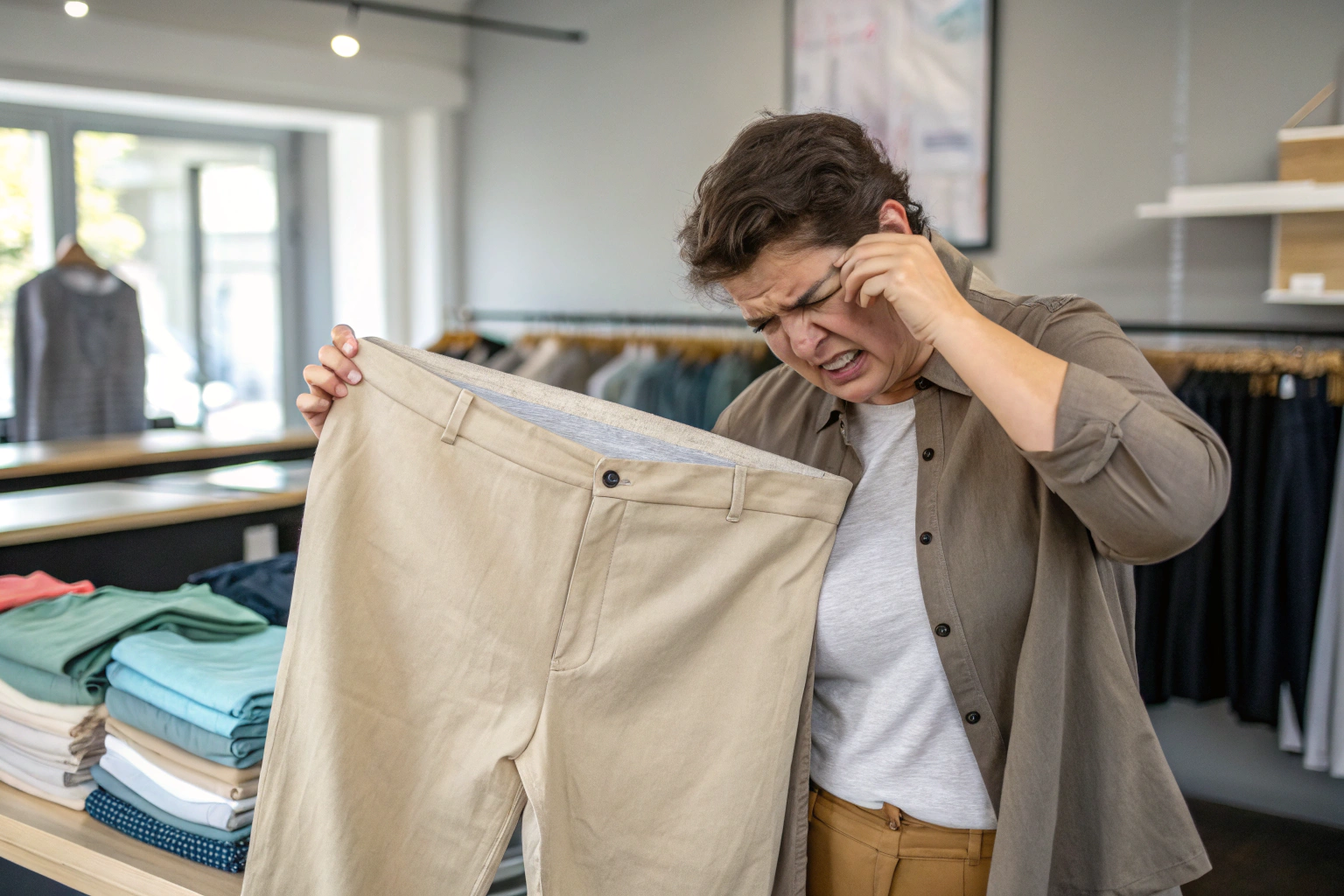
You cut 200 pairs of linen trousers. The measurements are perfect off the table. You ship them to your boutique in New York. Two weeks later, you get an angry email. A customer washed his $295 pants in cold water, laid them flat to dry, and the inseam shrank two inches. Now he wants a refund, and he is posting about it on Reddit. I have seen this horror story play out dozens of times. A mill sells you "finished" fabric, but they skipped the compaction step to save steam costs. You pay for their shortcut with your brand reputation. The fear of dimensional instability keeps designers awake at night.
Every meter of cotton linen fabric that leaves Shanghai Fumao is mechanically pre-shrunk and heat-set to a residual shrinkage rate below 2% for warp and weft, tested to AATCC 135 standards. We don’t just wash the fabric and hope for the best. We force the yarns to relax completely through a controlled combination of moisture, heat, and mechanical compression on a rubber-belt compacting machine. The fabric leaves our facility dimensionally stable. If you cut it correctly, your customer’s garment will not distort.
But "pre-shrunk" is a word that gets tossed around like confetti in this industry. I want to show you the exact machinery we use, the chemical processes that lock the fibers in place, and the testing protocols that prove the shrinkage is truly gone. You need to know what to ask for and how to verify the answers, because a lying supplier can cost you a season’s profit.
How Does Mechanical Compacting Stop Fabric Shrinkage
Shrinkage is not a mystery. It is basic physics. When we spin and weave yarn, we stretch it under high tension. The fibers are like little coiled springs held straight by force. The moment you release that tension with water and heat—exactly what a washing machine does—the fibers try to snap back to their natural curly state. The fabric gets shorter and thicker. You cannot stop this with chemicals. You can only pre-load the snap-back before you ship the fabric.

What Does A Compacting Machine Actually Do To Cotton?
A compacting machine, specifically a felt or rubber blanket compactor, is the only honest way to pre-shrink woven cotton linen. The process is beautifully simple. The dry fabric passes between a heated steel cylinder and a thick rubber blanket. The rubber blanket is stretched around a pressure roller. When the rubber relaxes, it physically pushes the warp and weft yarns closer together. Think of it like forcing an accordion closed before the music starts. The yarns are bunched tightly, taking up all the future shrinkage slack.
The key parameter here is the "compaction ratio," typically expressed as a percentage. For a heavy 10oz cotton-linen canvas, we might set a compaction ratio of 8% to 10%. This means we are physically reducing the length of the fabric by that amount on purpose, fully aware that the customer will not lose it later. A cheap factory avoids this because it reduces their meterage. If you sell fabric by the meter and you shrink it by 10%, you just "lost" 10% of your billable length. That is why shady mills skip it. They sell you stretched fabric; you pay for water weight and air. We absorb that yield loss because we price it into our cost structure. To understand the mechanical details better, you should read about how a rubber blanket compacting machine pre-shrinks woven cotton fabric without chemicals. The physics is simple, but the calibration of the felt blanket pressure takes years to master.
Can You Over-Compact Linen And Ruin The Drape?
Yes, and this is a mistake I made once in 2017. I had a batch of lightweight linen for a women’s blouse order going to an Australian label. I was so paranoid about shrinkage claims that I told the finishing manager to push the compactor to the max. We hit a 15% compaction ratio. The fabric came out looking beautiful and dense, but it had lost its fluidity. The blouses hung like stiff boards. The client rejected the batch, and I had to eat the cost.
Linen is a bast fiber. It is inherently more rigid than cotton. Over-compacting crushes the hollow core of the flax fiber, which kills its natural breathability and that lovely "cool hand" that linen is famous for. You end up with a fabric that feels like heavy cotton canvas, not airy summer linen. We now run a "drape test" on a sample swatch before compacting the entire batch. We hang a 30cm square over a rod and measure the bending angle. If the fabric doesn’t drape to at least a 45-degree natural hang after compaction, we back off the pressure. It is a balance between stability and softness. Finding that balance requires knowing how to avoid over-compacting lightweight linen blends while maintaining shrinkage control. The machine is a tool, not a magic wand, and the operator needs to respect the fiber.
Why Do We Use Heat Setting For Blended Fabrics
Mechanical compaction fixes the length and width. But what about the molecular memory deep inside the fiber? Cotton and linen are cellulose. They form hydrogen bonds with water. When you wash a fabric, water molecules sneak into the amorphous regions of the cellulose and break those bonds. The fiber swells and rearranges. Heat setting with a stenter frame locks the fabric geometry at a molecular level so that this rearrangement happens inside the factory, not inside your customer’s washing machine.

What Temperature Stabilizes Cotton Linen Blends?
We run our stenter at exactly 180°C for a standard 55% linen, 45% cotton blend, with a dwell time of 45 seconds. This temperature is hot enough to break and reform the hydrogen bonds in the cellulose without scorching the natural sugars in the flax. Linen yellows if you overheat it. You get a "baked" color that no amount of optical brightener can fix.
During heat setting, the stenter chains hold the fabric at a precise width. This fixes the weft stability. We often set the width 1 inch wider than the target finished width, knowing that the subsequent cold wash will pull it in slightly. This is called "over-width setting," and it is a forecasting game based on historical batch data. A rookie operator sets the width to the exact specification. He ships the fabric, it washes, the width shrinks half an inch, and you fail the spec. We have a database of 5,000+ batch records that predicts exactly how much spring-back each construction will have. The finishing department head, who has been doing this for 18 years, checks every new recipe against this database before loading the stenter program. For the chemistry behind this, understanding how heat setting on a stenter frame stabilizes the molecular structure of cellulose fibers explains why this step is not optional for quality exports.
Does Heat Setting Affect The Softness Of The Hand Feel?
Yes, and this is where we use a trick called "cool-down conditioning." If you blast a cotton-linen fabric with 180°C heat and then roll it up hot, the finish feels crispy and papery. This is not the soft, inviting hand feel that sells a premium garment. We solved this by installing a cooling drum at the very end of the stenter line. The fabric passes over a chilled steel roller that drops the temperature to room temperature almost instantly before winding.
This rapid cooling locks in the softness. It prevents the residual heat from continuing to cure the softener chemicals inside the roll. Imagine cooking a steak and letting it rest; textile finishing is similar. If you don’t rest it correctly, it seizes up. We also inject a micro-mist of a silicone-softening agent just before the cooling drum. The heat opens the fiber pores, the softener rushes in, and the cold drum traps it there. The result is a fabric that is both dimensionally stable and luxurious to touch. You cannot get this with compaction alone. You need the thermal chemistry to finish the job, which is why some mills struggle; they might compact the fabric properly but skip the correct cooling and softening process, leading you to investigate troubleshooting excessive hand feel stiffness after heat setting natural fiber blends. The two processes must work in sequence like a relay team.
How Do We Test For Residual Shrinkage Before Shipping
You cannot trust a supplier who says "it’s pre-shrunk, don’t worry." You need a number on a test report. Our in-house CNAS-accredited laboratory runs a destructive shrinkage test on every single batch before it goes into the inspection and packing queue. We cut a swatch, wash it violently, dry it, and measure the difference. If the residual shrinkage exceeds 2% in either warp or weft direction, that batch is quarantined. It does not leave the factory. We either re-process it or sell it as a distressed lot to a local market vendor who doesn’t care about dimensions.

What Is The AATCC 135 Standard For Woven Fabrics?
AATCC 135 is the American standard for dimensional change of woven fabrics after home laundering. It defines exactly how you wash the fabric—water temperature, detergent type, machine cycle, and drying method. We run the most aggressive version of this test: a normal cycle at 40°C water, tumble dried on medium heat. This simulates what a consumer actually does at home, not what the care label politely suggests.
Here is a snapshot of our internal pass/fail criteria for a standard 7oz cotton-linen shirting:
| Test Parameter | Our Requirement | Industry Average | Risk If Ignored |
|---|---|---|---|
| Warp Shrinkage | ≤ -2.0% | -3% to -5% | Trouser legs become too short |
| Weft Shrinkage | ≤ -1.5% | -2% to -4% | Jacket chest pulls tight |
| Torque/ Skew | ≤ 3% | 5% to 8% | Side seams twist to the front |
| Growth (Stretch) | ≤ +1.0% | +2% to +3% | Knees and elbows bag out |
Notice how tight our tolerances are compared to the industry average. A -3% warp shrinkage means a 40-inch trouser length shrinks to 38.8 inches. That is a visible failure. A -2% shrinkage means it shrinks to 39.2 inches. That is usually within the safety margin of a hem. We fight for that single percentage point because we know it is the difference between a returned garment and a repeat customer. If you want to replicate this test yourself, you can learn the detailed procedure for conducting an AATCC 135 home laundering shrinkage test on linen cotton blends. Doing this in your own office with a sample yardage before cutting is the single smartest investment you can make in quality assurance.
Can A Fabric Pass The Test But Still Shrink At Home?
Yes, and this is the dirty secret of textile testing. A mill can cheat the test. They steam-press the swatch before measuring, artificially stretching it back to the original dimension. Or they test with a single cold rinse instead of a full aggressive wash cycle. The report looks clean, but the fabric is unstable. This is called "chasing the certificate, not the quality."
We added a second layer of verification to catch this. After the standard AATCC 135 test, our lab technician performs a "re-wash test" on the same swatch. We wash it a second time and measure again. A truly stable fabric will show almost zero additional shrinkage on the second wash, maybe 0.2% to 0.3%. A fabric that was cheated to pass the first test will shrink another 2% on the second wash because the latent tension was never truly released. This second-wash test is not required by international standards. It is our own internal gate. If you are sourcing from a new supplier, ask them to provide second-wash shrinkage data. Their reaction will tell you everything. This is why understanding how to verify residual shrinkage claims with a repeated home laundering protocol is a superpower for bulk fabric buyers. One test is a data point; a re-test is proof.
What Happens If You Skip Pre-Shrinking On A Bulk Order
I want to paint you a picture of what happens when you skip this step to save 15 cents a yard. You order 5,000 yards of un-shrunk cotton linen for a run of 2,000 shirts. The fabric arrives, you cut and sew, and everything looks perfect. Then you send it through a commercial garment wash to get that soft vintage feel for the retail floor. The shirts come out of the dryer two sizes too small and twisted sideways. You have 2,000 units of trash. The fabric cost you $15,000. The total landed cost, including labor and trims, is $45,000. Now it is all deadstock. I watched a sustainable brand in Vancouver cry real tears over this in 2020.

How Much Fabric Do You Lose To Post-Wash Shrinkage?
The math is brutal and simple. If a fabric has a 5% residual shrinkage and you cut a shirt body that is 30 inches long, it will shrink 1.5 inches. That turns a size Medium into a Small. You cannot sell it. You could theoretically cut the pattern 5% larger to compensate, but shrinkage is rarely perfectly uniform across the roll. One section of the roll might shrink 4%, another 6%. You end up with a batch of shirts that all fit slightly differently. That is a quality control nightmare and a returns disaster.
The only proper solution for an un-shrunk fabric is to do a full "bulk fabric relaxation" step yourself before cutting. This means you, the buyer, unroll 5,000 yards, pass it through a steam relaxer or wash it in a laundry facility, dry it, and re-roll it. You pay for this extra handling, the energy, and the water. And you still lose 5% of the yardage to the shrinkage itself. So your 5,000-yard order is now effectively 4,750 yards, and you paid a processing fee on top of it. You might have saved 15 cents a yard on the front end, but you paid 50 cents a yard in extra handling and yield loss on the back end. The financial case for how pre-shrunk fabric reduces total garment production cost compared to greige un-finished goods is absolutely clear. Pre-shrunk fabric is a bargain, not an expense.
Does Un-Shrunk Linen Cause Seam Puckering?
Yes, and it is an ugly defect that screams "cheap manufacturing." When you sew un-shrunk fabric with polyester thread, you are stitching a stable thread onto an unstable fabric. The thread does not shrink. The fabric shrinks around it during the first wash. The seam line bunches up like a ruffled potato chip. This is called "seam puckering," and it is almost impossible to press out.
Linen, because of its rigid fiber structure, is especially prone to this. If you try to iron the puckered seam, you stretch the thread, but the fabric remains permanently gathered. The garment looks puckered and old before it is ever worn. The only fix is to use pre-shrunk fabric and, ideally, pre-shrunk cotton thread so both components move together. We always recommend to our clients who do garment dyeing or garment washing to source their thread from us as well, pre-conditioned to match the shrinkage rate of the fabric exactly. This coordination between fabric and trim is something you get from a full-service mill, not a commodity yardage seller. Learning about preventing seam puckering in linen garments caused by differential shrinkage between fabric and thread is a lesson most brands learn the hard way, through chargebacks.
Conclusion
Pre-shrinking is not an optional service. It is the fundamental difference between a raw material and a finished textile. I do not sell fabric that will betray you in the wash. The compacting machine, the heat-setting stenter, the AATCC 135 lab, the second-wash re-test—these are not marketing bullet points. They are the physical barriers between your brand and a social media complaint that goes viral for all the wrong reasons. A 2% residual shrinkage guarantee means you can confidently cut 1,000 blazers in Shanghai and know that the size 40 that arrives in London will still be a size 40 after it comes back from the dry cleaner. That is the promise.
Do not gamble your production budget on a supplier who says "trust me." Verify it. If you are considering a cotton linen program for your next collection, ask Elaine to send you our latest pre-shrunk sample yardage, along with the physical AATCC 135 test report that matches that specific roll. Wash it yourself. Measure it. Iron it. If it fails our 2% standard, we will buy the fabric back. That is how sure I am. Reach out to Elaine at elaine@fumaoclothing.com to get a pre-conditioned swatch set and start your production on a foundation that doesn’t shift under your feet.








