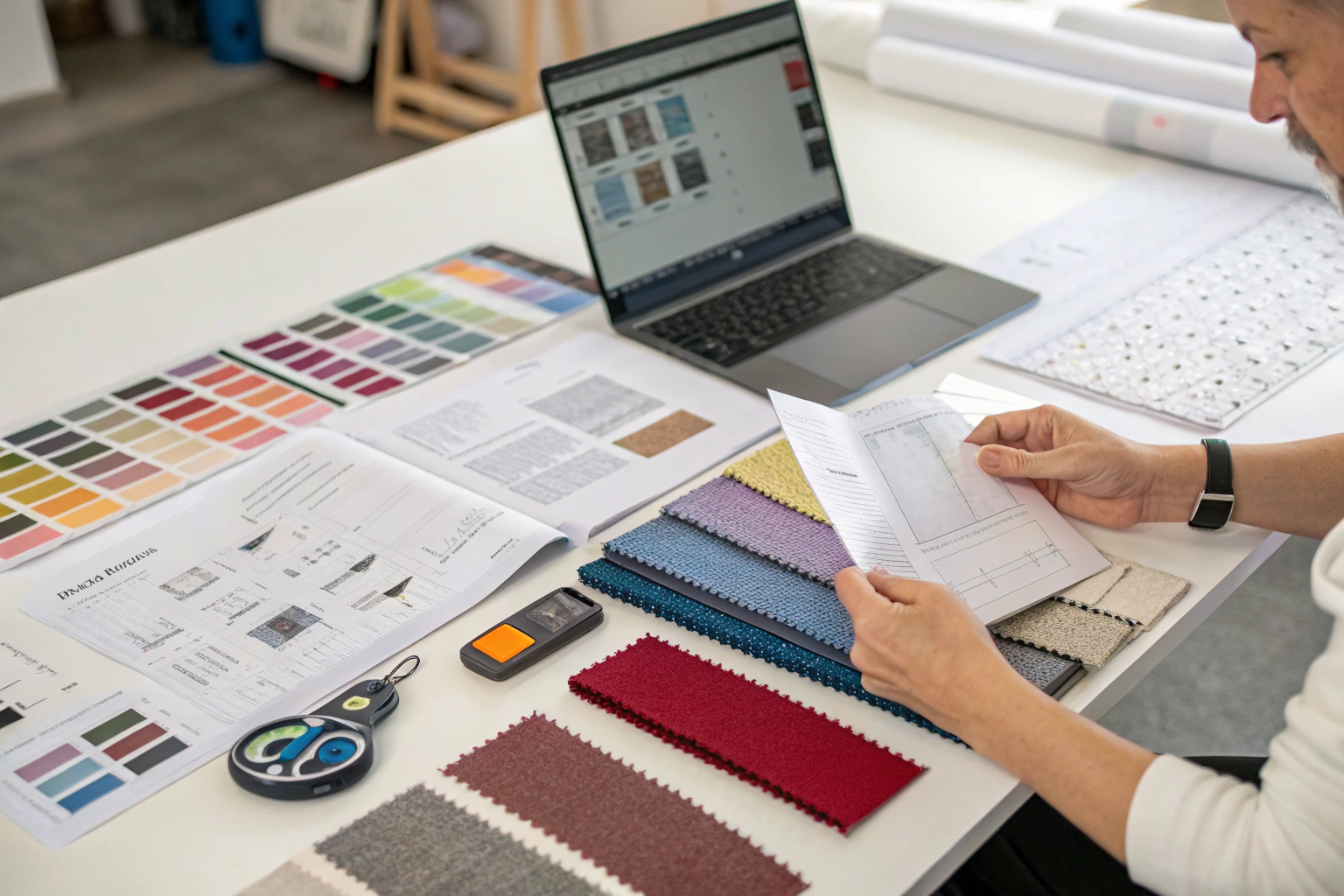
You have a vision. A beautiful, drapey, eco-friendly viscose-linen blend for a summer blazer. You can see it in your head, feel it in your imagination. You send a two-sentence email to a mill: "I need a soft, sustainable beige suiting. Something flowy. What’s the price?" A week later, you receive a stiff, sandpaper-textured, 100% polyester swatch in a color closer to mustard yellow than beige. You’re frustrated. The mill is confused. Nobody wins. The gap between what you imagined and what you specified could sink your entire production timeline.
A spec sheet is not a boring piece of admin; it’s a physical contract written in yarns and finishes. When you send it to Shanghai Fumao, you hand us the blueprints to your idea. I’ve seen clear specs shave four weeks off a development cycle. I’ve seen vague ones sink a beautiful concept into a sea of expensive, unusable lab dips. In this article, I’ll walk you through exactly what we need to see from you—the fiber breakdown, the weight tolerance, the hand-feel reference, the mechanical testing requirements—so that the first swatch you open feels like the fabric you’ve been dreaming about. No mind-reading required. Just a shared language.
What Fiber Composition Should I Specify for My Blend?
"Soft suiting" is a feeling, not a fiber content. "Stretchy activewear" could be a dozen different elastane percentages. The single most important line item on your custom spec sheet is the fiber composition expressed as an exact percentage breakdown—and you need to declare if you want it verified by a burn test, a chemical dissolution test, or a DNA analysis. If you write "cotton blend," I can give you 98% cotton 2% spandex or 51% cotton 49% polyester. Those are radically different fabrics, and they are both legally "cotton blends."
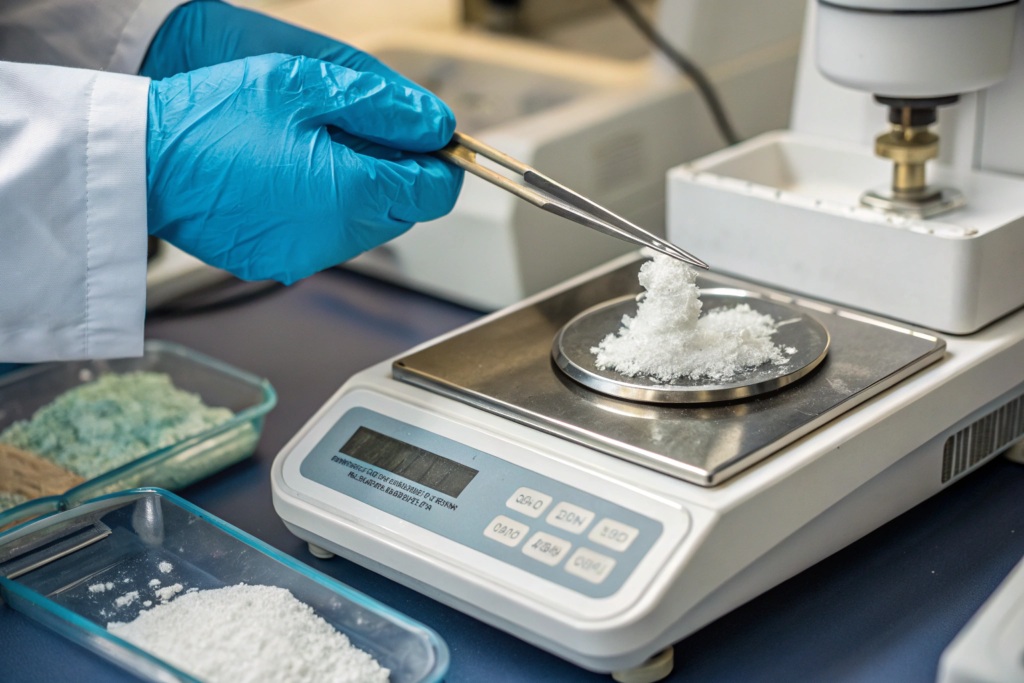
At Shanghai Fumao, our CNAS lab will verify the composition of your production bulk against your spec using the ISO 1833 chemical dissolution method. If your spec says 70% Viscose / 27% Linen / 3% Elastane, we will chemically strip the viscose with formic acid, weigh the residual linen, strip the elastane with dimethylformamide, and report the actual percentages to within ±2% tolerance. If you specify "viscose-linen blend" without numbers, we can only guess your intended hand feel. A 70/30 viscose-linen is soft and fluid. A 55/45 linen-viscose is crisp and slubby. Be specific. In early 2024, a London designer sent us a spec that simply said "Tencel blend, heavy." We had to pause development for two weeks just to clarify whether she meant 100% Tencel Lyocell (which wears warm and soft), a Tencel-cotton blend (more breathable), or a Tencel-polyester blend (better recovery). The delay cost her the production slot window.
How Do Fiber Percentages Affect the Final Drape and Recovery?
The exact percentage of a fiber is not about purity; it’s about engineering specific physical properties. Elastane percentage is the most critical number in a stretch woven or a knit. A 2% elastane in a cotton poplin gives you "comfort stretch"—the shirt moves with you but doesn’t look like activewear. A 5% elastane turns it into a performance stretch fabric with obvious recovery snap. At 8%, you’re in jeggings territory, and the long-term recovery after repeated washings becomes a serious technical challenge.
Here’s a practical breakdown of what different elastane percentages do in a woven cotton shirting, based on our internal spec tolerances:
| Elastane % | Drape Behavior (Woven Cotton) | Recovery After 30% Stretch | Typical Spec Call-Out |
|---|---|---|---|
| 1-2% | Natural, minimal crease. Looks like no-stretch cotton. | 85-90% (slow recovery, minor bagging) | "Comfort stretch, non-performance" |
| 3-4% | Visible gentle stretch. Waistband easy to move in. | 92-95% (moderate recovery) | "Easy stretch, daily shirting" |
| 5-7% | Obvious stretch, legging-like in hand feel. | 96-98% (fast snap-back) | "Performance stretch, slim fit" |
| 8%+ | Rubber-band feel. Heavy weight in drape. | 98-99% (instant recovery) | "High-recovery compression" |
For polyester-viscose blends, the ratio determines the price point, the static cling, and the pilling risk. A 65% Polyester / 35% Viscose (PV 65/35) is the industry workhorse: the polyester skeleton provides durability and crease resistance, the viscose provides a soft, cool hand and reduces static. If a buyer says "I want a cheap suiting that looks like wool," I immediately start them at PV 70/30 and we iterate from there. For more insights into how these blends play out in real garments, you can explore this detailed viscose and polyester blend behavior guide for lightweight woven fashion fabrics.
Why Should I Specify the Fiber Origin (Virgin vs. Recycled)?
There’s a price gap, a quality gap, and a marketing gap between virgin polyester and recycled polyester (rPET). A spec that says "100% Polyester" defaults to virgin chips unless you explicitly write "100% Recycled Polyester (GRS Certified)." Post-consumer recycled polyester, made from plastic bottles, often has a slightly lower intrinsic viscosity than virgin polyester. This means it can be slightly more brittle, and the dye uptake can be slightly more uneven, especially in dark navy and black shades.
If you want the eco-claim and the premium price tag of sustainable fashion, you must specify "GRS-certified recycled polyester" and accept that the hand feel might be incrementally rougher. We solve this at Shanghai Fumao by using a specific GRS-certified chip from a Zhejiang supplier that maintains a viscosity of 0.65 dl/g, comparable to virgin. But you need to call it out on the spec. A buyer from a Swedish eco-brand in mid-2023 rejected a batch of our fabric because it felt "too perfect" and they suspected we had used virgin polyester instead of rPET. We had to send them the GRS transaction certificate and the bale-level plastic bottle feedstock origin documentation to prove it was indeed recycled. (Yes, sometimes being "too good" is a problem.) I always recommend reading up on the actual fiber viscosity specification in recycled polyester yarns and how it affects dyeing uniformity to understand what you’re asking for.
How Do I Define an Acceptable Hand Feel for a Mill?
"Soft" is the most dangerous word in a spec sheet. It’s subjective, cultural, and completely unreliable. A Japanese buyer’s "soft" is often crisp and dry with a papery rustle. An American buyer’s "soft" is often a silicone-coated, slippery, cool-to-the-touch slickness. If you write "soft suiting" and nothing else, you are rolling a dice. I’ve seen a buyer reject a sample because it wasn’t "soft," when what they really meant was they wanted a peach-skin finish, which is a specific mechanical emerizing process, not an inherent fiber property.
We solve this with two tools: a reference swatch and a hand feel descriptor vocabulary. The reference swatch is the single most powerful device in fabric development. Find a fabric you love—cut a swatch from a competitor’s garment, an old sample, or a vintage piece—and send it to us with the spec. Staple it to the sheet. Write "hand feel must match this reference, specifically the surface slipperiness and drape." We can then reverse-engineer the finish, the yarn twist, and the softener chemistry in our lab. Sometimes, we don’t even need to know the fiber content of the reference; we just need the target tactile experience. For the vocabulary, use specific industry terms that describe the mechanical and surface properties: "crisp," "fluid," "dry," "oily," "slick," "waxy," "bouncy," "limp." Avoid emotional poetry like "cloud-like" or "buttery" without also giving the mechanical reference.
What Quantitative Tests Can Back Up "Softness"?
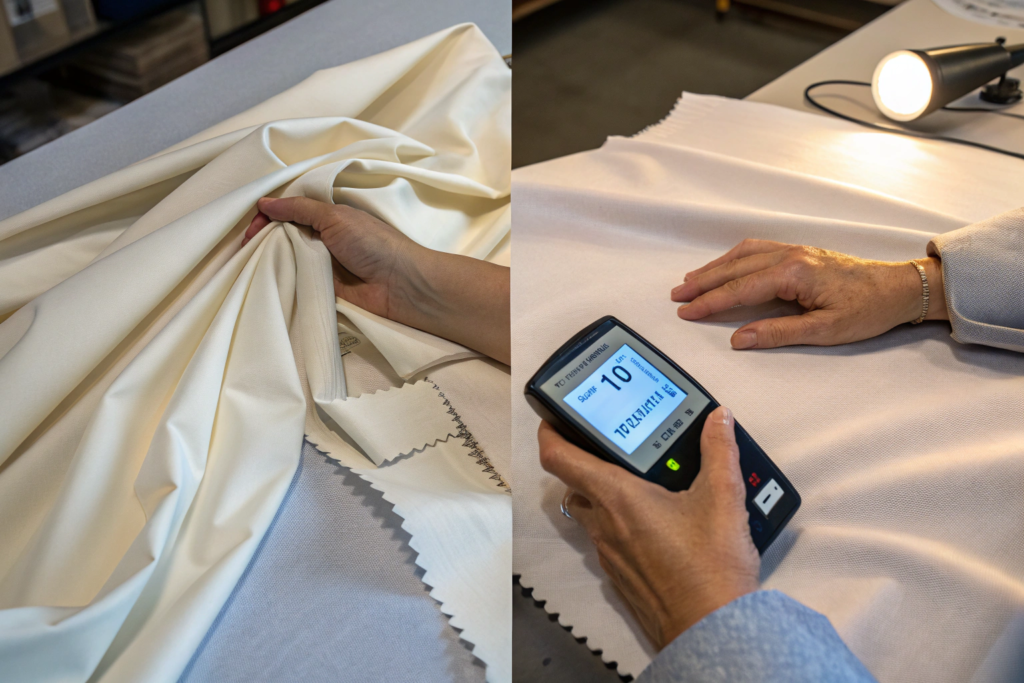
Feel is subjective, but bending rigidity and surface friction are measurable. If you want to lock in a hand feel for repeatable bulk production, ask for the Kawabata Evaluation System (KES) values or the simpler FAST (Fabric Assurance by Simple Testing) numbers. The FAST system measures compression (in microns), bending rigidity (in micro-Newton meters), and extensibility (as a percentage). A fabric with a bending rigidity below 10 µNm is considered very flexible and drapey; above 50 µNm is stiff and boardy.
At Shanghai Fumao, if a client says "I want this to drape like a silk charmeuse but it’s a polyester satin," we measure the bending length of the reference charmeuse using a cantilever test (ASTM D1388). The reference drapes at, say, a 30mm overhang length. We then adjust the polyester satin’s finish until it matches that exact 30mm bending length. This is how you convert poetry into physics. You should also look at the correlation between fabric bending rigidity measured by FAST system and subjective consumer hand feel assessments to appreciate how numeric data translates into the "feel" you’re chasing.
How Should I Describe My Desired Surface Texture?
Surface texture is independent of hand feel. A fabric can be soft (low bending rigidity) but have a rough, granular surface texture (like sand-washed silk). A fabric can be stiff (high bending rigidity) but have a slippery, glass-smooth surface (like a starched taffeta). You need to specify both independently.
We use a surface texture taxonomy with five categories: slick/slippery (glass-like, fibers heavily calendered or coated), waxy (candle-like, typical of high-quality combed Egyptian cotton with a light silicone finish), dry/papery (little to no lubricant, natural friction, typical of linen and ramie), granular/peach-skin (micro-fibrillated surface achieved through emerizing or enzyme washing), and raised/fuzzy (brushed, napped, or sueded). A spec that says "dry hand feel with a granular, peach-skin surface" tells me exactly that you want a sand-washed finish on a fabric that doesn’t feel oily. That clarity is worth its weight in gold and eliminates two rounds of unnecessary lab dips. Understanding the textile finishing processes for achieving peach-skin and emerized surface effects on synthetic fabrics can help you name exactly what you’re feeling.
What Production Artwork Format Prevents Dyeing Errors?
You design a gorgeous floral print in Photoshop on your MacBook, hit "save as JPEG," and email it to us with the subject line "Print this on pink modal." The file arrives uncalibrated, in RGB color space, with no physical color reference attached. Our CAD team opens it, converts the RGB to CMYK for digital printing, and produces a strike-off. You open the parcel and scream, "This is salmon pink, not dusty rose!" The error didn’t happen in our dye house; it happened in your file setup. The machine read your numbers correctly; your numbers just didn’t encode the color you meant.
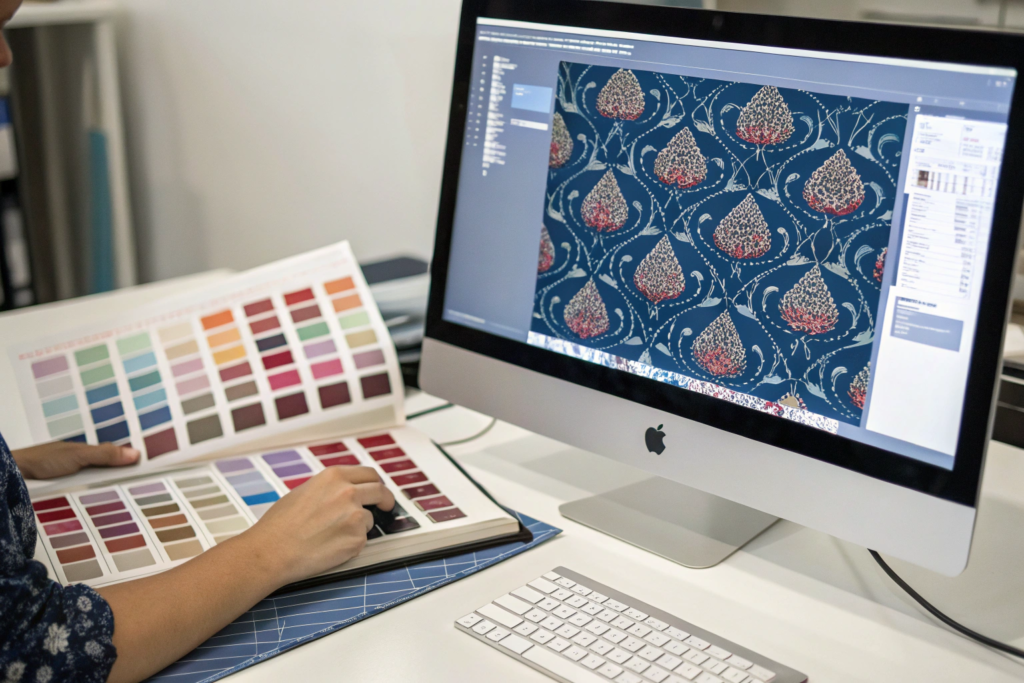
At Shanghai Fumao, we require three things for any custom print or yarn-dyed pattern: a vector artwork file (.AI or .EPS, with color-separated layers and Pantone TCX color callouts assigned to each layer), a physical Pantone TCX (Textile Cotton eXtended) color reference snipped from the official Pantone book, and a JPEG reference image showing the intended visual layout of the repeat. The vector file is the executable code for the digital textile printer or the screen engraver. The Pantone TCX chip is the color calibration target. The JPEG is the "intent" visual for a human to check if the separation looks correct before we ink up the machine. If you send only a JPEG, our CAD operators must guess the intended Pantone mapping, and their "dusty rose" interpretation will almost certainly not match yours.
Why Are Pantone TCX References Essential for Digital Textile Printing?
Pantone TPX (paper) and TCX (cotton swatches) are not the same color. The same Pantone number appears visibly different on paper (coated, bright white substrate) versus on a textured, slightly off-white cotton swatch. Dyes look different on different substrates because of the scattering of light within the fiber. If you spec "Pantone 19-4052 Classic Blue TPX" from a paper fan, our printer will match the ink formulation to that paper standard. The result on a modal jersey will be a slightly muted, red-shifted version of what you expected, because the modal fiber absorbs dye differently than coated paper reflects ink.
Always purchase the physical fabric swatch from Pantone (TCX) or at minimum, specify "Pantone 19-4052 TCX" in your spec sheet. Even better, send us your target TCX swatch physically with the spec, so our spectrophotometer can measure it directly and create a custom ICC profile mapping the digital file to the exact dye recipe for that substrate. A detailed guide on using Pantone TCX versus TPX color references for digital textile printing work will explain why the substrate shift matters more than you think.
How Do I Specify Color Tolerances on a Lab Dip?
A lab dip is a proposal. You receive it, light it in a D65 light box, and compare it to your standard. But "close enough" is a financial risk. If your spec doesn’t define the acceptable Delta E (the mathematical distance between two colors in CIELAB color space), our QC team doesn’t know where the boundary of approval lies.
We recommend buyers specify a Delta E CMC (2:1) tolerance of ≤ 1.0 for critical fashion colors (a branded signature red or a core navy) and ≤ 1.5 for secondary seasonal colors. A Delta E of 1.0 is a commercially achievable, tight match that requires skilled lab technicians. A Delta E of 2.0 is visible to a trained eye, and by the time the garment hangs on a rack under different store lighting, that 2.0 difference can look like a completely different dye lot. Write this line in your spec: "Lab dip approval requires Delta E CMC(2:1) ≤ 1.2 versus supplied physical standard under D65/10° observer." That single sentence removes all subjectivity from the approval process and protects you from a bulk dye lot that "looked close enough" in the factory but doesn’t match your collection’s other pieces. You might find it useful to understand how colorimetry and Delta E CMC tolerance specifications apply in textile quality control protocols.
How Do I Assign a Test Standard to an Unknown End-Use?
You write "needs to be durable" on the spec. But durable for what? A sofa cushion that a family of five and a Labrador retriever will abuse daily? A children’s school uniform that will be washed at 60°C twice a week? A sheer curtain that hangs immobile behind glass for a decade? A generic call for "durability" without a corresponding test standard transfers the liability for failure onto you because you implicitly accepted whatever interpretation the mill chose to apply.
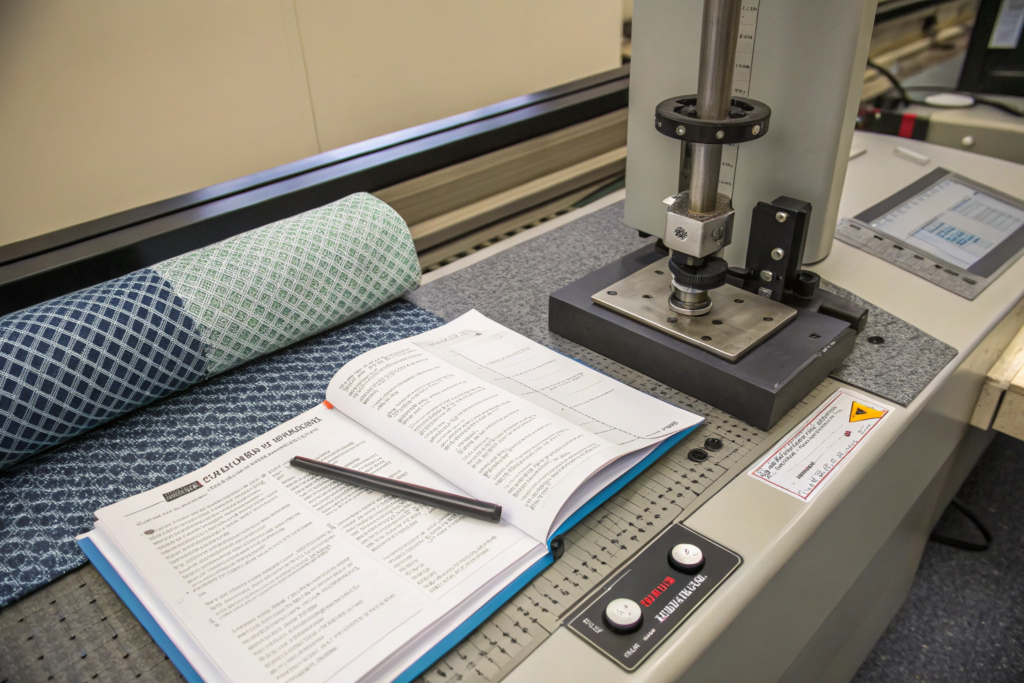
We need you to connect the end-use to a specific, named test method with a target value. If you don’t know which test applies, just describe the worst-case scenario the product will face. "This fabric will be made into restaurant booth seating, cleaned daily with a bleach-based spray, and must withstand a 90kg person sliding across it repeatedly." From that description, our technical team will propose the appropriate test matrix: ISO 12947 Martindale abrasion resistance to 40,000 rubs, ISO 105-E01 color fastness to water spotting, and ISO 105-X12 wet crock fastness Grade 4 minimum, with a specific bleach-resistance protocol. At Shanghai Fumao, we prefer to write the test standards with you, based on the end-use, before we cut the first sample, rather than discover after bulk delivery that the fabric doesn’t do what you needed.
What Abrasion Resistance Number Should My Upholstery Fabric Hit?
Martindale rub counts are not marketing numbers; they are predictors of seat-pan survival. The industry breaks down abrasion resistance into roughly three tiers for residential and contract upholstery, and if you don’t specify the tier, you could get a beautiful viscose-linen that disintegrates on a cinema seat within six months.
The general Martindale abrasion scale for upholstery, measured under a 12kPa pressure load on standard wool abradant fabric, looks like this:
| Martindale Rub Count | Performance Tier | Suitable End-Use | Fumao Advice |
|---|---|---|---|
| < 15,000 | Decorative Only | Cushions not sat on, wall hangings | Not recommended for seating. |
| 15,000 – 25,000 | Light Domestic | Occasional-use chairs, bedroom benches | Acceptable with delicate fiber blends only. |
| 25,000 – 40,000 | General Domestic | Daily-use family sofas, dining chairs | Our minimum standard for upholstery. |
| 40,000 – 100,000 | Heavy Domestic / Light Contract | Hospitality seating, hotel lobbies | Requires 100% polyester or nylon. |
| 100,000+ | Severe Contract | Airport seating, cinema, 24-hour use | Specialty high-tenacity filament yarns only. |
Write this in your spec: "Abrasion resistance required: minimum 40,000 Martindale rubs, tested to ISO 12947-2, no thread breakage, Grade 4 visual assessment." That line tells us you need a heavy-duty contract fabric, not a pretty decorative slub. For deeper reference material, I recommend reviewing the Martindale abrasion testing standards for contract upholstery textile end-use classifications to understand exactly what rub count your project legally requires by fire code and warranty.
How Do I Call Out Tear Strength for Workwear or Outdoor Gear?
Tear strength and tensile strength are completely different physical properties. Tensile strength measures the force to pull fabric apart in a straight line. Tear strength measures the force to propagate an existing cut or rip, which simulates a snag on a branch, a sharp corner of a machine part, or a dog’s claw. For workwear, tactical gear, and outdoor equipment, tear strength is often more critical than tensile strength because failures begin at a point of damage, not across a uniform cross-section.
Specify ASTM D1424 (Elmendorf falling pendulum tear test) or ISO 13937-2 (trouser tear method). For a heavy-duty workwear cotton-polyester twill, acceptable warp tear strength should be above 25 Newtons, weft above 20 Newtons. For ultralight ripstop nylon for a tent fly, the tear strength is the defining specification—you might ask for 15N in a fabric that weighs only 40gsm, which is a remarkably high strength-to-weight ratio that requires high-tenacity nylon 6,6 filament. Write your test call-out with the exact method and minimum Newtons. A data-driven comparison of Elmendorf tear test methods for woven industrial textiles will show you why the pendulum geometry matters in different fabric constructions.
Conclusion
A clear spec sheet speaks the language of numbers, standards, and physical references. It replaces "soft" with a target FAST bending rigidity and a peach-skin reference swatch. It replaces "durable" with "ISO 12947-2 Martindale, 40,000 rubs minimum." It replaces "blue" with "Pantone 19-4052 TCX, Delta E CMC ≤ 1.2 under D65." When you hand this kind of spec to a mill, you are not just a buyer placing an order—you are a product engineer defining a manufacturing formula. The mill becomes your laboratory, not your guessing game.
I’ve seen the moment a buyer realizes that a single line of text—"wet crock fastness Grade 4 min, AATCC 8"—can protect a $30,000 investment from becoming a box of bleeding returns. That moment transforms how they source fabric forever. The spec sheet is your armor. It protects your vision from being lost in translation between your mood board and the dye bath.
If you’re creating a custom fabric and you’re not sure which test standard matches your end-use, or you don’t have a Pantone TCX book to pull from, bring us into the conversation early. We will help you write the spec before we ever touch a yarn. At Shanghai Fumao, we prefer to receive a spec that’s technically ambitious and specific because it gives our engineers a clear target to hit. Send your preliminary brief to our Business Director, Elaine, at elaine@fumaofabric.com. She can provide you with our internal spec sheet template, which walks you through fiber content, finish, testing protocols, and color standards in a structured format. Let’s turn your concept into a document that outputs the exact fabric you want, on the first try.