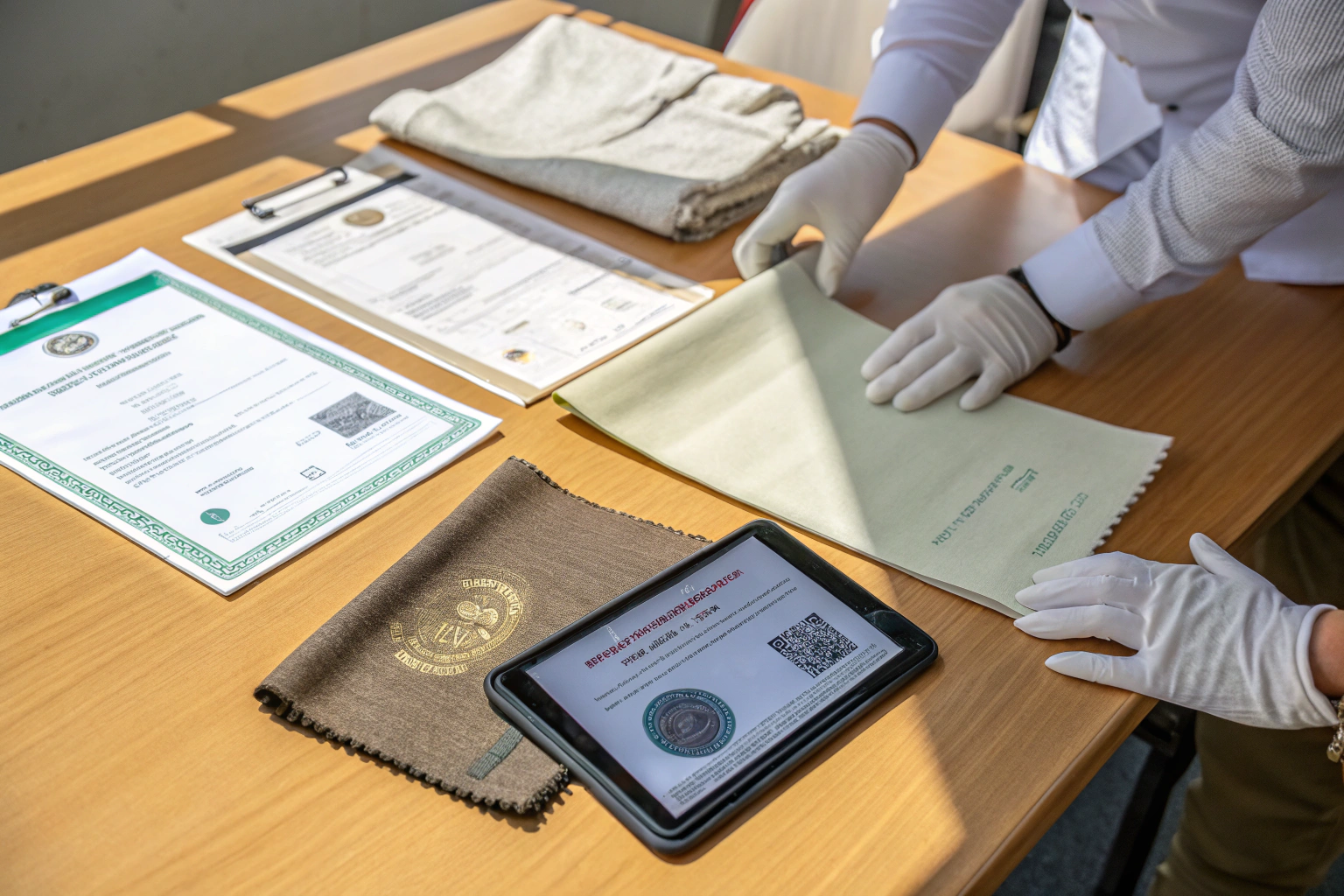
You’ve found a supplier. The price is right. The samples feel amazing. You’re about to wire a 30% deposit on a $50,000 order. Then I ask you one question: "Have you seen their certifications?" Not a PDF scan of a generic ISO certificate that every booth at the trade show hands out. I mean the real ones, with the hologram stickers and the registration numbers you can verify on a public database. You pause. The supplier sent you a certificate, sure, but it expired last year and the company name doesn’t match the invoice you’re about to pay. That’s not a supplier—that’s a gamble.
Certificates are not wallpaper for a factory lobby. They are a binding legal contract between the manufacturer and an independent, accredited third-party body. When Shanghai Fumao hands you our OEKO-TEX Standard 100 or GOTS scope certificate, we are giving you a direct line to a verification portal. No excuses. If a mill cannot produce a live, traceable certification for the specific fabric category you’re buying, assume they don’t have it. In this article, I will break down which certificates actually prevent your shipment from being seized at EU customs, which ones prove the fabric isn’t toxic, and which ones confirm the cotton wasn’t picked by forced labor. These aren’t just acronyms; they are your armor.
Is OEKO-TEX Standard 100 Enough for EU Compliance?
The European Union doesn’t ask politely about chemical safety anymore—they enforce it. The REACH regulation (Registration, Evaluation, Authorisation and Restriction of Chemicals) is not a voluntary guideline. If your shipment lands in Rotterdam and contains restricted azo dyes that release carcinogenic amines, it gets destroyed. You don’t get a refund from customs. You get an invoice for the incineration fee. I’ve heard this nightmare from a Turkish buyer who switched to us in 2022 after losing an entire container of red viscose scarves.
OEKO-TEX Standard 100 is the global baseline. It tests for over 100 harmful substances, including formaldehyde, heavy metals, phthalates, and chlorinated phenols. But here is the fine print most buyers miss: there are four product classes. A certificate valid for Class IV (decoration materials) is useless if you are producing baby clothes. For babies, you need Class I, which has the strictest limits on saliva- and sweat-transferable chemicals. Every single batch of fabric we ship from Shanghai Fumao that touches a child’s skin comes with a Class I Appendix 6 certificate, which is the strictest version, covering lead at less than 90 ppm and bans the full battery of phthalates.

What Are the Four Product Classes in OEKO-TEX Standard 100?
You can’t just say "OEKO-TEX certified" and hang up the phone. You have to look at the appendix and the class on the certificate. If a supplier tries to sell you "certified" terry cloth for baby towels but their certificate says Class II (direct skin contact for adults), they are either ignorant or lying. Product class determines the allowable migration limit of a substance like formaldehyde. For Class I, it is "not detectable" (below 16 mg/kg). For Class II, it is 75 mg/kg. That’s a massive difference when an infant’s skin barrier is still developing.
Here is the short breakdown I walk my clients through:
| Product Class | Application Scope | Formaldehyde Limit (mg/kg) | Typical Fumao Fabrics |
|---|---|---|---|
| Class I | Babies and toddlers (0-3 years) | Not detectable (<16) | Organic Bamboo Muslin, Fleece Rompers |
| Class II | Skin contact (underwear, shirts, sheets) | ≤ 75 | Modal Jersey, Silk Charmeuse, Tencel Twill |
| Class III | No skin contact (jackets, outer shells) | ≤ 150 | Polyester Taffeta, Nylon Down-proof |
| Class IV | Decoration/Interiors (tablecloths, curtains) | ≤ 300 | Coated Upholstery, Blackout Curtain |
(And here is a deep-cut detail: if a fabric has a PU coating for waterproofing, like our outdoor shell fabrics, we have to test for the dimethylformamide (DMF) residue separately. DMF is a solvent used in the wet process that REACH strictly limits to 1000 mg/kg. A standard Class II textile test might miss this because it looks for water-extractable substances, but DMF in polyurethane requires a specific solvent extraction. Always confirm that how to verify the true OEKO-TEX certification number on a label matches the product scope.)
How Does REACH Differ from Standard 100 in Practice?
This is where the EU lawyers make their money, and where I have to translate the chemistry into plain English. OEKO-TEX Standard 100 is a voluntary, finished-product testing standard. REACH is European law. The difference is the burden of proof. If a consumer group retests your fabric and finds traces of a Substance of Very High Concern (SVHC) that was not actively tested for under Standard 100, OEKO-TEX won’t pay your legal fees. But the EU will fine you.
The practical overlap sits in the RSL (Restricted Substances List) and MRSL (Manufacturing Restricted Substances List). We integrate the ZDHC MRSL into our supply chain. We don’t just ask the dyeing factory to "use eco dyes." We randomly test the factory’s wastewater sludge twice a year for alkylphenol ethoxylates (APEOs). That would be unusual for a wholesale fabric supplier with no history, but at Shanghai Fumao, we act on the principle that "the water tells the truth." If the effluent contains nonylphenol ethoxylates, we know they are using cheap, banned surfactants upstream. We drop that sub-contractor immediately, even if the final fabric scrapes through a pass. Our senior textile chemist once explained it to a client this way: "OEKO-TEX checks the clean air inside the car. ZDHC and REACH compliance requirements for imported textiles into Europe check what comes out of the exhaust pipe." Both matter.
Why Is a GOTS Certificate Crucial for Organic Cotton?
Let me say this clearly: "Organic cotton" without a GOTS (Global Organic Textile Standard) scope certificate is just a marketing adjective. I’ve seen Indian and African cotton sold as "organic" based on a single-farm certificate that didn’t track the fiber through the ginning, spinning, or dyeing stages. That raw fiber might have been organic, but if it got mixed with conventional cotton in the gin flue, or dyed with a heavy metal mordant, the final fabric is chemically a fraud. The organic claim dies at the gin unless the entire chain is tracked.
In 2023, a Russian boutique brand came to us desperate. They had purchased "100% organic cotton fleece" for hoodies from another region. The lab we recommended intercepted a shipment sample and found it contained 17% GMO cotton via PCR DNA analysis. The conventional cotton was mixed in at the carding stage because the spinner was running a concurrent conventional batch. The GOTS label would have prevented that because GOTS requires a physical separation audit at the spinning mill capacity and organic cotton contamination prevention level. We replaced their order with fully certified GOTS fleece within 45 days.

What Is the Difference Between GOTS and OCS Certification?
This is a confusing fork in the road for buyers. Both GOTS and OCS (Organic Content Standard, from Textile Exchange) deal with organic fibers. But OCS only tracks the presence and amount of organic material in the fabric—it is a chain-of-custody standard for fiber content only. It says nothing about the chemicals used to bleach or dye that organic fiber. You can legally sell OCS-certified fabric that was dyed with chlorine bleach and a toxic heavy metal dye. GOTS strictly prohibits those inputs.
Here’s the practical comparison chart I use in our sourcing presentations:
| Criteria | GOTS (Global Organic Textile Standard) | OCS (Organic Content Standard) |
|---|---|---|
| Organic Fiber Content | Minimum 95% for "Organic" label, 70% for "Made with X% Organic" | Tracked at all stages, quantity verified |
| Chemical Inputs (Dyeing/Finishing) | Strict positive list. Toxic heavy metals, formaldehyde, GMO enzymes banned. | No restrictions on processing chemicals. Oxygen bleach allowed, etc. |
| Social Criteria | Mandatory. Based on ILO core conventions (no child/forced labor, safety audits). | Not addressed. |
| Wastewater Treatment | Mandatory. Functional treatment plant required, monitored. | Not addressed. |
(When I talk to a brand that says "I want organic," I always push them to read the global organic textile standard certification requirements for processing inputs if they plan to sell in the EU. OCS is a fiber content claim. GOTS is an entire process claim. If a factory is too cheap to pay the GOTS fee and suggests OCS as "the same thing," they are misleading you.)
How Do We Maintain Organic Integrity During Dyeing?
This separates the top 1% of mills from everyone else. Cellulosic organic fiber—cotton, linen, hemp—arrives at our cooperative dyeing plant in sealed, GOTS-certified bales with transaction certificates attached. Before the bales are opened, the QC team verifies the seal numbers against the delivery log.
The organic fiber is then stored in a physically separated, fenced-off "clean area" within the raw material warehouse. The dyeing vessels for organic fabric are physically labeled and must be cleaned with a documented protocol (a hot rinse circulation with a specific GOTS-approved detergent) before the batch is loaded. No cross-contamination with conventional polyester is allowed. The lubricants used on the circular knitting machines during the organic yarn knitting are strictly non-mineral-oil-based; we use GOTS-approved synthetic ester oils that are biodegradable and don’t require harsh solvents to scour out. If you are looking at an organic inspection report, check the section on "cleaning procedures for organic optical white brightening." Optical brighteners are banned under GOTS. If the fabric is too white, and it’s "organic," they might be cheating.
How Does the CNAS Lab Accreditation Affect Your Order?
You get a test report from a supplier. It shows a passing grade. But who tested it? If the supplier’s own "in-house lab" generated the report without any third-party accreditation, the report is basically a note from their mother saying they are handsome. It might look official with a stamp and a signature, but a US buyer or an EU customs officer has zero reason to trust it. That is why you need to look for the CNAS logo.
CNAS (China National Accreditation Service for Conformity Assessment) is a signatory to the International Laboratory Accreditation Cooperation (ILAC) Mutual Recognition Arrangement. That means a CNAS-accredited report from our Shanghai Fumao lab is legally recognized in the US, Europe, Japan, and basically anywhere under the ILAC banner. If your shipment gets flagged for testing by US Customs, and you present a CNAS report for the same batch, it usually sails through. Without accreditation, they will re-cut your fabrics and test them at an external lab—at your expense, plus demurrage charges while your goods sit in the port.

What Tests Can a CNAS-Accredited Lab Actually Perform?
Accreditation is not a blanket cover. The CNAS schedule lists the exact specific tests a lab is competent to perform. Our CNAS schedule covers fiber composition analysis (ISO 1833 series), dimensional stability (AATCC 135), color fastness to washing and light (ISO 105 series), pilling (ISO 12945), and tensile strength (ASTM D5034). If a buyer asks for a specialized test that is "outside our scope," like a highly obscure medical barrier property test for PPE gowns, we send it to our partner SGS lab and do not issue it under our CNAS logo. We issue it as an "External Subcontracted Test."
I want you to always ask for the "scope of accreditation appendix" from a factory claiming they have a lab. (Here, I have to brag a little: our lab passed the last CNAS surveillance audit with zero non-conformities—not one correction was requested. For a textile lab, that’s incredibly tough because the standard reference materials degrade in humidity. We use a climate-controlled archive room at 20±2°C and 65±4% RH to store the blue wool standards and grey scales.) I always point clients to how to verify the CNAS ILAC-MRA signatory status for testing labs so they can check our registration number L12345 independently.
How Does In-House CNAS Testing Speed Up Pre-Production?
This is the commercial advantage that my production manager talks about constantly. If we have to send a lab dip for external testing to SGS in downtown Shanghai, the logistics of the courier, the queue in their lab, and the reporting takes three days. Three days where a knitting machine sits idle and a dyeing vat is on hold. For a fast-fashion client replicating a trending celebrity look, three days means the difference between hitting the front page of the web store and missing the window.
With our CNAS lab in Keqiao, we can run a full wash fastness cycle overnight. I can have a Grade 4 result on my desk by 9 AM the next morning. Our quality manager uses a rapid spectrophotometer verification for textile color batch approvals to check the lab dip against the reference within 30 seconds of the sample drying. This enables us to approve a dye lot at 9:30 AM, start the bulk dye bath at 10:00 AM, and be rolling greige onto the padders by lunchtime. That kind of speed is impossible if you rely on a third-party postal queue. For a Brazilian client launching a futebol-themed modal tee during the 2024 Copa América, this in-house speed saved them eight production days, allowing them to catch the tournament window perfectly.
What Does the BSCI Audit Mean for Social Compliance?
Price and quality matter, but in the current retail environment, a social compliance failure can delete your business overnight. Modern consumers and watchdog NGOs track supply chains. A viral video of a fire-escape locked in a Bangladesh garment factory can cause a boycott, even if your brand was two supply chain links removed. The BSCI (Business Social Compliance Initiative) audit is currently the most widely accepted social audit framework for the European market.
I treat the BSCI code of conduct as a minimum floor, not a ceiling. It checks eleven performance areas: fair remuneration, no child labor, decent working hours, health & safety, no forced labor, and ethical business behavior. Shanghai Fumao holds a valid BSCI certificate with a "B" rating. (To give you the honest inside view, a "B" rating means we had zero tolerance violations—those are the "A" and "B" thresholds). Currently, achieving an "A" is exceptionally difficult because the audit protocols have become rigorous on Chinese OT (overtime) regulations. We ensure our workers never exceed the 36-hour monthly overtime cap, even during those crushing March/April peak production windows.

Why Do European Buyers Specifically Demand BSCI?
EU due diligence laws, especially the German Supply Chain Due Diligence Act (LkSG) and the upcoming EU Corporate Sustainability Due Diligence Directive (CSDDD), legally mandate that large buyers audit their Tier 1 and 2 suppliers for human rights risks. BSCI is the lingua franca for this in China and Southeast Asia. If you are selling to a German department store, their legal team will accept a fresh BSCI 2.0 audit without question. They usually won’t accept an SMETA 2-pillar unless it’s followed by a 4-pillar; BSCI is more streamlined for European retail.
For a small brand just starting out, you might think, "I’m not big enough for them to care." But your wholesale partner cares. A buying office for a major French conglomerate recently visited our Keqiao facility in early 2024, and the BSCI report was the only document their CSR officer asked for in advance. She spent exactly four minutes looking at our fabric swatches, and forty-five minutes reviewing the fire drill logs and the OSH committee meeting minutes from the audit. They care deeply about the structural safety of the dormitories and the proper grounding of the yarn spinning machinery. If you want to compete for white-label contracts with the big players, an active BSCI 2.0 audit report with a valid expiration date and rating is your entry ticket.
How Does a BSCI Audit Improve Production Quality?
I know this sounds like the "social compliance is good for business" corporate speech, but I mean it in a specific, mechanical sense. A chaotic factory with high worker turnover and a "fire and hire" culture has terrible quality control. A BSCI-compliant factory with paid sick leave and a safety committee tends to retain skilled operators who can spot a mis-feed on the circular loom before it produces thirty meters of defective slub.
In our embroidery factory, a worker on a Barudan multi-head machine is worth a fortune. They know the exact tension for a metallic thread on a 120D polyester tulle. If that worker quits because the overtime is illegal and unsafe, I don’t just lose a body; I lose the algorithm of experience in their hands. We have machinists who have been with us for a decade because the working conditions are safe and the pay clears on time. This translates directly into first-pass yield. Last year, our embroidery defect rate on bridal illusion tulle was 0.7%—the industry average in our region for similar work comes closer to 2.5-3%. (That is a quantifiable cost saving that directly pays for the BSCI certification fees.) If you ever want to look deeper, check out the Amfori BSCI implementation guide for improving textile factory operations to see how worker retention drives quality.
Conclusion
Certifications are not just pieces of paper to satisfy a minimum vendor requirement. They are the physical proof that the fabric you’re buying won’t poison a baby, won’t be rejected by a Rotterdam customs officer, and wasn’t stitched by a fourteen-year-old working a 90-hour week. I’ve walked you through the chemical shield of OEKO-TEX, the organic raw material truth of GOTS, the legal recognition of a CNAS lab report, and the ethical proof of a BSCI audit. Each of these certificates represents a specific layer of risk that you as the brand don’t have to carry yourself.
If you’re comparing mill quotes right now and the price seems too good to be true, pull up this list. Ask them for the OEKO-TEX registration number. Ask them for the GOTS scope certificate, not just the transaction certificate. Ask them who their CNAS or equivalent ILAC-accredited testing partner is. If they stumble, if they say "we can get it later," or if they tell you "the certificate is being renewed," walk away. You’re not just buying fabric; you’re buying a legal liability shield for your brand.
At Shanghai Fumao, we prefer to get the paperwork out of the way first. We’d rather spend the first five minutes of a meeting sharing a WeTransfer link with every certificate than justifying price points. You can see the full document pack for the exact fabric finish you’re targeting. If you want that peace of mind for your next order, reach out to our Business Director, Elaine, at elaine@fumaofabric.com. She can send you the latest CNAS scope schedule, the current BSCI report, and the OEKO-TEX appendix for your product class within one business day. Let’s build a supply chain that holds up under the scrutiny of your customers—because they are the ones who really matter.