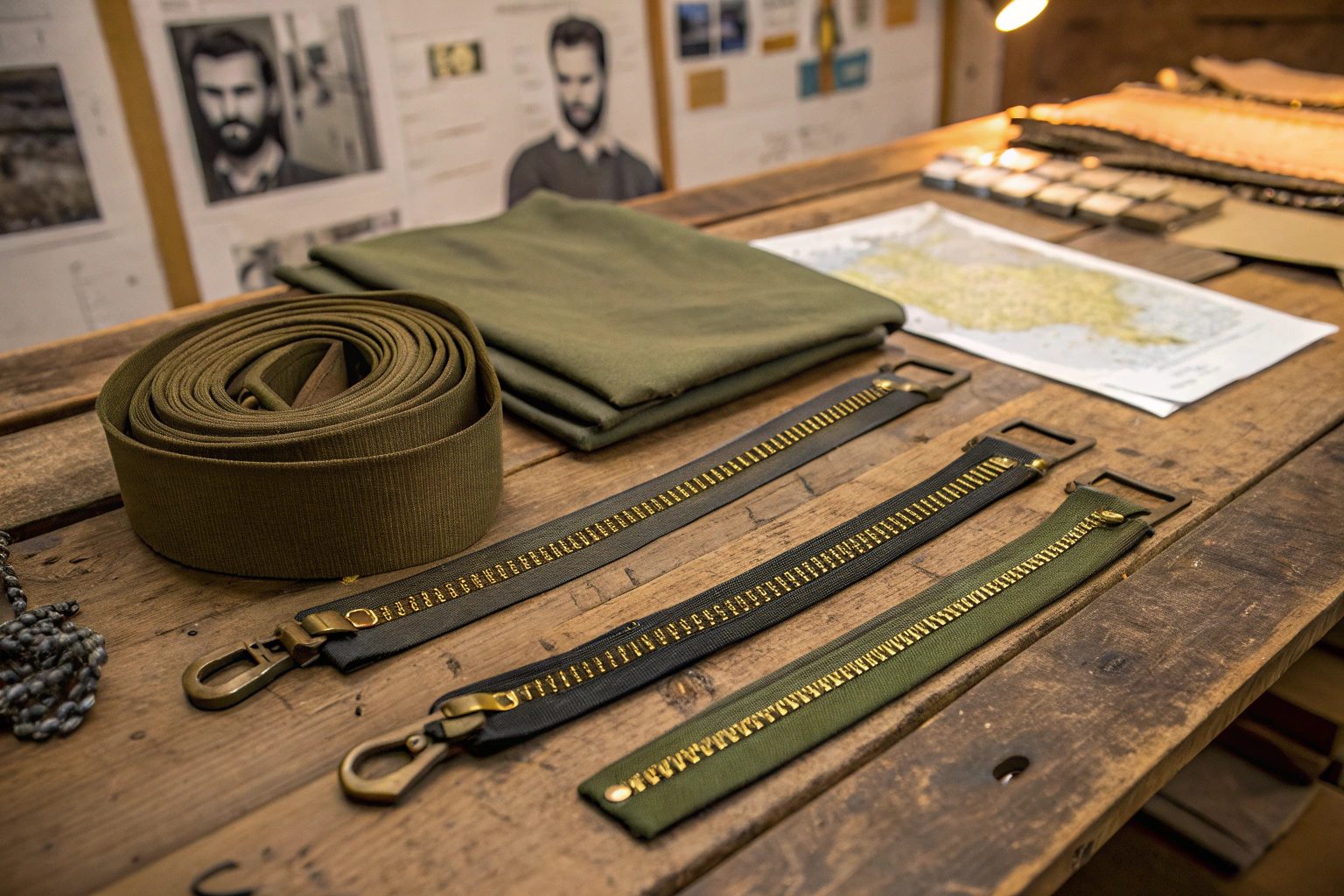
You know that sinking feeling when a customer sends back a winter parka because the zipper split open like a cheap suitcase? Or worse, when the shiny gold snaps on that gorgeous linen blazer start turning green after two months in the customer’s closet? I see this happen to importers every single season. You spend months perfecting the fabric weight and the drape. You obsess over the stitching details. Then you slap on a #3 zipper with a flimsy slider because it saved you fifteen cents per unit. And just like that, your brand’s reputation is hanging by a broken pull tab. The fabric gets the glory when the garment looks good, but the hardware takes the blame when everything falls apart. The brutal truth is that most designers treat zippers and buttons as an afterthought—a last-minute scramble on Alibaba while the factory is waiting to cut the order. That approach is a disaster waiting to happen in a shipping container crossing the Pacific.
The solution isn’t just "buy a YKK zipper." Don’t get me wrong, YKK is the gold standard for a reason, and I spec them all the time for our clients. But matching hardware to fabric is a system of physics and chemistry. It’s about Load Bearing Capacity (can that zipper tape handle the tension of a heavy wool coating without puckering?), Galvanic Corrosion (will that metal button react with the dye in your indigo denim?), and Shrinkage Compatibility (will that nylon coil zipper warp when you steam press the final garment?). A heavy-duty zipper on a lightweight silk chiffon will ruin the drape. A delicate zipper on a 14oz denim jean will pop teeth like popcorn. The art—and it is an art we’ve honed at Shanghai Fumao over twenty years of outfitting everything from Arctic expedition gear to Paris runway samples—lies in balancing the structural integrity of the hardware with the behavioral properties of the textile. Let me show you how we think about this puzzle from both sides of the supply chain: the fabric mill and the trim factory.
What Are the Strongest Zipper Types for Heavy Fabrics?
When a client tells me they are making a waxed canvas backpack or a sheepskin aviator jacket, I don’t even open the standard trim catalog. I go straight to the industrial section. The strength of a zipper is defined primarily by the Size Number (e.g., #3, #5, #8, #10). That number refers roughly to the width of the chain in millimeters when zipped. A #3 zipper is for blouses and dress pants. It’s a lightweight. A #5 is your workhorse for jeans and hoodies. But when we talk "heavy-duty," we are in #8 and #10 territory. These are the zippers you see on firefighter gear and motorcycle boots.
The physical structure of the teeth matters just as much as the size. You have three main contenders in the heavyweight division: Metal Teeth (Brass or Aluminum), Molded Plastic Vislon, and Coil. Let me be clear: Vislon (Delrin) zippers are incredibly strong for their weight. They don’t rust, and the teeth are molded directly onto the tape so they don’t come off easily. But they are stiff. On a soft lambswool coat, a #10 Vislon zipper feels like you’ve sewn a piece of garden hose into the front placket. It ruins the hand feel. That’s why for heavy fashion fabrics (like a thick melton wool), we often lean toward an Antique Brass Metal Zipper. The weight of the brass actually helps the coat hang better. It adds structure. But you must watch for Slash Yarn. If the fabric is a loosely woven tweed, those fine metal teeth will eat the weft yarns alive if the zipper tape isn’t wide enough to create a buffer zone. I’ve seen zippers installed beautifully only to have the fabric unravel around the zipper tape within three wears. This is where fabric selection and zipper selection absolutely must happen at the same time.

How to Match Zipper Tape Material to Fabric Shrinkage Rates?
This is the invisible killer of garment quality. You buy a beautiful organic cotton twill. It has a shrinkage of maybe 3-5%. You buy a standard polyester zipper tape. It has a shrinkage of 0.5%. You sew them together flat and smooth. Then the consumer washes the jacket. The cotton shrinks. The zipper does not. The result? The front of the jacket looks like a roller coaster. It’s wavy. It’s ugly. It screams "cheap."
The fix is in the tape specification. Standard zipper tape is polyester. That’s fine for most synthetics and stable knits. But for fabrics that shrink—especially how to prevent zipper waviness on high shrinkage linen and cotton fabrics—you need to source a Preshrunk Cotton Tape Zipper or a Texturized Polyester Tape that has some mechanical give. At Shanghai Fumao, when we are providing a full-package solution (fabric + trims), we always pre-wash the fabric sample and the zipper tape together in our lab. We measure the differential. If the fabric shrinks more than 2% more than the zipper, we either change the zipper tape or we add a Fusible Straight Stay Tape to the fabric seam allowance to lock it down. This is a detail that fast-fashion brands ignore because it takes an extra 10 seconds of sewing time. But if you are building a brand that relies on customer loyalty, this is where you win. This technical guide on how to calculate and compensate for differential shrinkage between fabric and zipper tape is a great resource to share with your factory. And this forum thread covers real-world solutions for wavy zippers after washing cotton jackets.
When Should You Choose Vislon Over Coil for Outerwear?
Coil zippers are lovely. They are flexible, lightweight, and snag-resistant. They glide like butter. But they have a fatal flaw for heavy outerwear: Impact Resistance. If you sit on a coil zipper, or if a heavy bag swings into it, the coil can separate. Not the slider opening—the actual coil between the teeth. Once that happens, the zipper is dead. You can’t fix it. You have to replace the whole thing. (Here I have to jump in—replacing a zipper on a finished puffer jacket is one of the most miserable jobs in the sample room. It’s a nightmare. Avoid it at all costs.)
Vislon teeth, made from Delrin acetal resin, are much harder to separate laterally. They can take a beating. That’s why you see them on dive gear and luggage. For a down puffer jacket, where the fabric is under tension from the fill, Vislon is the safer bet. However, the trade-off is Slider Feel. A #8 Vislon zipper makes a loud, crunchy sound. A #8 Coil zipper is silent. For a luxury brand, that sound might be perceived as "cheap." So we often have to guide clients through that sensory decision. Do you want indestructible performance, or do you want silent, refined luxury? You can’t always have both.
Here’s a recent example: In January 2025, a Norwegian brand came to us for a heavy-duty fishing bib. They spec’d a #10 Coil zipper on the leg opening because they wanted it to be flexible when kneeling. We had to push back hard. We explained that saltwater and sand would destroy that coil in one season. We switched them to a #10 Vislon with a Marine Grade Slider (which has a special coating to prevent salt corrosion). They were worried about stiffness, but we solved it by adding a Zipper Gusset (an extra panel of fabric) so the zipper wasn’t sitting directly over the knee joint. Problem solved. Fabric matched, hardware matched, fisherman happy.
Which Metal Finishes Resist Tarnishing on Garments?
Let’s talk about the jewelry of the garment: buttons, snaps, rivets, and zipper pulls. If you’re buying from a low-cost supplier who doesn’t specialize in trims, you’re almost certainly getting a "Flash Plating" . It looks shiny for about two weeks. Then the base metal (usually cheap zinc or iron) starts to oxidize. That green gunk you see on brass buttons? That’s Verdigris. It happens when copper reacts with moisture and certain fabric dyes. It’s a chemical reaction, and it will ruin a silk blouse or a white linen shirt permanently.
If you want hardware that stays looking fresh for the life of the garment, you need to understand the hierarchy of plating quality. At the bottom, you have Electroplated Lacquer. It’s fine for dry-clean-only evening wear that gets worn once a year. For anything that touches skin or sees the inside of a washing machine, you need PVD Coating (Physical Vapor Deposition) or E-coat (Electrophoretic Deposition). PVD is a vacuum process that bonds titanium or zirconium to the surface at a molecular level. It’s what makes high-end watch bands and faucets scratch-proof. For fabric applications, it means the finish won’t wear off on your customer’s hands. E-coat is essentially a baked-on paint that encapsulates the metal. It’s great for matte black finishes.

How to Avoid Rust Stains from Buttons on Denim?
This is a specific, maddening problem for denim brands. You put a beautiful copper shank button on the waistband. The jeans get washed. The iron in the water or the chemicals in the detergent react with the metal, and you get an orange rust ring around the button. It’s called "Button Bleed." It makes a $200 pair of jeans look like a $20 pair.
The fix is twofold. First, you must spec "Denim Approved" or "Laundry Safe" buttons. This means the back of the button has a sealed lacquer coating over the metal shank. Second, and this is a trick we use at Shanghai Fumao for our garment-dyed programs, we put a tiny Plastic Washer behind the button on the inside of the waistband before we clinch the tack. This creates a micro-barrier between the metal tack and the damp fabric. It adds a fraction of a cent to the cost, but it saves the brand from a 100% return rate.
Another huge factor is Rust Resistance in High Humidity Environments. If you’re shipping garments to Southeast Asia or Florida, you cannot use standard iron snaps. You need Brass or Stainless Steel. Brass is heavier and more expensive, but it ages gracefully (that vintage patina look). Stainless steel is lighter and practically inert. For a recent project with a US workwear brand making hi-vis safety vests, we had to use non-magnetic, corrosion-resistant snaps because the vests were being washed daily in industrial machines with harsh bleach. Standard snaps would have disintegrated in a month. We sourced a 316 Marine Grade Stainless Steel Snap and tested it for 50 industrial wash cycles. Zero rust. That’s the kind of reliability that gets you a re-order. This resource on understanding metal finishing standards for apparel trims to prevent oxidation provides a deep dive into testing protocols. Additionally, this forum discusses how to identify real brass buttons versus plated zinc knockoffs.
Does Weight of Metal Hardware Affect Fabric Drape?
Yes, and it’s something most young designers completely overlook. They pick a gorgeous, heavy, solid brass zipper pull shaped like a skull for a lightweight rayon challis dress. Then they wonder why the front placket sags and pulls the neckline down asymmetrically. Gravity is undefeated. Heavy hardware will always win against lightweight fabric.
The relationship between hardware weight and fabric weight is critical. For sheer fabrics like chiffon or georgette, we use Spring Loaded Snaps instead of heavy metal shank buttons, or we use Injection Molded Plastic Zippers with a faux-metal finish. They give the look without the weight penalty. For a fluid satin blouse, a #3 Coil zipper with a tiny, hollow teardrop pull is perfect. If you must have that heavy branded pull for marketing reasons, we have to engineer the garment differently. We add a Fusible Interfacing to the entire zipper placket and sometimes even a hidden Stay Tape that anchors the zipper tape to the shoulder seam so the weight is distributed to the shoulder instead of hanging on the delicate neckline edge.
Here’s a specific case from August 2024. A European designer was making a bias-cut slip dress in 16mm silk charmeuse. She had custom-made, heavy Galvanized Iron Buckles for the thin straps. They looked amazing on the sketch. On the first fitting, the straps stretched out 2 inches in ten minutes and the buckles slid down to her elbows. We had to re-source the exact same buckle design but cast in Zamak (a zinc alloy) which was 40% lighter. The visual was identical, but the dress stayed up. It cost an extra 8% on the trim budget, but it saved the entire production run from being unwearable.
How to Test Hardware Durability Before Bulk Ordering?
You can’t just trust a spec sheet from a trim supplier. I’ve seen spec sheets that look like they were written by a marketing intern who’s never seen a salt spray chamber. You have to test it yourself, or you have to work with a partner like Shanghai Fumao who tests it for you before we even show you the swatch card. Testing hardware isn’t just about looking at it. It’s about simulating the abuse a garment will take over its lifetime.
There are two levels of testing: Bench Tests (quick and dirty in the office) and Lab Tests (certified with numbers). For a quick bench test on a zipper, I always do the "Yank Test." I zip it halfway up, hold the top of the tape in one hand and the bottom in the other, and yank my hands apart. A good heavy-duty zipper shouldn’t open. The slider might break, but the teeth should hold. If the teeth separate, throw that zipper in the trash. For snaps, I do the "Coffee Cup Test." I snap the garment shut, hang it from the snap on the edge of a desk, and put a heavy mug in the garment. Does the snap pop open? If so, it’s a safety hazard for anyone who breathes heavily after lunch.
For the real deal, we use our in-house lab. We test Crosswise Strength (pulling the zipper apart from side to side). A #5 zipper should withstand at least 60kg of crosswise force. A #8 should handle over 90kg. We also test Slider Locking Strength. You’d be surprised how many sliders just slide down on their own because the lock pin is soft plastic.

What Is the Salt Spray Test for Hardware Corrosion?
This is the gold standard for metal trims. The Salt Spray Test (ASTM B117) involves putting the buttons or zipper pulls in a sealed chamber and continuously spraying them with a 5% salt water mist at 35°C. It’s like putting the hardware in a torture chamber that simulates years of sweaty wear in a humid coastal climate in just a few days.
For standard fashion jewelry, we might look for 12-24 hours without visible red rust. For a marine application or a heavy winter coat that will see road salt, we require 72 to 96 hours of resistance. When I get a report from a trim factory that says "Passed 48 hours salt spray," I know that button will last maybe two winters in Chicago before the plating wears through. We often push for E-coat Black Finishes on zipper sliders because they can withstand 200+ hours of salt spray without a blemish. This is critical for how to evaluate corrosion resistance of metal zipper sliders for coastal markets.
If you don’t have a lab, there’s a ghetto version of this test you can do at your desk. Put the hardware in a Ziploc bag with a damp paper towel and a sprinkle of table salt. Seal it and leave it on a sunny windowsill for 48 hours. It’s not scientific, but it will quickly weed out the absolute garbage trims that start rusting overnight. This external link from a coatings association explains the ASTM B117 salt spray test procedure for evaluating metal hardware durability. And this industry blog post discusses practical ways to test garment accessories for corrosion without a lab.
Can You Test Snap Pull Strength Without a Lab?
Yes, you can get a fairly accurate reading with a simple Digital Fish Scale. You can buy one on Amazon for fifteen bucks. It’s one of the best investments a small designer can make. You loop the hook of the scale through the male side of the snap (the stud) while the female side (the socket) is attached to a fixed piece of fabric. You pull straight up, slowly and steadily, watching the digital readout.
CPSC (Consumer Product Safety Commission) regulations in the US require that snaps on children’s clothing withstand at least 15 lbs of force before detaching to prevent choking hazards. For adult heavy-duty outerwear, you want to see 20-30 lbs minimum. If the snap pops off at 8 lbs, it’s a disaster waiting to happen on a crowded subway when someone snags their bag strap.
Here’s a real-world scenario from February 2025. We were developing a heavy canvas apron for a restaurant supply client. They needed a quick-release buckle that could hold a towel. The sample buckle from the generic supplier broke at 7 lbs of pressure. We switched to a Duraflex Stealth Buckle (a high-end injection molded brand) and tested it to 45 lbs without failure. The price difference was $0.18 per unit. Over a 5,000 piece order, that was a $900 upgrade. The client initially balked at the cost. We showed them the video of the scale test. They paid the $900. Because replacing a broken buckle on a finished apron in the field costs more than $0.18. This link provides a guide on how to use a force gauge to test snap and button attachment strength for apparel.
Where to Source Reliable Heavy-Duty Hardware in China?
This is the million-dollar question, isn’t it? Everyone wants the YKK quality at the no-name price. And I’ll tell you straight up: that doesn’t exist. YKK has a massive R&D department and proprietary plating lines. You pay for that. But that doesn’t mean there aren’t excellent, reliable alternatives in China that offer 90% of the performance for 60% of the cost. You just have to know where to look and how to qualify the vendor.
The key is to separate Trading Companies from Specialist Manufacturers. If you’re on Alibaba and the same company sells zippers, buttons, hang tags, and poly bags, they are a trading company. They are buying from 10 different small factories and consolidating. That’s fine for simple projects, but for heavy-duty, matched-to-fabric hardware, you want a Zipper Factory that specializes only in zippers. You want a Button Factory that has their own electroplating wastewater treatment facility (because that means they are big enough to be regulated and have consistent process control).
The primary hub for this is not just "China." It’s specific towns. For metal zippers and buttons, you want Wenzhou and Yiwu. For high-end nylon coil zippers, you want Fujian (where SBS zippers are made—they are a huge domestic player). For branded sliders, you want Shenzhen or Dongguan because of the precision mold-making industry there.

How to Identify YKK Compatible Zipper Parts?
Many of our clients come to us saying, "I want to use a YKK zipper, but I want my own custom branded puller on it." That’s called "YKK Compatible" or "Type 5/8/10 Slider." This is a massive gray market in China, and it’s perfectly legal as long as you don’t counterfeit the "YKK" logo on the slider body. You can buy a generic #5 metal slider body that fits YKK #5 chain, and then attach your own custom aluminum pull tab to it.
The risk is in the Tolerance. A cheap "YKK type" slider might be 0.2mm too wide. That’s the difference between a smooth zip and a zipper that pops open if you look at it funny. When we source these at Shanghai Fumao, we do a "Chain Compatibility Check." We take a random meter of authentic YKK chain and 10 random samples of the "compatible" sliders. We slide each one onto the chain. If even one of the ten binds or feels gritty, we reject the lot. We also measure the Inside Width of the Slider Channel with a caliper. It’s a tiny measurement, but it determines everything.
For brands that want how to source high quality unbranded heavy duty zipper sliders that fit YKK chain, the process requires a supplier who understands this tolerance game. You can’t just order 5,000 sliders without testing the batch. I always recommend ordering Pre-Production Slider Samples and bringing them to a local tailor or seamstress. Have them install them on a scrap of your actual fabric. The real test is in the sewing. This forum thread on the differences in slider geometry between YKK and generic compatible sliders is an excellent read for anyone deep in the weeds on this. And this supplier blog explains the technical specifications of zipper slider internal channel widths.
Should You Buy Hardware from Fabric Mills or Trim Specialists?
This is a question of convenience versus expertise. Some fabric mills offer to "bundle" the hardware for you. They say, "Don’t worry, we’ll handle the zippers." In 90% of cases, this is a mistake if you are doing a heavy-duty or high-end garment. The fabric mill is an expert in yarn and weave. They are not an expert in metal casting or spring tempering. They are just buying from the same Wenzhou market I mentioned, marking it up 20%, and shipping it to you. You’re paying a middleman for no added value.
The only exception is when the mill has a Vertical Integration with a specific trim factory they’ve co-owned or partnered with for a decade. For example, we at Shanghai Fumao have a long-standing partnership with a coated fabrics specialist that also makes Injection Molded Cord Locks and Stoppers. Because we develop the fabric coating and the plastic toggle at the same time, we can ensure the Color Matching between the fabric coating and the plastic part is flawless. That’s a synergy you can’t get by ordering fabric from one place and toggles from another.
But for core metal hardware—zippers, rivets, heavy snaps—I strongly advise my clients to work with a dedicated trim sourcing agent or to deal directly with the trim factory, even if it means managing two separate shipments. The quality control is just better. The trim factory lives and dies by their electroplating reputation. The fabric mill lives and dies by their yarn inventory. Let each specialist do what they do best. You can learn more about the specialization of the supply chain in this analysis of why apparel brands should separate fabric sourcing from trim sourcing for better quality control.
Conclusion
Sourcing the right heavy-duty zipper and hardware is more than just picking a pretty color out of a catalog. It’s a dialogue between the fabric and the trims. The fabric has a personality—it shrinks, it stretches, it breathes. The hardware has a structure—it grips, it locks, it shines. When you force them together without understanding their individual behaviors, the marriage fails. The zipper waves. The button rusts. The snap pops open.
But when you get it right, the customer never even thinks about it. They just know the jacket feels "quality." They trust the zip. That trust translates into brand loyalty. As we’ve explored, this requires being specific about zipper tape shrinkage, being realistic about metal plating in saltwater climates, and being diligent about pull tests with a simple fish scale. It requires pushing back on the factory when they offer you a cheap #3 zipper for a 12oz denim jean. It requires understanding the geography of the hardware industry in China—knowing that Wenzhou is for metal and Fujian is for nylon.
At Shanghai Fumao, we approach every project with this integrated mindset. We don’t just roll out fabric yardage; we help you engineer the entire garment package. We know which zipper tape will lay flat on our double-faced wool. We know which snaps won’t crush the pile of our velvet. And we know how to test it all so you don’t have to lose sleep wondering if your shipment is going to arrive looking like a rusted antique.
If you’re ready to stop guessing and start building garments that perform as good as they look, let’s have a conversation. We can walk you through the specific hardware specs that pair best with the fabric you’re falling in love with. You can reach out to our Business Director, Elaine, directly. She has a library of tested hardware solutions and can get you the samples and pricing you need to make an informed decision.
Send an email to: elaine@fumaoclothing.com. Let’s make sure your next collection is built to last.