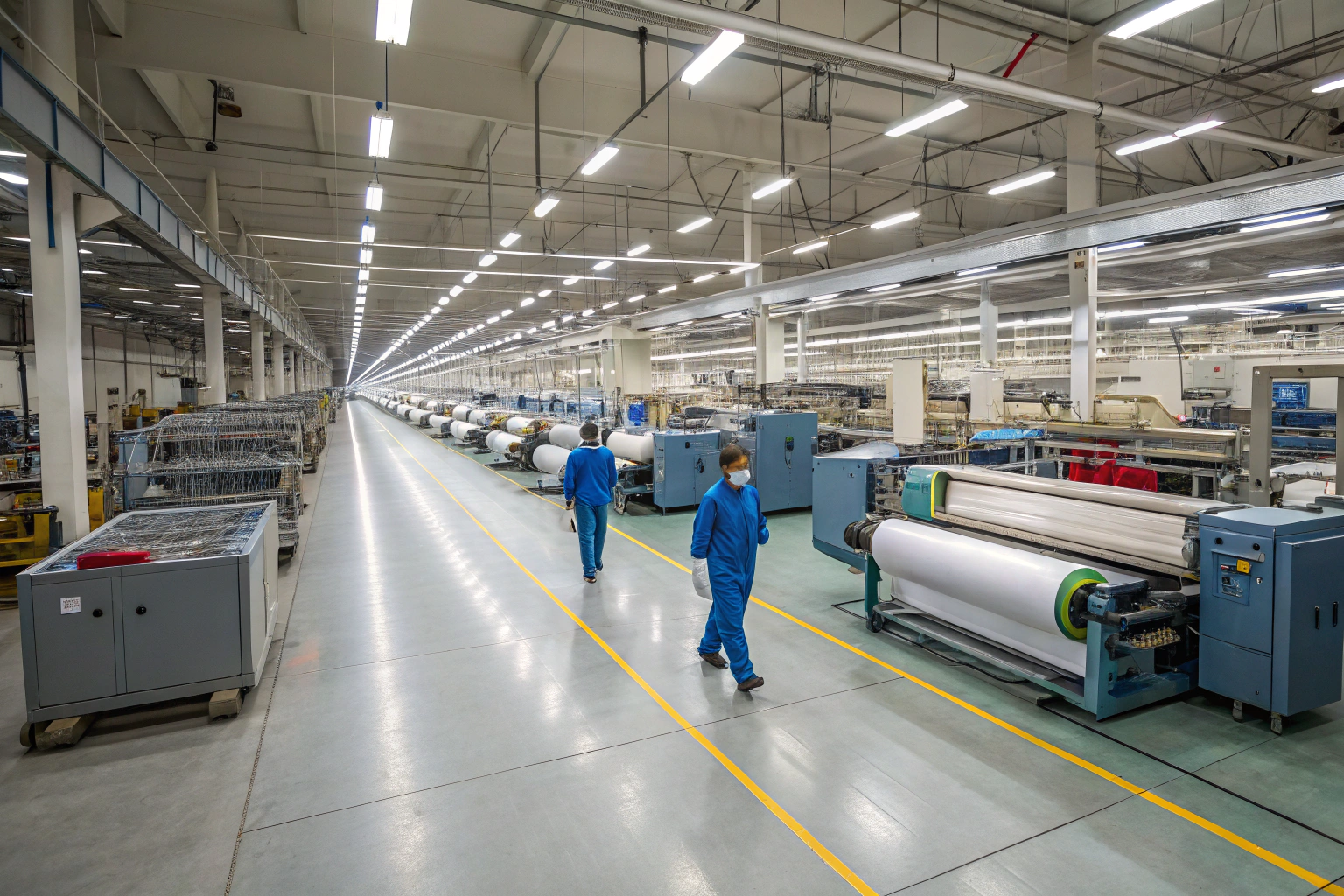
You know the feeling. You approve a sample. It looks perfect. You place a bulk order. When the fabric arrives, something is off. The color is slightly different. The handfeel is not the same. The width varies from roll to roll. You’re stuck. Do you accept it and risk your garment quality? Or do you reject it and delay your entire production schedule?
I’ve been there with our clients. I’ve seen the frustration. And I’ve learned that most quality problems don’t come from one big mistake. They come from handoffs. When you use different factories for weaving, dyeing, and finishing, each handoff is an opportunity for something to go wrong.
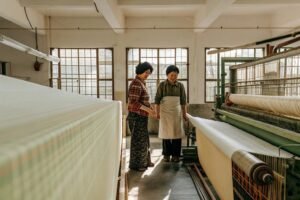
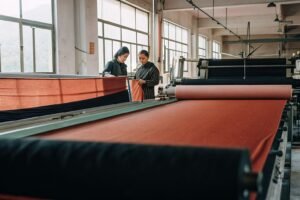
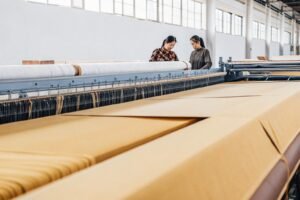
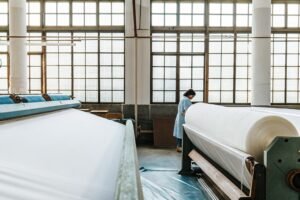
That’s why we built our business differently. At Shanghai Fumao, we have five integrated production lines under one management structure. We own our weaving factory. We have exclusive partnerships with our dyeing and printing factories. We run our own coating, inspection, and packaging operations. And we manage all of it with a single QR code tracking system that follows every roll from yarn to your door.
Let me walk you through how each of these five lines works and why integration is the secret to consistent quality. I’ll share real examples from our production floor and show you how we catch problems before they become your problems.
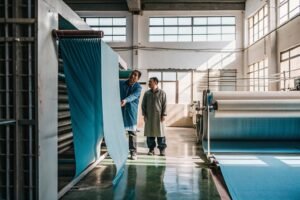
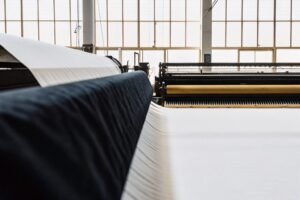
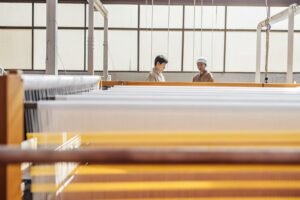
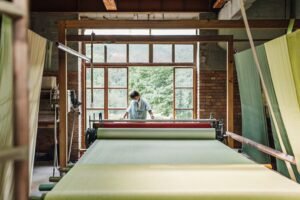
Line 1: Weaving – How Do We Control Quality at the Very First Step?
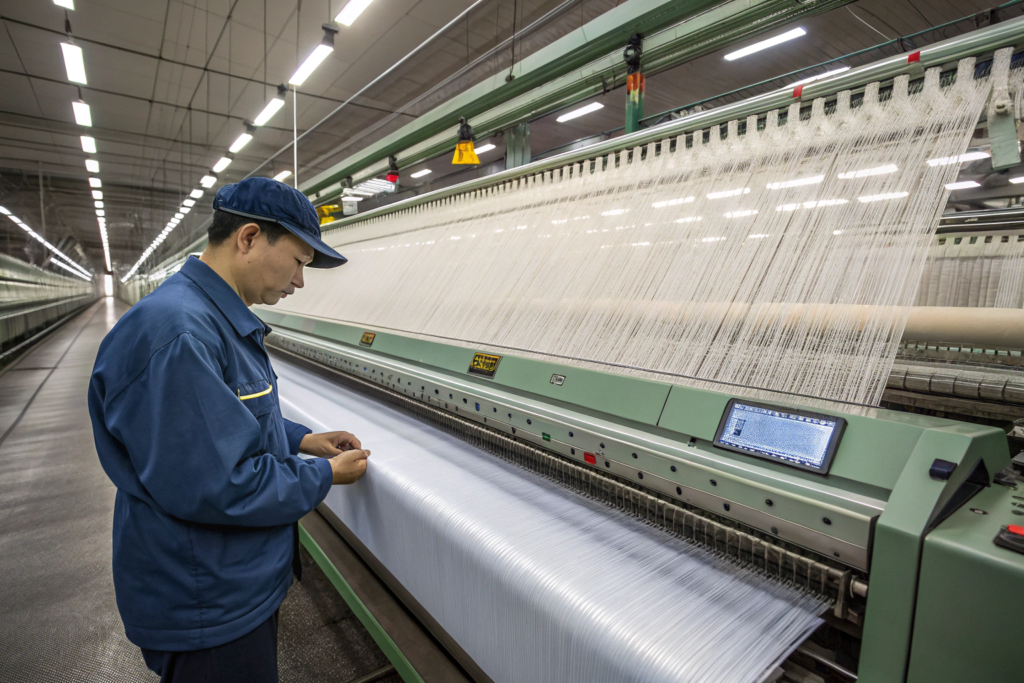
Weaving is where fabric is born. If the weaving is wrong, nothing else matters. You can dye it perfectly, finish it beautifully, but if the weave structure is inconsistent, the fabric will never perform the way you need it to.
What Happens Before the First Yarn Goes on the Loom?
Most quality problems in weaving start with yarn preparation. We learned this the hard way in 2021. We had an order for 8,000 yards of a fine cotton poplin. The client was a menswear brand in London. The fabric looked great when it came off the loom. But when they started cutting, they found broken yarns every few meters. We had to remake the entire order.
We traced the problem back to the warping process. The yarn tension was inconsistent during warping, creating weak spots that broke later in weaving. Now we have a strict protocol for yarn preparation that our technicians follow for every order.
Here’s what we do:
-
Yarn Inspection: Every batch of yarn is tested for evenness and strength before it goes to warping. We use Uster testing equipment. If the yarn doesn’t meet our standards, we send it back to the mill. We reject about 5% of incoming yarn.
-
Warping Control: Our warping machines are set to maintain consistent tension within 2% variation. The operator checks tension every 30 minutes. If it drifts, they adjust immediately.
-
Loom Setup: For every new fabric, we run a 100-yard pre-production batch. We test for weight, width, and weave density. Only when the pre-production passes do we start bulk weaving.
We have 120 looms in our weaving factory. They range from simple air-jet looms for basic fabrics to sophisticated jacquard looms for complex patterns. Each machine has a digital record. We know exactly when it was last serviced, what fabrics it runs best, and which operator is assigned to it.
A client from Canada who visited us in 2023 told me, “I’ve been to a lot of weaving factories. Yours is the cleanest I’ve seen. And you actually check the yarn before it goes on the machine.” That’s the difference. We don’t assume the yarn is good. We verify.
How Do We Catch Weaving Defects Before They Go to Dyeing?
Weaving defects are much easier to fix before dyeing. Once the fabric is dyed, defects are harder to see and harder to repair. So we do two rounds of inspection at the weaving stage.
First Inspection: When the fabric comes off the loom, a technician walks the entire roll. They look for broken ends, holes, uneven selvages, and oil stains. If they find a defect, they mark it with a colored tag. The defect is either repaired or the section is cut out.
Second Inspection: After the fabric is rolled, it goes to our inspection table. We run every roll through a light table. The inspector checks for the same defects again, plus any that might have been missed the first time. We use a four-point grading system. Any roll that scores more than 20 points per 100 yards is rejected and rewoven.
In 2022, we had an order for 12,000 yards of a complex jacquard for a European luxury brand. The first inspection caught 3% defects. The second inspection caught another 2%. We rewoven those sections. The client received 12,000 yards of fabric with less than 1% defect rate. That’s the standard we hold ourselves to.
We also use QR code tracking at this stage. Each roll gets a unique QR code when it leaves the weaving line. That code contains the yarn batch number, the loom number, the operator name, and the inspection results. When that roll moves to dyeing, our dyeing partners scan the code and know exactly what they’re working with. No paperwork. No lost information.
Line 2: Dyeing – How Do We Ensure Color Consistency Across Every Batch?
Color consistency is one of the hardest things to achieve in textile production. If your garment has panels from different rolls that don’t match, it looks cheap. And once you’ve cut the fabric, there’s no fixing it.
How Do We Match Colors Without Guesswork?
We don’t rely on visual matching alone. Human eyes are good, but they’re not consistent. What looks like a match in morning light might look different in afternoon light. That’s why we use spectrophotometers.
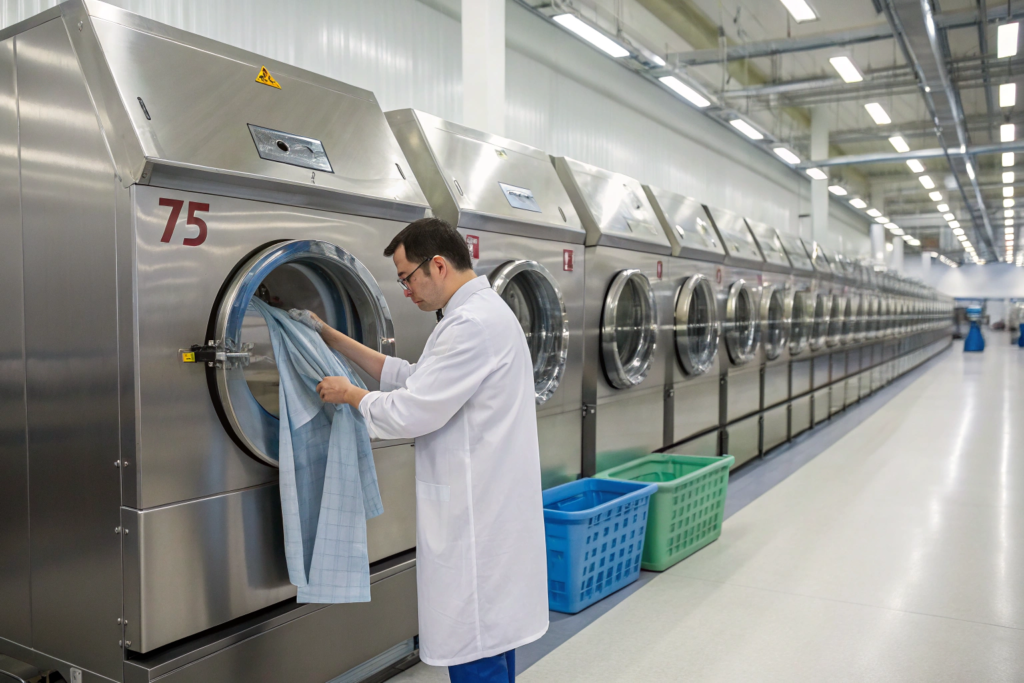
Our dyeing partners have color-matching labs equipped with Datacolor spectrophotometers. When you send us a Pantone number or a physical sample, our lab technicians measure it digitally. They get the exact color formula—how much of each dye, what temperature, what time.
Here’s how we handled a challenging color match in 2023. A client from Australia wanted a specific teal color for a performance fabric. The fabric was a nylon-spandex blend, which dyes differently than cotton. We ran the first lab dip. The spectrophotometer said it was a 96% match. Our senior colorist looked at it and said, “It’s good, but it’s slightly too green under fluorescent light.” He adjusted the formula. The second lab dip was a 99.5% match. The client approved it.
When we ran bulk production, we pulled samples from every batch. Each sample went through the spectrophotometer. If the delta E was above 1.0, we held the batch and re-dyed. We ended up with 99.8% of the order within a delta E of 0.8. The client told us later, “I’ve never had a supplier match that color so consistently across 10,000 yards.”
What About Dye Lot Control?
This is where integration matters. A lot of brands source from suppliers who outsource dyeing to whoever has capacity. That means your fabric might be dyed in three different factories across three different batches. Good luck matching colors.
Because we have exclusive relationships with two dyeing factories, we can control the process. For any given order, we use the same dyeing factory for the entire order. The same operator. The same machines. The same formula.
We also keep what we call a “master standard” for every color we produce. It’s a physical sample that stays in our lab. When a client reorders a fabric months later, we pull the master standard and match to it. We don’t rely on memory or digital files.
In early 2024, a client from the UK reordered a fabric they first bought in 2022. The color was a specific shade of olive green. We pulled the master standard. Our lab ran the formula. The new batch matched within a delta E of 0.9. The client said, “I was worried it wouldn’t match. But it’s perfect.” That’s what happens when you control the process from start to finish.
We also test every batch for colorfastness. We run wash tests and light tests. For fabrics that will be used in activewear, we run sweat tests. For fabrics that will be used in children’s wear, we run saliva tests. If any batch fails, it doesn’t ship.
Line 3: Printing – How Do We Keep Patterns Sharp and Registration Precise?
Printing is where art meets engineering. A beautiful design can be ruined by blurry edges, color bleeding, or misaligned patterns. And once the fabric is printed, there’s no going back.
What Printing Technologies Do We Use?
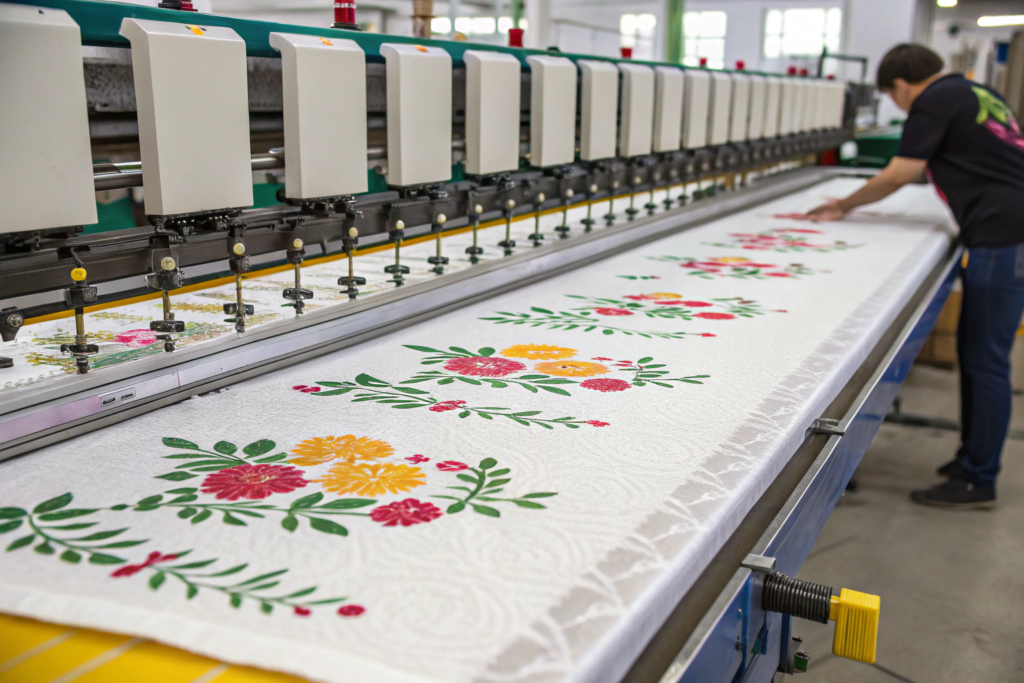
We have two printing factories in our network. One specializes in rotary screen printing for large runs. The other does digital printing for short runs and complex designs.
For rotary screen printing, precision starts with the screens. Each color in your design requires a separate screen. The screens have to be aligned perfectly, or the colors won’t register correctly. Our screen makers use laser engraving for the sharpest edges. They check registration with a microscope before the screens go on the machine.
We learned the importance of this in 2022. A client from the US ordered a striped pattern for a collection of men’s shirts. The stripes were fine—only 2mm wide. Our screen maker produced the screens. The first print run had a slight misalignment. The stripes looked fuzzy. We stopped the machine, adjusted the registration, and ran a new sample. The second sample was perfect. We printed the entire order. The client told us later, “I had another supplier try this pattern. They couldn’t get the registration right. You did it on the first try.” Well, technically it was the second try. But we don’t ship the first try if it’s not right.
For digital printing, we use reactive inks that bond with the fibers. This gives brighter colors and better wash fastness than pigment printing. We can do runs as small as 100 yards for clients who need custom prints without huge minimums.
A client from Berlin came to us in 2023 with a series of digital illustrations they wanted to print on silk. The designs were complex with gradient colors. Our digital printing team worked with them to adjust the color profiles. We printed a sample, they approved, and we ran 500 yards across four designs. The final fabric was stunning. They used it for a capsule collection that sold out in two weeks.
How Do We Inspect Printed Fabric?
Printing defects are easier to see than solid color defects. But they’re also harder to fix. So we inspect printed fabric with extra care.
Every printed roll goes through our inspection table under bright lights. The inspector looks for:
- Registration errors: Are the colors aligned correctly?
- Bleeding: Are the colors staying where they should?
- Missed spots: Are there any areas where the print didn’t transfer?
- Scratches: Are there lines or marks from the screens?
We use a four-point grading system for printed fabric too. Any roll with more than 15 points per 100 yards is rejected. For high-end clients, we use a stricter standard.
In 2023, we had an order for a complex jacquard print from a luxury brand in Italy. The pattern had 12 colors. We printed 3,000 yards. During inspection, we found a slight registration shift in about 300 yards of the run. It was subtle—most people wouldn’t notice. But we marked those rolls and offered them as seconds. The client took the good rolls and appreciated our honesty. They’re still ordering from us today.
Line 4: Coating & Finishing – How Do We Add Performance Without Compromising Handfeel?
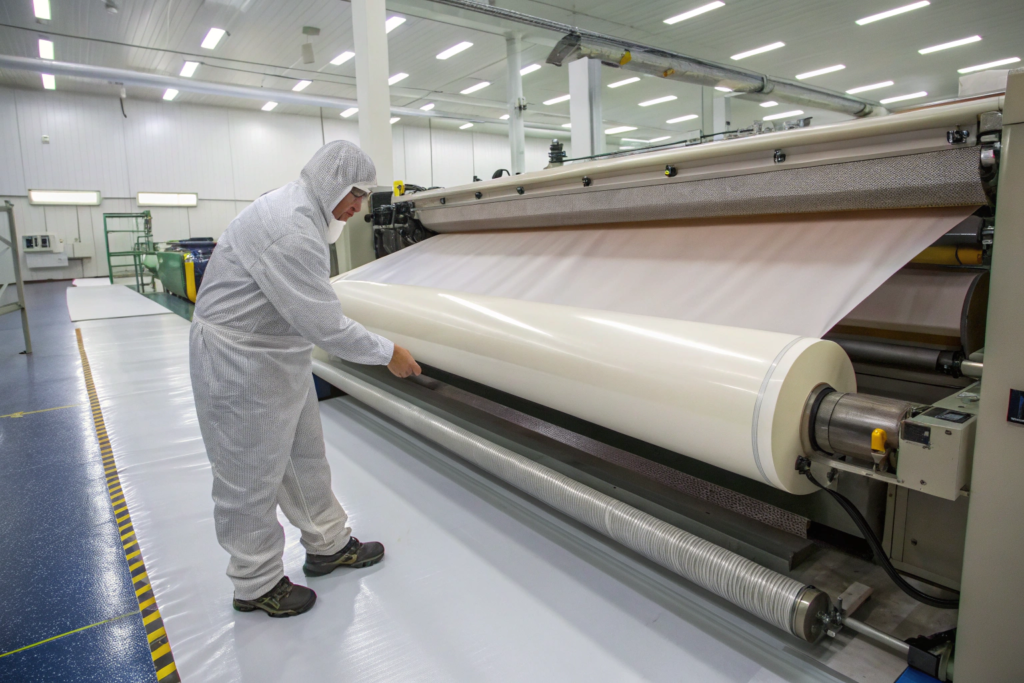
This is the line that turns basic fabric into performance fabric. Waterproof. Moisture-wicking. Anti-bacterial. UV protection. These finishes can make your product stand out. But if they’re applied wrong, they can ruin the fabric’s handfeel or durability.
What Types of Finishes Do We Apply?
Our coating factory handles a wide range of finishes. We have a full lab for testing and developing new finishes. Some of the most common we apply:
- Water-repellent finishes: For outdoor and performance wear. We use C6 and C0 chemistries depending on the client’s sustainability requirements.
- Moisture-wicking: For activewear. The finish pulls sweat away from the body and spreads it to dry faster.
- Anti-microbial: For sportswear and medical applications. Silver-ion based finishes that prevent odor-causing bacteria.
- UV protection: For outdoor and children’s wear. We can achieve UPF ratings from 30 to 50+.
- Softener: For improved handfeel. We use silicone-based softeners that don’t wash out quickly.
A client from Sweden came to us in 2023 with a request for a waterproof, breathable fabric for a new line of cycling jackets. They had tried a supplier in Vietnam, but the waterproof coating made the fabric feel like plastic. They came to us.
Our coating team ran three trials. The first trial had good waterproofing but poor breathability. The second trial had good breathability but the coating wasn’t durable. The third trial hit the sweet spot—a water column rating of 8,000mm, breathability of 5,000g/m²/day, and a soft handfeel. The client approved it. We coated 5,000 yards. Their jackets launched in early 2024 and sold well.
How Do We Test Coated Fabrics?
Coating is one of the most tested parts of our process. Every coated fabric goes through a battery of tests in our lab:
- Water column test: How much water pressure can the fabric resist before leaking? For waterproof fabrics, we target 5,000mm minimum.
- Spray test: How well does water bead up and roll off? We use the AATCC 22 standard.
- Wash durability: We wash the fabric 10 times and retest. Good finishes should retain at least 80% of their performance after 10 washes.
- Handfeel panel: We have a panel of technicians who rate the handfeel. If it’s too stiff, we adjust the finish.
In early 2024, we had a client from the US who wanted a moisture-wicking finish on a cotton-spandex jersey. We applied the finish and ran the tests. The wicking was excellent. But the handfeel was slightly stiffer than the client wanted. We went back to our chemical supplier and found a new softener that worked with the wicking chemistry. The second trial had the same wicking performance with a softer handfeel. The client approved it.
That’s the value of having the coating line under our control. We can iterate. We can adjust. We don’t have to send the fabric back to a separate factory and wait weeks for a new trial.
Line 5: Inspection & Packaging – How Do We Make Sure Only Good Fabric Leaves the Door?
This is the last line. This is where we make the final decision: does this fabric ship, or does it get held? I’ve seen too many suppliers who rush through inspection because they’re behind schedule. They ship fabric that should have been rejected. The client gets it, finds problems, and the relationship is damaged.
We don’t do that. We have a professional QC team whose only job is to inspect and approve fabric before it ships. They don’t report to the production manager. They report to me. If they say no, it doesn’t ship. Period.
What Does Our Inspection Process Look Like?
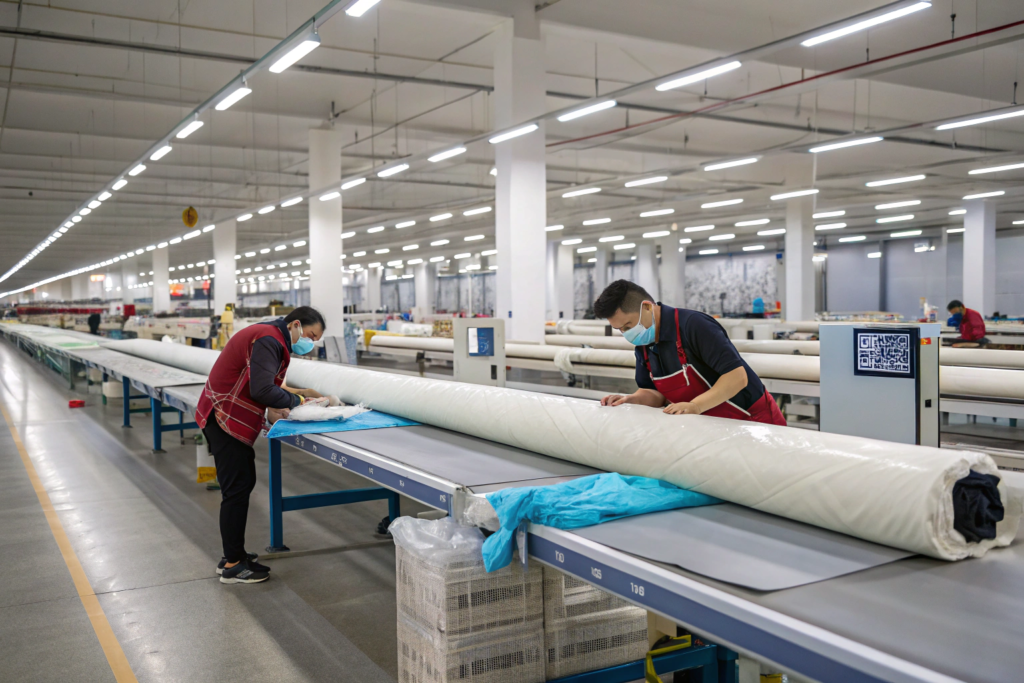
Every roll of fabric goes through our inspection line. We use standard four-point grading. Here’s how it works:
- The fabric runs over a light table at a controlled speed.
- The inspector marks every defect with a colored sticker.
- Defects are scored based on size. A small defect is 1 point. A large defect is 4 points.
- Each roll has a maximum allowable points per 100 yards. For standard orders, it’s 20 points. For premium orders, it’s 15 points.
- If a roll exceeds the limit, it’s marked as a second or rejected entirely.
In 2023, we inspected 2.5 million yards of fabric. Our average defect rate was 1.8%. That means 98.2% of the fabric we shipped met our quality standards. I’m proud of that number. But I’m more proud of the 1.8% that we caught and fixed before it became someone else’s problem.
We had a client from Japan who placed a 20,000-yard order for a very fine cotton shirting. During inspection, our team found a subtle weaving defect in about 5% of the rolls. The defect was barely visible—you had to hold the fabric up to light to see it. But our inspector flagged it. We called the client and explained. We offered to ship the good rolls immediately and reweave the defective ones. The client appreciated the honesty. They said, “Other suppliers would have shipped it and hoped we didn’t notice.” That’s not how we work.
How Does QR Code Tracking Tie Everything Together?
I’ve mentioned QR codes throughout this article. Let me explain how they actually work.
Every order gets a unique QR code when it enters our system. That code follows the fabric through all five lines. When you scan the code, you see:
- Yarn source: Which mill provided the yarn, and the test results
- Weaving details: Which loom, which operator, inspection results
- Dyeing details: Which dyeing factory, the formula used, colorfastness test results
- Printing details: Which printer, registration check results
- Coating details: Which finish, performance test results
- Inspection results: Points per roll, final grade
- Packaging details: Roll weights, tube size, carton numbers
- Shipping details: Container number, departure date, estimated arrival
A client from Canada told me in 2023, “I used to spend three hours a week emailing suppliers for updates. Now I scan a code and I know everything. I can show my team exactly where their fabric is.” That’s transparency. That’s trust.
We also use the QR code for traceability. If a client ever has a problem with a garment, we can trace it back to the exact roll, the exact batch of yarn, the exact dye lot. That allows us to fix problems quickly and prevent them from recurring.
In 2022, a client from the UK had a complaint about color fading on a small batch of garments. They gave us the production code from their factory. We traced it back to the fabric roll using our QR system. We found that the dyeing formula for that batch had been recorded incorrectly. It was a one-time error. We replaced the fabric and updated our system to prevent it from happening again. If we didn’t have that traceability, we wouldn’t have known what went wrong.
Conclusion
Five production lines. One integrated system. That’s how we ensure consistent fabric quality at Shanghai Fumao. We don’t outsource critical steps to factories we’ve never visited. We don’t cross our fingers and hope that different suppliers coordinate with each other. We own it. We manage it. And we stand behind it.
The weaving line catches problems before they start. The dyeing line ensures color consistency across every roll. The printing line delivers sharp patterns with precise registration. The coating line adds performance without sacrificing handfeel. And the inspection line makes sure that only fabric that meets our standards leaves the door.
I’ve been doing this for over 20 years. I’ve seen the industry change. I’ve seen clients come and go. But one thing has stayed the same: the suppliers who survive are the ones who control their quality. They don’t rely on luck. They rely on systems.
That’s what we’ve built. And it’s why clients from 100+ countries trust us with their fabric production. Whether you’re making basic t-shirts or high-performance outerwear, we have the infrastructure and the experience to deliver consistent quality, order after order.
If you’re tired of quality surprises, I want you to reach out to our Business Director, Elaine, at elaine@fumaoclothing.com. Tell her about your next collection. Ask her for a tour of our QR code system. Or better yet, come visit our factory in Keqiao. Walk the five lines yourself. See the inspection tables. Meet the team who makes it happen.
We’re not the biggest supplier in China. But I believe we’re one of the most committed to quality. And that commitment starts with controlling our own production. Let us show you what that means for your brand.