I had a German client in 2023—midsize sustainable brand, really passionate about their environmental mission. They ordered a large quantity of what they thought was GOTS-certified organic cotton from a supplier they found online. The price was good, the samples looked beautiful. They paid the deposit, received the goods, and started selling. Six months later, a random test by a German consumer watchdog showed traces of prohibited pesticides in the fabric. The supplier’s certificate was fake. My client had to recall every garment, refund every customer, and pay a hefty fine. The brand never fully recovered.
That story still makes me angry. Not just because of the fraud, but because it was avoidable. Certifications exist to protect buyers, but only if you know what to look for, how to verify them, and which ones actually matter for your market.
In 2026, the certification landscape is more complex than ever. Buyers are demanding proof of sustainability. Governments are tightening regulations on chemicals and forced labor. Retailers are requiring documented compliance from their suppliers. If you’re importing fabric to the US or Europe, knowing exactly which certifications to demand isn’t optional—it’s survival.
What are the essential chemical safety certifications for fabric imports?
The first thing customs or a big retailer will check isn’t your fabric’s quality—it’s whether your fabric contains banned chemicals. In 2026, chemical compliance is the baseline. Without it, your goods don’t enter the country.
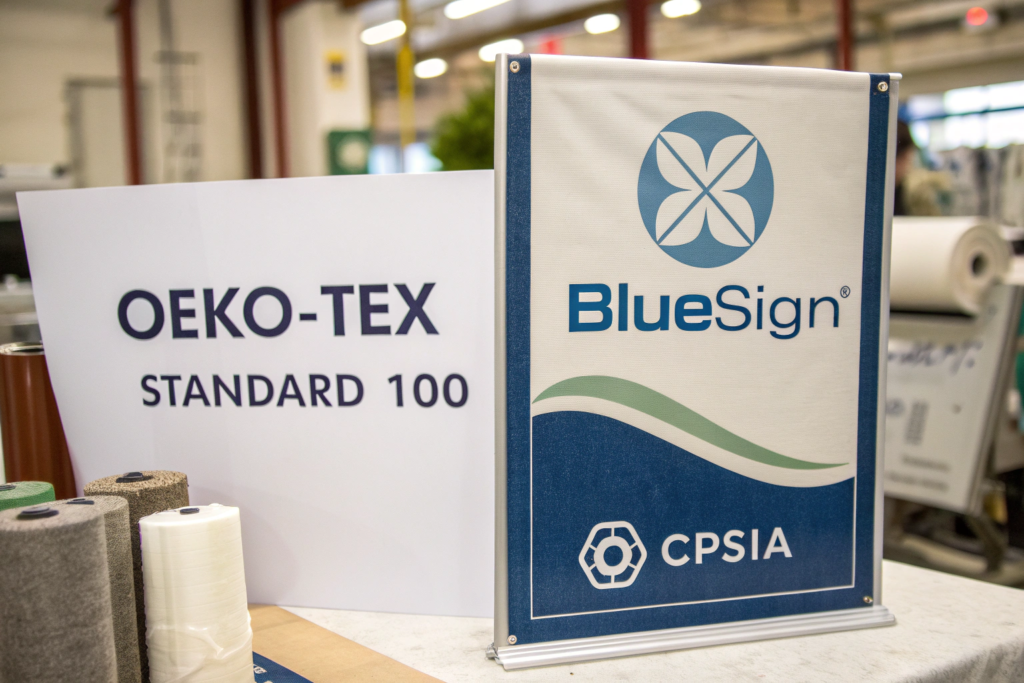
The two most important chemical safety certifications for fabric imports are OEKO-TEX Standard 100 and Bluesign. OEKO-TEX tests for hundreds of harmful substances—pesticides, heavy metals, formaldehyde, phthalates—and is accepted by virtually every retailer worldwide. Bluesign goes further, certifying not just the finished fabric but the entire production process, ensuring chemical management from start to finish. For the US market, CPSIA compliance for children’s products is also mandatory.
Here’s what many buyers don’t realize: OEKO-TEX has different product classes. Class 1 is for baby products (the strictest limits), Class 2 for skin-contact items like t-shirts, Class 3 for non-skin-contact like outerwear, and Class 4 for home textiles. If you’re importing organic cotton onesies for infants, you need Class 1, not just any OEKO-TEX certificate. I’ve seen buyers accept a Class 2 certificate for babywear, not realizing the chemical limits are different. That’s a compliance gap that can cost you.
What does OEKO-TEX Standard 100 actually test for?
The list is extensive—over 300 regulated substances. But the ones that most often cause failures are:
- Azo dyes: Some release carcinogenic amines. Banned in EU and increasingly scrutinized in US.
- Formaldehyde: Used in wrinkle-resistant finishes. Must be below strict limits.
- Heavy metals: Lead, cadmium, nickel in zippers and buttons are common failure points.
- PFAS/PFCs: "Forever chemicals" in water-repellent finishes. Under intense scrutiny in 2026.
- Phthalates: Plasticizers in prints and coatings.
When we send fabric for OEKO-TEX testing at our CNAS-accredited lab, we test for all of these. If a finish fails, we reformulate. We don’t wait until the fabric is woven to discover a problem. The OEKO-TEX website’s limit values page breaks down exactly what’s tested and the passing thresholds.
Is Bluesign certification worth the extra cost?
For premium brands, yes. Bluesign is more comprehensive than OEKO-TEX. It audits the entire supply chain—the chemical suppliers, the dye house, the finishing processes. It ensures that chemicals used are safe for workers, consumers, and the environment. The certification is expensive and time-consuming for factories, which is why fewer have it. But if you’re selling to demanding European brands or marketing yourself as a leader in sustainability, Bluesign gives you credibility that OEKO-TEX alone doesn’t. Patagonia, for example, requires Bluesign for much of their supply chain. The Bluesign system explanation shows how rigorous the process is.
Which sustainability certifications actually prove eco-claims?
"Eco-friendly," "green," "sustainable"—these words mean nothing without certification. In 2026, regulators on both sides of the Atlantic are cracking down on greenwashing. If you claim it, you need to prove it.
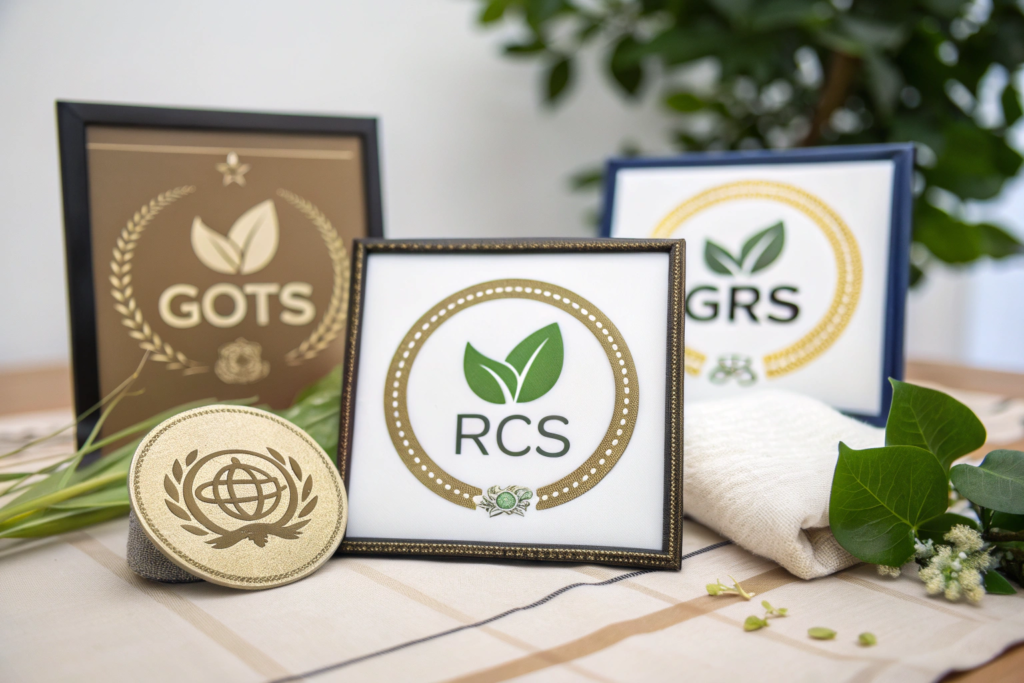
The gold standards for sustainability claims are GOTS (Global Organic Textile Standard) for organic natural fibers, and GRS (Global Recycled Standard) or RCS (Recycled Claim Standard) for recycled materials. GOTS covers the entire supply chain—from harvesting of organic cotton to manufacturing and labeling—with strict environmental and social criteria. GRS verifies recycled content and tracks it through production, also adding social and environmental requirements.
Here’s a trap I see buyers fall into: accepting a "recycled polyester" claim without certification. A supplier says "this fabric is made from recycled bottles." Maybe it is, maybe it isn’t. Without GRS certification and a transaction certificate (TC) linking the fabric back to certified recycled yarn, you have no proof. If a retailer audits you and asks for your recycled content documentation, "the supplier told me" isn’t enough. You need the paper trail.
What’s the difference between GOTS and OCS?
GOTS (Global Organic Textile Standard) and OCS (Organic Content Standard) both certify organic fiber content, but they’re different. GOTS is stricter—it requires at least 70% organic fiber AND mandates environmental and social criteria throughout the supply chain (wastewater treatment, worker safety, no child labor). OCS simply verifies the organic content percentage (either 5-100% for OCS Blended or 95-100% for OCS 100) without requiring the broader environmental and social standards. If you’re marketing a product as truly sustainable, GOTS carries more weight. If you just need to verify organic content for a blend, OCS might suffice. The Textile Exchange comparison of standards is helpful for understanding these nuances.
How do I verify GRS recycled content?
GRS certification requires a chain of custody. Every step—from the bottle recycler to the yarn spinner to the fabric mill to the garment factory—must be certified and issue a Transaction Certificate (TC) for each shipment. When you buy GRS-certified fabric from us, you get:
- Our GRS scope certificate (proving we’re certified)
- The TC from our yarn supplier (proving the recycled yarn was certified)
- Our TC to you (proving we used that certified yarn in your fabric)
You keep these documents. If a retailer asks for proof, you produce the chain. Without them, your "recycled" claim is just marketing. The GRS implementation manual explains exactly what documentation is required.
What social compliance certifications matter for US and EU markets?
In 2026, it’s not just about the fabric—it’s about how it was made. US Customs is actively enforcing the Uyghur Forced Labor Prevention Act (UFLPA). European buyers are demanding proof of ethical manufacturing. Social compliance is now a trade barrier.
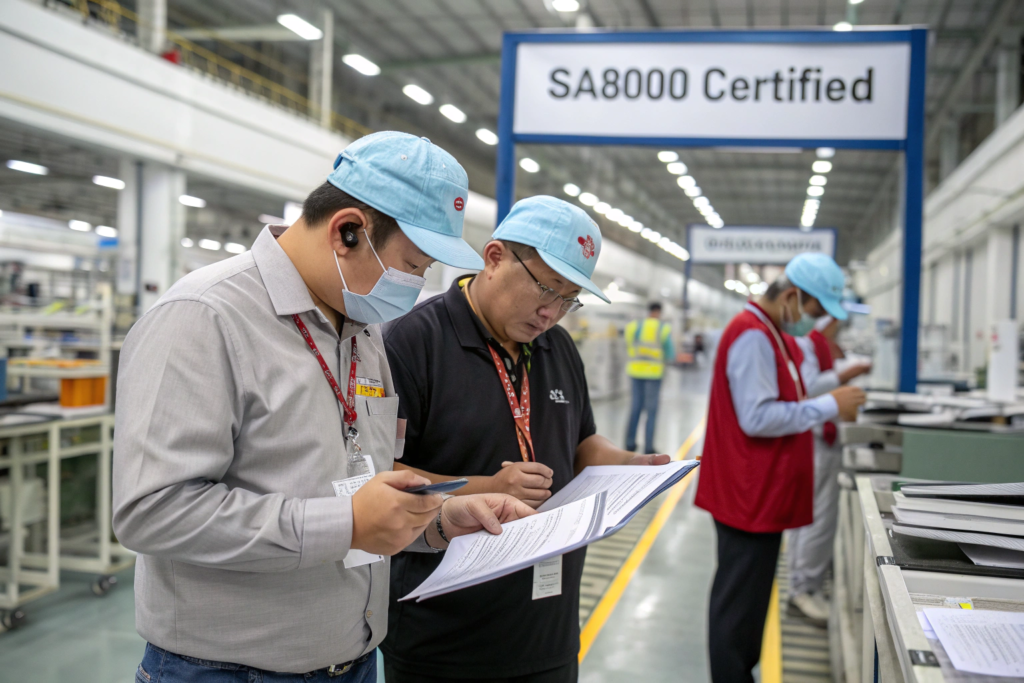
The most widely accepted social compliance certifications are SA8000, BSCI (amfori BSCI), and SEDEX/SMET audits. These audit factories for working conditions, wages, working hours, and health and safety. For US imports, compliance with UFLPA requires documented traceability showing that no materials originated from Xinjiang or other high-risk areas. This is non-negotiable in 2026—if you can’t prove your supply chain is clean, your goods will be seized.
The UFLPA has changed everything for US importers. It creates a presumption that any goods from Xinjiang are made with forced labor. To rebut that presumption, importers must provide clear and convincing evidence of the entire supply chain—from cotton farm to finished garment. This means traceability documentation at every step. We’ve invested heavily in traceability systems to meet these requirements. Every roll of cotton fabric we ship to the US now comes with documentation showing where the cotton was ginned, spun, woven, and finished. It’s expensive, but it’s the only way to keep goods moving.
What is BSCI and do my suppliers need it?
BSCI (Business Social Compliance Initiative) is a European-led factory audit standard. Many European retailers require their suppliers to have a BSCI audit with a certain grade (usually A, B, or C). The audit covers: fair remuneration, working hours, health and safety, child labor, forced labor, and freedom of association. If you’re selling to European brands, ask your factory for their BSCI audit report. If they don’t have one, or if their grade is D or E, you’ll struggle to do business. The amfori BSCI website explains the audit process and grading system.
How do I prove UFLPA compliance for cotton goods?
This is the biggest challenge for US importers in 2026. You need:
- Supply chain mapping: Every facility from farm to factory, with names and addresses.
- Traceability documentation: Contracts, purchase orders, shipping records showing the flow of materials.
- Cotton origin verification: Ideally, certifications like Better Cotton or organic certifications that include origin data.
- Audit reports: Social audits for every facility in the chain.
We work with US Customs brokers who specialize in UFLPA compliance to ensure our documentation meets the required standards. For a detailed guide, the CBP UFLPA guidance page has all the official requirements.
What performance certifications should I consider for technical fabrics?
If your fabric needs to do something—repel water, resist flames, block UV—you need certification to prove it works. Performance claims without testing are just words.
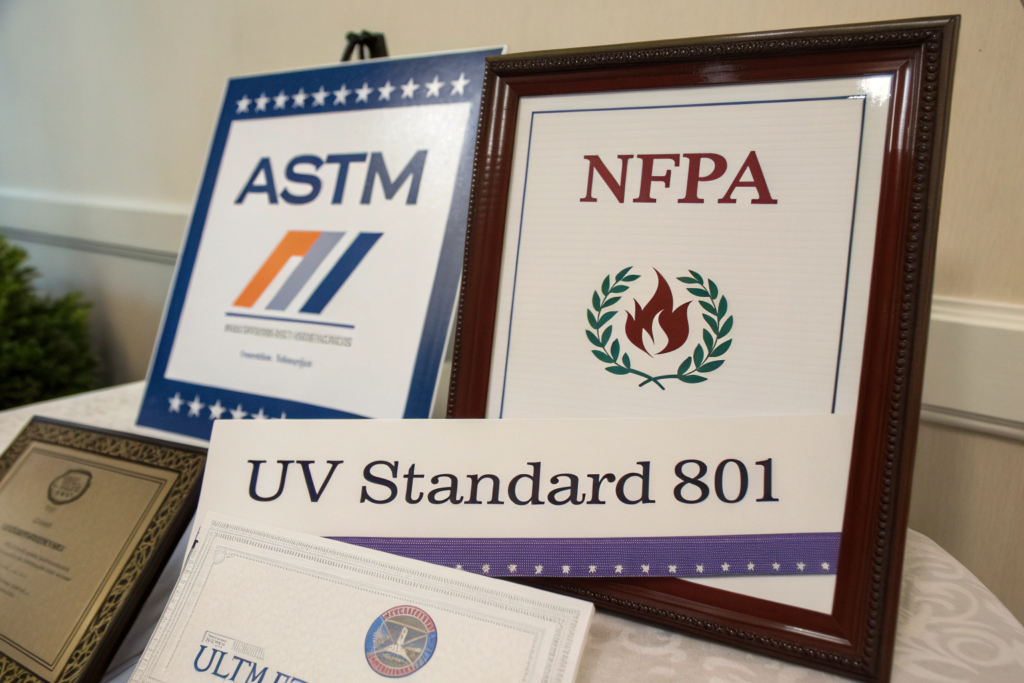
For technical fabrics, look for certifications like ASTM (American Society for Testing and Materials) standards for specific properties, NFPA (National Fire Protection Association) for flame resistance, and UV Standard 801 for ultraviolet protection. These aren’t just marketing badges—they’re test results you can show to retailers and end customers.
Performance certification is about matching the test method to your claim. If you claim "waterproof," you need to specify which standard you tested to—ASTM D751 for coated fabrics, AATCC 35 for rain test, or ISO 811 for hydrostatic head. Different standards give different results. We always ask clients: "What performance do you need, and what standard does your buyer require?" Then we test accordingly.
What certifications prove water resistance or waterproofing?
The key certifications are:
- Hydrostatic head (AATCC 127, ISO 811): Measures water pressure fabric can withstand. 1,500mm is shower-resistant, 10,000mm+ is waterproof.
- Spray rating (AATCC 22): Measures how water beads on the surface. 90+ is excellent.
- Rain test (AATCC 35): Simulates rainfall and measures water penetration.
For a garment to be labeled "waterproof," it usually needs a taped seams and a hydrostatic head of at least 5,000mm for the fabric AND the seams. We recently tested a client’s outdoor jacket fabric to ASTM D751 and achieved 15,000mm—well above their requirement. The ASTM committee D13 on textiles develops these standards.
How do I verify flame retardant certifications?
Flame retardant certifications are strict and legally required for certain products (children’s sleepwear in the US, for example). The key standards:
- US: 16 CFR Part 1610 (general apparel), 16 CFR Part 1615/1616 (children’s sleepwear)
- EU: EN 14878 (children’s nightwear), EN 1103 (general apparel)
- NFPA 701: For fabrics used in public spaces like curtains
These tests are destructive—the fabric is burned under controlled conditions. If it passes, you get a certificate. But note: flame retardant finishes can wash out. Some certifications require testing after multiple washes. Always check whether the certification is for "as received" or "after 50 washes." The CPSC’s flammability standards page has the full requirements.
How can I verify that certifications are real and not fake?
Remember my German client with the fake GOTS certificate? That happens more than you’d think. Fake certificates are a real problem in this industry. Learning to spot them is a survival skill.
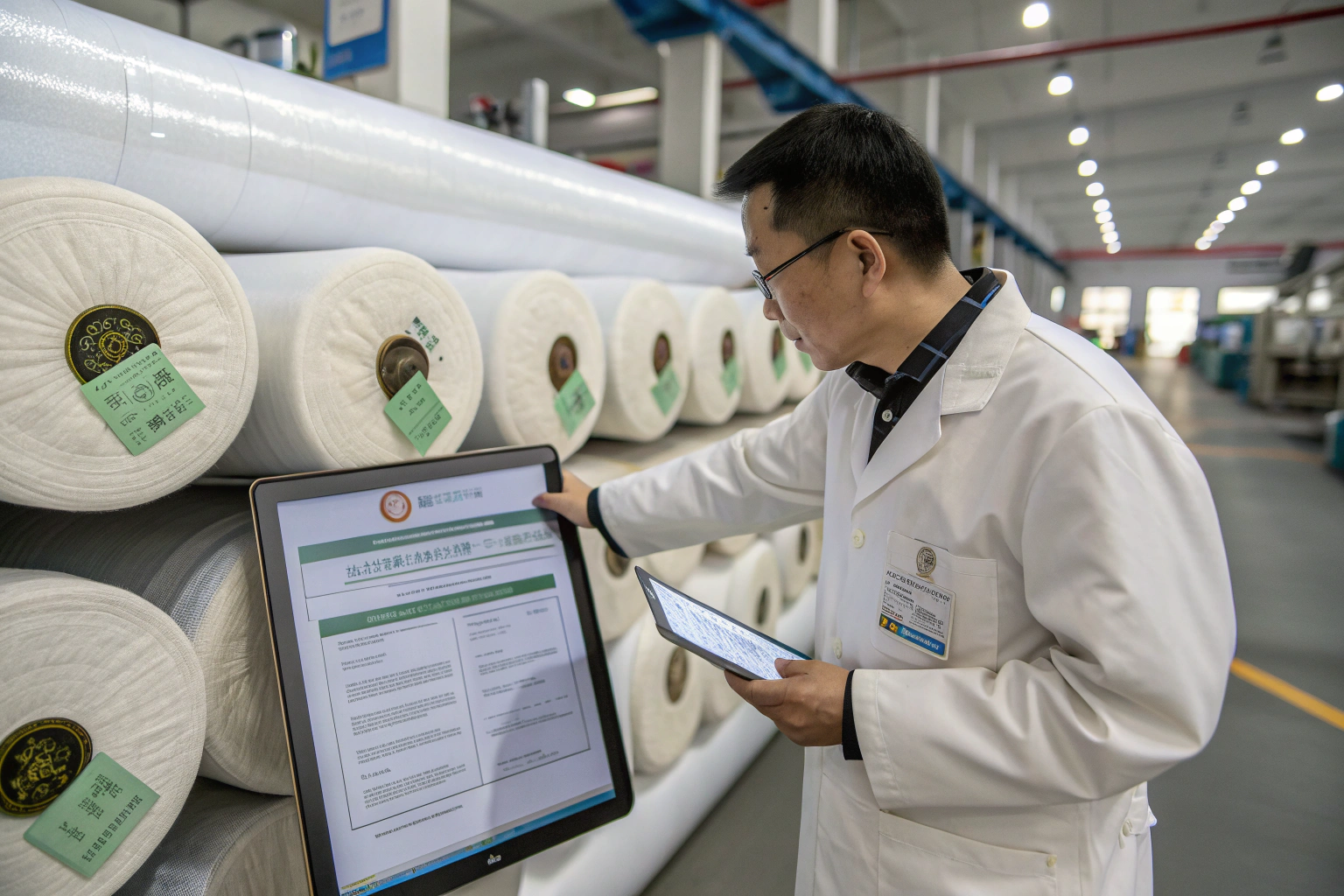
To verify a certification, don’t just look at the PDF the supplier sends you. Go to the certifying body’s website and check their database. GOTS, GRS, OEKO-TEX, and Bluesign all have online directories of certified companies. Search for the supplier’s name and certificate number. If it’s not there, it’s fake. Also, check the dates—certificates expire. An OEKO-TEX certificate is valid for one year. If it’s dated three years ago, it’s expired.
I had a potential supplier approach us last year with a GOTS certificate claiming they were certified for organic cotton processing. I checked the GOTS database—they weren’t listed. I asked for their "scope certificate," which lists the specific products and processes they’re certified for. They couldn’t produce it. Turns out, they’d used a friend’s certificate and photoshopped the company name. We walked away. If you’re not sure how to verify, the GOTS public database is the place to start.

What’s a "scope certificate" and why do I need it?
A scope certificate is issued by the certifying body to a specific facility. It states exactly what that facility is certified to do—for example, "spinning of GOTS certified cotton yarn" or "weaving of GRS certified recycled polyester fabric." It includes:
- Facility name and address
- Certificate number and issue/expiry dates
- Scope of certification (products and processes)
- Standards met (GOTS, GRS, etc.)
When a supplier claims to be certified, ask for their scope certificate. Then verify it with the certifying body. Without it, their claim is meaningless. The Textile Exchange guide to transaction certificates explains how these documents should look.
Can I ask for test reports instead of certificates?
Yes, and often you should. A certificate says "this fabric meets the standard." A test report shows the actual data—the specific levels of formaldehyde, the exact hydrostatic head result, the precise heavy metal concentrations. For critical parameters, I recommend asking for the full test report from an ISO 17025 accredited lab. This gives you the raw data, not just a pass/fail summary. If you’re importing children’s products to the US, you’ll need this anyway for your CPSIA documentation. The ISO 17025 accreditation explained page explains why lab accreditation matters.
Conclusion
Certifications in 2026 aren’t just marketing tools—they’re passports. Without the right ones, your goods don’t enter the country. Without verified ones, your claims are worthless. Without traceable ones, you’re vulnerable to audits, recalls, and reputational damage.
The landscape is complex: chemical safety (OEKO-TEX, Bluesign), sustainability (GOTS, GRS), social compliance (BSCI, UFLPA documentation), and performance (ASTM, NFPA). Each serves a different purpose, each requires different verification, and each protects you in a different way.
At Shanghai Fumao, we’ve been navigating this for over 20 years. Our CNAS-accredited lab tests to international standards daily. We hold current GOTS, GRS, and OEKO-TEX certifications. We provide full traceability documentation for UFLPA compliance. And we never, ever send a shipment without the paperwork our clients need to clear customs and satisfy their retailers.
If you’re tired of worrying whether your supplier’s certificates are real, or if you’re just not sure which certifications your next collection actually needs, let’s talk. We’ll walk you through exactly what documentation we provide, how to verify it, and why it matters for your specific market.
Reach out to our Business Director, Elaine. She manages our compliance team and can answer your questions about certifications, testing, and documentation. Email Elaine directly at: elaine@fumaoclothing.com. Let’s make sure your next shipment arrives with the right papers, every time.