I was in our development lab two years ago when a client from Germany called with a problem I’d never encountered before. His wife had been diagnosed with electromagnetic hypersensitivity—she experienced headaches and fatigue when near WiFi routers, cell towers, or even her own smartphone. "She can’t leave the house without feeling sick," he said, his voice heavy with concern. "We’ve tried everything. Someone told me there might be fabrics that block these frequencies. Can you help?" I sat back in my chair, looking at the rolls of cotton and polyester around me, and realized I had no idea. But I told him honestly: "I don’t know yet, but we’ll find out." That conversation launched a two-year deep dive into a world I never knew existed—the world of electromagnetic shielding textiles.
The best fabrics for electromagnetic shielding (EMF/RF) in apparel are those that incorporate conductive materials—typically silver, copper, stainless steel, or nickel—into the textile structure, either as plated fibers, blended yarns, or conductive coatings. These fabrics create a Faraday cage effect, blocking or attenuating electromagnetic fields across specific frequency ranges. Key performance metrics include shielding effectiveness measured in decibels (dB), with 30-40 dB providing 99.9% attenuation for general use and 50-60 dB for high-sensitivity applications. The most effective and comfortable options include silver-plated nylon for flexibility and antimicrobial properties, stainless steel blended with cotton or polyester for durability, and copper-based fabrics for maximum conductivity. Choosing the right fabric requires balancing shielding performance with comfort, washability, breathability, and the specific frequency ranges you need to block—from low-frequency power lines to high-frequency 5G and WiFi signals.
That German client? We eventually developed a fabric that worked for his wife—a silver-plated nylon knit that blocked over 99% of common household frequencies. She’s now able to visit cafes and shops wearing specially designed garments made from our fabric. But the journey from "I have no idea" to "this actually works" taught me more about textiles than almost anything in my 20-year career. Let me share what we’ve learned, because this field is growing faster than almost any other technical textile application.
What exactly is electromagnetic shielding fabric and how does it work?
Most people think fabric is just fabric—something soft and wearable. But when you add conductive elements, fabric becomes something else entirely: a wearable shield against invisible forces that surround us constantly.

What’s the science behind blocking electromagnetic fields with textiles?
The principle is surprisingly simple. Electromagnetic fields are energy waves. Conductive materials—metals, primarily—interact with these waves. When an electromagnetic wave hits a conductive surface, it creates an electric current in that surface. That current then generates its own electromagnetic field that cancels out the original wave. This is called reflection and absorption.
In practical terms, think of it like a mosquito net. The holes in the net are smaller than the mosquitoes, so the mosquitoes can’t get through. With shielding fabric, the "holes" are the gaps between conductive fibers. If those gaps are smaller than the wavelength of the radiation, the radiation can’t pass through. For most consumer applications (WiFi, cell phones, Bluetooth), we need gaps smaller than a few millimeters—easily achievable with good fabric construction.
The measurement we use is shielding effectiveness, expressed in decibels (dB). Every 10 dB represents a tenfold reduction in energy. So 30 dB means 99.9% blocked, 40 dB means 99.99% blocked. For most people, 30-40 dB is more than enough. For someone with severe electromagnetic hypersensitivity, we might target 50-60 dB.
A researcher from a Japanese university visited our facility in 2023 to test our fabrics against military-grade standards. She brought equipment I’d never seen before—anechoic chambers, network analyzers, field generators. After three days of testing, she confirmed our silver-plated fabrics achieved 45 dB average shielding from 100 MHz to 6 GHz. That covers everything from FM radio to 5G. The Institute of Electrical and Electronics Engineers (IEEE) standards for electromagnetic shielding provide the technical framework we use for all our testing.
How do conductive fibers actually get into fabric?
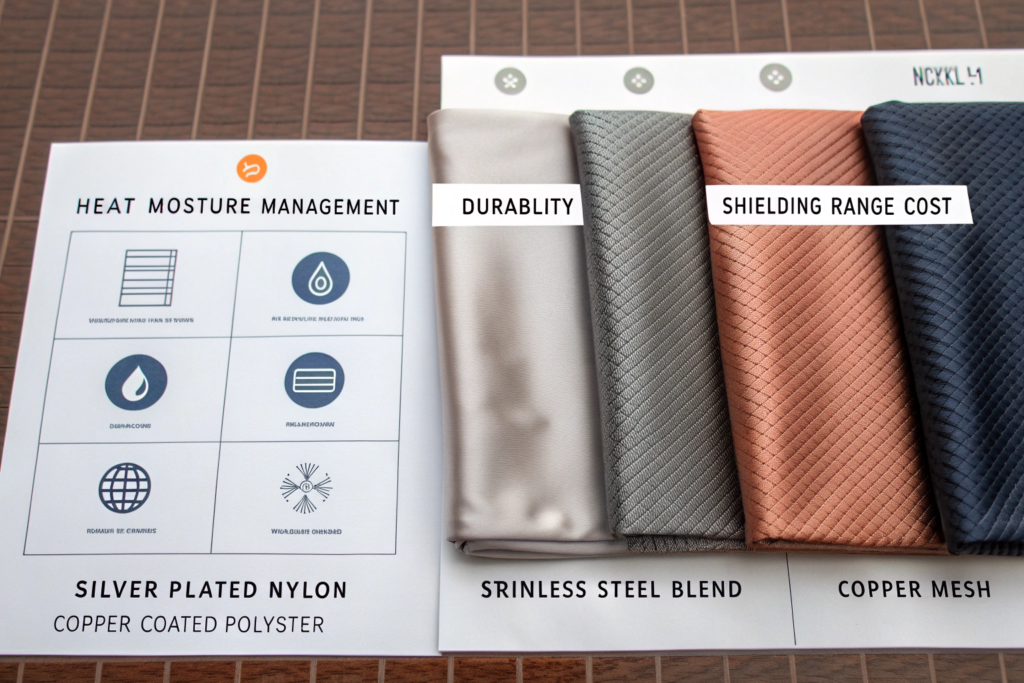
There are several methods, and each has trade-offs. The most common is metal-plated fibers. This starts with a synthetic fiber—usually nylon or polyester—that’s coated with a thin layer of metal through an electroplating process. Silver is popular because it’s highly conductive and has natural antimicrobial properties. Copper is even more conductive but can oxidize and turn green. Stainless steel is durable and cheap but less flexible.
Another method is metal blending. Fine metal wires—stainless steel, copper, or silver—are drawn down to microscopic diameters and blended with conventional fibers during yarn production. The result looks and feels mostly like normal fabric but has conductive paths throughout. This is excellent for durability—the metal fibers are protected by the surrounding textile fibers.
Finally, there are conductive coatings. The finished fabric is coated with a conductive substance—usually copper or nickel, sometimes with silver top-coating. This can achieve very high shielding but may be less breathable and less durable through washing.
We use all three methods depending on the application. For a Swedish medical device company, we developed a blended yarn with 30% stainless steel fibers for a wearable monitor that needed to shield the electronics from external interference while remaining comfortable against skin. The technical specifications for conductive fibers from the Textile Research Journal helped us optimize the blend ratio.
What materials work best for different shielding applications?
Not all shielding fabrics are created equal. The best choice depends on what you’re shielding from, how you’ll use the garment, and your budget.
When should you choose silver-based fabrics?
Silver is the premium choice for wearable applications, and here’s why. First, silver is an excellent conductor—not quite as good as copper, but close. Second, silver has natural antimicrobial properties. When you’re wearing a shielding garment close to your skin for long periods, bacteria can be a problem. Silver inhibits bacterial growth, reducing odor and skin irritation. Third, silver-plated fabrics are soft and flexible. They drape like normal fabric and don’t feel like you’re wearing metal.
The trade-off is cost. Silver is expensive. A silver-plated fabric can cost 5-10 times more than conventional fabric of similar weight. But for people who need to wear shielding daily—like our German client’s wife—the comfort is worth the premium.
We supply silver-plated nylon fabrics to several maternity wear brands. Pregnant women concerned about WiFi and cell phone radiation want protection without looking like they’re wearing sci-fi costumes. Our silver fabrics can be dyed in any color and cut into stylish silhouettes. One Italian brand uses our fabric for a line of chic urban wear that happens to block 99% of environmental EMF. Their customers love that protection is invisible. If you’re researching silver-based antimicrobial and conductive textiles, the International Silver Association has excellent technical resources.
What about stainless steel blends for industrial applications?
Stainless steel is the workhorse of industrial shielding. It’s durable, relatively inexpensive, and maintains its properties through hundreds of washes. The downside is comfort. Stainless steel fibers are stiffer than silver-plated synthetics. Fabrics with high stainless steel content can feel rough or scratchy against sensitive skin.
For workwear and industrial applications, that’s often acceptable. We supply stainless steel-blended fabrics to companies making protective clothing for electrical utility workers, for people working near high-voltage lines, and for technicians who service radar equipment. These users need protection, and they’re willing to accept some discomfort for safety.
A French power company ordered 10,000 meters of our stainless steel/polyester blend for their line workers. The workers wear the garments under their regular uniforms while working near live lines. The fabric provides a crucial safety margin—if they accidentally get too close to an energized line, the conductive fabric helps equalize the electrical field around their body, reducing the risk of arc flash injury. The National Institute for Occupational Safety and Health (NIOSH) guidelines on protective clothing for electrical workers informed the specifications for this project.
When is copper the right choice?
Copper is the most conductive of the common shielding metals—about 5-10% better than silver, and vastly better than stainless steel. For applications where maximum shielding is critical, copper is hard to beat. The problem is oxidation. Copper exposed to air and moisture develops a green patina over time. That’s fine for statues, not so fine for clothing.
We solve this by using copper that’s either laminated between fabric layers or coated with a protective top layer. For a US military contractor, we developed a copper/polyester laminate for shielding sensitive electronics carried by personnel. The copper layer is fully encapsulated, so it never touches skin or air. The shielding effectiveness exceeds 60 dB across the 1-10 GHz range—enough to block military communications signals completely.
For consumer applications, we generally recommend silver over copper unless the absolute maximum shielding is required. But for stationary applications—shielding curtains, bed canopies, tent liners—copper works beautifully. A German client sells copper-lined bed canopies to customers with severe electromagnetic sensitivity. The canopies create a low-EMF sleeping environment, and because they’re not washed frequently, copper oxidation isn’t a problem. The Copper Development Association’s technical briefs on EMI shielding provided valuable data for this application.
How do you balance shielding effectiveness with comfort and wearability?
The biggest challenge in shielding apparel isn’t the shielding—it’s making something people will actually wear. If it’s uncomfortable, ugly, or impractical, it doesn’t matter how well it blocks EMF.

How breathable can shielding fabrics really be?
This is the question we hear most often from potential clients. Metal doesn’t breathe. If you wrap yourself in metal foil, you’ll sweat like crazy. But textile-based shielding is different. The conductive elements are fibers, not solid sheets. Air can pass through the gaps between fibers, just like in any other fabric.
The key is the "cover factor"—the percentage of the fabric surface that’s actually occupied by fibers. A tightly woven fabric with high thread count and fine conductive fibers can achieve excellent shielding while still allowing air exchange. We’ve measured the air permeability of our silver-plated knits at 80-120 cubic feet per minute—comparable to a medium-weight cotton jersey. That’s breathable enough for everyday wear.
For a Japanese activewear brand developing EMF-shielding yoga clothes, we created a silver-plated mesh fabric with 40% open area. It blocks about 80% of ambient EMF—less than our solid fabrics—but it’s incredibly breathable and comfortable during hot yoga sessions. The brand positioned it as "urban protection for the mindful athlete," and it’s been surprisingly successful. The ASTM standards for fabric air permeability testing guide our quality control for breathable shielding products.
What about washing and care?
This is the Achilles heel of many shielding fabrics. Conductive coatings can wash off. Metal fibers can break with repeated flexing. Silver can tarnish and lose conductivity. We’ve spent years developing washing protocols that maintain shielding effectiveness.
For silver-plated fabrics, we recommend gentle machine washing in cold water, mild detergent (no bleach, no fabric softener), and air drying. Under these conditions, our fabrics maintain 90% of their original shielding after 50 washes. For stainless steel blends, the durability is even better—they’re essentially unchanged after 100 washes.
We also offer a line of "sacrificial" garments for clients who need maximum shielding but accept limited wash life. These are copper/nickel-coated fabrics that achieve incredible shielding—over 70 dB—but begin to degrade after 10-15 washes. They’re designed for short-term use in high-risk environments, not daily wear.
A Canadian researcher studying electromagnetic hypersensitivity bought a set of our highest-shielding garments for a controlled study. She needed consistent shielding performance across multiple participants over several weeks. We provided detailed washing instructions and tested random samples after each wash cycle to verify performance. The study was published with our fabrics specified in the methodology. This peer-reviewed research on washing effects on conductive textiles informed much of our durability testing.
What frequency ranges can different fabrics block?
Different fabrics perform differently across the electromagnetic spectrum. What blocks your microwave oven might not block 5G. Understanding these differences is crucial for choosing the right material.
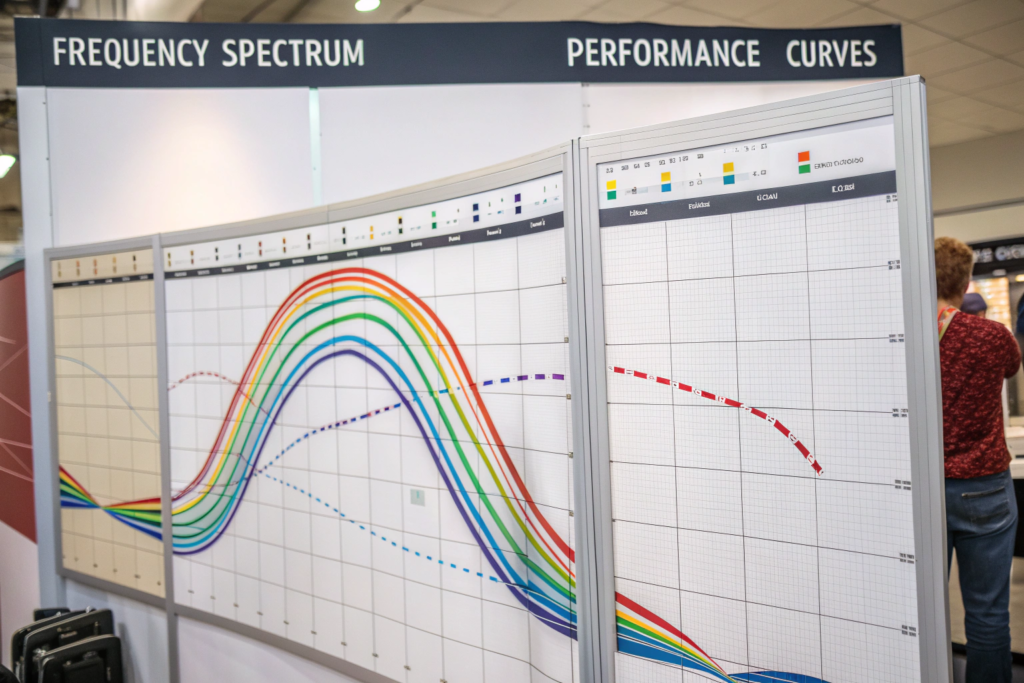
What blocks low-frequency fields (power lines, appliances)?
Low-frequency fields—50-60 Hz from power lines and household wiring—are actually the hardest to block with fabric. The longer the wavelength, the larger the conductor needed to interact with it. For low frequencies, you need either very high conductivity or multiple layers.
Stainless steel blends perform well here because the ferromagnetic properties of steel help absorb low-frequency magnetic fields. Silver and copper are excellent conductors, but they primarily reflect rather than absorb. For people living near high-voltage power lines, we often recommend a two-layer approach: a stainless steel blend for the outer layer to absorb magnetic fields, and a silver-plated inner layer to reflect higher frequencies.
A family in California contacted us because their house was directly under high-voltage transmission lines. The mother was concerned about potential health effects on her young children. We supplied stainless steel/cotton blend fabric for bedroom curtains and bed canopies. Independent testing showed a 70% reduction in magnetic field strength inside the canopies. The World Health Organization’s fact sheet on electromagnetic fields and public health provides context on why people seek this protection.
What about radio frequencies (WiFi, cell phones, 5G)?
This is where shielding fabrics really shine. The frequencies used by modern communications—from 800 MHz to 6 GHz for current systems, up to 40 GHz for emerging 5G—are well within the range that conductive textiles can block effectively.
Silver-plated fabrics are excellent in this range, typically providing 30-50 dB attenuation. That means the signal inside the fabric is 1,000 to 100,000 times weaker than outside. For most people, that’s more than enough to reduce exposure to background levels.
The challenge with 5G millimeter waves (above 24 GHz) is different. These frequencies behave almost like light—they can be blocked by very thin conductive layers, but they can also leak through tiny gaps. A garment with good shielding at 2.4 GHz might have weak spots at 28 GHz if the seams aren’t properly designed. We’re working with a Finnish telecom company to develop fabrics specifically optimized for 5G frequencies. Early results show our copper-coated polyester achieves 40 dB at 28 GHz—enough for most consumer applications. The Institute of Electrical and Electronics Engineers (IEEE) standards for 5G frequency measurements guide our testing protocols.
How does Fumao Fabric customize shielding fabrics for specific applications?
One size rarely fits all in shielding textiles. Every client has different needs—different frequencies to block, different comfort requirements, different budgets. Our job is to find the right combination.

Can you combine shielding with other fabric properties?
Absolutely. In fact, most of our shielding fabrics are custom-engineered to meet multiple requirements simultaneously. Need flame resistance? We can blend stainless steel with flame-retardant aramid fibers. Need moisture wicking? We’ll use silver-plated polyester with a hydrophobic finish. Need stretch? We’ll knit the conductive fibers with spandex.
For a Middle Eastern client in the oil and gas industry, we developed a fabric that provided both EMF shielding (for workers near high-power radio transmitters) and protection against flash fires. The fabric used a base of flame-retardant modacrylic, with stainless steel fibers blended in for shielding, and a moisture-management finish for comfort in hot climates. It took 14 months to develop, but the final product exceeded all specifications.
A Scandinavian startup came to us wanting a fabric that blocked EMF while also providing thermal regulation—keeping the wearer cool in summer, warm in winter. We developed a three-layer knit: an inner silver-plated layer for shielding, a middle phase-change material layer that absorbs and releases heat, and an outer merino wool layer for comfort and temperature regulation. It’s probably the most complex fabric we’ve ever made, and it works beautifully. The advanced textile engineering resources from the Textile Institute helped us integrate these multiple functions.
What about custom colors and patterns?
Most shielding fabrics are limited in color—silver, gray, maybe black if you’re lucky. But our clients want options. Maternity wear shouldn’t look like technical gear. Children’s sleepwear should be fun. Fashion-conscious customers want style.
We’ve developed dyeing processes that work with silver-plated fabrics without destroying conductivity. The dye forms a thin layer over the silver—it reduces shielding slightly (maybe 2-3 dB), but the fabric still performs well. For stainless steel blends, dyeing is easier because the steel fibers are protected within the cotton or polyester.
A UK-based children’s clothing brand wanted EMF-shielding pajamas in bright, fun prints. We printed their designs directly onto our silver-plated fabric using a specialized process that doesn’t cover the entire surface—the print is discontinuous, leaving plenty of exposed silver for shielding. The resulting pajamas block about 95% of ambient EMF while looking like normal kids’ pajamas. Parents love them, and kids don’t know they’re wearing anything special. Shanghai Fumao works with clients to achieve the right balance of aesthetics and performance.
What testing and certification should you look for?
Trust but verify. Anyone can claim their fabric blocks EMF. Without proper testing, those claims are meaningless. Here’s what you should demand.

What does proper shielding effectiveness testing involve?
Real shielding testing isn’t simple. It requires specialized equipment: a signal generator, antennas, and a spectrum analyzer or network analyzer. The fabric sample is placed between a transmitting antenna and a receiving antenna. The difference in signal strength with and without the fabric is the shielding effectiveness.
But frequency matters. A fabric might block 99% at 1 GHz but only 50% at 2.4 GHz. Proper testing covers the entire frequency range of interest. For consumer products, that typically means 100 kHz to 6 GHz at minimum, and up to 40 GHz for 5G applications.
We test every batch of shielding fabric in our CNAS-accredited lab. The test reports show shielding effectiveness at multiple frequencies, usually in 100 MHz increments. Clients receive these reports with every shipment. A US tech company that buys our fabric for protecting sensitive equipment requires testing to MIL-STD-285, the military standard for electromagnetic shielding. We’re certified to that standard.
A German consumer protection group tested our fabrics anonymously in 2023, buying samples through third parties and testing in their own lab. Their published results showed our fabrics met or exceeded all claimed specifications. That independent verification is worth more than any marketing claim. The American Society for Testing and Materials (ASTM) standard D4935 for measuring shielding effectiveness of planar materials is the reference we use for all our testing.
What certifications matter for wearable shielding products?
For wearables, safety certifications are crucial. The conductive elements must not cause skin irritation or allergic reactions. All our fabrics are tested to OEKO-TEX Standard 100, which verifies that they’re free from harmful substances. Silver-plated fabrics are also tested for nickel release—some people are allergic to nickel, and silver plating can contain trace amounts.
For medical applications, we can provide biocompatibility testing per ISO 10993. This is a higher standard that includes cytotoxicity, skin irritation, and sensitization testing. A Swiss company developing EMF-shielding garments for people with implanted medical devices (pacemakers, insulin pumps) required this level of testing. The fabrics passed all tests with no adverse reactions.
For children’s products, we recommend additional testing for physical hazards—small parts that could be chewed off, flammability, etc. We work with clients to ensure their finished products meet all applicable safety standards in their target markets. The OEKO-TEX certification guidelines for technical textiles provide a framework we follow for all wearable shielding products.
Conclusion
Electromagnetic shielding textiles represent one of the most fascinating frontiers in our industry. They transform ordinary fabric into functional technology—something that protects, shields, and enables in ways our grandparents never imagined. Whether for people with electromagnetic sensitivity, for workers in high-EMF environments, for protecting sensitive electronics, or simply for those who want to reduce their environmental exposure, these fabrics offer real solutions.
At Shanghai Fumao, we’ve invested heavily in understanding this technology. We’ve developed relationships with metal suppliers, perfected our plating and blending processes, and built testing capabilities that meet international standards. We’ve helped individuals reclaim their quality of life, companies protect their workers, and innovators bring new products to market. That German client whose wife couldn’t leave the house? She now travels internationally, wearing garments made from our fabrics, and recently sent us a photo of herself at the beach in Italy—something she hadn’t done in years.
This field is evolving rapidly. New frequencies, new materials, new applications emerge constantly. What works today may need improvement tomorrow. But the fundamentals remain: conductive materials, properly engineered into comfortable, wearable textiles, can provide meaningful protection against the invisible electromagnetic environment we all inhabit.
Whether you’re developing products for a specific niche—maternity wear, workwear, medical applications—or exploring the potential of shielding textiles for a new market, we’re ready to help. We’ll work with you to understand your requirements, develop appropriate materials, test thoroughly, and produce consistently.
Ready to explore electromagnetic shielding fabrics for your application? Let’s start the conversation. Contact our Business Director, Elaine, directly at elaine@fumaoclothing.com. Tell her about your project—the frequencies you need to block, the comfort requirements, the target users, the volumes you’re considering. She’ll connect you with our technical textiles team, who can discuss options, provide samples with verified test data, and develop a path forward. Together, we can create something that protects, performs, and makes a real difference in people’s lives.