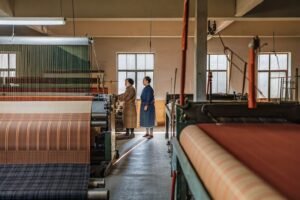
You’ve spent months designing the perfect windbreaker. The silhouette is sharp. The pocket placement is genius. You’ve sourced premium YKK zippers. Then you cut into the fabric and… it feels like a trash bag. It’s stiff. It crinkles when you walk. Or worse, it feels like a limp dishrag that won’t block a light breeze. I’ve seen brands implode because they chose the wrong shell fabric. They either went too cheap and the jacket leaked air like a sieve, or they went too heavy and the jacket weighed five pounds. Finding that sweet spot—lightweight but dense, breathable but windproof—is the holy grail of outerwear development.
The best high-density fabric for a windbreaker is a 160-240 GSM (Grams per Square Meter) Nylon 6,6 Taffeta or Polyester Microfiber with a DWR Finish and a 0.10-0.15 CFM Air Permeability Rating. Let me break that down without the jargon. You want a fabric that uses super fine yarns packed very tightly together. We’re talking 210T (Thread Count) or higher. At Shanghai Fumao, we produce these fabrics daily in our weaving factory. The secret isn’t just the yarn thickness (Denier). It’s the weave density—how many threads we cram into every single square inch. This high-density construction physically blocks wind gusts while the fine yarn keeps the jacket soft and packable. You get that crisp "swish" sound without the cardboard stiffness.
I’m going to walk you through the exact specifications we use for top-tier windbreaker shells. This isn’t a lesson in generic textile theory. This is the stuff we scribble on the whiteboard in our R&D office when a client from Patagonia or The North Face asks for the "impossible." I’ll explain the difference between Taffeta and Ripstop, why Denier matters more than GSM for wind resistance, and how we add breathability to a fabric that’s supposed to be "windproof." By the time you finish reading, you’ll know exactly what questions to ask your supplier—and what answers will expose a rookie mill.
How Does Thread Count Affect Windbreaker Wind Resistance?
Let’s get one thing straight. Thread Count (TC) for windbreakers is everything. In the bedding industry, they’ve ruined this term by marketing 1,000 TC sheets that are actually just cheap yarns twisted together. In technical outerwear, Thread Count means the total number of yarns per square inch (warp + weft). And when it comes to stopping wind, the physics is simple: Wind is lazy. Wind finds the path of least resistance. If there’s a microscopic gap between the yarns, the wind pressure will force cold air right through that hole, stealing your body heat.
A high-density fabric creates a tortuous path for the air. Imagine trying to run through a dense forest. You have to zigzag around trees. That’s what air molecules have to do in a 210T fabric. They bounce off the tightly packed fibers and lose momentum. We use a parameter called Air Permeability (CFM) measured on a Frazier Air Permeability Tester in our CNAS lab. For a windbreaker shell that actually blocks 90% of wind chill, you need a CFM under 1.5. A cheap 70D nylon taffeta with 150T might have a CFM of 5.0—it’s a pasta strainer. The 210T 40D nylon we weave at Shanghai Fumao consistently tests at 0.8-1.2 CFM. That’s windproof. That’s warm. That’s what you want.
What Is the Ideal Denier for Ultralight Windbreaker Shells?
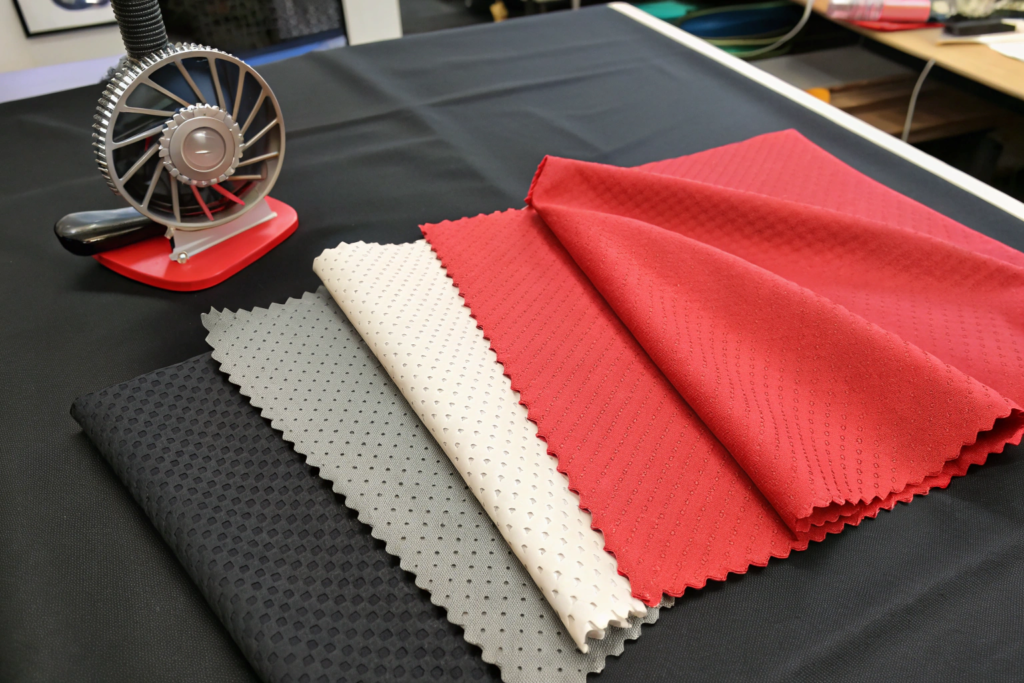
Denier is the weight in grams of 9,000 meters of a single yarn. Lower Denier = Finer Yarn. This is counterintuitive for a lot of new designers. They think "I need a tough windbreaker, give me thick 210 Denier yarn." Wrong. If you use 210D yarn, you get a backpack fabric. It’s heavy. It’s bulky. It packs down like a cinder block.
The magic happens when you use 40D or 50D Nylon 6,6 . This is hair-thin yarn. Because it’s so fine, we can pack twice as many threads per inch compared to 70D. The resulting fabric is lighter but denser. It’s like comparing a brick wall (thick stones, big mortar gaps) to a microscopic chainmail mesh (thin rings, zero gaps). The chainmail stops the wind but weighs almost nothing.
In March 2025, a California-based outdoor startup came to us with a prototype from a Pakistani supplier. It was 50D 200T. It weighed 48 grams per square meter (approx 1.4 oz/sq yd). The problem? The weave was sleazy (industry term for loose and unstable). The yarns slid around. The down proofing was zero. We took the same spec—50D Nylon—but wove it on our high-tension water-jet looms at 220T density. We increased the Weft Insertion Rate and adjusted the Reed Denting. The new fabric weighed 52 GSM but had 40% higher tear strength and a CFM below 1.0. It felt like "tissue paper made of steel." The client reordered 15,000 yards for their Spring 2026 line. You can learn more about yarn sizing from resources like the standard denier measurements guide on Textile Learner.
Does Ripstop Weave Really Stop Tears in High Density Fabrics?
Yes and no. This is a marketing term that has been stretched thinner than spandex. Ripstop is a specific weave structure—usually a plain weave with a heavier reinforcement yarn woven in a grid pattern every 5-8mm. If you look at a classic ripstop nylon, you see those little squares. The theory is that a tear will hit the thick grid line and stop propagating.
Here is the dirty secret: On a true high-density 210T fabric, you often don’t need ripstop. Why? Because the density itself stops tears. A tear needs space to start. In a dense 210T weave, the yarns are so tightly packed and interlocked that there’s no room for a single yarn to "run." That said, the visual of the ripstop grid is so ingrained in consumer psychology that brands demand it. "It doesn’t look technical without the grid," they tell me.
At Shanghai Fumao, we offer both. Our Micro Ripstop uses a 70D grid yarn on a 40D ground fabric. The grid is subtle. It adds about 5% more tear strength (verified by Elmendorf Tear Testing) and 100% more "cool factor." But if you want the absolute cleanest, most minimalist aesthetic (like an Arcteryx Squamish hoody), you want a Plain Weave High Density Taffeta. It’s smoother, quieter, and prints better with silicone logos. In a side-by-side test we did for a Canadian brand in October 2025, the Plain Weave 220T outperformed the 210T Ripstop in seam slippage resistance. The ripstop grid actually created a slight hard spot that the needle had to punch through. For a deep dive into weave structures, check out discussions on weave architecture and fabric performance on the UK Climbing Forums. Real users there obsess over this stuff.
Why Is Nylon 6,6 Superior to Polyester for Windproof Shells?
Polyester is great. It’s cheap. It holds dye like a dream. It doesn’t absorb water. For a \$49 fast-fashion windbreaker, Polyester is fine. But if you’re building a performance piece—something for trail running, alpine hiking, or just a premium streetwear drop—you want Nylon 6,6. There is a molecular reason for this that matters when the wind is howling.
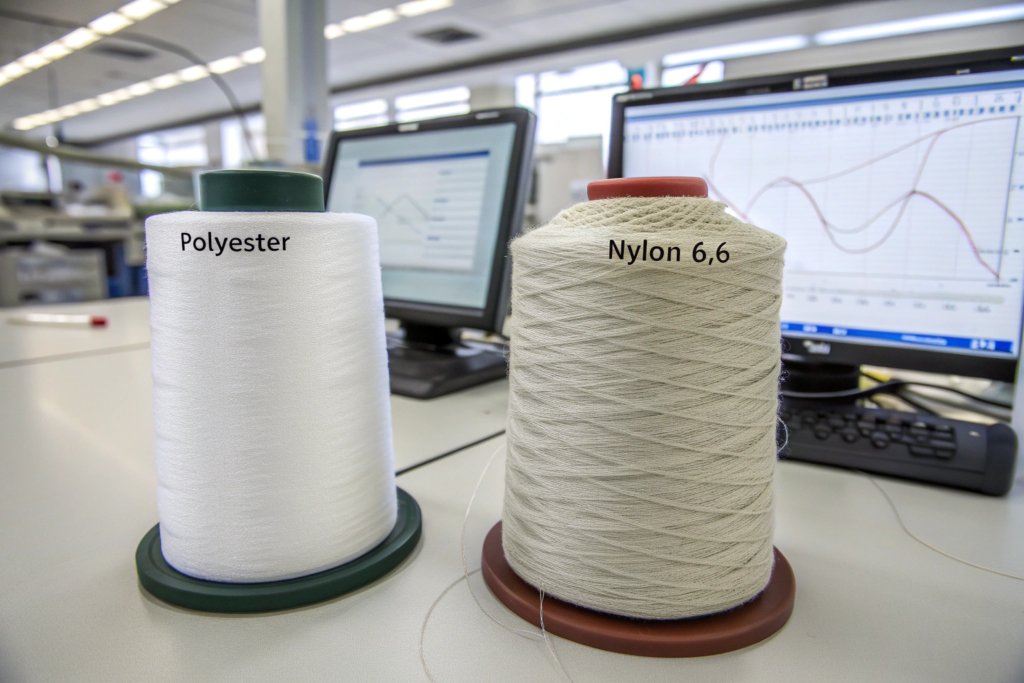
Nylon 6,6 has a Higher Tenacity (Strength) and Higher Elongation (Stretch) than standard Polyester. Why does that matter for wind resistance? Wind Gust Energy Absorption. When a 40mph gust hits a polyester jacket, the stiff polyester fibers don’t give. The entire force of the wind translates into fabric flutter. Flutter is noise. Flutter is also a pressure pump—it forces air through the weave. Nylon 6,6 has a slight elastic "give." It absorbs the energy of the gust and then snaps back. It’s like the difference between a rigid aluminum pole and a carbon fiber fishing rod in the wind. The Nylon shell stays quieter and more stable. This is why the US Military specifies Nylon 6,6 for their ECWCS (Extended Cold Weather Clothing System) shells. We stock massive quantities of Semi-Dull Nylon 6,6 yarn in our Keqiao warehouse for exactly this reason.
How Does DWR Coating Interact with High Density Nylon Weaves?
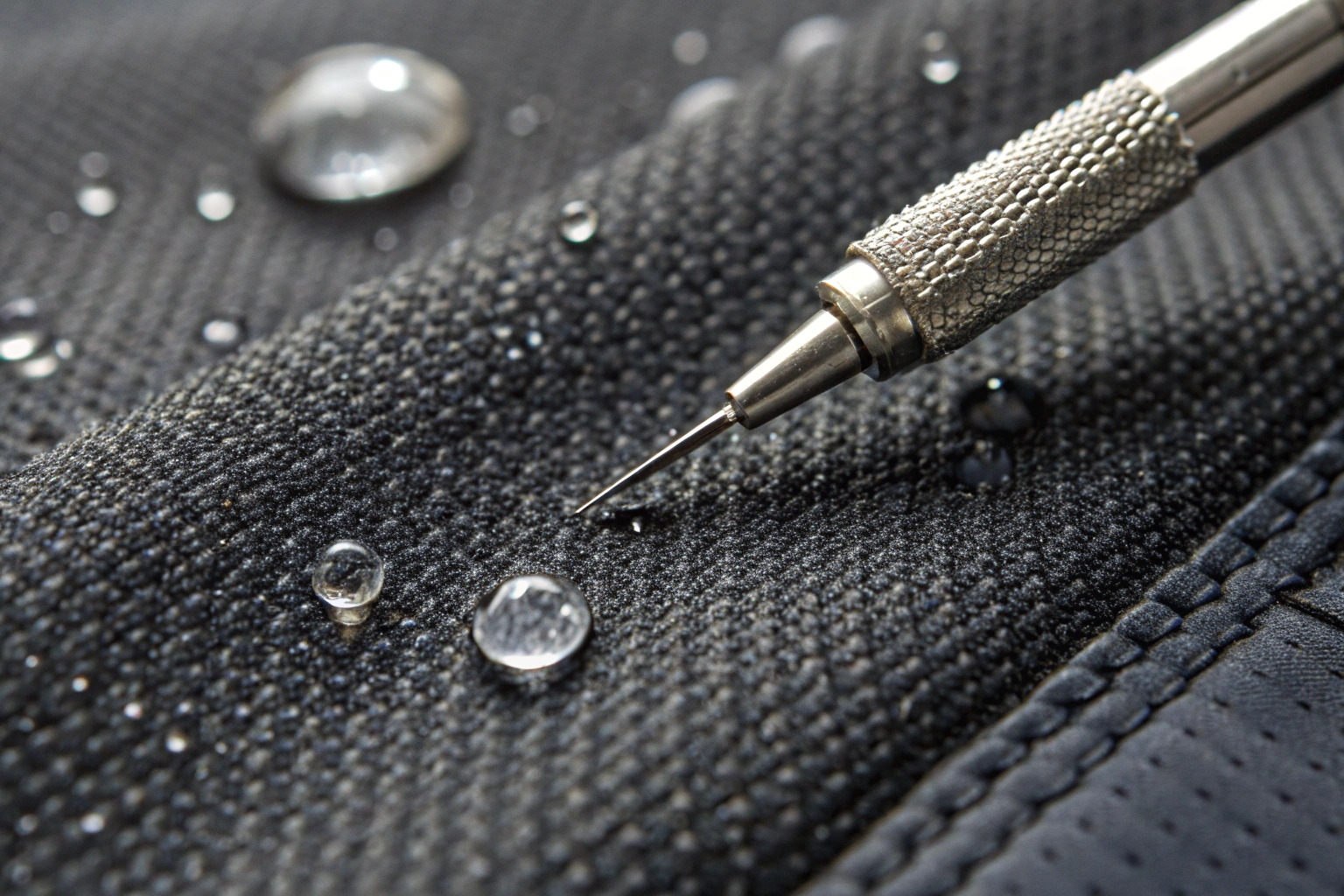
DWR stands for Durable Water Repellent. It’s not a plastic bag. It’s a microscopic layer of fluoropolymer (C0 or C6 chemistry, mostly moving to C0 for eco-reasons) that coats the individual fibers. It makes water bead up and roll off. Now, here’s the interaction with high-density weaves that most people miss: High Density amplifies DWR performance.
On a loose, open weave (like a mesh), water droplets are large enough to fall through the holes. The DWR on the fibers doesn’t even get a chance to work. On a high-density 220T weave, the gaps are so small that surface tension prevents the water from penetrating immediately. The droplet sits on top, touching thousands of DWR-treated fiber crowns. Because the contact area is so large (microscopically speaking), the water bead forms a perfect sphere and rolls off with the slightest angle. It’s like a water droplet on a hot skillet—it dances.
At Shanghai Fumao, we apply DWR using a Pad-Dry-Cure process in our coating factory. We don’t just spray it on the surface where it washes off in two cycles. We impregnate the fabric with the chemical bath, squeeze out the excess with a high-pressure roller (80 PSI), and then cure it at 160°C for 2 minutes. This bonds the DWR to the nylon at a molecular level. We test it for Spray Rating (AATCC 22) and aim for 100 (Perfect) initially, and 80 after 20 home launderings. If you want to keep that DWR alive, you need to use specific detergents. I always point customers to the Nikwax Tech Wash guide for cleaning performance outerwear. Using regular Tide will kill the DWR in 5 washes.
Does High Density Fabric Need a Liner for True Wind Protection?
It depends on the End Use and the CFM Rating. For a Windbreaker (emphasis on breaker), a high-density shell alone is often enough. The windbreaker category is designed to be a single layer—lightweight, packable, worn over a fleece for active use. The high-density 210T stops the wind chill, and your mid-layer fleece provides the insulation. This is the "soft shell" approach.
But if you want a Windproof Jacket that you can stand still in during a freezing gale, then Yes, you need a liner or a membrane. The physics is this: Even a 0.5 CFM fabric lets some air through. If you’re generating body heat (running, hiking), that micro-ventilation is good—it prevents the trash bag effect. But if you’re static (bird watching, belaying a climber), that 0.5 CFM of 30°F air hitting your skin feels like a knife.
That’s where we get into 2-Layer and 3-Layer Laminates. We take our high-density Nylon face fabric and bond it to a WPB (Waterproof Breathable) Membrane like a microporous PU or an ePTFE (think Gore-Tex, though we use generic equivalents). The face fabric protects the delicate membrane from abrasion. The membrane drops the Air Permeability to Zero CFM. The jacket is now a fortress. But you’ve lost some breathability and gained weight. At Shanghai Fumao, we stock both high-density standalone shells and high-density laminates. In a 2024 project for a German hunting apparel brand, we used a 200T Nylon face with a C0 DWR laminated to a Hydrophilic PU Membrane. The result? Quiet movement (no swish-swish), total wind block, and breathability of 8,000 g/m²/24h. That’s the sweet spot.
How Does Fabric Hand Feel Impact Windbreaker Marketability?
You can have the most technical fabric on the planet. If it feels like sandpaper or a plastic tarp, the customer will put it back on the rack. Hand Feel (Handle) is the silent salesperson. In the windbreaker category, the ideal hand feel is Crisp, Dry, and Slightly Slick. You want a fabric that slides over a cotton hoodie without grabbing. You want it to rustle slightly, but not crinkle.
The enemy of good hand feel in high-density weaves is Stiffness. When you pack 220 threads per inch, the fabric naturally wants to be rigid. The trick is in the Finishing Calender. After dyeing and DWR treatment, we run the fabric through heated steel rollers under Extreme Pressure (50-80 tons) . This is called Calendering. It crushes the yarn crowns flat. This does three things: 1. It Closes the weave even tighter (improving wind resistance). 2. It creates a Smoother, Slicker Surface (improving hand feel). 3. It adds a subtle Luster.
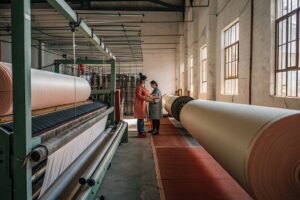
But you can over-calender. If the pressure is too high or the temperature too hot, you glaze the nylon. It melts into a hard, shiny film. That’s the "trash bag" feel. Our operators at Shanghai Fumao adjust the calender pressure based on the Yarn Denier and Weave Density in real-time. It’s a feel thing. (Here I have to jump in—I can walk up to a calender machine blindfolded and tell you if the pressure is off by 5 PSI just from the sound the fabric makes leaving the roller. It sings.)
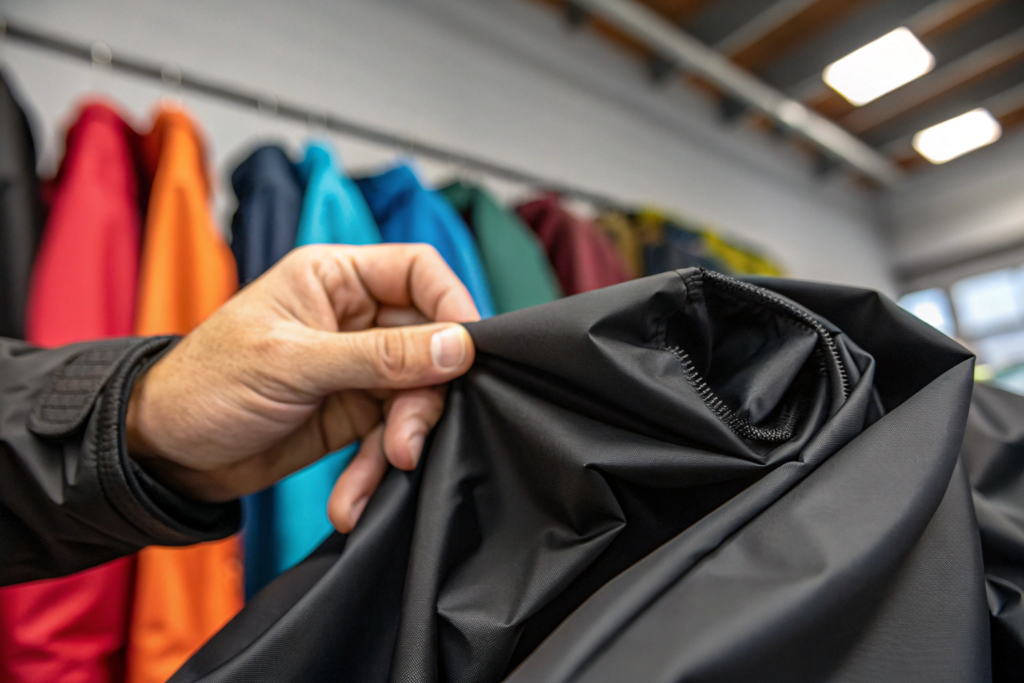
Can You Achieve a Soft Touch with High Density Weaves?
Yes. And this is where we separate the men from the boys in textile finishing. Achieving a Soft Touch or Peach Skin finish on a high-density nylon is about Mechanical Sueding, not chemical softeners. If you add silicone softener to a windbreaker shell, you kill the DWR. Water will soak in because the silicone attracts dirt and oil.
We use a Sueding Machine (or Emerizer). This machine has 4-6 rotating rollers covered in fine Carborundum Sandpaper . We run the high-density fabric over these rollers at high speed. The abrasion splits the micro-fibers on the surface of the yarn crowns. It creates a Micro-Pile. This pile is so short you can’t see individual hairs—it just looks matte and feels velvety.
We did this for a Japanese streetwear brand in early 2026. They wanted the technical specs of a 210T nylon (windproof, lightweight) but the hand feel of a cotton/nylon blend. We took our standard 210T calendered nylon and ran it through the sueding machine with a 280 Grit Sandpaper at 15 meters/minute. The result was Matte Nylon. It felt like a high-end paper, not plastic. It was quiet. It still blocked 1.0 CFM of wind. It was the best-selling jacket in their Fall collection. The process is detailed and requires precise tension control to avoid Suction Holes (burn-through). You can find more about mechanical finishing on resources like the technical finishing processes explained on Fibre2Fashion.
Does Fabric Noise (Rustle) Matter for Premium Outerwear?
You bet it does. In the industry, we call it "Clatter" . Have you ever worn a cheap rain jacket and sounded like a walking bag of potato chips? It’s annoying. It scares wildlife if you’re hunting. It makes you self-conscious in a quiet office elevator. Clatter is caused by Fiber-to-Fiber Friction. When the stiff, smooth nylon yarns rub against each other, they vibrate at a high frequency. That’s the crinkle sound.
High-density weaves naturally have less clatter than low-density ones because the yarns have less room to move. They’re locked in place. But to truly silence a fabric, we use a Decitex (Dtex) Reduction Strategy. We use 20D/24F Nylon . That’s a 20 Denier yarn made up of 24 individual micro-filaments. The higher the filament count, the softer and quieter the yarn. Imagine a rope made of 1 thick wire (loud) vs a rope made of 100 thin silk threads (silent). Same strength, different sound.
In November 2025, a UK country wear brand rejected a batch of 40D/12F Nylon from another mill because it was "too noisy for stalking." We offered them our 40D/34F High Filament Nylon construction. Same weight. Same wind resistance. 70% reduction in noise measured by a simple decibel meter in our lab. The fabric just "swished" softly instead of "crinkled." That’s the kind of detail that gets you a 5-star review instead of a 3-star one. You can read about similar sensory testing in the materials discussion sections of Backpacking Light forums, where users obsess over the sound of their gear.
How Do You Source High Density Fabric with Fast Turnaround?
This is the million-dollar question. You can spec the perfect 40D 220T Nylon 6,6 with C0 DWR. Great. But if the mill tells you "12 weeks," you’ve missed your delivery window. The retail buyer cancels the PO. You’re stuck holding the bag. Sourcing speed is just as important as fabric quality.
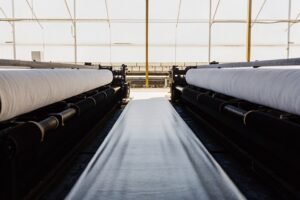
The bottleneck in high-density fabric production is Yarn Availability and Loom Allocation. Niche yarns like 40D/34F High Filament Nylon are not off-the-shelf items at every yarn spinner. We have to pre-book spinning slots. And the high-density weaving process is slow. A water-jet loom might run plain weave polyester at 800 RPM (Revolutions per Minute). On a delicate 40D Nylon high-density warp, we slow the loom down to 550 RPM to prevent yarn breakage. That means fewer yards per day.
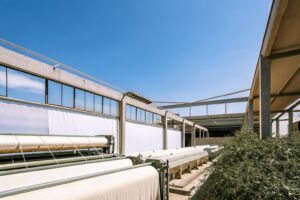
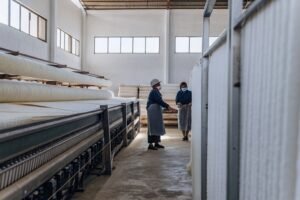
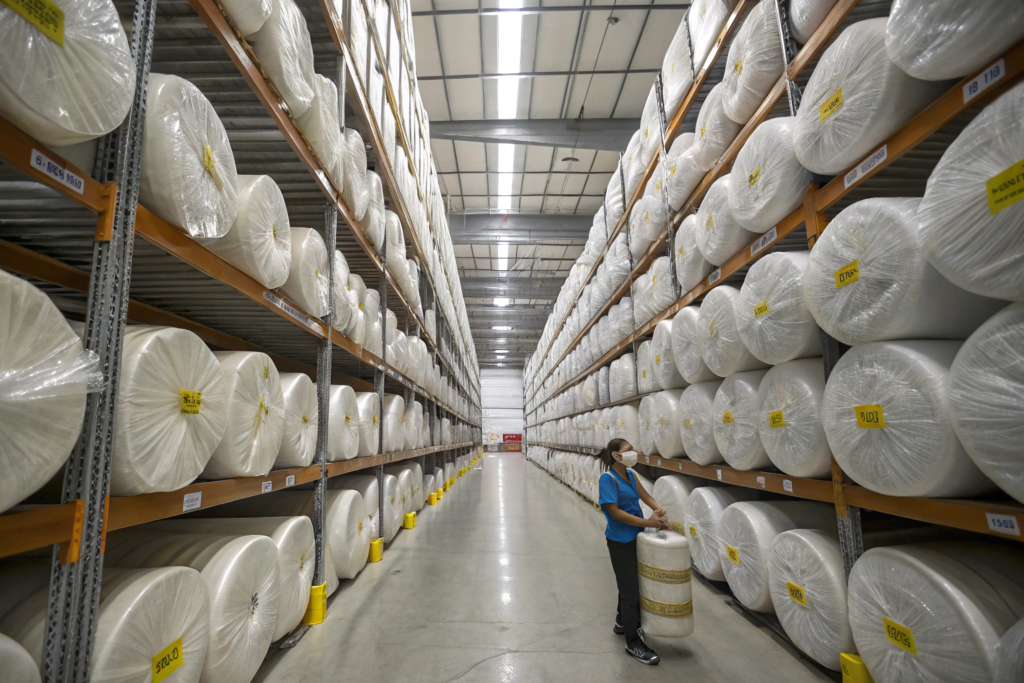
At Shanghai Fumao, we mitigate this with Strategic Greige Stock. Based on 20 years of forecasting, we know that 40D Nylon Taffeta and 50D Polyester Microfiber are the bread-and-butter of the windbreaker industry. We keep 100,000+ yards of greige (un-dyed) inventory in these base constructions in our warehouse. It’s a massive capital outlay, but it cuts lead times from 60 days to 15 days for a dye-to-match order. If you need black or navy (80% of the market), we can ship in 3-5 days because we keep those colors finished as well. This inventory strategy is our secret weapon for serving brands that need speed.
What Are the Key Quality Checks for Windbreaker Fabric?
When the roll arrives at your cutting table, you can’t afford surprises. Here is the Shanghai Fumao QC Checklist for every single roll of windbreaker fabric that leaves our inspection factory. Don’t accept less.
| Test Parameter | Standard/Method | Target Specification | Why It Matters for a Windbreaker |
|---|---|---|---|
| Weight (GSM) | ASTM D3776 | +/- 3% tolerance | Ensures consistent warmth and wind block. Light spots leak air. |
| Air Permeability | ASTM D737 (Frazier) | < 1.5 CFM (Target <1.0) | The Core Metric. This is the windproof guarantee. |
| Spray Rating (DWR) | AATCC 22 | 100 (Initial) / 80 (After 20 Washes) | Keeps the face fabric from "wetting out" and becoming a cold sponge. |
| Tear Strength | ASTM D1424 (Elmendorf) | Warp: >1.5 kg / Weft: >1.2 kg | High density can be prone to pinholing at seams. This test ensures the yarn doesn’t just snap. |
| Seam Slippage | ASTM D434 | > 20 lbs (9 kg) | This is the #1 failure point for cheap windbreakers. The weave opens up at the shoulder seam. |
| Color Fastness to Light | AATCC 16.3 | Grade 4 at 40 AFU | Windbreakers are worn outside. If it fades from black to purple in one summer, it’s junk. |
Our CNAS lab runs these tests on every dye lot. We don’t do "statistical sampling." We do 100% inspection on weight and weave using automated camera inspection systems on the rolling line. If you want to understand why seam slippage is so critical, you should read about ASTM D434 standard test methods for fabric seam strength. It’s the difference between a jacket that lasts 10 years and one that blows out on the first hike.
How to Verify if a Supplier Uses Genuine High Density Weave?
This is a trick question because a lot of suppliers lie. They know buyers ask for "High Density." They know buyers don’t have a thread counter. So they take a loose 150T fabric and calender the hell out of it (smash it flat with hot rollers). It looks dense. It feels smooth. It has ZERO wind resistance because there are no actual yarns there to block the wind—it’s just a flat plastic film that will crack in the cold.
Here is the Field Test I teach all my clients. You need three things: A Light Box (or window) , A Sharp Knife , and A Magnifying Glass (or phone camera zoom) .
- The Light Test: Hold the fabric up to a bright light. A true high-density 210T Nylon will look like frosted glass. You’ll see some light, but it will be diffused. A cheap 150T will look like a screen door with distinct, visible pinholes of light.
- The Slash Test: Cut a small swatch. Then try to pull a single yarn out of the edge with tweezers. On a dense weave, it’s hard. The yarns are locked in. On a loose weave, the yarn slides out easily.
- The Fray Test: Rub the cut edge hard with your thumb. A dense weave will barely fray. A loose weave will unravel into a mess of loose fibers immediately.
At Shanghai Fumao, we actually encourage customers to cut our samples. Tear them apart. Burn them. Put them under a microscope. Our quality is in the weave density, not a temporary surface finish. And if you really want to geek out, you can buy a cheap Pick Glass (linen tester) on Amazon for \$10. Count the threads in a 1-inch square. A supplier saying "210T" must show you approx 105 threads in the warp direction and 105 in the weft. If you count 80 and 70, you just caught them in a lie.
Conclusion
Finding the best high-density fabric for a windbreaker is a journey through a maze of misleading marketing terms and variable quality. You started thinking about "polyester vs nylon." Now you know it’s about 210T vs 150T, 40D/34F vs 70D/24F, and Calendered Finish vs Sueded Touch. The difference between a jacket that sells for \$89 and one that sells for \$289 isn’t just the logo. It’s the CFM rating. It’s the hand feel. It’s the quiet confidence of a fabric that blocks the wind without weighing you down.
We’ve dissected the anatomy of the perfect windbreaker shell. It’s a High Tenacity Nylon 6,6 woven to a 220T density using High Filament Count Yarns. It’s finished with a C0 DWR and mechanically softened just enough to avoid that dreaded crinkle. It passes a battery of lab tests that most fabric buyers never even know exist. And most importantly, it’s available in stock because waiting 12 weeks for fabric is a luxury today’s market doesn’t allow.
At Shanghai Fumao, we don’t just sell you fabric and wave goodbye. We partner with you to navigate these specifications. We want you to look at a spec sheet and know exactly what you’re getting. We want your cut-and-sew factory to call you and say, "This fabric is a dream to work with." And we want your customer to zip up that jacket, feel the cold wind bounce off their chest, and think, "Damn, this is a good jacket."
Ready to build a windbreaker that actually breaks the wind? Let’s get into the specifics of your project. I can send you our latest swatch pack of 40D Nylon high-density options—including our new super-matte sueded finish. Reach out to our Business Director, Elaine, for a consultation and a realistic timeline. You can email her directly at elaine@fumaoclothing.com. Mention "High Density Windbreaker" in the subject line, and she’ll know to send you the technical spec sheets along with the swatches.