I’ve been in this game for over two decades, and I’ve seen a thousand jacquard samples that look like a kindergarten art project. The pattern is blurry. The back side is a rat’s nest of loose floats. The fabric is so stiff it could stand up on its own. You send that to a buyer, and you’ve just lost the account. Jacquard weaving isn’t just about throwing a fancy design on a loom. It’s about controlling tension on 10,000 individual warp ends. It’s about knowing when to use a single beam versus a double beam. And frankly, it’s about having the guts to tell a client, "This design won’t work on that yarn; let’s tweak it." That’s where we come in.
Yes, our jacquard capability stands head and shoulders above the average Keqiao mill because we don’t treat jacquard as an afterthought. At Shanghai Fumao, we treat it as an engineering discipline. Most trading companies and even many weaving factories outsource their jacquard work to a small workshop in the countryside with ancient, creaking looms. The result is inconsistent density and a 15% defect rate on intricate patterns. We brought that capability in-house and upgraded it with modern electronic jacquard heads. We combine the precision of German mechanical engineering with the speed of Chinese production. This means you get the intricate detail of a high-end Italian brocade but at a price point and lead time that works for a contemporary ready-to-wear collection.
I’m going to break down exactly why our jacquard process is different. This isn’t about fancy marketing fluff. It’s about warp tension, weft insertion, and the gray matter of our loom technicians. I’ll show you how we handle complex repeat sizes that other mills refuse to touch, how our finishing techniques make the pattern "pop" rather than flatten out, and why our jacquard fabric doesn’t just look good on the roll—it sews like a dream and washes like a tank. Let’s pull back the curtain on the weave room.
What Makes Electronic Jacquard Looms Superior for Fashion?
Let’s be clear. Mechanical Jacquard (the old punch card system) is a museum piece. It’s charming. It’s history. It’s also slow, noisy, and limited in pattern size. If you want to do a complex floral with 16 colors in the weft, a mechanical loom will laugh at you. Or rather, it will just snap the yarn every five minutes. We use High-Speed Electronic Jacquard Machines (primarily Staubli and Bonas heads mounted on rapier looms). The difference is night and day.
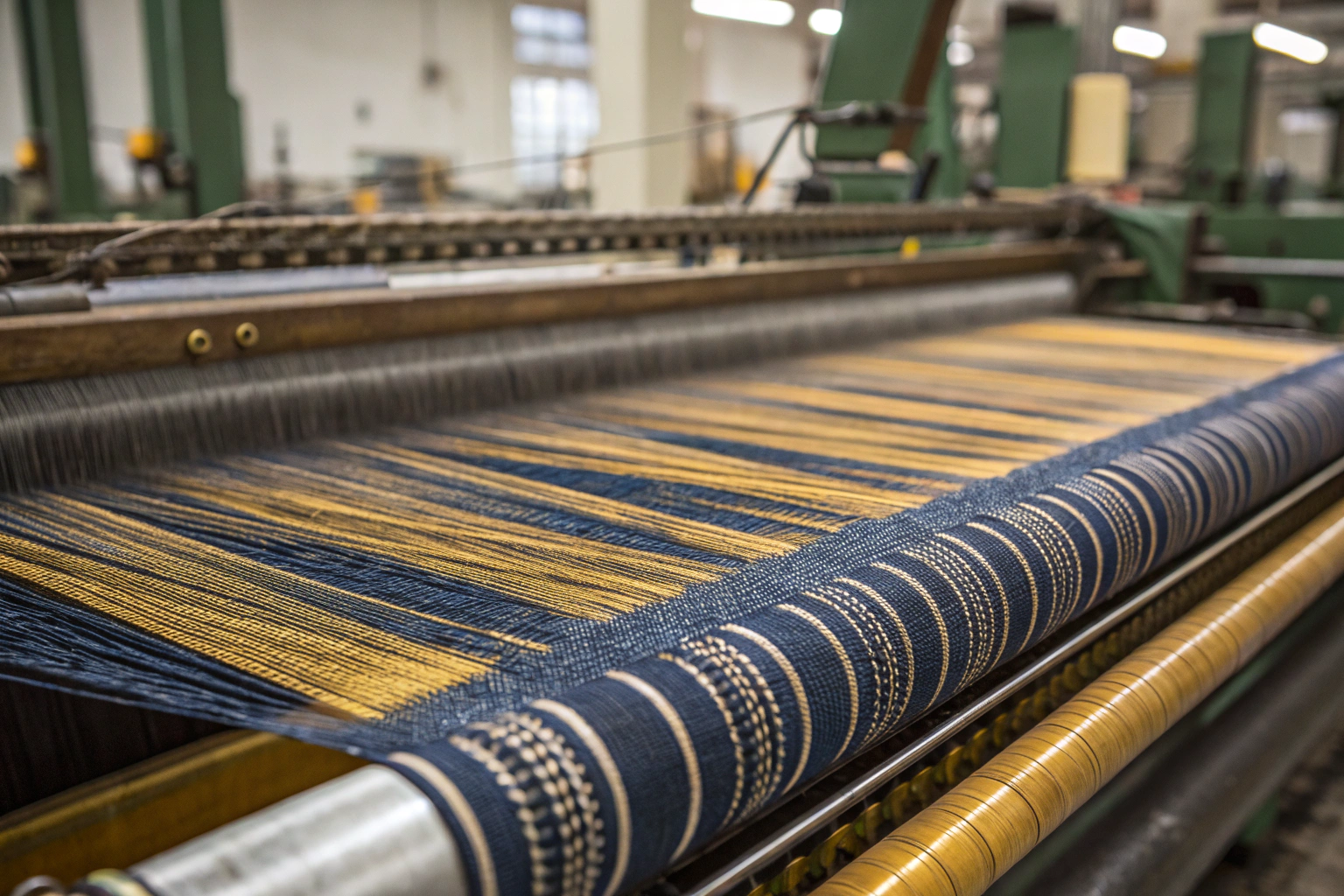
Electronic Jacquard gives us individual warp end control. Think of it this way: A plain weave loom is like a traffic cop directing two lanes of traffic (Up and Down). An electronic jacquard loom is like an air traffic controller guiding 12,000 individual planes simultaneously. Each warp yarn can be raised or lowered independently for every single pick of the weft. This allows us to create three-dimensional surface textures, subtle tonal shading (using satin stitches), and seamless large repeats. For the fashion brands we work with at Shanghai Fumao, this capability is the difference between a generic background texture and a signature branded textile. In October 2023, a New York designer came to us with a sketch of a geometric pattern with a 24-inch repeat. A local mill told her it was impossible on her budget. Our electronic looms handled it easily because we program the design digitally, not with physical chains of cards.

Why Do Large Repeat Patterns Increase Jacquard Fabric Value?
Let’s talk economics and aesthetics. The repeat is the size of the pattern unit before it tiles again. A small repeat (say, 2 inches) is cheap to weave. Why? Because the harness setup is small. The loom only needs to control a few hundred hooks. But small repeats scream "commodity." They look like a tablecloth from a discount bin. Large repeats (18 inches, 24 inches, or even continuous "seamless" repeats) scream luxury and exclusivity. They look like a \$3,000 designer dress.
The value increases because of two factors: Machine Capability and Design Risk. First, you need a jacquard head with enough hooks (the little wires that lift the warp). A 2-inch repeat on a dense fabric might need 600 hooks. A 24-inch repeat might need 10,000 hooks or more. Many small mills simply don’t own the hardware. We invested in high-hook-count heads specifically to serve the premium fashion segment. Second, the larger the repeat, the more yarn we waste on the backside as floats. Long floats can snag on jewelry or zippers. We have to engineer the weave structure to tie down those floats without ruining the face design. This is the "secret sauce" of our R&D team. In February 2024, we wove a custom jacquard for a French couture house with a 36-inch scenic repeat. The fabric had a ground of matte crepe and a pattern in shiny viscose. The contrast was stunning. It sold out at retail in three weeks. You can read more about the engineering challenges of such designs on forums where textile engineers discuss optimizing weave structures for large jacquard repeats.
We also use CAD software (NedGraphics) to simulate the drape and texture before we cut a single thread. This saves our clients the cost of sampling an unworkable design. If you want a deep dive into how digital design is changing the industry, I recommend looking at how digital jacquard simulation reduces sampling waste in textile development. It’s a game changer for reducing time to market.
Can Electronic Jacquard Reduce Fabric Defects Significantly?
Absolutely. And it comes down to tension compensation. Let me explain the most common jacquard defect: the Stop Mark. This is a visible line across the width of the fabric that happens when the loom stops (to change a bobbin or fix a broken end) and then starts again. On a mechanical loom, when you stop, the warp tension relaxes slightly. When you restart, the first few picks are beaten in tighter. Result? A thick or thin line.
Modern electronic looms have servo motors and electronic let-off systems. When the loom stops, sensors detect the exact tension on the warp beam. When we restart, the computer calculates the exact amount of "back-roll" needed to bring the tension back to the exact same micro-newton level it was at before the stop. It’s like a car with anti-lock brakes—the computer is faster and more precise than a human mechanic. This eliminates 90% of stop marks.
In our production data from Q1 2026 at Shanghai Fumao, our electronic jacquard lines run at a First Quality Yield of 97.8% on complex designs. On the old mechanical looms we retired five years ago, that yield was closer to 88%. That 10% gap is the difference between profit and loss on a wholesale fabric order. It means you aren’t paying for 10% "B-grade" fabric that you have to scrap or sell off at a loss. (Here I have to jump in—our QC team actually cheers when a new electronic loom is installed because it means less time with a needle picking out tiny slubs by hand.)
How Does Fumao Handle Complex Jacquard Finishing?
Weaving the fabric is only 60% of the battle. The finishing is what gives jacquard its soul. You can weave the most intricate pattern in the world, but if you then run it through a harsh, high-tension stenter frame that flattens it like a pancake, you’ve ruined the texture. You’ve lost the dimensionality. At Shanghai Fumao, we have a dedicated finishing protocol for jacquard that is slower and more expensive than standard fabric finishing. We do this because we know the end-use is high-value fashion, not industrial rags.
The key difference is Low-Tension Processing. Jacquard fabrics often have areas of dense weave (the pattern) next to areas of loose weave (the ground). If you pull it tight through hot water or steam, the dense areas restrict the shrinkage of the loose areas. This creates bubbling, puckering, or cockling on the fabric surface. Our finishing line uses an Overfeed Stenter. This means the machine actually pushes extra fabric width into the heat-setting zone so the fabric is relaxed, not stretched. We also use Sueding Machines with carbon brushes for peach-skin finishes and Tumble Dryers for air-softening. We don’t just starch it stiff to make it look good for inspection. We finish it for the wearer.

Why Is Low-Tension Finishing Crucial for Raised Patterns?
This is physics 101, but so many mills get it wrong. When you weave a Brocade or a Matelassé, you are deliberately creating a structure where some warp threads are tighter (the "binding" warp) and some are looser (the "pattern" warp). The pattern warp floats over several weft picks to create that raised, embossed look. If you then run that fabric through a finishing range with high tension, you elongate the tight warp and compress the float. The pattern flattens out. It looks like a cheap print instead of a rich jacquard.
Our technique involves using a Relaxation Dryer before we even touch the stenter. The fabric sits in a steam-filled, no-tension environment for several minutes. This allows the crimp in the yarn to "bloom." The fibers swell and lock into their woven position. Then we set the width gently. A buyer from a UK heritage brand visited us in November 2025 to inspect a run of a heavy cotton damask for upholstery. They were stunned that the pattern stood up 2mm higher off the ground than the sample from their Italian supplier. The secret? Our low-tension drum washer. We literally don’t yank the fabric around.
We also pay close attention to Selvedge Control. On wide jacquard looms, the selvedge (edge) can curl. If it curls in finishing, it creates a permanent crease down the length of the roll. We use selvedge uncurlers and mahlo weft straighteners that are calibrated every morning. This is the kind of attention to detail you can discuss in communities like the Professional Textile Industry Network on LinkedIn, where finishing defects are a common topic.
Does Fumao Apply Special Coatings to Jacquard Fabrics?
Yes, and this is a huge part of our value proposition for performance fashion. A lot of jacquard is used for evening wear—dry clean only, delicate. But what if you want the look of a jacquard in an active dress or a water-resistant jacket? We can do that.
Our coating factory (remember, we have that in-house capability) can apply Clear Microporous Membranes to the back of jacquard fabrics. This makes a beautiful jacquard woven shell waterproof (10,000mm rating) and breathable. We can also apply Antimicrobial Finishes to jacquard knits for athleisure. The challenge with coating jacquard is strike-through. Because the fabric has thick and thin areas, a standard knife-over-roll coating will soak through the thin areas and look like a glue stain on the face. We use a Transfer Coating process. We apply the coating to a release paper first, dry it partially, and then laminate it to the back of the jacquard under pressure. This keeps the face clean and perfect.
In June 2025, we produced a run of jacquard denim for a high-end streetwear brand. It was a complex diamond pattern woven with indigo warp and black weft. They wanted the back coated with a soft, clear PU to prevent the black yarn from crocking onto white sneakers. We used a gravure roll application to apply an ultra-thin, even layer of coating just to the yarn crowns. It sealed the color without changing the hand feel. It’s this kind of specific, technical solution that sets Shanghai Fumao apart. You can learn more about these techniques by checking resources like the American Coatings Association technical papers on textile lamination. It’s niche, but it’s what we do.
How Does Fumao Ensure Color Accuracy in Multi-Color Jacquard?
Multi-color jacquard is a beast. We aren’t just printing color on top of white fabric. We are weaving with different colored yarns. If the yarn color is off by even a 5% shade tolerance, the entire pattern looks "muddy" or "dirty." You lose the crisp contrast between the red flower and the navy background. And you can’t just re-dye a jacquard fabric once it’s woven—the yarns are locked in.
Our process starts in the Yarn Dyeing stage. This is the foundation. Most defects in jacquard are actually yarn defects. We use Spectrophotometer Analysis on every single cone of yarn before it goes to the warping creel. We measure the *Lab color space values and compare it to the client-approved standard. If the Delta E (difference) is greater than 0.8, we reject the yarn cone. This is a strict tolerance. Many mills use a Delta E of 1.5, which is visible to the trained eye. We also use Computerized Color Matching (CCM)** in the dye house to formulate the recipe. This eliminates the variability of an old dye master just "eyeballing" the dye powder on a scale. At Shanghai Fumao, we treat color as data, not art.

What Is the Role of Warp Tension in Pattern Clarity?
This is a lesson I learned the hard way about 15 years ago with a 10,000-yard order of plaid flannel. The pattern was wavy. The vertical lines weren’t straight. We lost the client. The problem wasn’t the design. It was Warp Tension Variation. In a jacquard weave, the tension on the warp beam needs to be dead even across the entire width of the loom—from selvedge to selvedge. If the tension in the middle is higher than at the edges, the weft insertion will bow. The pattern will look like a smiley face (or a frowny face).
To combat this, we use Sectional Warping machines with electronic tension sensors. When we build the warp beam, we monitor the tension on each 2-inch section of yarn. We record this data. Then, on the loom, we use Automatic Tension Rollers that adjust in real-time. As the beam diameter gets smaller (empties), the tension changes. The computer compensates for this change continuously.
This is especially critical for Double-Beam Jacquards. Sometimes we weave a pattern with a fine silk face warp and a coarse cotton back warp. These two yarns have different elasticity. They must be on separate beams with independent tension control. If you try to put them on one beam, the silk will snap or the cotton will sag. Our looms are equipped with Two-Beam Let-off Systems. This allows us to create fabrics with a crisp, dimensional face and a soft, comfortable back. For more on the mechanics of this, I often refer serious clients to technical discussions on warp tension optimization in high-density jacquard weaving on Textile School. It’s a bit academic, but it explains why we obsess over the numbers.
How Do We Prevent Yarn Breakage During High-Speed Jacquard Weaving?
This is the number one cost driver in jacquard production. Every time a warp yarn breaks, the loom stops. A technician has to find the broken end, tie a weaver’s knot, and re-thread the heddle and reed. On a dense jacquard with 20,000 ends, this can take 10-15 minutes per stop. If the yarn is cheap or weak and breaks 10 times an hour, you’re losing money fast. More importantly, each stop is a chance for a Start Mark defect (which we talked about earlier).
The solution starts with Yarn Quality. We source only Class 1 Combed Yarns for jacquard warps. Combed yarn has the short fibers removed. It’s smoother and stronger than carded yarn. We also apply Warp Sizing (a protective starch coating) in our own sizing plant. We use a High-Pressure Squeeze Roll to ensure the size penetrates deep into the yarn core, not just coating the surface. Surface size creates lint. Lint clogs the heddles. Clogged heddles cause friction. Friction causes breakage.
We also control the environment. Our jacquard weave room is Climate Controlled (25°C +/- 2°C, 65% RH +/- 5%) . If the air is too dry, yarn gets brittle. If it’s too humid, the yarn gets sticky. In August 2024, during a humid spell, we saw breakage rates on a fine 80s cotton warp creep up from 0.8 breaks/hour to 1.5 breaks/hour. We immediately kicked on the dehumidifiers and brought the RH back down to 65%. Breakage rate dropped back down within an hour. That’s the level of monitoring we do. It saves you money in the final price per yard. You might find similar troubleshooting advice in the r/ManufacturingPorn subreddit where factory operations are discussed, but trust me, we live it every day.
Why Choose Fumao Over Italian Jacquard Mills for Wholesale?
Look, I’m not going to sit here and tell you we are better than Italy at everything. Italy has 500 years of silk tradition in Como. They have design archives that are breathtaking. But for a wholesale buyer who needs 2,000 meters of a custom jacquard for a Spring collection that retails at a contemporary price point, Italy is often a logistical and financial non-starter.
The Italian mills I know are masters of small-batch luxury. They are also expensive and slow. Their lead times are 12-16 weeks. Their minimums are high. Their communication is sometimes limited to a single email a day due to time zones and August holidays. We offer a different value proposition: Industrial Speed with Artisan Detail. We have the same Staubli electronic heads. We have the same CAD software. But we have a workforce that works in shifts around the clock and a supply chain that is 20 minutes away from the dye house. We can match 90% of the quality and deliver it in 4-6 weeks. For a fashion brand, that speed-to-market is often worth more than the last 5% of "heritage hand feel." At Shanghai Fumao, we position ourselves as the Practical Premium option.

What Are the Lead Time Advantages of Chinese Jacquard Production?
Let’s get specific with numbers. This is a timeline comparison for a Custom Design Jacquard (2,000 yards) based on our actual performance and quotes from Italian partners.
| Stage of Production | Shanghai Fumao (Keqiao) | Typical Italian Mill (Como/Biella) | Key Difference |
|---|---|---|---|
| Design CAD & Loom File | 3-5 Days | 7-10 Days | We use AI-assisted digitizing software to speed up pattern mapping. |
| Yarn Sourcing & Dyeing | 7-10 Days | 14-21 Days | Our yarn suppliers are within a 5km radius. In Italy, yarn often moves cross-country. |
| Warping & Loom Setup | 3-4 Days | 5-7 Days | We run 24/7 shift patterns. Italian mills often shut down nights/weekends. |
| Weaving (Production) | 10-14 Days | 14-21 Days | Comparable speeds, but we have more spare capacity. |
| Finishing & QC | 5-7 Days | 10-14 Days | Our in-house lab speeds up testing approval vs. 3rd party labs. |
| Total Estimated Lead Time | 28-40 Days | 50-73 Days | ~4 Weeks Faster |
That extra month is money in your pocket. It means you can confirm a trend later. It means you don’t have to air freight the finished garments (which costs a fortune). It means you can react to a hot-selling item with a quick reorder. In September 2025, a US contemporary brand placed a reorder for a jacquard bomber jacket that blew up on TikTok. We turned the fabric around in 22 days (expedited). Their Italian supplier quoted 8 weeks minimum. That speed saved their season.
Can Fumao Replicate Italian Fabric Hand Feel in Jacquard?
Yes, but we don’t call it "replication." We call it Reverse Engineering the Finish. Hand feel (or "handle" as we say in the trade) is 70% Finishing Chemistry. The other 30% is yarn type and weave structure. If you give us an Italian swatch that feels like a "dry, crispy hand with a smooth drape," we don’t just look at the weave. We put it in our lab.
We do a Fiber Burn Test to confirm composition. We do a Extraction Test to see what softeners or silicones are on the fabric. Then we go to our chemical supplier (Rudolf or Tanatex) and say, "We need a macro-silicone softener that gives a dry, bouncy hand, not a greasy, wet hand." We run 5-10 finishing trials on our lab padding mangle using different softener concentrations and curing temperatures. We have a library of over 50 different "hand feel" profiles that we’ve developed over the years—from "Peach Skin" to "Paper Touch" to "Wool Cashmere Feel."
We did this for an Australian designer in 2024 who loved a \$45/yard Italian cupro jacquard but couldn’t afford it. We wove a similar construction using high-quality Bemberg™ Cupro yarn (same raw material) but finished it with our proprietary "Silk Touch" softener combination. The resulting fabric had 95% of the drape and luster of the Italian original at 55% of the price. She’s been a repeat customer ever since. (Here I have to jump in—our finishing manager, Mr. Wang, is a wizard. He can tell you the exact percentage of silicone in a finish just by rubbing the fabric between his thumb and forefinger for three seconds. It’s spooky.)
Conclusion
Jacquard weaving is the pinnacle of textile manufacturing. It’s where art meets heavy industry. It’s loud, it’s dusty, and it requires a level of precision that most people can’t comprehend. But when you see that finished roll of fabric with a crisp, multi-dimensional pattern that shifts in the light… man, that’s the good stuff. That’s why I still come to the factory every day.
We’ve walked through the specific, tangible reasons why Shanghai Fumao’s jacquard capability is a cut above. It’s not magic. It’s electronic loom investment. It’s low-tension finishing protocols. It’s scientific color matching and climate-controlled weaving rooms. And it’s a four-week lead time that keeps your brand agile in a cutthroat market. We aren’t trying to be an Italian museum piece. We’re trying to be the most reliable, highest-quality production partner for today’s global fashion industry. We give you the toolset to create luxury textures without the luxury red tape.
If you’re tired of fuzzy jacquard samples and 12-week wait times, let’s have a real conversation. We can look at your design brief, analyze the repeat, and give you a straightforward assessment of what’s possible and what it will cost. No fluff. No surprises.
To discuss a custom jacquard project or to see our extensive digital swatch library of existing jacquard constructions, please reach out directly to our Business Director, Elaine. She coordinates all our international development projects and can get you a quote within 48 hours. Her email is elaine@fumaoclothing.com. Let’s weave something unforgettable together.