
You’ve been there. You find a new fabric supplier. The first order is great. The price is sharp. The quality is on point. You think you’ve finally found "The One." Then order two arrives. The color is off. The lead time slips by three weeks. The sales rep who was so responsive during sampling now takes four days to answer an email. The "partnership" feels like a series of disconnected transactions, each one a fresh gamble. You’re back on Alibaba, scrolling through thousands of listings, starting the exhausting vetting process all over again. It’s a treadmill of uncertainty that drains your time and eats away at your brand’s consistency.
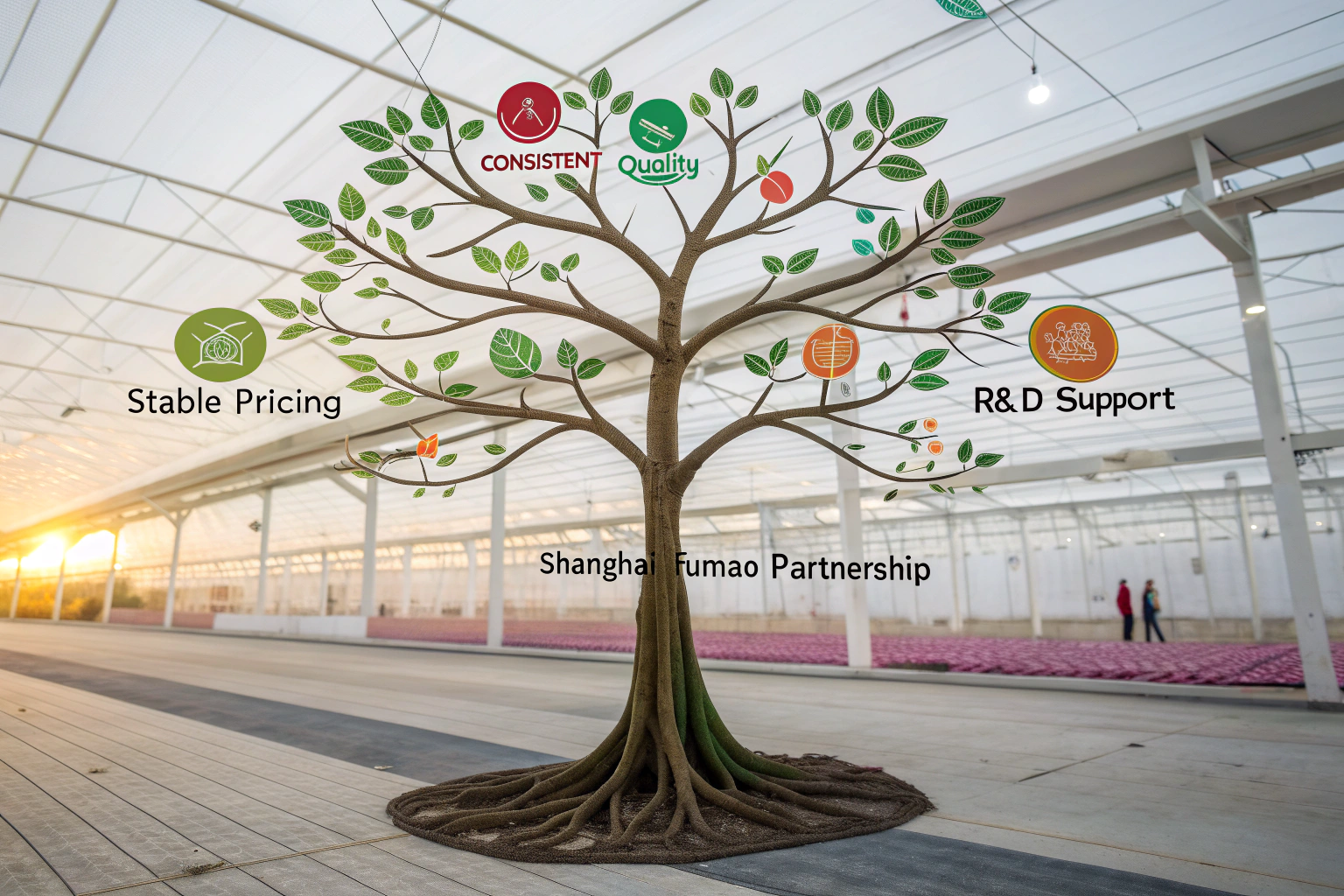
The single greatest long-term benefit of partnering with Shanghai Fumao is Predictable Continuity. We call it Supply Chain Serenity. It’s the confidence that the 400GSM organic fleece you ordered in 2024 will be the exact same 400GSM organic fleece you reorder in 2026. It’s knowing that when you email your account manager, you’ll get a reply within 12 hours (usually 2). It’s knowing that the CNAS Lab Report you get with Lot #A will match the specs of Lot #B a year later. This continuity translates directly to Brand Equity. Your customers come to trust the fit and feel of your garments because the fabric never "mysteriously changes." And operationally, it means Lower Procurement Costs. You stop paying for 3rd party inspections on every single container. You stop air-freighting emergency replacement fabric. You stop wasting your team’s time onboarding new vendors every six months.
I’m going to walk you through the specific, tangible ways a long-term partnership with us builds value over time. This isn’t about the first PO. This is about the tenth PO. The twentieth. It’s about the preferential access to capacity during peak season, the shared R&D that creates exclusive fabrics for your brand, and the financial flexibility that comes when a supplier actually trusts you. These are the benefits that don’t show up on a first-time quote sheet, but they are the difference between a brand that struggles and a brand that scales.
How Does Multi-Year Sourcing Reduce Per-Unit Fabric Cost?
Let’s talk about the economics of trust. The price on a spot-buy PO is always a Risk-Adjusted Price. When you’re a new, unknown buyer, the supplier has to price in the risk of you being difficult, paying late, or canceling the order. That’s a "Stranger Tax." It’s usually 5-10% baked into the margin. Over the course of a multi-year relationship, that tax disappears.
At Shanghai Fumao, we practice Strategic Cost Averaging. Let’s use Yarn Price as an example. The price of cotton and polyester fluctuates weekly based on global commodity markets. A transactional buyer feels every single spike. They place an order in March when cotton is at \$0.85/lb. By June, it’s \$0.95/lb. The supplier demands a price increase. The buyer fights it. Relationship sours. For our Long-Term Partners, we Hedge Yarn Purchases. When we forecast their annual volume (say, 200,000 yards of a core cotton spandex), we buy the yarn futures or stock the greige inventory in advance. We can Lock in a 12-Month Price Agreement. The partner doesn’t get hit with mid-season surcharges. Their COGS is stable. They can plan their retail pricing with confidence.
There’s also Amortization of Development Costs. The first time we develop a custom color or a specific finishing hand feel for you, it takes 40 hours of lab time. That cost is absorbed by Shanghai Fumao as an investment. If you only order 500 yards, we lose money on that development. If you reorder that same color for three years, that initial R&D cost gets spread over 50,000 yards. It becomes negligible. This is why we offer Free Lab Dips for Reorders to our long-term partners. The math works for both of us.

Does Fumao Offer Volume Discounts for Annual Contracts?
Yes, but we structure it differently than a simple "5% off for 10,000 yards." That’s a one-time transaction discount. For long-term partners, we offer Tiered Rebate Programs and Capacity Reservation Discounts.
A Tiered Rebate works like this: We agree on an Annual Volume Target (e.g., 100,000 yards). You don’t have to order it all at once. You place POs throughout the year as needed. At the end of the fiscal year, if you’ve hit the target, we issue a Retroactive Rebate Credit (usually 3-5% of total spend) applied to future invoices. This aligns our incentives. We want you to grow. We give you a reason to consolidate your sourcing with us rather than splitting orders among three different vendors.
Capacity Reservation is even more valuable for a fast-growing brand. Let’s say you forecast you’ll need 20,000 yards of Nylon Taffeta next October for a big coat program. You don’t have the PO from your retail buyer yet. You’re nervous. If you wait until August to place the order, we might be booked solid. With an annual partnership, you can place a Soft Reservation on our production calendar. No deposit needed. Just a good-faith forecast. We block the loom time. This guarantees you Peak Season Capacity without the cash flow strain of placing a firm PO 6 months out. In September 2025, a Canadian outerwear partner did exactly this. They forecasted 15,000 yards. The actual PO came in at 22,000 yards. Because we had blocked capacity, we absorbed the 7,000-yard increase and still delivered on time. A spot buyer would have been told, "Sorry, lead time is 12 weeks now."
Can Long Term Partners Access Greige Stock Before Market Peaks?
Absolutely. This is one of the most under-appreciated benefits of a deep partnership. Greige Stock Priority Access is our version of a "Fast Pass" at Disney World, but for fabric.
As I’ve mentioned in other articles, we carry massive inventory of core greige constructions (Cotton Twill, Nylon Taffeta, Polyester Pongee). When the market heats up—say, in August when every brand suddenly needs puffer jacket shell fabric—the spot market price for greige goods spikes. And availability dries up. New buyers are told, "Sorry, we have no open capacity for greige weaving until November."
Long-term partners are Immunized from this. We have a Partner Allocation List. Before we sell greige stock on the open market or to new inquiries, we check the forecast of our established partners. If Partner A has a history of ordering 20D Nylon in Q3, we Earmark that greige for them. We don’t sell it to a stranger offering a higher price. We do this because the Lifetime Value of the partner relationship is worth infinitely more than the extra 10 cents a yard we might scalp on a spot sale. In July 2024, the nylon market tightened significantly. A spot buyer offered us a 20% premium for our 20D greige stock. We declined. We fulfilled our partner’s POs at their contracted annual price. That partner has since doubled their business with us. That’s the long-term play.
How Does Fumao Support Consistent Garment Quality Over Time?
Fabric is the raw material. Garment quality is the finished product. The bridge between them is Consistency. If the fabric changes, the sewing line falls apart. Operators who have sewn 10,000 units of a style develop Muscle Memory. They know exactly how much tension to apply, exactly how much to stretch the binding. If the fabric suddenly has 10% more spandex or a stiffer hand feel, that muscle memory becomes a liability. Seams pucker. Sizes come out wrong. Efficiency drops.
At Shanghai Fumao, we maintain Detailed Technical Records for every partner. We call it a "Fabric Fingerprint." For every SKU we produce for a brand, we keep:
- Yarn Lot Archive: A sample of the exact yarn cone used.
- Loom Settings: Warp tension (in Newtons), Weft Insertion Timing (in degrees).
- Dye Recipe: The exact grams per liter of each dye stuff and chemical.
- Finish Recipe: The exact softener, pressure, and temperature of the calender.
- Lab Test Results: Shrinkage, Color Fastness, Tear Strength.
When a partner places a reorder 18 months later, we don’t just pull a spec sheet. We pull the Fingerprint. We match the new production to the old record. We might even Blend a new yarn lot with an old archived lot to ensure the visual and tactile match is perfect. This is the kind of obsessive record-keeping that prevents the dreaded "drift" in quality. You can learn more about the importance of this in discussions on textile consistency and quality management on the AATCC forums.

What Is a "Repeatable Lab Dip" and Why Does It Matter?
A Lab Dip is a small sample of fabric dyed to match a specific color standard (like a Pantone chip). Getting a match Once is easy. Getting the Exact Same Match two years later, on a different lot of greige fabric, with a different batch of dye powder… that’s where the artistry and science of a professional dye house shines.
The value of a Repeatable Lab Dip is Seamless Season-to-Season Continuity. A brand designs a core chino program in "Olive." They sell it Spring 2025. It’s a hit. They reorder for Fall 2025. If the new "Olive" is slightly more brown or slightly more green, the pants don’t match the jacket from the previous season. The customer who wants to complete the suit is angry. The retailer who stocks both seasons side-by-side on the rack is angry. That’s a Chargeback.
At Shanghai Fumao, we use Computer Color Matching (CCM) for all repeat lab dips. The software analyzes the target color (from our archive) and calculates the exact recipe using the current dye inventory. But software isn’t enough. Our Color Matcher (a human with 25 years of experience) then visually approves the dip under Three Different Light Sources (D65 Daylight, TL84 Store Light, Incandescent Home Light). This checks for Metamerism (colors matching under one light but not another). We won’t ship a repeat color until it scores a Delta E < 0.8 from the archived standard. This is a tighter tolerance than most commercial contracts require. We do it because we know that "Olive" has to be "Olive," every single time. You can read more about this in the X-Rite guide to digital color management in textiles.
How Are Construction Specs Archived for Future Production Runs?
This is the "bible" of fabric manufacturing. If you don’t have a disciplined archiving system, you’re just reinventing the wheel every time. We use a Digital Spec Archive accessible to our production, QC, and sales teams.
When we finish a successful production run, the Quality Assurance Manager signs off on a Master Roll Spec Sheet. This sheet contains:
- Construction Details: Ends per inch (EPI), Picks per inch (PPI), Yarn Count (Ne or Denier).
- Finishing Details: Finished Width, Weight (GSM), Calender Pressure (Tons), Stenter Temperature (°C).
- Physical Test Data: Shrinkage (%), Tear Strength (kg), Seam Slippage (lbs).
- Reference Swatch: A physical swatch of the approved fabric is Heat Sealed in a Mylar Sleeve and filed in our climate-controlled archive room. Why Mylar? Because plasticizer from PVC sleeves can yellow fabric over time.
This archive is Sacred. If a partner wants to reorder style #FUM-23105, we don’t ask them for a new spec. We pull the archive. We replicate it exactly. This protects the partner from "Spec Creep." That’s when a mill slowly changes the construction to save money (e.g., dropping from 110×80 density to 105×76 density) hoping the buyer won’t notice. We don’t play that game. The archive keeps us honest.
Why Is Direct Mill Access Critical During Global Supply Crises?
Remember the Suez Canal blockage? The Red Sea attacks? The pandemic lockdowns? The global supply chain is a fragile web. When a crisis hits, the Middlemen Disappear. They go silent on WhatsApp. They have no inventory. They have no control. They just forward you the bad news.
A direct mill partnership is your Lifeboat in the Storm. When the Shanghai port was congested in 2022, we couldn’t magically make the boats move faster. But we could provide Real-Time Visibility. We could tell a partner: "Your container is currently in the Yangshan Deepwater Port holding area. The vessel ETD is delayed 3 days. Here is the updated booking confirmation." A trader can’t provide that. They don’t have the direct relationship with the forwarder or the terminal.
More importantly, a mill can offer Production Re-Routing. During the US West Coast port labor disputes, we worked with a partner to Divert a Container from Long Beach to Prince Rupert, Canada, and then rail it into the Midwest. This required re-issuing the Bill of Lading, the Commercial Invoice, and the Packing List. It was a paperwork nightmare. But we did it. Because we own the process. A middleman would have just said, "Sorry, container is stuck in LA. Wait 4 weeks."
At Shanghai Fumao, we view crisis management as part of the long-term value proposition. We don’t charge extra for being responsive during a disaster. It’s built into the relationship. We know that helping a partner survive a supply chain shock earns Lifetime Loyalty.

How Did Fumao Manage Client Orders During the Red Sea Crisis?
The Red Sea crisis that began in late 2023 forced container ships to divert around the Cape of Good Hope. This added 10-14 days to transit times and doubled freight costs. For a brand on a tight seasonal calendar, this was a potential disaster.
Our response was Proactive Communication and Inventory Buffering. First, we immediately emailed every partner with open orders and explained the situation. We provided Three Options:
- Hold and Wait: Keep goods in our Keqiao warehouse until rates stabilize (risky for timing).
- Ship via Cape Route: Accept longer lead time and higher freight surcharge.
- Ship via China-Europe Railway Express: Faster than sea (18-22 days) but more expensive than standard sea freight.
We didn’t just send an invoice for the higher freight. We worked with our forwarders to Negotiate Consolidated Rates. Because we ship 200+ containers a year, we have leverage. We secured rail space for a US outdoor brand’s critical winter coat shell fabric in January 2024. The cost was higher, but the goods arrived in 21 days instead of 50 days. The brand launched on time. They absorbed the freight hit, but they Had Product to Sell. That’s a win. The alternative was a warehouse full of coats with no shells.
Second, for partners who could wait, we offered Free Extended Warehousing in Keqiao. We held their finished fabric for 6 weeks at no charge until the ocean freight market cooled slightly. This cost us warehouse space, but it saved the partner thousands in detention fees at the destination port. That’s what a partner does.
Can a Mill Guarantee Capacity When Commodity Yarn Is Scarce?
Yes, but only for Long-Term Partners with Forecasts. There is no magic wand. When there’s a global shortage of a specific yarn (like High Filament Nylon 6,6 or Extra-Long Staple Cotton), the spinning mills allocate their output. They allocate to Stable, High-Volume Customers. That’s us.
Because Shanghai Fumao has 20-year relationships with our yarn suppliers, and because we place Blanket Orders for yarn months in advance, we have First Right of Refusal on available supply. When a spot buyer calls a spinner in a shortage, they get laughed at. When we call, we get our allocation.
We pass this security on to our partners. In 2025, there was a tightness in the 40D Nylon DTY (Draw Textured Yarn) market due to a plant shutdown in Taiwan. Spot prices spiked 25%. Spot buyers couldn’t get yarn at any price. Our partners who had shared their annual forecast for activewear fabrics? They got their fabric. On time. At the contracted price. Because we had already bought the yarn for them.
This is the ultimate long-term benefit: Insulation from Commodity Volatility. You can’t get this from a website. You can’t get this from a trader. You only get it from a vertically integrated mill that treats you like a stakeholder, not a transaction.
What Financial Incentives Exist for Exclusive Sourcing Agreements?
Exclusive sourcing sounds restrictive. "You want me to only buy from you?" But in the textile world, a well-structured exclusive agreement is actually a Financial Leverage Tool for the brand.
We don’t ask for exclusivity on everything. That’s unrealistic. We ask for exclusivity on Core Programs or Specific Fabric Categories. For example, "We will be your exclusive supplier for 20D Nylon Downproof Shells and 300GSM Cotton Fleece." In exchange, we offer Enhanced Terms.
These terms can include:
- Extended Payment Terms: Moving from LC at Sight to Net 60 Days after 12 months of perfect payment history. This is a massive cash flow benefit for a growing brand. It means you sell the garments to retailers before you have to pay us for the fabric.
- Reduced or Waived Sample Fees: Sampling costs real money. For exclusive partners, we waive the courier fees and lab dip fees for development. We view it as joint R&D.
- Consignment Stock Programs: For very high-volume, predictable partners, we can hold Finished Goods Inventory in Keqiao that is legally theirs but physically in our warehouse. They draw down against it with POs. This slashes lead times to 3-5 Days for reorders.
These financial incentives aren’t just about saving pennies. They are about Velocity. Faster cash conversion cycles. Faster speed to market. That’s how you beat the competition.

Does Fumao Offer Consignment Stock for Top Tier Partners?
Yes. This is our "Fumao Reserve" Program. It’s not for everyone. It requires a Minimum Annual Volume Commitment (usually 50,000 yards across a few core SKUs) and a 12-Month Rolling Forecast.
Here is how it works. Let’s say you use 20D Black Nylon Taffeta and 400GSM Natural Cotton Fleece consistently. We agree on a Buffer Stock Level (e.g., 5,000 yards of each). We produce this buffer stock at our expense and store it in our Bonded Warehouse. This fabric is Allocated to You. We cannot sell it to anyone else without your permission.
When you need fabric, you issue a Release PO. We ship within 72 Hours. You pay for that specific shipment. The buffer stock level drops. We then replenish the buffer on our next production run.
The benefit to you:
- Zero Lead Time on Core Fabrics. You can react to a hot seller immediately.
- No Cash Tied Up in US Warehouse Inventory. You don’t pay for the fabric until you need it. This improves your Inventory Turnover Ratio.
- Hedge Against Price Increases. The buffer stock price is locked in for the 12-month agreement period.
We launched this program in 2024 with three long-term partners. Their reorder business grew by 40% year-over-year because they never missed a sales opportunity due to "out of stock." (Here I have to jump in—this program gives our warehouse manager anxiety because he has to keep "other people’s fabric" separate from "our fabric," but the color-coded racking system works like a charm.)
How Does Partnership Reduce the Cost of Third-Party Inspections?
Third-party inspection (SGS, Intertek, Bureau Veritas) is expensive. A standard AQL 2.5 Final Random Inspection costs \$350-\$500 per day, plus travel time. If you’re a new buyer ordering from an unknown factory, you Must Do This for every single shipment. It’s non-negotiable insurance.
But if you’re a long-term partner of Shanghai Fumao, you’re paying for insurance against a risk that no longer exists. You know our quality systems. You’ve visited our factory. You’ve seen our CNAS-Accredited Lab. You’ve received 20 shipments with a 98%+ Pass Rate. At some point, the cost of the inspection exceeds the value of the risk mitigation.
Many of our partners have transitioned to a Skip-Lot Inspection Protocol with us. They inspect the first shipment of a new style, but for repeat orders of the same style, they rely on our Internal Mill Test Reports (MTRs) . Our MTR is generated by our CNAS lab, which is held to the same ISO 17025 standard as SGS. It’s a legally defensible document. This saves our partners roughly \$1,500 – \$2,000 per year per SKU in inspection fees.
Of course, if a partner wants a third-party inspection for their own internal compliance or customer requirements, we welcome it. Our doors are open. We have a 100% success rate with unannounced audits. But the trust we’ve built allows partners to reallocate that inspection budget to marketing or product development. That’s a competitive advantage.
Conclusion
The fabric industry is full of transactional relationships. You send a PO. I send a price. You send money. I send fabric. End of story. That model works if you’re making cheap promotional tote bags that change design every month. It fails miserably if you’re building a brand. A brand is a promise. And that promise is only as strong as the weakest link in your supply chain.
A long-term partnership with Shanghai Fumao transforms the supply chain from a Cost Center into a Strategic Asset. It’s the difference between buying fabric and Investing in Capacity. You invest your trust and your forecast with us, and we return that investment with Price Stability, Quality Continuity, Crisis Resilience, and Financial Flexibility. We become an extension of your operations team. We worry about the yarn market so you can worry about your Instagram ads. We archive your color standards so you can design next season’s collection with confidence. We block loom time for you when the market is crazy.
This is the real benefit. It’s not a line item on a quote sheet. It’s the Freedom to Scale. It’s waking up in the morning and not worrying if your fabric shipment from China is going to be a disaster. It’s knowing that the partner on the other side of the world has your back.
If you’re ready to stop sourcing fabric and start building a supply chain partnership, let’s have a conversation about your long-term goals. We can discuss our Annual Partner Program and what a customized agreement might look like for your specific product mix.
Reach out to our Business Director, Elaine. She manages all strategic partnership inquiries and can walk you through the specifics of our tiered benefits. Her email is elaine@fumaoclothing.com. Let’s build something that lasts longer than a single season.








