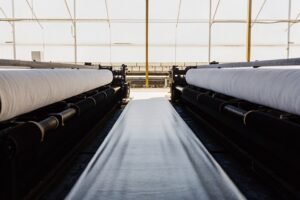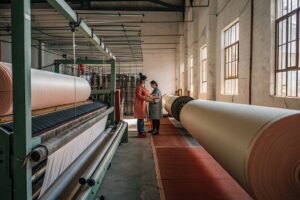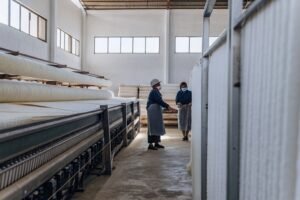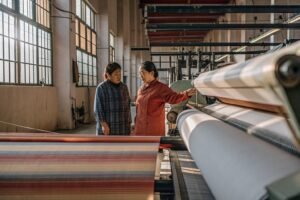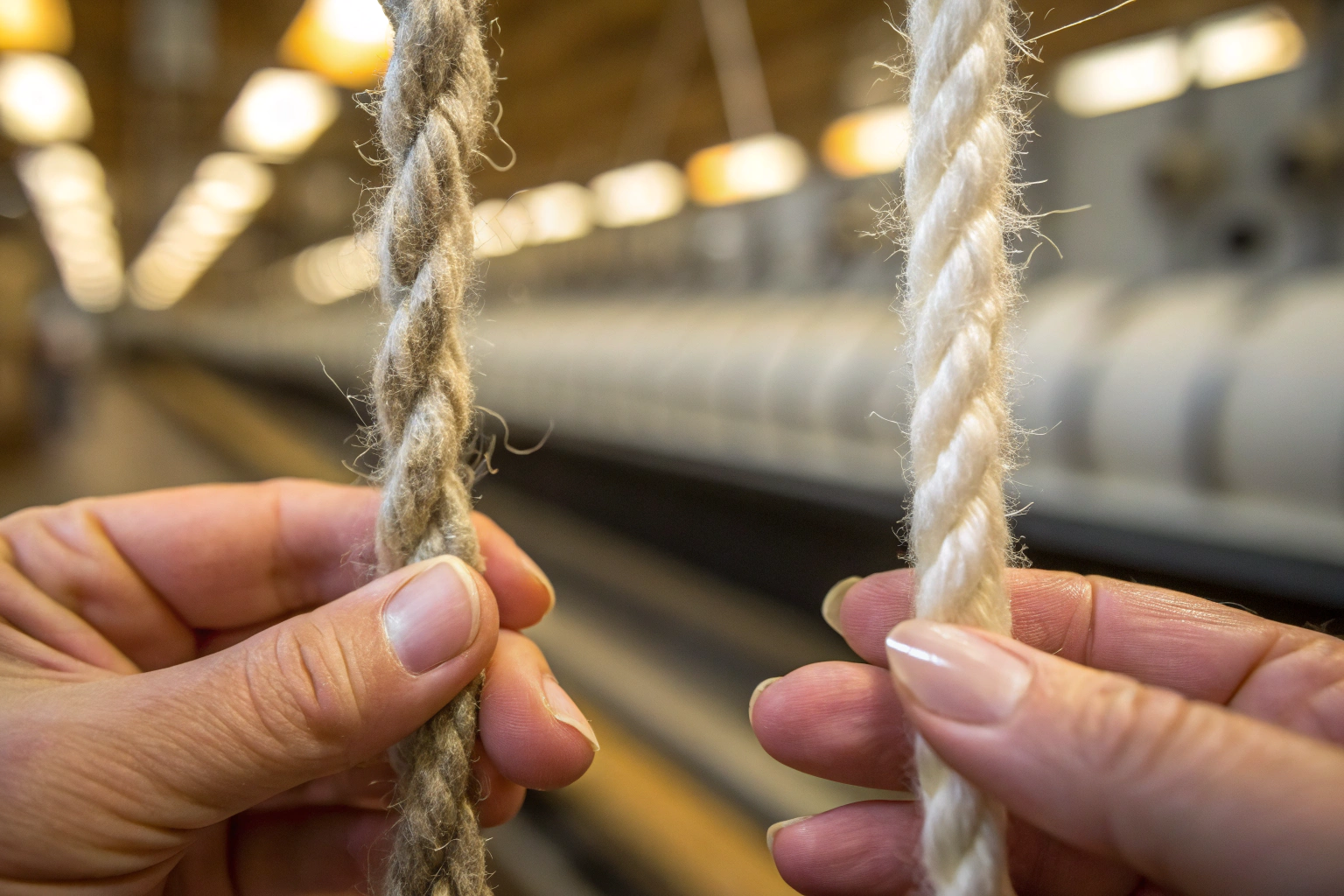
I was standing in our spinning mill in Keqiao last winter with a young entrepreneur who had just launched a premium t-shirt brand. He had two white t-shirts in his hands. One was from a well-known mall brand, priced at $12.99. The other was his sample, made with our fabric, priced at $48.00. He rubbed them both, held them to his cheek, and said, "I can feel the difference, but I can’t explain it. Why does mine feel like a cloud and theirs feel like… paper?" I took the two shirts from him, turned them inside out, and pointed to the surface of the fabric. "Look at the fuzz," I said. "That’s open end yarn. It’s made fast and cheap. Yours is ring spun. It’s made slow and careful. That’s the whole story right there."
The fundamental difference between ring spun yarn and open end yarn comes down to how the individual cotton fibers are twisted together. Ring spinning is a mechanical process that uses a rotating spindle and a traveler to continuously twist and wind the yarn. It mimics the action of a hand-spinning wheel. It’s slow, it’s expensive, and it produces a yarn where the fibers are aligned parallel to each other and tightly twisted. Open end spinning (also called rotor spinning) uses a high-speed rotor that separates the fibers with air and then reassembles them around a core. It’s incredibly fast—up to five times faster than ring spinning. But the fibers in open end yarn are not aligned. They’re wrapped around each other in a chaotic, random pattern. Some fibers are wrapped tightly. Some are just looped around the outside. Some are barely attached at all.
That’s the technical explanation. But for a brand owner or a designer, the real question is: What does that mean for the fabric I’m buying? At Shanghai Fumao, we spin both types of yarn for different applications. We don’t have a religious objection to open end spinning. It has its place. But if you’re building a brand that promises quality, softness, and durability, you need to understand why ring spun is almost always the superior choice.
How Does The Spinning Process Affect Yarn Strength And Durability?
This is the most objective, measurable difference between the two yarn types. Ring spun yarn is stronger. Not by a little. By a lot. When you compare a 30/1 ring spun yarn to a 30/1 open end yarn made from the exact same cotton bale, the ring spun yarn will have 15-20% higher tensile strength. This is a fact, verified by thousands of tests in our CNAS lab.
Why? Because of fiber alignment. In a ring spun yarn, the cotton fibers are combed parallel and then twisted together. The twist binds the fibers along their entire length. When you pull on the yarn, the force is distributed evenly across hundreds of fibers, all pulling together in the same direction. It’s like a well-organized tug-of-war team where everyone pulls at the same time.
In an open end yarn, the fibers are a tangled mess. Some fibers are wrapped around the core. Some are just "belted" around the outside. When you pull on an open end yarn, the force is carried by a smaller number of "wrapper" fibers. The core fibers aren’t contributing as much because they’re not locked in by the twist. The yarn fails at a lower force. It’s like a tug-of-war team where half the people are facing the wrong direction.
This strength difference translates directly to the weaving and knitting floor. When we run a 40/1 ring spun yarn on our high-speed air-jet looms, we might get 1.2 yarn breaks per 100,000 meters. With a 40/1 open end yarn, that number jumps to 3.5 breaks per 100,000 meters. Every break stops the loom. A technician has to tie the broken ends and restart the machine. That’s lost production time. That’s why fabric made from open end yarn is cheaper—not just because the yarn is cheaper to spin, but because the weaving efficiency is lower.

How Does Yarn Strength Affect Garment Longevity?
A garment’s life is a series of small stresses. The shoulder seam of a t-shirt gets pulled every time you put it on. The elbow of a sleeve stretches every time you bend your arm. The knees of your pants stretch every time you sit down. A fabric made from ring spun yarn can absorb these stresses and recover. The strong, well-twisted yarn acts like a spring. It stretches, but it doesn’t break.
A fabric made from open end yarn has a lower threshold for failure. The weak wrapper fibers on the surface of the yarn are the first to go. They abrade away during wear and washing. This is why open end fabrics tend to thin out over time. The fabric doesn’t rip dramatically. It just slowly loses mass until it becomes translucent and fragile. You’ve seen this in cheap t-shirts that start out feeling substantial and end up feeling like tissue paper after 20 washes.
I had a client who produced workwear for a construction company. They needed durable, heavy-duty shirts. The initial samples were made with an 8/1 open end yarn. The shirts felt heavy and sturdy out of the box. But after three months of industrial laundering, the fabric had lost 30% of its tensile strength. The shirts were developing holes at the stress points. We switched them to an 8/1 ring spun yarn. The fabric weight was identical. The cost was 18% higher. But the shirts lasted two full seasons instead of one. The company’s uniform replacement budget dropped by 40%. The higher upfront fabric cost was a rounding error compared to the savings in replacement garments.
This is a perfect illustration of how ring spun yarn strength contributes to garment durability and longevity. For any application where the garment will be worn hard and washed frequently—uniforms, workwear, kids’ clothing—ring spun is not a luxury. It’s a necessity.
Can Open End Yarn Ever Be The Better Choice?
Yes. I want to be fair here. Open end yarn is not "bad." It’s a different tool for a different job. Open end yarn excels in bulk and coverage. Because the fibers are randomly oriented and the yarn has a lower twist, it traps more air. A fabric made from open end yarn will feel loftier and thicker than a ring spun fabric of the exact same weight. This is called "bulk."
For applications where hand feel and durability are less critical than cost and coverage, open end is the smart choice. Think about the backing fabric for a coated upholstery fabric. You never touch it. You never wash it. It just needs to be a stable, inexpensive substrate for the coating. Open end yarn is perfect for that.
It’s also commonly used for denim. The slightly irregular, "hairy" surface of open end yarn actually enhances the abrasion characteristics of denim. It creates more surface area for the indigo dye to wear away, giving those beautiful, high-contrast fades that denim enthusiasts love. Some premium denim mills actually prefer open end yarn for the weft (the crosswise yarn) because it creates a more textured, "authentic" vintage look.
The key is to understand the trade-off. Open end gives you bulk and cost savings, but you sacrifice strength and softness. Ring spun gives you strength and softness, but you pay more and the fabric has a slightly "flatter" initial appearance (though it softens beautifully with washing). This is the core of understanding the trade-offs between open end and ring spun yarn for different fabric applications.
Why Does Ring Spun Fabric Feel Softer Against The Skin?
This is the difference that my entrepreneur friend felt immediately. Softness is subjective, but it’s rooted in objective fiber physics. The human fingertip is incredibly sensitive. It can detect surface irregularities as small as a few microns. When you touch an open end fabric, your fingertips are touching thousands of loose fiber ends that are sticking out of the yarn like tiny bristles. These bristles create friction and a sensation of "roughness" or "scratchiness."
When you touch a ring spun fabric, the surface is dramatically smoother. Because the fibers are aligned and twisted tightly into the yarn core, there are far fewer loose ends protruding. Your fingertip glides over the surface of the yarns rather than catching on individual fibers. This is why ring spun cotton is described as "soft" or "silky."
But there’s another factor: fiber migration. In a ring spun yarn, the longer fibers tend to migrate to the core of the yarn, while the shorter fibers are forced to the surface. This is a natural consequence of the twisting action. In an open end yarn, the fiber distribution is random. You’re just as likely to have a short, scratchy fiber on the surface as a long, smooth one. Ring spinning essentially "hides" the rougher fibers inside the yarn, presenting a surface composed of the smoothest, longest fibers.

How Does Washing Change The Hand Feel Of Each Yarn Type?
This is where ring spun fabric really shines. An open end fabric arrives with a certain level of softness, but it doesn’t improve much with washing. In fact, it often gets worse. As the weak wrapper fibers abrade away, the yarn becomes thinner and the fabric can develop a rough, "picked" surface.
A ring spun fabric, especially if it’s made from combed cotton, actually gets softer with every wash. This is the "break-in" period that premium denim and high-end shirting are famous for. The mechanical action of washing and drying relaxes the twist slightly. The fibers bloom and fluff up microscopically. The fabric conforms to the wearer’s body. It becomes a personalized, comfortable garment.
I had a client who made luxury bed sheets. They were using a 60/1 ring spun yarn for their sateen. Their competitor was selling a sheet set with a "1000 thread count" made from a 50/1 open end yarn. The competitor’s sheets felt heavier and slicker out of the package. The customer loved them—for about three washes. Then the open end sheets started to pill and feel rough. Our client’s ring spun sheets felt crisp out of the package, but after five washes, they were buttery soft. The customer reviews told the story. The competitor had a 3.8-star rating with complaints about "pilling after a month." Our client had a 4.7-star rating with reviews saying "gets softer every time I wash them."
This is the long game of fabric quality. Open end fabric is front-loaded. It feels good enough on the retail floor to make the sale. Ring spun fabric is back-loaded. It rewards the customer for keeping the garment, building loyalty over time. For brands that rely on repeat purchases, this is a critical distinction. Understanding how ring spun and open end cotton fabrics evolve in softness after repeated laundering is essential knowledge for any brand manager.
What Role Does Twist Play In The Softness Equation?
Twist is a double-edged sword. More twist generally means more strength and less pilling. But too much twist makes the yarn hard, wiry, and "crunchy." It loses its softness. This is why you can’t just take an open end yarn, add more twist, and make it perform like a ring spun yarn. The fiber alignment is still random.
Ring spinning allows for a specific type of twist called "Z-twist" that is highly uniform. The twist is concentrated in the core of the yarn, leaving the surface fibers relatively relaxed. This is what creates that "soft strength."
Open end yarn twist is different. It’s often described as having a "sheath-core" structure. The core fibers are relatively straight, and a thin layer of "wrapper" fibers is twisted tightly around the outside. This tight wrapper layer is what gives open end yarn its strength, but it’s also what makes it feel "crispy" or "papery." You can’t relax that wrapper layer without the yarn falling apart.
At Shanghai Fumao, we spend a lot of time dialing in the optimal twist multiple (TM) for each yarn count and end-use. For a ring spun 40/1 used in a luxury t-shirt, we might use a TM of 3.8. This gives excellent strength with a soft, fluid drape. For a ring spun 20/1 used in denim, we might use a TM of 4.2. This gives the yarn the rigidity and "crunch" that denim needs to hold a crease and develop sharp fades. Twist is not a one-size-fits-all setting. It’s a precise engineering parameter.
How Do The Two Yarn Types Affect Fabric Appearance And Dyeing?
The visual difference between a ring spun fabric and an open end fabric is subtle but significant. Ring spun fabric has a cleaner, more uniform surface. The aligned fibers create a smooth, almost polished look. Light reflects off the fabric evenly, giving it a subtle luster. This is especially noticeable in solid colors, where a ring spun jersey looks "deep" and "rich."
Open end fabric has a "cloudy" or "dusty" appearance. The random fiber orientation scatters light in all directions. The surface looks matte and slightly textured. In dark colors like navy or black, this can make the color look flat and faded, even when it’s brand new.
This difference is amplified in the dyeing process. Ring spun yarn, because of its uniform fiber alignment and smooth surface, absorbs dye evenly and deeply. The color is vibrant and saturated. Open end yarn absorbs dye unevenly. The tightly wrapped surface fibers take the dye quickly, while the looser core fibers take it more slowly. This can lead to a "frosty" or "heather" effect, even when dyeing a solid color. Some mills actually use this to their advantage, creating "melange" effects with open end yarn that would be more expensive to produce with ring spun. But for a true, deep solid color, ring spun is the only way to go.

Why Does Ring Spun Fabric Print Better?
This is a critical consideration for anyone doing screen printing, digital printing, or discharge printing. The smooth, uniform surface of a ring spun fabric provides a perfect canvas for ink. The ink sits on top of the fabric surface, creating a crisp, clean edge. The print looks sharp and professional.
On an open end fabric, the fuzzy surface acts like a sponge. The ink wicks into the loose fibers and spreads slightly. This is called "ink bleed" or "dot gain." The edges of the print look soft and blurry. Fine details and small text can become illegible. If you’re printing a intricate logo or a photorealistic image, you will see a noticeable difference in print quality between ring spun and open end.
I had a client who was a graphic designer launching a line of artist-series t-shirts. The designs were complex, with fine lines and subtle gradients. The first production run was on a budget open end jersey. The prints looked "muddy." The fine lines filled in. The gradients were blotchy. They were embarrassed to sell them. We re-ran the order on a ring spun combed jersey. The same screens, the same ink, the same printer. The prints were razor sharp. The difference was entirely in the fabric surface. That’s the power of why ring spun cotton provides a superior surface for screen printing and digital textile printing.
Does Ring Spun Yarn Pill Less Than Open End?
This is one of the most common questions I get, and the answer is an emphatic yes. Pilling is the formation of those annoying little fuzz balls on the fabric surface. It’s caused by loose fibers working their way out of the yarn and tangling together.
Open end yarn is a pilling machine. It’s literally designed with loose "wrapper" fibers on the surface. These fibers are just begging to be rubbed loose and form pills. Even with aggressive anti-pilling finishes, an open end fabric will always pill more than an equivalent ring spun fabric.
Ring spun yarn, especially if it’s combed and made from long-staple cotton, has very few loose fibers to begin with. The fibers that are on the surface are anchored deep within the twist. They resist being pulled out. The result is a fabric that stays smooth and pill-free for the life of the garment.
We do a standardized pilling test in our lab (ASTM D4970, Martindale method) for all our fabrics. A typical 30/1 ring spun combed jersey will score a 4.5 to 5.0 after 500 cycles. A 30/1 open end jersey, made from the same cotton, will score a 3.0 to 3.5. That’s the difference between a garment that looks new after a year of wear and a garment that looks like it needs to be thrown away. For any brand concerned with how yarn spinning method impacts pilling resistance in knit and woven fabrics, the choice is clear.
How Should I Decide Between Ring Spun And Open End For My Project?
The decision comes down to a matrix of four factors: Price, Performance, Aesthetic, and Application. You have to be honest about where your brand sits on this matrix. There’s no shame in using open end yarn for the right product. The shame is in using open end yarn and pretending it’s premium, or using ring spun yarn for a product where the customer won’t notice or care.
Here’s the framework I use with my clients. We go through this checklist for every new development project.
Choose Ring Spun Yarn If:
- The garment will be worn directly against the skin (t-shirts, underwear, bedding).
- The brand promise includes "softness," "luxury," or "heirloom quality."
- The design includes fine-gauge printing or intricate details.
- The garment needs to withstand frequent industrial or home laundering.
- The target retail price point supports a higher fabric cost.
Choose Open End Yarn If:
- The garment is a basic, price-driven commodity (promotional giveaways, basic workwear).
- The fabric will be heavily coated or finished (upholstery backing, some denim).
- The aesthetic calls for a "rustic," "vintage," or "textured" look.
- The production volume is massive and every penny of cost matters.
- The customer’s primary buying criteria is price, not longevity.

Can I Blend Ring Spun And Open End Yarns In The Same Fabric?
Yes, this is a common strategy to balance cost and performance. It’s called a "hybrid construction." For example, you might use a ring spun yarn in the warp (the lengthwise yarns) of a woven fabric, and an open end yarn in the weft (the crosswise yarns).
Why? The warp yarns are under constant tension on the loom and take the most stress during weaving. They need to be strong. Using ring spun in the warp reduces loom stops and improves weaving efficiency. The weft yarns are inserted with less tension. They can be a cheaper open end yarn without causing as many problems. The finished fabric benefits from the strength of the ring spun warp and the bulk of the open end weft, at a cost that’s lower than 100% ring spun.
We developed a fabric like this for a client making entry-level denim jeans. They wanted the look and feel of a premium denim but at a price point for the mass market. We used a 10/1 ring spun yarn in the warp (dyed with indigo) and a 10/1 open end yarn in the weft (natural greige). The warp provided the strength and the beautiful vertical grain of the denim. The weft provided bulk and a soft hand feel at a lower cost. The jeans retailed for $68 and had a 4.2-star rating. They found the sweet spot.
This is an advanced technique in how to use hybrid yarn spinning strategies to optimize fabric cost and performance. It’s not just about picking one yarn or the other. It’s about engineering the fabric structure to put the right yarn in the right place.
What Questions Should I Ask My Supplier About Yarn Quality?
Don’t just accept "ring spun" on a spec sheet. Ask for specifics. A vague claim of "ring spun" could mean a low-quality, carded ring spun yarn with a short staple fiber. That’s better than open end, but it’s still not premium.
Here are the five questions I would ask any fabric supplier about their yarn:
- "What is the yarn count and the specific spinning system?" (e.g., 30/1 Ring Spun Combed Compact)
- "What is the cotton origin and staple length?" (e.g., US Pima, 1-3/8" staple)
- "What is the twist multiple (TM) used for this construction?" (e.g., TM 3.8)
- "Can you provide a test report showing the yarn’s Uster evenness and hairiness values?"
- "Do you have a retained sample of the actual yarn lot used for my order?"
If the supplier can answer these questions confidently and provide documentation, you’re dealing with a professional operation. If they look at you blankly and say "It’s good quality, don’t worry," you’re dealing with a trader who doesn’t control their supply chain. Walk away.
At Shanghai Fumao, we have this data for every yarn lot we purchase. We track it in our ERP system. We can tell you the exact spinning mill, the cotton blend, and the Uster statistics for the yarn in your fabric. This is the level of transparency required to build a consistent, high-quality brand.
Conclusion
Ring spun yarn is better than open end yarn in almost every way that matters to the end consumer: it’s stronger, softer, smoother, and it ages more gracefully. It makes garments that feel better on the skin, look better on the hanger, and last longer in the closet. It is the foundation of every premium cotton product on the market.
Open end yarn has its place. It’s a workhorse of the textile industry, producing affordable fabrics for a global market. It’s not inherently "bad." It’s just not "premium." The problem arises when brands try to sell open end fabric at ring spun prices, or when buyers don’t know the difference and end up disappointed by the quality of the garment they’ve sourced.
The difference between these two yarns is not a marketing story. It’s a physical reality that you can see under a microscope, measure in a lab, and feel with your own hands. If you’re building a brand that stands for quality, you owe it to yourself and your customers to understand that reality.
If you’re trying to navigate the yarn options for your next collection, or if you’ve got a fabric sample that you’re not sure about, send it to us. We’ll put it under the microscope and tell you exactly what you’re looking at. Reach out to our Business Director, Elaine, at elaine@fumaoclothing.com. She can set up a technical consultation and help you specify the right yarn for your product and your price point. Don’t guess. Know.