
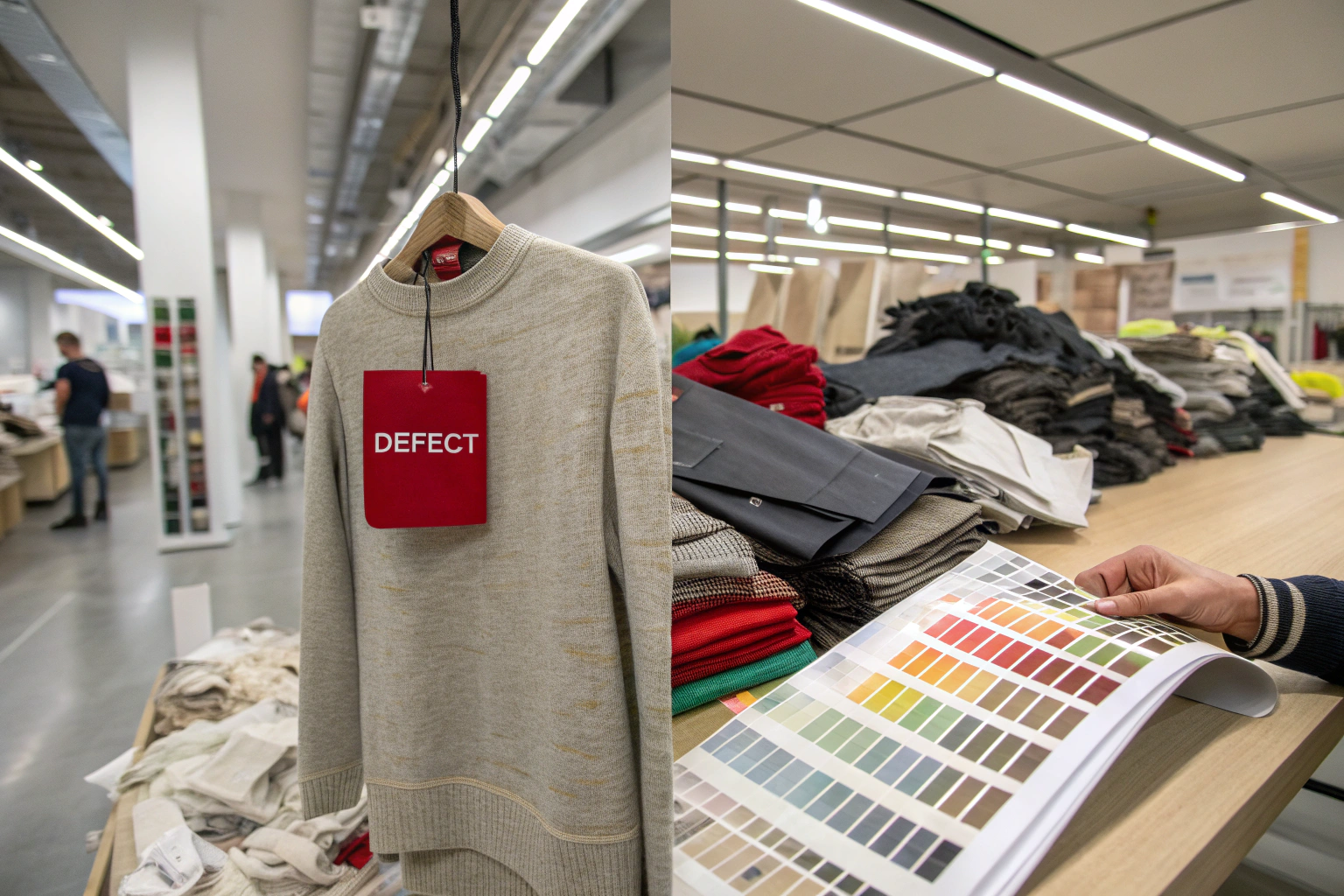
Let me tell you about a phone call that every apparel brand owner dreads. It came from a client of mine in Dallas last March. She supplies a mid-tier department store with women’s workwear. She’d just received a $47,000 chargeback notice. Not because the style was wrong. Not because the shipment was late. But because the return rate on her "Premium Stretch Crepe" blazer was 31%—more than triple the store’s acceptable threshold. The reason cited by customers? "Fabric pilled after two wears." "Seams pulled." "Lost shape." She had sourced that crepe from a low-cost mill to save $1.15 per yard. That $1.15 "saving" just cost her forty-seven thousand dollars and, more painfully, her shelf space in that store for the next season. The buyer told her flat out, "We can’t risk our floor space on a brand with quality issues."
The connection between fabric choice and retail chargebacks is direct and brutal. Retail partners like Nordstrom, Macy’s, or even boutique chains have sophisticated vendor compliance programs. They track every single reason a customer returns an item. If a garment is returned for "fabric pilling," "color fading," "shrinkage," or "seam slippage," that return is coded as a quality defect. Those defects are charged back to the vendor—you. The store deducts the cost of the return shipping, the inspection labor, and often the lost margin from your future payments. And if your defect rate exceeds the store’s threshold (usually 3-5%), they start charging compliance penalties on top of the return costs.
At Shanghai Fumao, we’ve spent years analyzing the chargeback reports our clients share with us. We’ve identified the specific fabric failures that trigger 80% of retail returns. The good news? Almost all of them are preventable at the fabric specification stage. You just have to know which corners you can cut and which ones will cut you.
What Fabric Defects Trigger The Most Retail Chargebacks?
Through our work with dozens of brands selling into major US and European retailers, we’ve seen the data. The chargeback codes are consistent across almost every department store. And they almost always trace back to three specific fabric failures. It’s not the design. It’s not the fit. It’s the material integrity.
The number one culprit, by a huge margin, is pilling. This is followed closely by dimensional instability (shrinkage/growth) and colorfastness issues (crocking/fading) . These three categories account for over 70% of all fabric-related quality returns in our clients’ data. And here’s the thing—none of these defects are visible when the garment is new on the hanger. They’re time bombs. They go off in the customer’s washing machine or after the third wear. By then, it’s too late. The return is already in the system, and the chargeback is already accruing.
I had a client who made men’s dress shirts for a large online retailer. They switched from a 50/2 yarn dyed poplin to a 40/1 piece dyed poplin to save $0.40 per yard. Within four months, their return rate for "fabric quality" jumped from 4% to 11%. The retailer put them on a "watch list" and threatened to delist the brand. We had to scramble to revert the fabric specification and air-freight replacement inventory. The cost of the air freight alone was $12,000. The original fabric savings on that season’s order was $8,000. The math is simple, but the damage to the retail relationship takes years to repair.

Why Is Pilling The Number One Cause Of Quality Returns?
Pilling is the silent killer of brand reputation. It’s those annoying little fuzz balls that form on the surface of a knit sweater or woven trouser after a few wears. To a customer, pilling screams "cheap." It doesn’t matter if the garment cost $200 or $20. Pilling makes it look like a rag.
Pilling happens when short, weak fibers in the yarn work their way to the surface of the fabric. Friction from wear—under the arms, on the sides of a sweater where the arm rubs the body, on the seat of a pant—pulls these loose fibers out. They tangle together into hard little pills. The pill stays attached to the fabric by a few strong anchor fibers. The only way to remove it is to shave it off or pull it off, which often damages the fabric further.
How do you prevent pilling at the fabric sourcing stage? You specify long-staple fibers and high-twist yarns. A long-staple cotton fiber (like Supima or Egyptian Giza) is inherently longer and stronger. There are fewer fiber ends per inch of yarn. Fewer ends mean fewer opportunities for a fiber to work loose and start a pill. A high-twist yarn locks those long fibers together tightly. They don’t have the freedom to wiggle out.
For a client supplying performance polos to a golf retailer, we switched their fabric from a standard 30/1 carded cotton-poly blend to a 30/1 combed and compact-spun cotton-poly blend. The cost increased by $0.28 per yard. The pilling rating on the Martindale abrasion test went from a 2.5 (Fail) to a 4.5 (Pass) . Their return rate for pilling dropped to under 1% the following season. The retailer removed them from the watch list. That $0.28 investment saved them tens of thousands in chargebacks and preserved their vendor scorecard.
This is a perfect example of how to specify yarn twist and staple length to prevent pilling in retail apparel. It’s not a secret. It’s just physics. But you have to write it into the spec sheet.
How Does Shrinkage Lead To Chargebacks?
Shrinkage is a chargeback that hits you twice. First, the customer returns the garment because "it doesn’t fit anymore" after washing. That’s the return chargeback. Second, if the shrinkage is severe and consistent, the retailer might pull the entire style from the floor and demand a full recall. That’s a catastrophic chargeback that can bankrupt a small brand.
The industry standard for acceptable shrinkage in woven cotton apparel, as per AATCC 135, is maximum 3% in length and width. Many retailers require less than 2%. If your fabric shrinks 5%, a size Medium shirt comes out of the dryer fitting like a Small. The customer is angry. They leave a one-star review. They return it.
Why does fabric shrink? Because of residual torque and relaxation. During spinning, weaving, and finishing, the cotton fibers are stretched and placed under tension. When the customer washes the garment in hot water and dries it with heat, the fibers relax and try to return to their natural, unstretched state. This is "relaxation shrinkage."
Preventing shrinkage requires two things at the mill level: mercerization and mechanical compacting. Mercerization swells the cotton fibers and locks them into a more stable, round shape. Compacting (also called Sanforizing for wovens) physically compresses the fabric lengthwise before cutting, pre-shrinking it. A fabric that has been properly mercerized and Sanforized will shrink less than 2%.
I had a client producing women’s blouses for a major department store. Their Fall 2024 line had a 6% shrinkage issue on a rayon challis print. The store charged back $23,000 in returns and another $15,000 in "compliance fees" for the high defect rate. We analyzed the fabric. The mill had skipped the compacting step to save $0.12 per yard. The total fabric order was 12,000 yards. The "savings" were $1,440. The chargebacks were $38,000. The mill is no longer in business with that client. Understanding how mechanical compacting and sanforizing prevent fabric shrinkage in retail garments is not optional. It’s survival.
How Can Fabric Specification Protect My Vendor Compliance Score?
Your vendor compliance score is like a credit score for your brand. Retailers track it obsessively. It includes on-time delivery, packaging accuracy, and quality defect rate. A low score means you pay higher chargeback fees, you get worse floor placement, and eventually, you get delisted.
Fabric specification is the most controllable factor in your quality defect rate. A vague spec sheet—one that just says "100% Cotton Twill, 200 GSM"—is an invitation for the mill to cut corners. They can use a low-twist, carded yarn. They can skip the mercerization. They can use a cheap reactive dye that crocks. And legally, they haven’t violated the spec, because the spec didn’t prohibit those shortcuts.
A retail-ready fabric specification is a legal document that defines the minimum acceptable performance standards. It includes not just the fiber content and weight, but the specific test methods and minimum scores for:
- Pilling (ASTM D4970)
- Shrinkage (AATCC 135)
- Colorfastness to Crocking (AATCC 8)
- Colorfastness to Light (AATCC 16)
- Seam Slippage (ASTM D434)
When you include these in your purchase order, you shift the liability for failure back to the mill. If the fabric fails these tests, it’s a non-conforming shipment. You have grounds to reject the goods or demand a significant discount before the fabric ever reaches the cutting room. This is proactive chargeback prevention.

What Testing Standards Should I Require From My Mill?
You don’t need to be a textile engineer to protect yourself. You just need to know the three or four critical ASTM or AATCC test methods that correlate directly with retail returns. Here is the cheat sheet I give to all my clients who are selling into department stores.
| Defect Type | Test Method | Minimum Passing Score (Retail Standard) | Cost to Test (Approx) |
|---|---|---|---|
| Pilling | ASTM D4970 (Martindale) | Grade 4.0 after 500 cycles | $45 |
| Shrinkage | AATCC 135 (Home Laundering) | Max 3.0% in Length/Width | $35 |
| Crocking (Dry/Wet) | AATCC 8 | Dry: 4.0, Wet: 3.5 | $25 |
| Seam Slippage | ASTM D434 | Min 25 lbs force | $40 |
At Shanghai Fumao, we provide these test reports from our CNAS-accredited lab with every bulk shipment at no extra charge. It’s part of our standard quality package. We know that if our fabric fails a test, our client gets a chargeback. And if our client gets a chargeback, we lose a client. It’s that simple.
For a client who was launching a new activewear line in a major sporting goods chain, we ran a full battery of tests on the development sample. The initial fabric we developed had a seam slippage score of 22 lbs—below the 25 lb threshold. The seams would have pulled open at the shoulder when the customer reached for something. We re-engineered the weave construction, increasing the picks per inch from 72 to 78. The slippage score jumped to 28 lbs. The cost increased by $0.18 per yard. The client passed their retailer’s quality audit with flying colors and secured the shelf space for the season. That’s the value of essential ASTM textile testing requirements for retail vendor compliance.
How Do I Handle A Chargeback That I Believe Is The Mill’s Fault?
This is where documentation saves you. If you have a clear fabric specification in your PO and a failing test report from a third-party lab, you have a strong case for a claim against the mill. Without those, you have a "he said, she said" argument that you will almost certainly lose.
The process works like this:
- Quarantine the Inventory: Do not cut the rest of the fabric. Stop production.
- Third-Party Verification: Send a sample of the defective fabric and a sample of the approved counter sample to an independent lab like SGS or Bureau Veritas. Request a comparative test report.
- File a Claim: Send the failing test report and photos of the defective garments to the mill. Request a credit for the cost of the fabric plus the cost of the chargeback (or a portion of it).
- Negotiate: Most reputable mills will offer a credit on a future order or a partial refund. They want to keep the relationship. Mills that ghost you or change their WhatsApp number are the ones you never work with again.
I had a client in 2024 who received a $12,000 chargeback for color fading on a printed rayon dress. We traced the problem to the printer’s choice of a low-grade pigment ink instead of the reactive dye specified. Because the client had a clear spec sheet that said "Reactive Dyes Only," we were able to go back to the printing partner and secure a 50% credit on the fabric cost ($6,000). It didn’t cover the entire chargeback, but it softened the blow significantly. Without that spec sheet, the printer would have said, "You approved the sample. The color matched the sample. Not our problem."
This is a hard lesson in how to document fabric specifications to support chargeback claims against suppliers. Your PO is your insurance policy. Write it carefully.
How Does Fabric Choice Impact Return Rates In E-Commerce Vs. Brick-And-Mortar?
The channel matters. A lot. In a brick-and-mortar store, the customer touches the fabric. They feel the hand feel. They stretch it. They hold it up to the light. Their expectations are set by that physical interaction. If they buy it anyway and it pills later, they’re disappointed, but they at least had a chance to assess it.
In e-commerce, the customer is buying a photograph. They’re buying a styled model shot on a beach or in a loft. They can’t touch the fabric. Their expectation is based entirely on the brand’s promise and the visual cues in the image. When the package arrives and the fabric feels like sandpaper or looks thinner than they imagined, the return is almost instant. The "unboxing experience" is a make-or-break moment for fabric quality.
E-commerce return rates are typically 15-30% higher than brick-and-mortar return rates for apparel. And the reasons cited for e-commerce returns are disproportionately about "fabric not as expected" or "quality lower than expected." This means fabric choice has an amplified impact on e-commerce profitability.

Should I Use Different Fabrics For My DTC Website Versus Wholesale?
Not necessarily different fabric types, but you should definitely use a higher grade of the same fabric for DTC. Let me explain with an example from a client who sells both on their own Shopify store and through a large online marketplace.
They were using a 180 GSM cotton-modal jersey for their wholesale t-shirts. The price point was $38 retail. The return rate was 5%—acceptable for wholesale. They used the exact same fabric for their DTC "Premium" t-shirt, priced at $48. The DTC return rate was 18%. Customers were returning it because it "felt thin" or "looked cheap."
We worked with them to develop a 240 GSM version of the same cotton-modal blend for their DTC channel. The heavier weight gave the fabric more "body" and a more luxurious drape. The cost per yard increased by 22%. But the DTC return rate dropped from 18% to 7% within two seasons. The increased fabric cost was more than offset by the reduction in return shipping costs, restocking labor, and lost margin on returned goods that couldn’t be resold at full price.
The lesson: DTC customers have higher expectations for "hand feel" and "substance" because they’re paying a premium and they can’t touch it first. You need to over-deliver on fabric quality in the DTC channel. A slightly heavier weight, a softer finish, a higher percentage of premium fiber—these small upgrades pay for themselves many times over in reduced returns.
This is a critical insight for how to optimize fabric weight and hand feel for direct-to-consumer apparel to reduce returns. The fabric is your only physical touchpoint with the DTC customer. Make it count.
How Can I Use Fabric Storytelling To Reduce Returns?
This is a psychological hack that smart brands are using more and more. If you tell the customer why the fabric feels the way it does, they’re less likely to perceive it as a defect. If you just ship a linen shirt, it arrives wrinkled. The customer thinks, "This is a wrinkled mess. Return." If you ship that same linen shirt with a hangtag that says, "Our signature air-washed linen is designed to relax and crinkle with wear. This is the natural character of the fiber. Steam if desired, but embrace the lived-in look."
Suddenly, the wrinkle is not a defect. It’s a feature. The customer’s expectation has been reset. They don’t return it.
I had a client who made 100% Tencel dresses. Tencel has a beautiful drape but is prone to "fibrillation"—tiny micro-fuzz that develops on the surface after washing. It’s a natural characteristic of the fiber. Customers were returning the dresses because they looked "fuzzy." We added a care card that explained, "Your dress is made from Tencel Lyocell, a sustainable wood-pulp fiber. Over the first few washes, you may notice a subtle, peach-like surface texture develop. This is the natural fibrillation process and is a sign of the fiber’s authenticity and softness." Returns for "fabric fuzziness" dropped by over 40%.
This is not deception. It’s education. The fabric is performing as intended. The customer just didn’t know the intention. By telling the story of the fiber—where it comes from, how it’s made, how it ages—you transform a potential return reason into a brand loyalty moment. Combine this with effective care label and hangtag strategies to manage customer expectations for specialty fabrics. It’s one of the cheapest and most effective ways to reduce chargebacks.
How Can Shanghai Fumao Help Me Build A Chargeback-Resistant Fabric Program?
This is what we do every day. We don’t just sell fabric. We engineer fabric programs that are designed to survive the gauntlet of retail vendor compliance and DTC customer expectations. Our approach is built on three pillars: Specification Integrity, Testing Transparency, and Supply Chain Consistency.
When a client comes to us and says, "I need a woven fabric for pants that will be sold in Nordstrom," we don’t just show them swatches. We ask for the retailer’s vendor manual. We look up the specific testing requirements for that category. We build a fabric construction that meets or exceeds those requirements from Day 1. We don’t develop a fabric and then test it to see if it passes. We design it to the standard.
For example, if a retailer requires a minimum of 25 lbs seam slippage, we know that a plain weave poplin with 80 x 76 construction will likely pass. A satin weave with the same yarn count will likely fail. We steer the client toward the construction that protects their vendor score.

What Documentation Do You Provide To Support Retailer Audits?
Retailer audits are stressful. The auditor shows up, asks for a mountain of paperwork, and if you can’t produce it, you get a compliance violation. We provide our clients with a complete Fabric Passport for every bulk order. This is a digital and physical document package that includes:
- Mill Certificate of Origin: Verifying where the yarn was spun and the fabric was woven.
- CNAS-Accredited Test Reports: Full data for pilling, shrinkage, crocking, lightfastness, and tear strength.
- Fiber Content Verification: Lab report confirming the exact fiber blend percentage.
- Chemical Compliance Documentation: REACH, CPSIA, and OEKO-TEX certifications as applicable.
- Production Lot Traceability: QR code linking the fabric roll to the specific dye lot and finishing batch.
This package is audit-ready. Our clients can hand it directly to the retailer’s quality assurance team. It demonstrates a level of supply chain control that most small and mid-sized brands lack. It buys credibility and, often, a more favorable view during the audit.
I had a client who was onboarding with a very demanding European department store. The store required extensive documentation of the supply chain’s environmental and quality practices. Our Fabric Passport provided 90% of what they needed in one PDF. The client’s onboarding process, which normally takes 6-8 weeks, was completed in 4 weeks. They were on the floor a month earlier than planned. That’s the hidden value of comprehensive fabric documentation packages for retail vendor onboarding.
Can You Guarantee Fabric Performance Against Chargebacks?
I’m going to be completely honest with you. No mill can offer a 100% financial guarantee against all chargebacks. There are too many variables outside our control. How the garment is sewn. How the customer washes it. Whether the retailer’s inspection standards are applied consistently.
What we can guarantee is this: if the fabric fails to meet the agreed-upon, written specifications that we signed off on together, we will make it right. We will issue a credit for the fabric cost. We will re-run the order at our expense. We will work with you to mitigate the damage. We stand behind our work.
But we can only guarantee performance against a spec. If you don’t give us a spec, we can’t guarantee anything. That’s why our development process always starts with a detailed technical review. We ask the hard questions up front: What is the end-use? Who is the retailer? What is the target price point? What are the non-negotiable performance requirements?
We want you to succeed in retail. Our business depends on it. A client who gets delisted from Macy’s because of fabric failure is a client who stops ordering fabric. It’s in our direct financial interest to make sure your fabric passes the retailer’s tests and survives the customer’s washing machine.
If you’re looking for a partner who understands the retail landscape and can help you navigate the minefield of vendor compliance, let’s talk. Reach out to our Business Director, Elaine, at elaine@fumaoclothing.com. She can set up a call to review your current fabric specs and your retailer’s vendor manual. We’ll identify the potential chargeback triggers in your line and propose construction upgrades that pay for themselves in reduced returns.
Conclusion
Fabric choice is the single most controllable factor in reducing retail chargebacks. It’s more controllable than fit (which is subjective) and more controllable than on-time delivery (which can be derailed by logistics). You can specify a fabric that is engineered to resist pilling, minimize shrinkage, and hold its color. You can document that specification in a way that protects you legally and commercially.
The brands that survive and thrive in the brutal world of department store retail and DTC e-commerce are the ones that treat fabric not as a commodity cost to be minimized, but as a strategic asset to be optimized. They understand that an extra $0.30 per yard spent on a combed, compacted yarn is not an expense. It’s an insurance premium against a $47,000 chargeback and a destroyed retail relationship.
At Shanghai Fumao, we don’t just sell you fabric. We help you build a fabric program that protects your brand’s reputation and your bottom line. Stop gambling with your vendor score. Start engineering your fabric for retail success.








