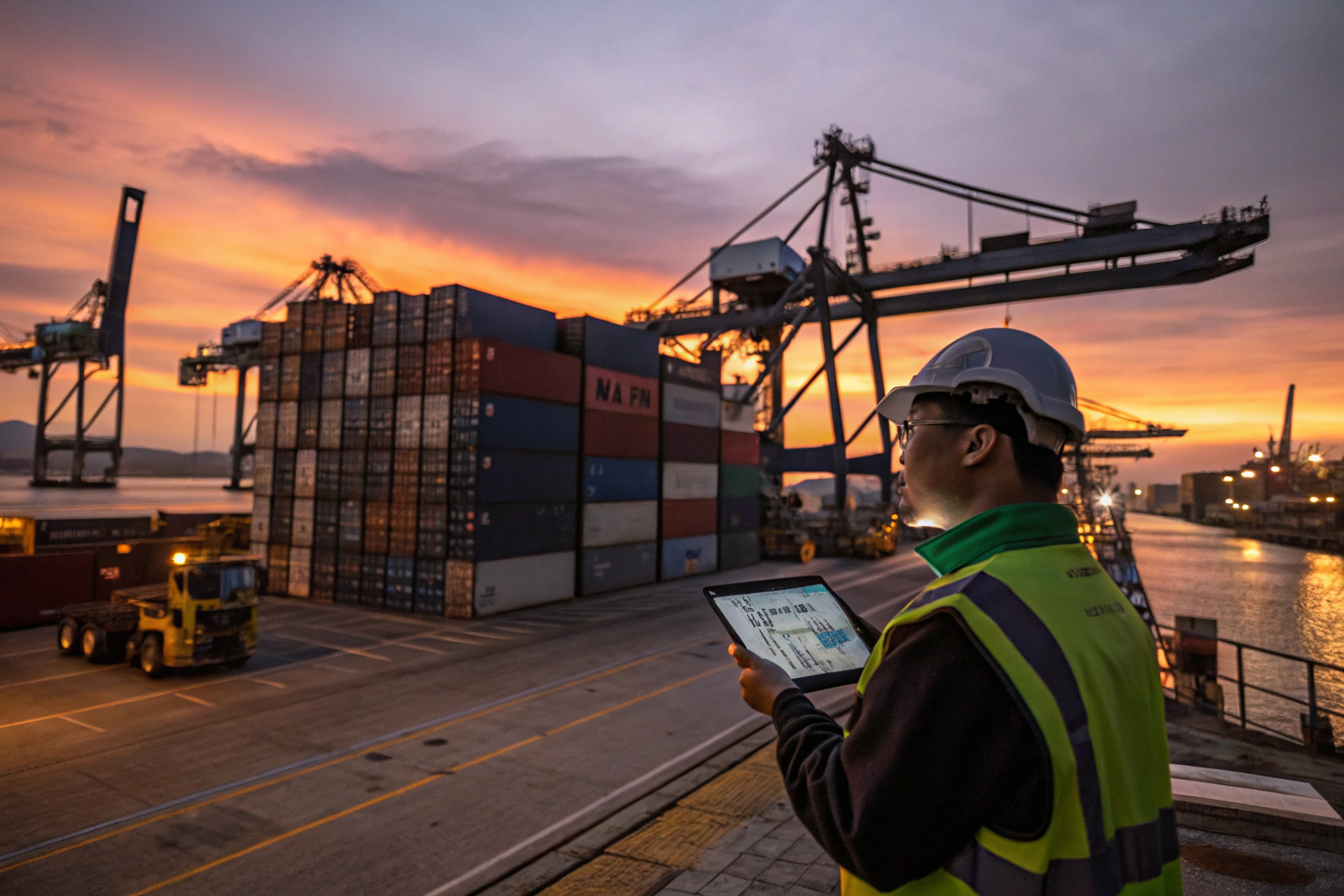
Let me set the scene for you. It’s October 15th. The Golden Week holiday in China just ended, and the entire global supply chain is waking up from a week-long nap with a massive hangover. Every factory in Keqiao is running 24/7. Every container truck in Ningbo port is booked solid. Every vessel is oversold. And somewhere in the middle of this chaos, a brand owner in Los Angeles is refreshing their tracking number for the hundredth time, watching their holiday inventory sit in a "Port Congestion" status for the ninth straight day. I’ve been on the phone with that brand owner. I’ve heard the panic in their voice. I’ve seen the air freight quotes that cost more than the fabric itself. Peak season logistics is not a theoretical problem. It’s a recurring nightmare that separates the professionals from the amateurs.
The short answer to how we handle logistics delays during peak season is this: we don’t just react to delays. We plan for them months in advance, and we maintain redundant, pre-negotiated capacity across multiple ports and carriers. We treat logistics not as the last step in the process, but as a core part of the production plan that gets locked in at the same time as the yarn order. At Shanghai Fumao, we’ve been navigating the seasonal chaos of Chinese exports for two decades. We know exactly when the bottlenecks will form—March to May and August to October, just like the user’s background correctly identifies—and we know exactly which levers to pull to keep your fabric moving when everyone else’s is stuck.
But here’s the part that most importers don’t fully appreciate until it’s too late: logistics delays are rarely caused by a single catastrophic event. They’re caused by a cascade of small failures. A truck shows up two hours late to the factory. That misses the cutoff time at the container freight station (CFS). That pushes the container to the next vessel sailing. That vessel arrives at the transshipment port just as a typhoon hits. That causes a five-day delay. That means the container misses the rail connection from Long Beach to Chicago. Suddenly, your "30-day lead time" is 52 days. And you’re air freighting 2,000 yards of fabric at $4.50 per kilo just to keep your cutting room from going dark.
Our job is to break that cascade before it starts. Here’s exactly how we do it.
What Pre-Season Planning Prevents Most Peak Season Delays?
The most important work we do to prevent logistics delays happens before the first yard of fabric is even woven. It happens in the planning meetings we hold with our key clients in January (for the March-May peak) and in June (for the August-October peak). These meetings are not casual check-ins. They’re forensic examinations of the upcoming production calendar.
We review every style, every fabric construction, and every target delivery date. We map those dates backward to determine the "must-ship-by" date from our factory. Then we add a buffer. Not a vague "we’ll try to ship early" buffer. A specific, calendarized buffer of 7 to 10 days for peak season. We call this the "Peak Season Contingency." If a client needs fabric in their Los Angeles warehouse by September 15th, we don’t target a ship date of August 15th. We target August 5th. That extra 10 days is our insurance policy against the inevitable congestion at Ningbo or Shanghai port.
This buffer is not free. It requires us to pull forward yarn orders and reserve dyeing capacity earlier. It ties up our working capital. But it’s infinitely cheaper than the alternative—air freight or missed deliveries. We had a client in 2024 who resisted the buffer. They insisted on a "just-in-time" ship date of August 20th for a September 20th delivery. August 20th was the absolute peak of peak season. The vessel was rolled (bumped to the next sailing) due to overbooking. The container sat at the port for 11 days waiting for the next vessel. It arrived in Los Angeles on October 3rd. The client missed their delivery window to Macy’s and incurred a $28,000 chargeback. The buffer would have cost them nothing extra in freight. The lack of a buffer cost them twenty-eight thousand dollars and a damaged retail relationship.

How Do We Manage Yarn And Greige Inventory To Beat The Rush?
This is the secret weapon that most fabric suppliers don’t talk about. During peak season, the bottleneck is not always the container ship. Often, the first bottleneck is yarn availability. When every mill in Zhejiang and Jiangsu is trying to buy the same 40/1 combed compact yarn, the spinners raise their prices and extend their lead times. A yarn that normally takes 7 days to procure can take 21 days during the March rush.
At Shanghai Fumao, we use a strategy called "Pre-Peak Yarn Stockpiling." Based on our clients’ forecasts and our own historical sales data, we purchase and hold inventory of our most popular yarn counts before the peak season starts. In January, we stockpile 30/1, 40/1, and 50/1 combed cotton. In July, we do the same for the Fall rush. This means that when a client places an urgent order in mid-March, we’re not waiting three weeks for yarn. We pull from our own warehouse and start warping the next day.
We do the same thing for greige fabric in our most popular constructions. We weave a "bank" of unfinished poplin, twill, and jersey during the slower periods (June-July and November-December). This greige stock sits on our shelves, ready to be dyed and finished. When a client needs a specific Pantone color on a standard base cloth, we don’t start from scratch. We pull a roll of greige, dye it, and ship it. This cuts 10-14 days out of the production timeline.
This strategy requires capital and warehouse space. It’s a significant investment. But it’s the only way to offer reliable lead times when the rest of the industry is quoting 6-8 weeks. This is a core part of how textile mills use strategic yarn and greige inventory to mitigate peak season lead time extensions.
What Role Do Local Dyeing And Finishing Partnerships Play?
Keqiao is the largest textile cluster in the world. Within a 20-kilometer radius of our office, there are over 80 dyeing and finishing plants. This density is our logistical superpower. When one dye house is slammed with orders and quoting a 10-day turnaround, we have relationships with five others. We can shift production to the partner with the shortest queue.
This is not something a trading company or a distant mill can do easily. They’re locked into their own captive dye house or a single long-term partner. If that partner is backed up, they’re stuck. We’ve spent 20 years cultivating relationships across the Keqiao ecosystem. We know the specialty of each plant. Plant A is the best for reactive dyes on cotton poplin. Plant B is the fastest for polyester wovens. Plant C is the only one we trust for delicate viscose challis.
During the peak of the August rush last year, our primary dye house for a specific client’s navy twill program had a 12-day backlog. We immediately moved the 8,000-yard order to Plant B, which had a 6-day backlog. The fabric shipped on time. The client never even knew there was a problem. This is the value of being deeply embedded in the local industrial ecosystem. It’s a form of supply chain resilience through localized manufacturing partnerships in China’s textile hubs. It’s not just about having a supplier. It’s about having a network.
What Shipping Strategies Do We Use During Port Congestion?
When the fabric is finished and packed, the next battle begins: getting it onto a vessel. During peak season, the standard procedure of "book a slot with Carrier A, deliver container to Ningbo, wait for sailing" is a recipe for disaster. Vessels are overbooked by 20-30%. Containers get "rolled" to the next sailing, or the one after that. Every roll adds a week of delay.
We use a multi-pronged strategy to combat this. First, we diversify our port of loading. Most importers fixate on Shanghai or Ningbo because they’re the biggest. But they’re also the most congested. We regularly use Nansha (Guangzhou) and Xiamen ports for clients whose destination is the US West Coast or Europe. The trucking distance from Keqiao to Nansha is longer (about 14 hours versus 3 hours to Ningbo), so the inland freight cost is higher. But the port congestion at Nansha is often significantly lower. The vessel turnaround time is faster. The container gets on a ship 5-7 days sooner. That time saving is almost always worth the extra trucking cost.
Second, we book space with multiple carriers simultaneously. We have corporate accounts with COSCO, Maersk, CMA CGM, and several regional carriers. For a critical shipment, we don’t put all our eggs in one carrier’s basket. We book provisional space with two different carriers on two different vessel sailings, departing 3-4 days apart. Whichever vessel confirms the loading first gets the container. We cancel the other booking (within the free cancellation window). Yes, this requires more administrative work. But it virtually guarantees that the container sails within the target week.

How Do We Navigate The Pre-Chinese New Year Shipping Chaos?
The 3-4 weeks before Chinese New Year (CNY) are a unique form of logistical hell. Every factory in China is trying to ship every possible container before the country shuts down for two weeks. Trucking rates double. Container availability plummets. Ports operate at 150% capacity. It’s the Super Bowl, Black Friday, and a natural disaster all rolled into one.
Our strategy for pre-CNY shipping is simple and rigid: Finish Production 3 Weeks Before the Holiday, Not 1 Week. We work backward from the CNY date (which changes every year based on the lunar calendar). If CNY starts on January 29th, our internal "hard stop" for production completion is January 8th. This gives us a three-week window to book trucks, clear customs, and get the container on a vessel before the absolute peak of the chaos in the final week.
This requires discipline with our clients. We have to be firm about order cutoffs. If a client places a PO on January 5th and expects shipment before CNY, the answer is usually "no." We can try, but we won’t promise. We’d rather be honest and preserve the relationship than make a false promise and destroy it.
I had a client in early 2025 who placed a re-order for a printed rayon on January 12th. CNY was January 29th. They begged us to ship before the holiday. We told them the printing factory was already closed for inventory and the trucking companies were no longer accepting new bookings. They were upset, but they understood. We held the fabric and shipped it on February 10th, the first day the port fully reopened. It arrived three weeks later than they wanted, but it arrived. If we had tried to force it through the pre-CNY chaos, the fabric would have sat in an unsecured warehouse for three weeks, at risk of damage or theft. Knowing when not to ship is just as important as knowing how to ship.
This is a perfect illustration of how to plan apparel production and shipping timelines around Chinese New Year closures. The holiday is not a surprise. It’s on the calendar years in advance. The only surprise is when importers fail to plan for it.
What Are The Alternatives When Ocean Freight Fails?
Sometimes, despite all the planning and all the buffers, ocean freight fails. A vessel breaks down. A port strike happens. A global pandemic shuts down a major terminal. When that happens, we have to escalate to the emergency options. And we have those options pre-negotiated and ready to deploy.
Option 1: Sea-Air Combined Transport. This is a hybrid solution that’s faster than ocean but cheaper than pure air freight. We ship the container via ocean to a transshipment hub like Dubai, Singapore, or Incheon (Korea). At the hub, the goods are deconsolidated and transferred to an air freight carrier for the final leg to the US or Europe. This can shave 10-14 days off the total transit time compared to all-ocean, at a cost that’s about 40-50% of pure air freight. We have a dedicated partner in Incheon who handles this for our US-bound clients.
Option 2: Pure Air Freight (Premium Service). When the situation is critical—a client’s cutting room will literally stop in 72 hours without fabric—we use air freight. We have negotiated "Peak Season Air Freight Rates" with DHL and several freight forwarders. These rates are locked in annually, so we’re not subject to the wild spot market spikes that can hit $8-10 per kilo during the October rush. Our rate is typically 20-30% below the open market spot rate.
We used air freight for a client in October 2024. Their ocean container was stuck in Vancouver due to a rail strike. They needed 1,500 yards of a specific performance knit to complete an order for a major sporting goods retailer. We pulled replacement yardage from our greige stock, finished it in 48 hours, and had it on a plane to Los Angeles within 72 hours. The air freight cost was $6,200. The client avoided a $45,000 cancellation penalty from the retailer. They were happy to pay the air freight bill.
This is the reality of emergency logistics solutions for fashion brands during supply chain disruptions. You need a partner who has these options ready to go, not one who is Googling "air freight quote China to USA" while your cutting room is idle.
How Do We Communicate Delays And Manage Expectations?
This is perhaps the most important part of handling logistics delays, and it’s the one that most suppliers get wrong. When a delay happens, the natural instinct of many mills is to go silent. They hope the problem will resolve itself before the client notices. They don’t want to deliver bad news. This is a catastrophic mistake. Silence creates anxiety. Anxiety creates distrust. Distrust ends relationships.
Our policy is "No Surprises." The moment we have confirmation that a shipment will be delayed—even by 48 hours—we communicate it to the client. We don’t wait until the day of the scheduled sailing. We send an email or a WhatsApp message with three specific pieces of information:
- The Cause: "The vessel COSCO SHIPPING ANDES V.045W is overbooked. Our container was rolled."
- The Impact: "The container is now scheduled for the next sailing, COSCO SHIPPING DENALI V.046W, departing 4 days later."
- The Mitigation: "We have confirmed the booking on the new vessel and escalated the priority with our forwarder. We are monitoring daily."
This level of transparency is uncomfortable. It means admitting that something outside our control has gone wrong. But it builds trust. The client knows we’re watching the situation and we’re being honest with them. They can adjust their own production schedule accordingly. They might not be happy about the delay, but they’re not blindsided by it.

What Tracking Visibility Do We Provide To Clients?
A tracking number from the shipping line is not enough. It updates sporadically, often with cryptic status codes that mean nothing to a fashion designer. We provide our clients with a "Live Shipment Dashboard" for every order. This is a simple, shared spreadsheet or a link to our logistics portal that shows:
- Milestone Dates: Factory Exit Date, Port Arrival Date, Vessel Departure Date, Transshipment Date, Port of Discharge Date.
- Container Number and Vessel Name: So the client can track it themselves if they want.
- Estimated vs. Actual: A visual comparison of the planned timeline versus the actual timeline.
- Action Items: Any holds at customs or documentation requests are flagged immediately.
This dashboard is updated every 48 hours by our logistics coordinator. If a vessel is delayed at sea, the ETA is revised. The client can see the revision in real-time. This eliminates the daily "Where’s my fabric?" emails that clog up inboxes on both sides. The client has self-service visibility.
For a client who was launching a new collection at a trade show in Paris, we provided this dashboard for their sample yardage shipment. They could see exactly when the samples cleared customs in France and were out for delivery to their hotel. They told us it was the most stress-free sample delivery they’d ever experienced. That’s the power of real-time shipment tracking and visibility for imported textile orders. It replaces anxiety with information.
How Do We Handle The Financial Impact Of Delays?
This is the hard conversation that defines a true partnership. When a delay is caused by our own production error—a missed dye lot, a quality issue that requires rework—we own it. We cover the cost of the delay, including contributing to air freight if necessary to meet the client’s critical deadline. This has happened maybe three times in the last five years. It’s rare, but when it happens, we don’t hide. We fix it on our dime.
When a delay is caused by force majeure—port congestion, weather, carrier overbooking—the financial responsibility is more nuanced. Our standard terms do not hold us liable for carrier delays, as this is standard industry practice. However, we don’t just shrug and say "not our problem." We work with the client to find the most cost-effective mitigation. We absorb the administrative costs of rebooking and expediting. We share our pre-negotiated air freight discounts. We act as their advocate with the carrier.
I had a situation in 2023 where a container of linen was delayed 18 days due to a labor slowdown at the Port of Oakland. The client was facing a production shutdown. The delay was clearly not our fault. But we offered to split the cost of air freighting a partial shipment (500 yards) to keep their cutting room running until the container arrived. We paid $1,200 of the $2,400 air freight bill. The client was shocked. "You don’t have to do that," they said. "I know," I replied. "But we’re partners. And partners help each other out of jams." That client has since tripled their annual order volume with us. Sometimes, the best financial decision is not the one that maximizes short-term profit. It’s the one that builds a long-term partnership.
Conclusion
Handling logistics delays during peak season is not about having a magic wand that clears port congestion or calms typhoons. It’s about having a system that anticipates the chaos and a culture that communicates through it. It’s about building buffers into the calendar, stockpiling inventory before the rush, diversifying across ports and carriers, and being brutally honest with clients when things go wrong.
The user’s background correctly identifies the critical windows: March-May and August-October are the danger zones. Chinese New Year and Golden Week are the immovable obstacles. The European fashion brand that completes pre-production 6 weeks before CNY is doing exactly the right thing. They’re not just managing their own timeline. They’re giving their supply chain partners the time and space needed to navigate the predictable chaos.
At Shanghai Fumao, we don’t promise that your fabric will never be delayed. That would be a lie, and we don’t lie to our clients. We promise that if a delay happens, you’ll know about it immediately, you’ll understand why it happened, and you’ll have a partner working alongside you to solve it. We promise that we’ve done the hard work upfront to make delays as rare and as short as possible.
If you’re tired of the peak season panic and the late-night tracking number refreshes, let’s build a better plan. We can review your upcoming production calendar and map out a logistics strategy that accounts for the known bottlenecks. Reach out to our Business Director, Elaine, at elaine@fumaoclothing.com. She can set up a planning call and show you how our approach to logistics can give you back your sleep during the craziest times of the year.