You’re designing a children’s sweater. It’s soft, colorful, and adorable. You’ve sourced what feels like a safe fabric. But what if that vibrant red dye contains traces of a heavy metal? What if the anti-wrinkle finish releases formaldehyde, a known skin irritant? For babies and children, whose skin is thinner, more permeable, and whose systems are still developing, these aren’t abstract risks—they are urgent safety concerns. This is where the OEKO-TEX Standard 100 certification comes in, and for kids wear, the specific Product Class I (often mistakenly called “Grade 2” in some markets, but Class I is the highest, strictest grade for babies) is not just a badge; it’s a fundamental duty of care.
The OEKO-TEX Standard 100 is an independent, global testing and certification system for textiles. It verifies that a product is free from harmful levels of over 100 regulated substances. Crucially, it has four product classes, with Class I representing the strictest possible limits for articles for babies and toddlers up to 3 years old. While some manufacturers might use a less stringent Class II (for adult skin contact) for older children’s wear, the industry’s gold standard—and what discerning brands and parents demand—is Class I for all kids’ apparel. This certification is a proactive shield. It answers the most critical question a parent has: “Is this truly safe for my child?”
Many manufacturers view this certification as a cost. We view it as the absolute baseline. At Shanghai Fumao, we’ve seen the shift firsthand. A major US kids’ wear brand we partnered with in late 2022 initially requested “OEKO-TEX certified” fabric. When we probed and confirmed they needed Class I certification for their toddler line, they were grateful for the guidance. Their previous supplier had provided Class II fabric, unknowingly exposing them to risk. We reproduced their entire range in Class I compliant cotton knits and wovens. The result? Not only did they pass a surprise retail compliance audit with flying colors, but they also used the certification as a key marketing point, seeing a measurable increase in customer trust and repeat purchases. This is the tangible impact of getting the certification right.
What Makes OEKO-TEX Class I Limits So Much Stricter for Kids?
A child’s body is not a scaled-down adult body. Their skin surface area relative to body weight is much larger, increasing potential exposure. Their skin barrier is less mature, absorbing substances more easily. Their metabolic and detoxification systems are still developing, making them more vulnerable to harmful chemicals. OEKO-TEX Class I standards are scientifically designed around this physiology, imposing the most rigorous limits across every tested category.
The difference isn’t marginal; it’s exponential. Let’s compare the limits for some key substances between Class I (Babies) and Class II (Adults). The numbers tell the story of an uncompromising safety standard:
| Substance / Parameter | OEKO-TEX Class I (Babywear) | OEKO-TEX Class II (Adult Apparel) | Why Stricter for Class I |
|---|---|---|---|
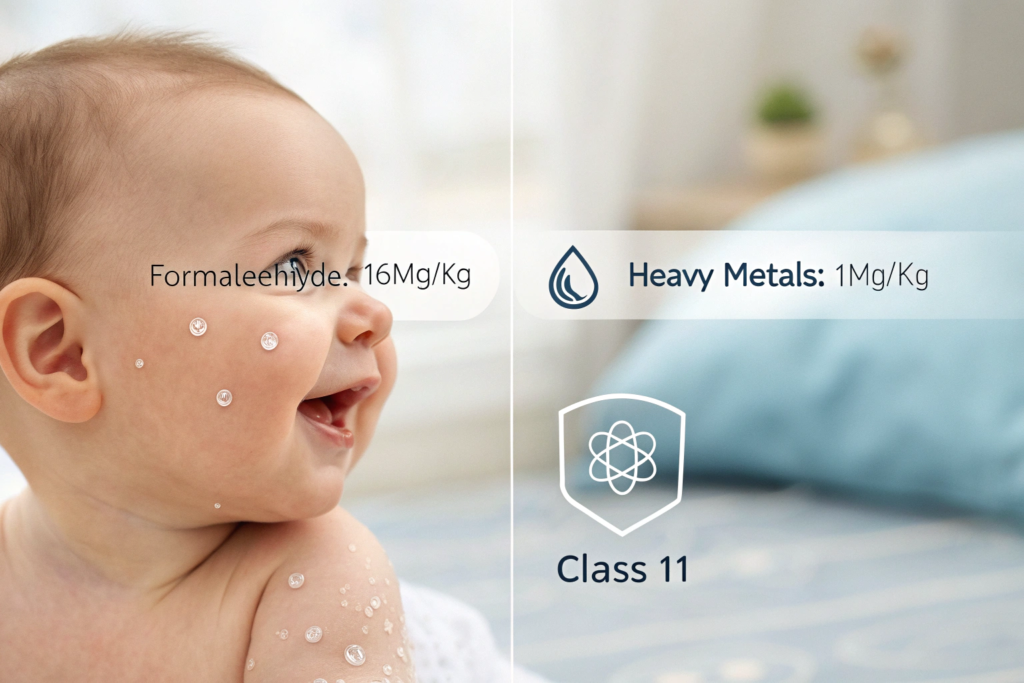
| Formaldehyde | ≤ 16 mg/kg | ≤ 75 mg/kg | Babies’ skin is highly sensitive; strict limit prevents irritation and allergic reactions. |
| pH Value | 4.0 – 7.5 | 4.0 – 7.5 (same range, but tighter enforcement) | A skin-neutral pH is critical to maintain babies’ delicate acid mantle. |
| Extractable Heavy Metals (Antimony) | ≤ 1.0 mg/kg | ≤ 5.0 mg/kg | To minimize ingestion risk from sucking on fabric and prevent systemic toxicity. |
| Allergenic Disperse Dyes | Banned (List of >20) | Banned | Prohibited to prevent severe allergic contact dermatitis. |
| Pesticides (Total) | ≤ 0.05 mg/kg (for each) | ≤ 0.5 mg/kg (for each) | Drastically reduced to limit exposure to toxic residues from raw materials. |
| Phthalates (e.g., DEHP, BBP) | ≤ 0.01% (100 mg/kg) | Regulated, but often higher limits in other standards | Strictly limited due to potential endocrine-disrupting effects. |
How Does the Certification Address the "Mouthing" Behavior of Babies and Toddlers?
This is a unique, critical consideration for Class I. Babies explore the world with their mouths. They chew on their clothing, suck on their sleeves, and drool on their bibs. OEKO-TEX testing simulates this “saliva and perspiration” scenario through rigorous extraction tests. The fabric is subjected to artificial saliva and acidic perspiration solutions, and the extracted liquid is then analyzed for harmful substances like heavy metals (antimony, arsenic, lead, cadmium) and colorants.
The limits for these extractable substances in Class I are unforgiving—often 5 to 10 times stricter than for Class II. For instance, our lab must ensure that the vibrant, colorfast dyes we use on infant rompers do not release any measurable amounts of heavy metals under these simulated mouthing conditions. This goes far beyond skin contact safety; it’s about ingestion safety. When we develop fabrics for teething blankets or baby sleepwear, this test is paramount. We source dyes and chemicals specifically pre-approved for OEKO-TEX Class I compliance to guarantee this. Resources like Healthy Child’s guide to non-toxic children’s products emphasize this, but the OEKO-TEX test is the actionable, scientific verification.
Why is Colorfastness to Perspiration and Saliva a Key Class I Test?
Colorfastness is often thought of as a quality issue (to prevent dye from staining other clothes in the wash). In kids’ wear, especially for Class I, it’s a safety issue. The test for colorfastness to perspiration and saliva checks if dyes migrate from the fabric under wet, warm, acidic conditions—exactly like a teething baby’s drool or sweat.
If a dye is not fast, it can transfer directly onto the child’s skin or be ingested. Beyond the staining, the concern is the chemical nature of the dye itself. A non-fast dye that transfers is more likely to be absorbed. All our certified kids’ wear fabrics must achieve a high rating (typically 4-5 on a grey scale) in this specific test. We recall a project for a European organic baby brand in 2023 where their initial fabric sample failed this test for a particular mustard yellow color. Our chemists reformulated the dye recipe, achieving perfect colorfastness while maintaining the hue, and secured the Class I certificate. This level of diligence is non-negotiable. It’s what separates a generic “baby fabric” from a certified safe infant textile.
Beyond Safety: How Does Class I Certification Drive Market Access and Brand Trust?
In the children’s wear sector, safety is the ultimate currency of trust. OEKO-TEX Class I certification is the most recognized and trusted form of currency exchange. It transcends being a technical specification; it’s a powerful business tool that unlocks doors with retailers, satisfies increasingly savvy parents, and builds unshakeable brand loyalty.
Major retailers worldwide, from department stores like John Lewis to specialty chains like Carter’s and large e-commerce platforms, increasingly mandate OEKO-TEX Standard 100 certification for children’s products, with a strong preference for Class I. It simplifies their compliance vetting and protects them from liability. For a brand, presenting a product with this certification dramatically streamlines the onboarding process with these channels. It’s a pre-verified passport to shelf space.
How Does Certification Become a Decisive Factor in Parental Purchasing?
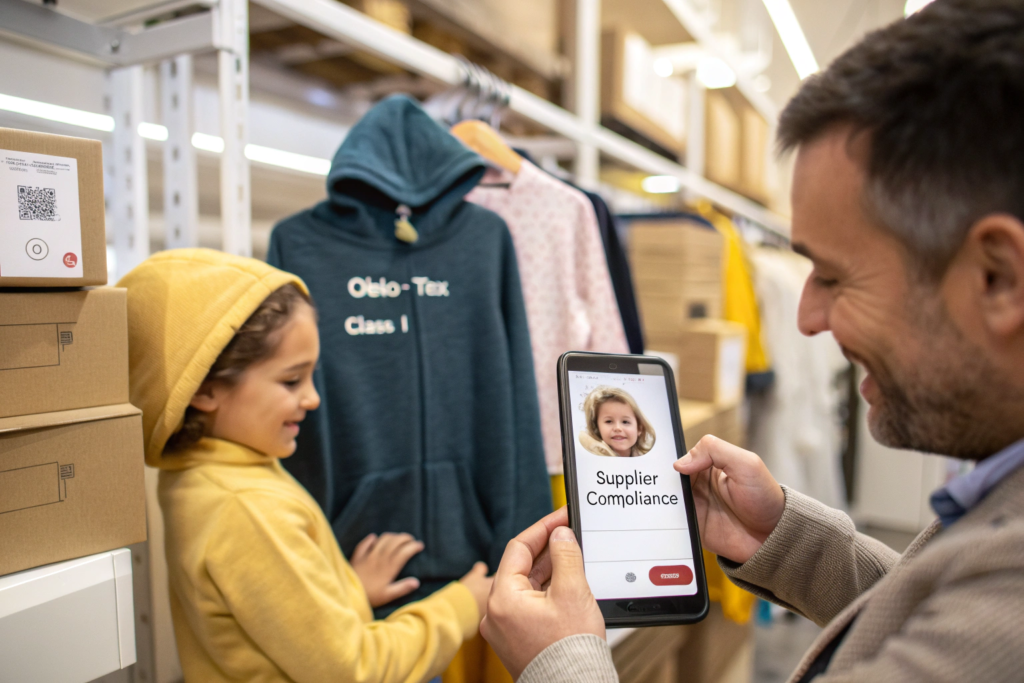
Today’s parents, especially millennials and Gen Z, are informed investigators. They read labels, research brands, and prioritize safety and sustainability. The OEKO-TEX label is instantly recognizable to this demographic. It acts as a quick, credible answer to their unspoken concerns. In a crowded online marketplace, where physical touch is absent, this third-party validation can be the decisive factor that converts a browser into a buyer.
We have direct feedback from our brand clients. A DTC children’s pajama brand that switched to our OEKO-TEX Class I certified organic cotton reported that featuring the certification badge on their main product image and hangtag led to a 20% reduction in product-related customer service inquiries and a significant boost in positive reviews mentioning “safety” and “peace of mind.” They effectively turned a compliance requirement into their unique selling proposition for safe children’s sleepwear. By providing certified fabrics, Shanghai Fumao enables our clients to tell this powerful story authentically.
Does Class I Certification Help Navigate Complex Global Regulations?
Absolutely. The global regulatory landscape for children’s products is a minefield: CPSIA in the USA, REACH and EN 71 in the EU, and various national standards. While OEKO-TEX is not a legal replacement, it is a comprehensive, internationally respected superset that covers and often exceeds the requirements of these individual regulations.
For example, the US Consumer Product Safety Improvement Act (CPSIA) has strict limits for lead and phthalates. OEKO-TEX Class I testing includes these substances with equally strict or stricter limits. For a brand exporting globally, maintaining a single, stringent OEKO-TEX Class I supply chain is far more efficient and less error-prone than trying to manage separate compliance protocols for each market. It’s a holistic risk management strategy. When our clients ship to the EU, their OEKO-TEX Class I certification is heavyweight evidence towards REACH SVHC compliance, smoothing customs processes. We guide our clients through this, ensuring the certification is correctly referenced in their technical documentation.
What Are the Critical Implementation Pitfalls in Kids Wear Certification?
The road to genuine compliance is full of pitfalls that can undermine the entire effort. The most common mistake is certificate misapplication—using a fabric with a Class II or general OEKO-TEX certificate for a baby or toddler product. This is a legal and ethical failure. Another pitfall is assuming certification is infinite; it’s not. It’s tied to specific articles, colors, and production sites.
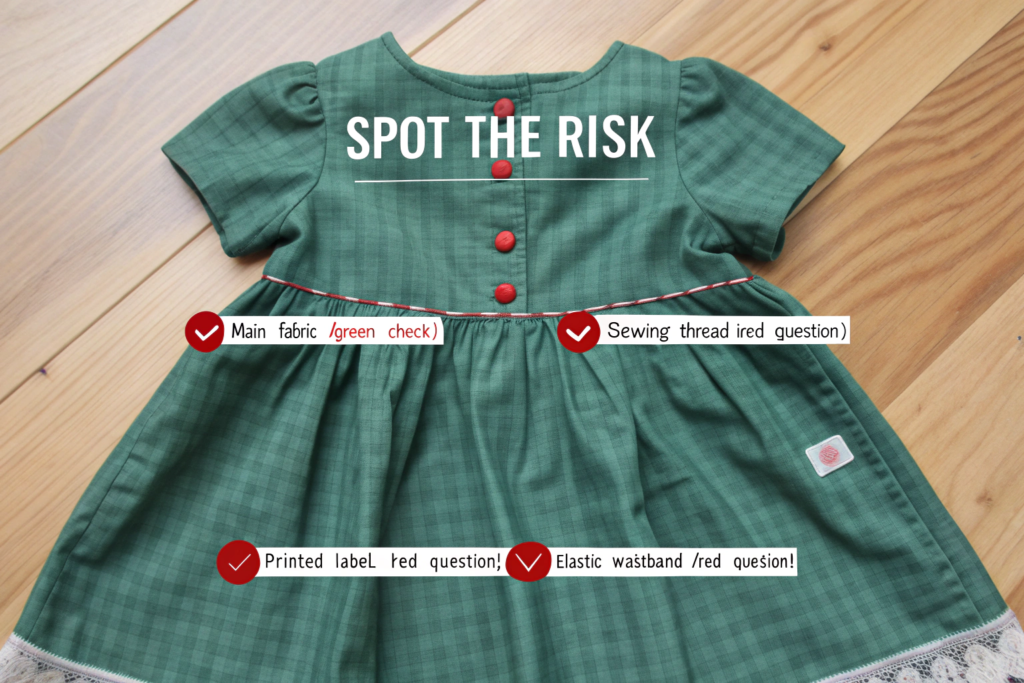
A particularly insidious risk is in trims and accessories. The OEKO-TEX Standard 100 certification applies to every component: the main fabric, the sewing thread, the elastic, the labels, the prints, and even the decorative buttons or sequins. If you use a certified fabric but pair it with non-certified, plastisol-printed labels or elastic that contains phthalates, the final garment is not certified. The entire product fails the chain of compliance.
How Does the “Article Number” Specificity Impact Kids Wear Collections?
An OEKO-TEX certificate is not a blanket approval for a mill. It is issued for a specific “article number,” which defines the exact fiber composition, construction (e.g., 30/1 single jersey, 180gsm), and chemical finish. If you are producing a kids’ t-shirt in five colors using the same article of fabric, all five colors can be covered under one certificate (if they were declared and tested). However, if you decide to make a matching hat from a different knit structure (e.g., a rib cuff), that is a different article and requires its own certification or a costly and time-consuming extension.
We manage this complexity for our clients. For a kids’ wear brand launching a coordinated set (top, bottoms, hat), we ensure all fabric articles—the jersey for the top, the french terry for the bottoms, the rib for the cuff—are individually certified under Class I. We provide a clear matrix to our clients, so they know exactly which certified article to use for each SKU. This prevents the fatal error of substituting an uncertified but visually similar fabric mid-production, which would void the entire batch’s claim to certification.
Why is Supplier Auditing and Ongoing Validity Checking Essential?
An OEKO-TEX certificate is valid for one year. It can be revoked if the supplier fails an annual audit, changes their production process, or uses non-compliant chemicals. If your fabric supplier’s certificate lapses or is revoked, your right to use the label on garments made from fabric produced after that date is nullified.
This creates a massive downstream risk for brands. Imagine you have 10,000 garments in production, hangtags printed with the OEKO-TEX logo, and then discover your fabric supplier lost their certification. You face a costly recall, remaking of tags, and reputational damage. Therefore, partnering with a financially stable, process-oriented supplier like Shanghai Fumao is critical. We treat certification maintenance as a core operational discipline. Our clients have permanent access to our certificate validity status via a secure portal. We encourage them to verify our certificates annually on the OEKO-TEX website—a practice that builds mutual trust. For brands, learning how to verify and audit your supplier’s OEKO-TEX certifications is a necessary skill.
How Does Fumao’s Integrated Model Guarantee True Class I Compliance?
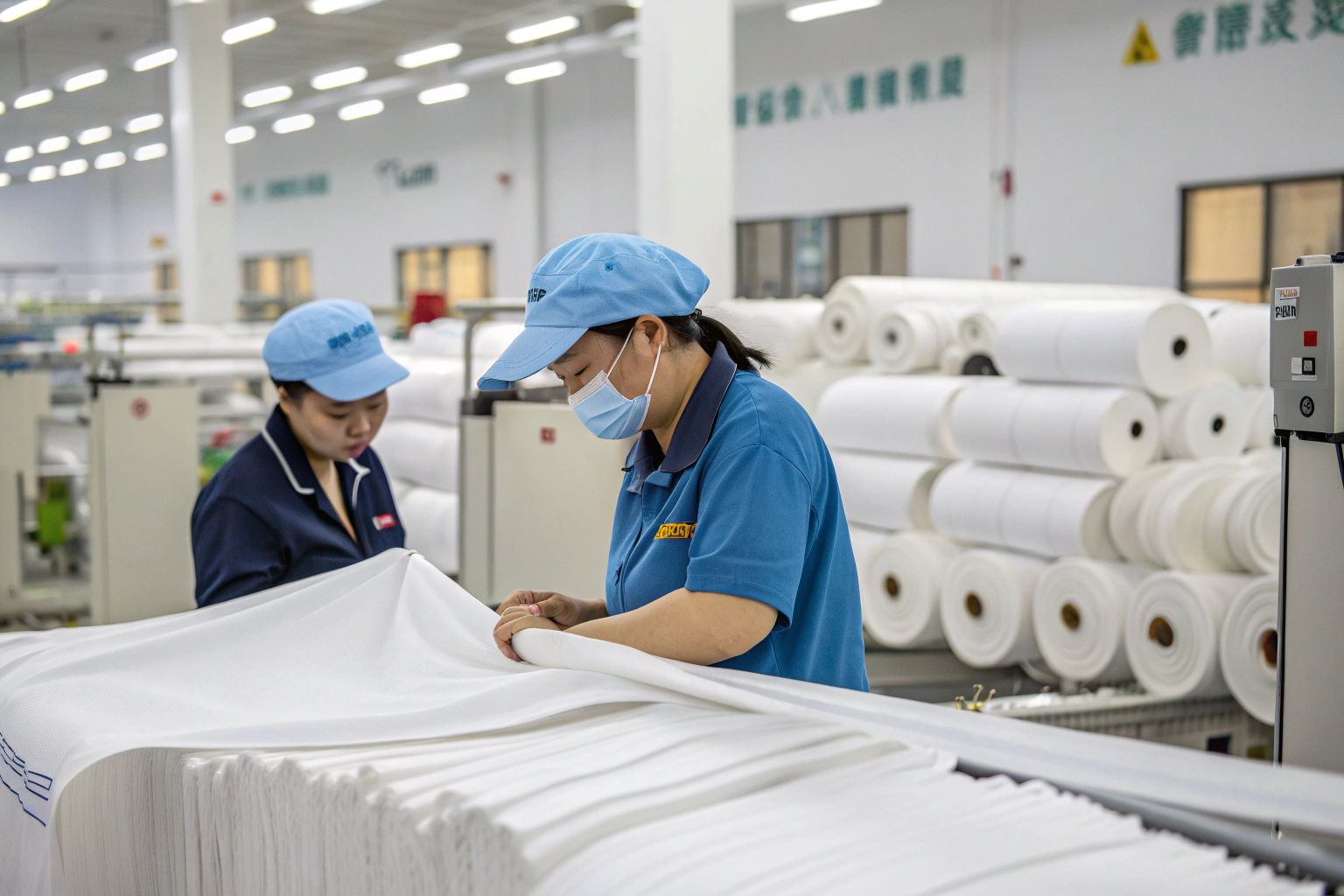
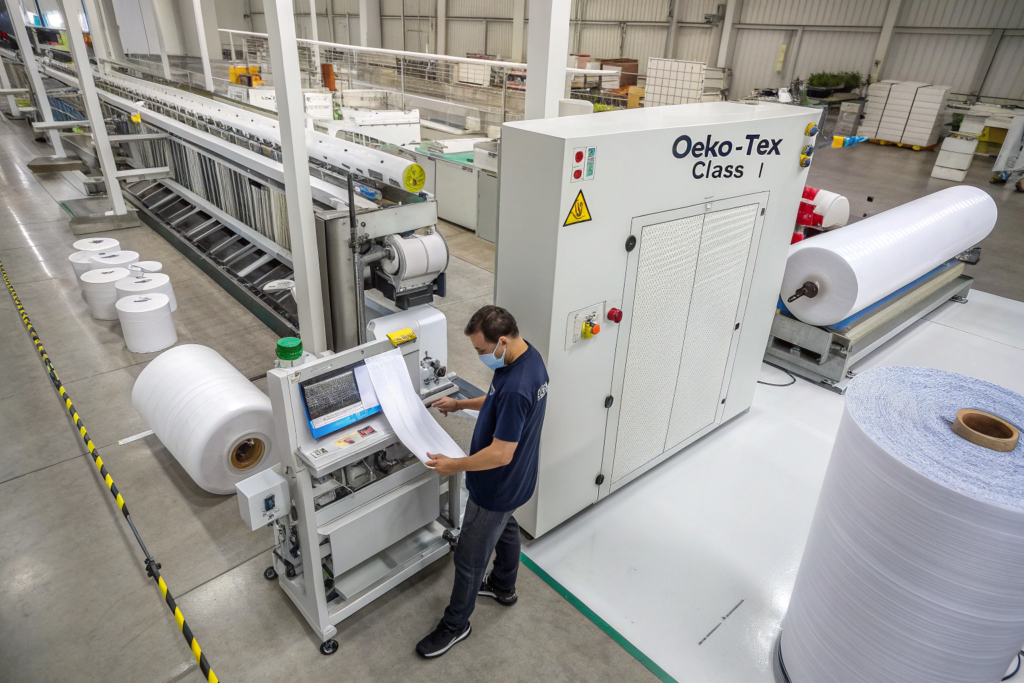
For many, OEKO-TEX Class I is a final lab test. At Shanghai Fumao, it’s a philosophy integrated from molecule to meter. Our control begins at the raw material selection—choosing cottons from sources with responsible pesticide management, sourcing GRS-certified recycled polyesters, and procuring dyes and auxiliaries exclusively from OEKO-TEX pre-approved chemical suppliers. Our in-house CNAS-accredited lab allows us to run pre-compliance tests at every stage: on incoming yarns, during dyeing, and after finishing, long before official certification samples are submitted.
This proactive, embedded approach is why we have a near-100% first-pass rate on our official OEKO-TEX Class I certifications. We don’t test to see if we pass; we control the process to ensure we pass. This is especially vital for kids’ wear, where the margins for error are zero. Our lab technicians are trained to understand the “why” behind each strict limit, fostering a culture of prevention rather than correction.
How Do We Manage Certified Trims and Component Sourcing?
We solve the “trim problem” by offering a fully certified component ecosystem. For our key kids’ wear fabric articles, we maintain a vetted list of compatible, OEKO-TEX Class I certified sewing threads, elastics, and even partner with label printers who use certified inks and materials. We can provide these components directly or furnish our clients with the certificate details of our approved sub-suppliers.
This turnkey solution was a game-changer for a Canadian kids’ athleisure brand in early 2024. They were struggling to source certified matching elastic for their leggings. We provided them with the elastic from our certified partner, along with its matching OEKO-TEX certificate, ensuring their final garment audit was seamless. We manage the complexity so our clients can focus on design and marketing, confident that every element, down to the stitch, supports their safety promise.
What is Our Process for Supporting Client License Acquisition?
Holding the fabric certificate is only step one. For the brand to legally attach the OEKO-TEX label to their garment, they must become a “licensee.” We guide our clients through this straightforward but essential process. We provide them with our official supplier certificate number and a “Declaration of Conformity” letter for the specific fabric article they purchased.
The client then submits this to the OEKO-TEX institute (e.g., through TESTEX or Hohenstein) via an online portal, along with details of their finished product. Upon approval and payment of a license fee, they receive their unique licensee number and official label usage guidelines. We’ve templated this process for our clients, making it a quick, hassle-free step that transforms their compliant material into a consumer-facing trust signal. It’s the final link in the chain that we help forge.
Conclusion
Choosing OEKO-TEX Grade 2 (Product Class I) certification for kids wear manufacturing is not a matter of checking a box for marketability. It is a profound commitment to product integrity, consumer safety, and brand responsibility. It is the most robust, scientifically-grounded, and globally recognized system for ensuring that textiles for the most vulnerable users are free from harmful substances. From the physiology-driven strictness of its limits to its role in securing retail access and parental trust, Class I certification is the non-negotiable foundation of modern, responsible children’s apparel production.
In a world where parents rightfully demand transparency, this certification provides the clear, verified answers they seek. It transforms a brand’s claim of safety from marketing language into a demonstrable, auditable fact. The complexity of achieving and maintaining true compliance underscores the importance of partnering with a supplier who views this not as an added cost, but as an intrinsic part of quality.
If you are building a children’s wear brand that places safety at its core, your fabric partner must share that conviction at a operational level. At Shanghai Fumao, OEKO-TEX Class I compliance is engineered into our process, from our chemical inventory to our final inspection. Let us help you build collections that parents can trust completely. Contact our Business Director, Elaine, to discuss sourcing certified fabrics for your next line. Reach her at: elaine@fumaoclothing.com. Together, we can create clothing that protects childhood in every sense.