
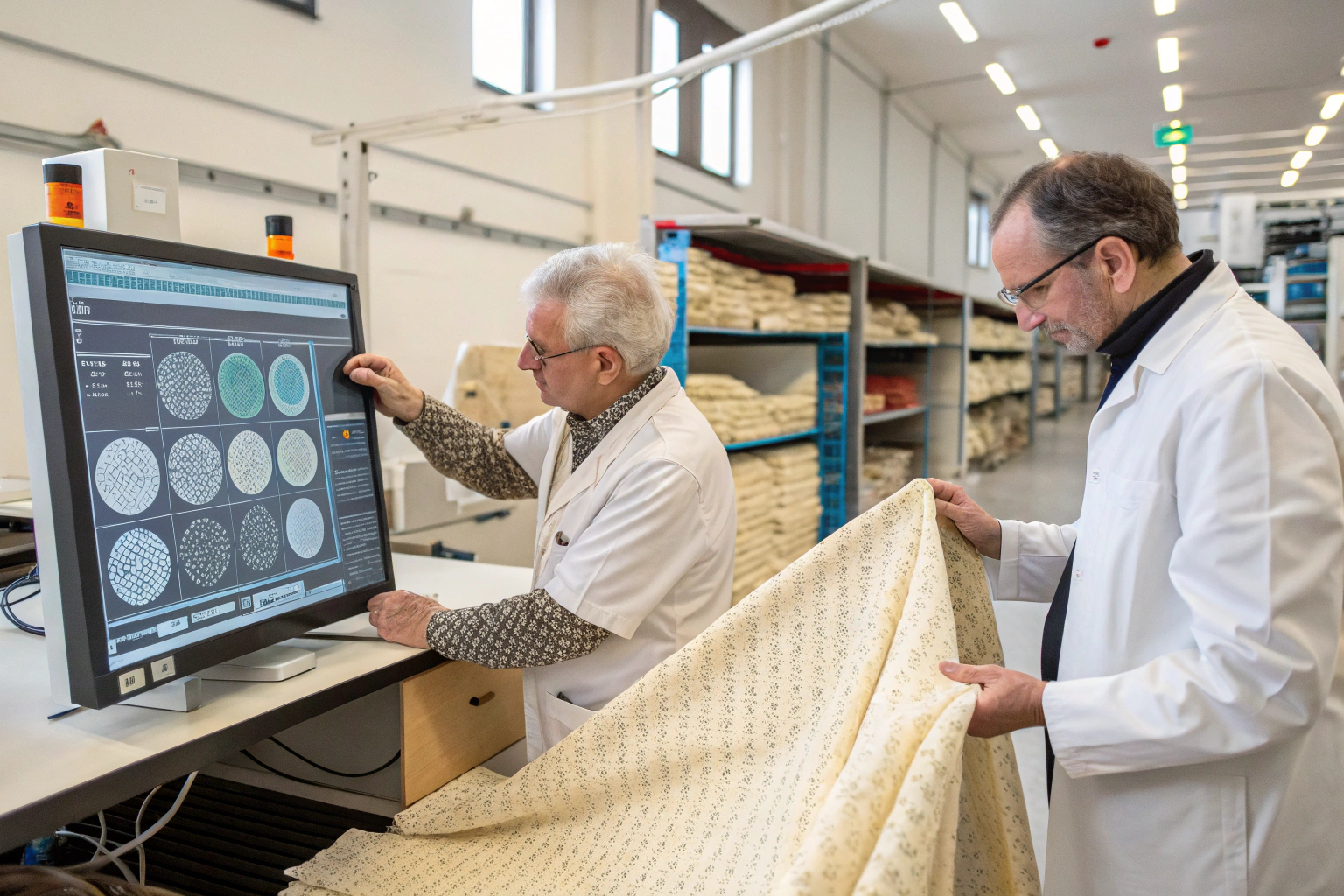
I’ve seen buyers walk into our Keqiao showroom armed with a checklist thicker than a phone book. They demand the GSM report, the tear strength data, the pilling resistance grade, and the exact stitch density per inch. They sit there, squint at the numbers, and nod slowly, thinking they’ve just decoded the fabric’s soul. But here’s the problem. A cheap Pakistani cotton can be engineered to hit a 300 GSM weight just by adding heavy starch, and it’ll feel like a dish rag after one wash. If you buy fabric strictly on numbers, you’re playing defense, not offense. You’ll avoid the obvious disasters, but you’ll miss the hidden magic that makes a garment sell out.
No, Fumao’s good fabric is not strictly a numbers game. The spec sheet is just the entry ticket. The real quality lives in the "Hand Spectrum" and the "Process Story" behind the digits. A 220 GSM slub jersey from Shanghai Fumao might have the exact same lab report as a competitor’s stock service, but ours will drape with a liquid-like flow because we use a "soft twist" spinning method that doesn’t register on a standard GSM scale. Numbers confirm consistency. They prevent you from getting a 180 GSM fabric when you paid for a 200. But numbers alone cannot measure the dry, peachy feel of a correctly singed cotton or the crisp "paper touch" of a high-density poplin. You need to read the fabric’s biography, not just its medical chart.
Now, if you’ve ever been burned by a mill that "hit the specs" but delivered dead-feeling fabric, you’re in the right place. I’m about to break down the three hidden layers of quality that exist between the data points—the things we test with our fingernails, our lightboxes, and our washing machines, not just our scales. Because in this industry, the best fabric isn’t the one that passes the test. It’s the one that tells the truth.
Why Does "Passing Specs" Still Fail the Final Garment?
I’ll tell you about a nightmare we inherited. In March 2024, a San Francisco-based workwear brand came to us in a panic. They had just received a 5,000-yard shipment of their core "Putty Brown" canvas from another supplier. The numbers were flawless. The GSM was spot on at 315, the tensile strength exceeded ASTM standards, and the shrinkage was a perfect 1.5%. But the fabric was unsellable. Why? Because it had absolutely zero "soul." It stood up on the cutting table like a piece of cardboard. The tech pack had specified every mechanical property but completely missed the bending modulus—the secret sauce that makes a canvas feel like a worn-in chore coat instead of a tent.
If you only date the spec sheet, you’ll marry a disaster.
What Is "Fabric Spine" and Why Isn’t It on a Mill Report?
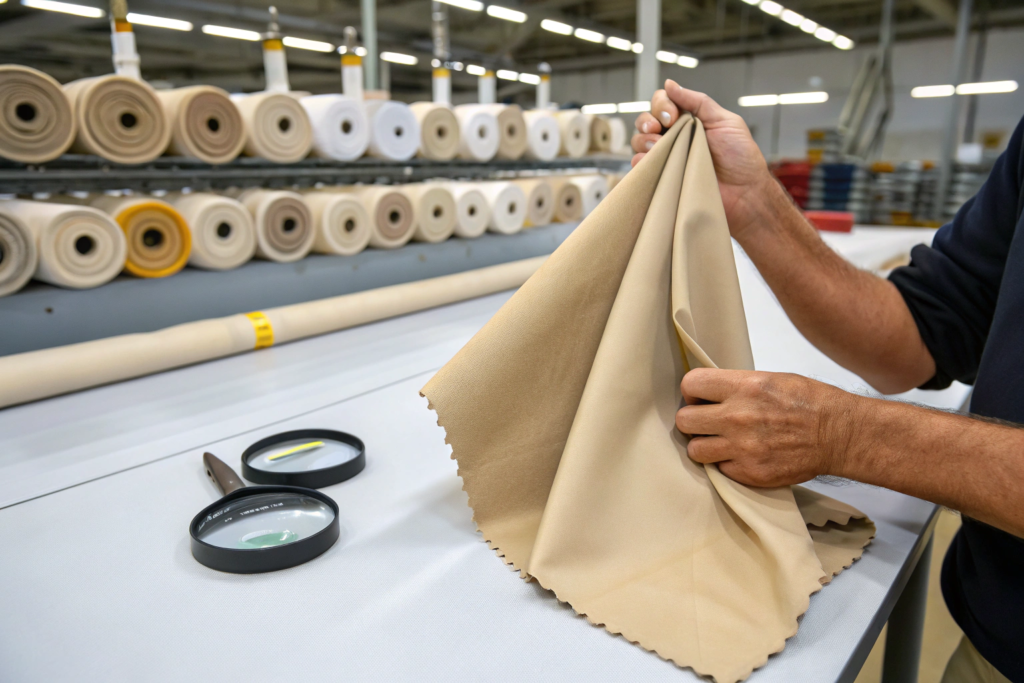
Fabric Spine is our internal term for the controlled stiffness that gives a garment architectural shape without sacrificing comfort. It’s not stiffness in the "cardboard" sense. It’s the gentle roll of a collar that stands up without an iron, or the hem of an A-line dress that flares out rather than collapsing against the shins.
Standard lab equipment doesn’t measure this well. A Kawabata Evaluation System (KES) can measure bending rigidity in precise scientific units, but most factories don’t own a KES because it costs more than a luxury car. So we developed a simple analog test we call the "Self-Support Edge." We cut a 4-inch by 1-inch strip of fabric and slide it off the edge of a metal ruler. The longer the strip extends before bending 45 degrees downward, the stronger the spine. Our premium shirting poplins extend nearly 2.5 inches. Cheap poplins collapse at 1 inch.
I remember a specific development in June 2023 for a US East Coast streetwear label. They wanted a heavyweight neutral tee that boxed out, not draped. The spec sheet said 280 GSM, but the first three samples clung to the mannequin like a wet paper towel. We fixed it by switching from ring-spun to open-end yarn with a higher twist multiplier (TM 4.2 instead of TM 3.6). The GSM didn’t change, but the torque in the yarn created a natural "stand-off" from the body. The customer said, "Now it looks like a $90 tee, not a $15 tee."
Can Two Fabrics with Identical Lab Data Feel Completely Different?
Absolutely. And this is the trap that purely data-driven buyers fall into. The lab data tests the fiber and the construction, but it barely scratches the surface of the finishing chemistry.
Consider our "Nimbus" fleece versus a standard market fleece. Both might test at 320 GSM, 80% cotton, 20% polyester. Both pass pilling tests at Grade 4. But we pour a specific silicone micro-emulsion softener into the final rinse bath, catalyzed at 150°C. This wraps each fiber in a nano-thin film, dropping the surface friction coefficient by roughly 40% compared to a standard macro-silicone finish.
The lab report can’t tell you this because it tests the fabric, not the hand. But your customer’s cheek knows it the second she pulls the hoodie on. She says, "Wow, this is like butter." That "butter" is a chemical engineering choice, not a number on a page. To understand more about the nuances of textile finishing, you might explore technical discussions on how silicone softener application impacts fabric hand feel in textile manufacturing. It’s a world where a one-degree temperature error in the stenter frame can turn "peach skin" into "sandpaper." If you search for how to choose the right silicone softener for cotton fleece without affecting absorbency, you’ll see this is a dark art, not a checklist item.
What’s the "Nail Test" and Why Does It Reveal More Than Tear Data?
Data tells you that a fabric can withstand 3.5 pounds of tearing force before it rips. But what does that actually mean to a woman yanking her suitcase out of an overhead bin while her jacket snags on the latch? That’s a sudden, localized shear stress. That’s where the "Nail Test" comes in.
We teach our QC team and our clients that your thumbnail is the world’s cheapest and fastest fabric snag simulator. It mimics the action of a zipper, a door handle, or a rough edge of a granite countertop—the real-world killers of clothing.
How Do You Simulate a "Zipper Snag" Without a Lab Machine?
You don’t need a Universal Testing Machine. You need your hand.
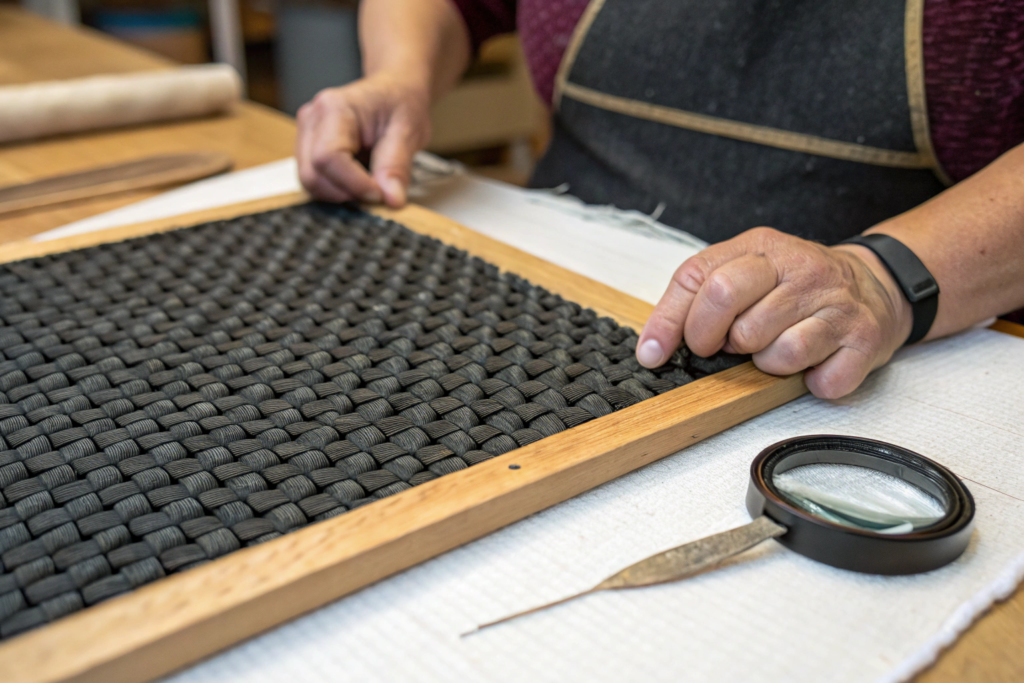
Here’s the Shanghai Fumao method for the "Fingernail Abrasion Check." First, you scratch the fabric surface firmly with your thumbnail in a circular motion, maybe five or six times. On a cheap, low-twist woven, you’ll immediately see the fibers lift, creating a hairy, rough patch. On a quality tight-woven satin or densely packed Oxford, the thumbnail simply slides over the surface without grabbing.
(Let me be blunt—if your fabric pills up just from a fingernail scratch during a showroom inspection, imagine what a Velcro strap on a backpack will do to it after a month.)
The second part of the test is the "Zipper Rip." Take two layers of the fabric, pinch them together, and try to force your thumbnail through the weave gaps. On a low thread-count fabric, the yarns will separate easily, leaving a visible hole. This is a catastrophic failure point for fitted garments like pencil skirts or slim chinos, where seam stress is constant. Our tight-end sateens, used in our US private label programs, are so dense that you cannot penetrate the weave with a fingernail. The tear data might say "15 lbs," but this live test proves that the yarn friction inside the weave is high enough to prevent catastrophic unraveling. It’s one thing to hit a tear strength number; it’s another to design a fabric that refuses to let a single snag spread. For further insight, you can study how to perform simple at-home durability tests on woven fabrics before purchasing for a clothing line, a topic discussed in various maker communities.
Why Does "Weave Density" Matter More Than Yarn Size?
This one drives me crazy. Buyers obsess over yarn count—40S, 60S, 80S—as if a higher number always means better quality. A 60S yarn means 60 hanks of yarn weigh one pound. It’s fine and silky. But if you weave that 60S yarn into a loose, airy construction with 80 picks per inch, it’s going to tear and shift like gauze. Meanwhile, a "coarser" 40S yarn woven at 140 picks per inch creates an incredibly luxurious, heavy, and durable dress shirt that holds its shape for years.
We demonstrate this with the "Light Box Test." We take a "luxury" 80S shirt from a fast-fashion brand and one of our standard 40S high-density oxfords, and we hold them up against the fluorescent ceiling lights in our showroom. The 80S shirt is practically transparent; you can see the silhouette of your hand behind it. Our 40S oxford is a solid, opaque wall of fabric. The yarn is technically "lower quality" by the raw fiber count, but the weave density makes the finished product far superior. To the customer, this translates directly: "This shirt won’t show my undershirt, and it won’t rip if I flex my shoulders." If you’re trying to understand the balance between yarn count and weave density, reading up on how different weave structures affect opacity and durability in dress shirting can help you look beyond just the "thread count" marketing hype.
Does "Good Drape" Need a Spectrometer to Prove Itself?
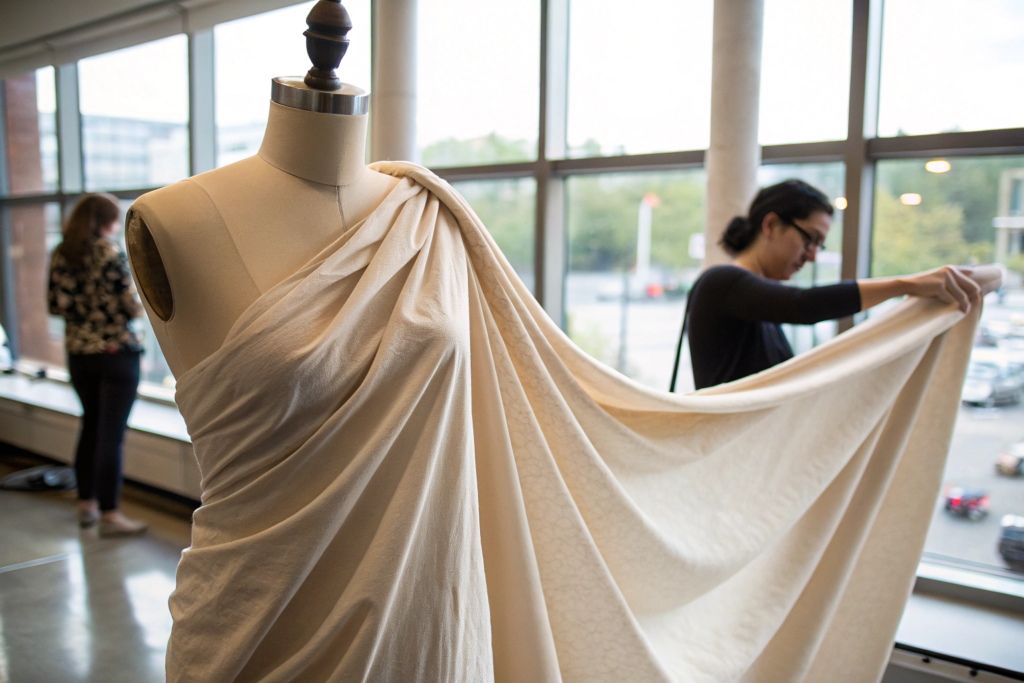
Some fabrics stand up. Others flow. And the difference between a cheap flow and an expensive flow is something you feel in your gut—literally. A bad drape fights the body. A good drape follows it. We call this the "Waterfall Floor" and the "Bell Shape," and I promise you, no spectrophotometer on the planet can quantify it in a way that makes sense to a designer.
If a fabric doesn’t move beautifully, your customer feels like she’s wearing a costume, not clothing.
How Does the "Coin Test" Predict a Dress’s Lifespan?
This is a quick and dirty trick we use for lightweight woven neutrals like challis, charmeuse, or rayon blends. You take a coin—a standard US quarter works well because of its weight and serrated edge—and you balance it in the center of a swatch that’s been pinched into a loose column. You let go of the fabric and watch how it falls over the coin.
If the fabric collapses sharply around the coin, creating a tight, creased silhouette, the drape is stiff and "papery." It will wrinkle immediately on the body. If the fabric oozes over the coin in a smooth, continuous curve, creating a soft bell shape without sharp angles, the drape is liquid. This "Ooze Factor" is what we target for Fumao’s viscose challis prints. It guarantees that a gathered skirt doesn’t puff out like a tutu but cascades down in vertical lines.
I recall a project in October 2023 with a Los Angeles-based contemporary brand. They complained that their rayon crepe midi dress was "hiking up" when walking. The problem wasn’t the cut; it was the fabric’s lack of vertical weight distribution. We added a small percentage of fine-weave metal fiber into the yarn core (a technique borrowed from wrinkle-free suiting). This increased the "crepe gravity" just enough that the dress hung straight down, resisting static cling, yet it remained soft. The lab data—weight, fiber content, tensile strength—stayed identical. But the Coin Test revealed the dramatic improvement.
Can You "Hear" the Quality of a Fabric Before You Touch It?
Yes, and this is the most underrated sensory shortcut in the industry. Certain fabrics have an acoustic signature. The crisp "paper rustle" of high-grade taffeta or the silent "swoosh" of a sand-washed silk charmeuse immediately communicates luxury before your fingers make contact.
We break it down into three sound profiles for our sales team. Crisp is the audible snap you get from a tightly woven, starched poplin or dupioni silk. It signals formality and structure. Swoosh is the soft, continuous white noise of a heavy satin or dense lyocell. It signals fluidity and opulence. Silent is the zero-decibel drape of a heavily brushed French terry or a peach-finished micro-modal. It signals cozy, stealth comfort.
We actually control this during finishing. By adjusting the "calender pressure"—basically, how hard we iron the fabric between massive steel rollers—we can dial the sound up or down. A hard calendar press flattens the yarns into a reflective, noisy surface. A soft calendar, or no calendar at all, leaves the yarns round and the surface silent. I once had a client from New York who designed luxury eveningwear. She closed her eyes in our showroom and rustled a swatch of our acetate satin next to her ear. She smiled and said, "That’s the sound of money." She didn’t care about the drape coefficient data. She cared about the audible signal her fabric sent to the end customer. In a world where how to evaluate high end satin fabric by touch and sound for bridal wear remains a key concern for designers, the acoustic test is often the final tiebreaker.
How Do You Price "Intangibles" Without Over-Explaining?
This is the final hurdle. You’ve proven the hand feel, the spine, and the drape. The customer loves it. Then they ask, "Why does this cost 30% more than the AliExpress listing that shows the same GSM?" If you answer with "Well, our coefficient of friction is lower," you’ve lost them. You sound like you’re inventing reasons to charge extra. The key is to price the insurance, not the ingredient.
We don’t sell "compact ring-spun yarn with a 4.5 twist multiplier." We sell "zero surprises." The price difference pays for the phone call we make to you before the batch ships, explaining that the color shifted by 0.7 Delta E and we’ve already fixed it in re-dyeing.
How to Translate "Process Control" Into "Sleep Insurance"?
Buyers don’t lose sleep because the fabric might be 5% less breathable. They lose sleep because they worry the shipment will arrive looking completely different from the approved sample, triggering a customer service disaster and a chargeback wave. That’s the anxiety we price against.
We call this "Batch-to-Batch Integrity." It’s the guarantee that Sweater #500 made in November feels identical to Sweater #1 made in August. Achieving this is extremely expensive. It means we reject dye lots that are "technically within tolerance" but visually slightly off. It means we track the humidity in our spinning room because cotton absorbs moisture from the air, and a 2% humidity shift changes the yarn weight.
In July 2024, a US client ordered a repeat batch of a "Sandstone" rib knit. Our dye master flagged the incoming greige yarn as having a slightly higher micronaire value (a measure of cotton fineness) due to a seasonal shift in the Xinjiang crop. Even though the spec sheet would have passed, we knew this micro-change would alter the dye uptake. We adjusted the dye recipe proactively, adding 1.5% more penetrant. The client never noticed a difference between Batch A and Batch B. That silent non-event is exactly what they paid for. The alternative—a visible stripe of mismatched color in their store display—would have been a public relations disaster. When you frame it as how to guarantee color consistency across multiple production batches from Chinese fabric suppliers, the "intangible" suddenly becomes very tangible to a brand’s bottom line.
Can "Faster Delivery" Actually Be a Quality Indicator?
Not always, but in our world, speed reflects system health. A factory that consistently delivers 7-day sample development and 25-day bulk production isn’t just "fast." It’s deeply organized. It has solved its own internal bottlenecks.
Think about it. If a supplier quotes you 50 days for a solid neutral cotton, it’s often because their production line is in chaos. They’re spending 15 days just fixing machine breakdowns or re-running failed dye lots. They aren’t slower because they’re "more careful." They’re slower because they’re inefficient. This inefficiency is a massive quality risk. Rushed work at the end of a chaotic cycle creates seam slippage, barre marks, and color trailing.
At Shanghai Fumao, our "Speed Factor" comes from vertical integration. We don’t send your greige fabric to a dyeing house across town and wait in a queue behind 20 other brands. Our dyeing cooperatives are synchronized with our knitting schedule via a shared ERP platform. When a knitting machine finishes a lot, the dyeing team already has the water bath pre-heated to the exact target temperature. This precision timing means the fabric doesn’t sit around for three days collecting dust and oil stains. To the buyer, this simply means: "They turn orders around fast because they’re rigorous, not because they’re cutting corners." If you’re navigating global supply chains, understanding how to reduce lead times for custom clothing manufacturing in China through vertical integration offers concrete proof that the supplier’s operational health directly safeguards your product quality.
Conclusion
So no, Fumao’s good fabric isn’t strictly a numbers game, but the numbers do matter—they’re just the first step, not the final word. I’ve shown you how we use the Fingernail Abrasion Check to catch snag risks that tear strength data misses, how we measure "Fabric Spine" with a ruler instead of a lab machine because nobody wears a tensile tester to dinner, and how the Coin Test reveals a dress’s lifespan better than a drape coefficient. We covered the acoustic signature of luxury, the unspoken fear of batch-to-batch color drift, and why our operational speed is actually a quality signal, not a marketing claim. Every yard we ship from our Keqiao facility carries a biography that begins long before the lab report is printed—in the humidity of the spinning room, the angle of the brushing rollers, and the chemistry of the softener bath. The data proves we met the minimum standard. The touch, the sound, the drape, and the consistency prove we exceeded it. That’s the real game.
If you’re ready to source fabric that passes the test where it matters most—in your customer’s hands—let’s start a conversation. We’ll build a sample package that demonstrates every intangible we discussed here, from Spine to Swoosh. Reach out to our Business Director, Elaine, at elaine@fumaoclothing.com. Tell her what your ideal fabric feels like, not just what it weighs, and she’ll put together a touch-proof case for why Shanghai Fumao belongs in your supply chain.








