Let me tell you what happens when a non-creative buyer tries to order swatches the way a designer does. They request the "inspirational" fabrics—the leopard jacquard, the metallic linen, the tie-dye mesh. These swatches sit on their desk for three months, gathering dust, because they have no idea how to build a commercial range from a statement piece. Meanwhile, their core basics—the white button-downs, the beige chinos, the navy tees—are bleeding in the wash, pilling at the crotch, and getting returned at 12%. They chased the sparkle and forgot the skeleton. The real problem isn’t that they lack taste. It’s that they don’t know which swatches prove a supplier’s competence, not just their creativity.
A non-creative buyer should always order what I call the "Diagnostic Seven" first: a White Poplin, a Black Jersey, a Neutral Brushed Fleece, a Heavy Stretch Twill, a Rib Knit Trim, a Sheer Chiffon, and a Melange Yarn-Dyed Slub. These seven fabrics are not the sexiest items in our 30,000+ SKU library at Shanghai Fumao, but they are the most honest. White reveals bleaching quality. Black reveals dye depth. Fleece reveals brushing consistency. Twill reveals recovery. Rib reveals needle precision. Chiffon reveals finishing courage. Melange reveals spinning integrity. Together, they give you a complete X-ray of a factory’s technical backbone without you needing to understand a single yarn count or finishing formula.
If you’re a procurement manager, a finance guy who got handed sourcing duties, or a brand founder who "doesn’t do design," stick with me. I’m going to walk you through each of these seven diagnostic tools, what they reveal, and the exact words you can use to describe your findings to a supplier—words that make you sound like a 20-year veteran even if you’ve never set foot in a dye house.
Why Should a "Boring" White Poplin Be Your First Request?
I’ve said this to every procurement manager who ever walked into my Keqiao showroom: "If a mill can’t do a perfect white shirt, they can’t do anything." White fabric is naked. There is no dye to hide the dirt, no print to distract from the broken yarns, no brushing to cover up the uneven weaving. A white poplin swatch is the single most honest piece of cloth you will ever hold, and it will tell you more about a supplier’s quality control in five seconds than a 50-page audit report.
When you order this swatch first, you’re not buying a shirt fabric. You’re buying a laboratory-grade diagnostic tool that measures cleanliness, chemistry, and consistency all at once.

What Should a "Clean" White Actually Look Like Under Store Lights?
Most non-creative buyers think "white is white." But white is actually a very specific shade with a measurable number. A good white poplin should look like fresh snow under fluorescent store lighting—slightly cool, with a faint blue-violet undertone, never yellow or cream. If it leans yellow, it means the mill skimped on the optical brightening agents or used a low-grade cotton with high wax content that didn’t scour clean.
Here’s what you do when the swatch arrives. Take it to a window at noon. Hold it next to a piece of standard printer paper. The fabric should look whiter than the paper, not dingier. If it looks like a smoker’s teeth—dull, grayish, sad—the mill has a dirty water problem or a weak bleaching sequence. Then hold it up to the light. You should not be able to see your fingers clearly through the weave. A quality poplin with 133×72 thread count will be opaque. If it’s translucent, the weave is too loose, and the garment will be see-through on the body.
I recall a specific batch in February 2024 for a US uniform company. Their previous supplier’s white poplin had a "creamy" cast that made their shirts look old and tired next to their competitor’s crisp whites. We ran our standard three-stage bleaching—oxygen, optical, reductive—and achieved a CIE Whiteness Index of 152. The client’s exact words: "It looks like a dentist’s smile." That’s the standard. For a deeper understanding of what drives that visual result, you can explore how the choice of optical brightening agents impacts final whiteness in cotton poplin fabric. It’s chemistry that most buyers never see, but your eyes detect it immediately.
How Does the "Stitch Test" Expose Weak White Poplin?
White poplin is used for shirts and blouses—garments with long, straight seams that take constant tension across the shoulders and upper back. A weak poplin will "seam slip" under stress. The yarns will pull apart along the stitch line, creating an open gap that looks like a run in a stocking but on your back.
You can test this on the swatch with just your fingers. Pinch the fabric about half an inch from the edge and pull sideways, perpendicular to the selvage. If the yarns slide apart easily, creating a visible hole or gap, the fabric has low seam strength. If the yarns lock tight and the fabric barely budges, the weave density is solid. Our poplin uses a "tight-end" construction with a higher number of picks per inch than standard market poplin, specifically to prevent seam slippage in commercial laundry conditions.
In October 2023, a hospitality client ordered 8,000 white shirts for a hotel chain. The initial sample from their previous supplier passed the visual check but failed this exact pinch test. Every shirt would have split at the back yoke within a month of industrial laundering. We delivered a batch with zero seam slippage complaints over a 12-month contract period. This is the invisible engineering that a "boring" swatch reveals, and it’s why procurement forums often discuss how to test woven cotton poplin for seam slippage resistance before bulk ordering. It saves you from a recall.
What Can a Simple Black Jersey Tell You About Dye Depth?
Black is the second-hardest color to dye correctly, right after white. Cheap black jersey doesn’t look black at all. It looks like a very dark, faded charcoal that turns reddish-brown after five washes, or worse, it looks "hollow"—a surface-only black that reveals a stark white core whenever the fabric stretches over a knee or an elbow. A black jersey swatch tells you whether the dye house understands fiber penetration, oxidation control, and post-dyeing reduction clearing.
When you stretch a quality black jersey, it should stay black. When you wash it, it should stay black. When you hold it under bright light, it should still be black. Not navy. Not brown. Black.

Why Do Cheap Blacks Turn "Rusty" After Washing?
The answer is surface dye and incomplete oxidation. For black cotton jersey, most mills use sulfur black dye because it’s cheap and deep. But sulfur black dye molecules sit on the fiber surface and require a precise oxidation step to fully develop their color. If the dye house rushes this step—if they pull the fabric out of the dye bath too early and don’t give the sulfur time to oxidize fully in air—the black looks great on day one but slowly turns rusty bronze as the unstable dye molecules degrade in the wash.
We run a "reduction clearing" step on every black batch. After dyeing, we treat the fabric with sodium hydrosulfite and caustic soda at 80°C to strip away the loose, unoxidized surface dye. This step costs money and time, and cheap factories skip it entirely. The fabric leaves the mill looking black enough to ship, but it’s chemically unstable. In August 2024, a streetwear brand sent us their competitor’s black tee. After five home washes, it had faded to a patchy reddish-brown across the shoulder seams. We replicated the garment with our sulfur black protocol, and after 20 washes, the Delta E shift was under 1.5. The black was still black.
(Let me be blunt here—if your black swatch smells strongly of sulfur or rotten eggs when you open the polybag, the mill didn’t rinse it properly. That smell is residual chemical that will also irritate sensitive skin. Return it immediately.)
Another key indicator is "grin-through." Stretch the black jersey over your fist. If you see white fibers poking through the stretched knit loops, the yarn wasn’t properly penetrated by the dye. The black is just a surface coating. Our dope-dyed black polyester blends solve this entirely because the pigment is inside the fiber, not on it. For an in-depth technical walkthrough, understanding how sulfur black dyeing and reduction clearing processes affect wash fastness in cotton knits will give you the vocabulary to challenge your supplier when their black turns rusty.
Which Heavy Twill Proves a Mill Can Handle Structure?
After white and black, you need to test structure. Structure means a fabric that holds a shape rather than collapsing into a limp puddle. Heavy twill is the archetype—it’s what you use for chinos, work pants, structured jackets, and bags. This swatch answers one critical question: does this mill understand the relationship between yarn twist, weave density, and finishing stiffness? Because a twill that feels like a cheap tablecloth has failed all three.
You don’t need to know the twist multiplier. You just need to squeeze the swatch in your fist, let go, and watch what happens.

How Does the "Chair Test" Prove Twill Quality Instantly?
This is the single best test for a non-creative buyer evaluating twill. Take the swatch, lay it flat on a hard chair seat, sit on it for 30 seconds, then stand up and hold the fabric up to the light. A quality twill will show deep, sharp creases where your weight pressed it, but zero shine, zero surface abrasion, and zero permanent flattening of the diagonal weave lines.
Cheap twill fails this test in two ways. First, it develops a greasy-looking shine on the high points of the weave because the yarns were made from short, weak cotton fibers that break and mat down under friction. Second, the diagonal twill lines get crushed flat and don’t recover, leaving a smooth, shiny patch that looks like an iron burn. This is called "chafe polish," and once it happens on a pair of chinos, the garment looks perpetually dirty and worn out even if it’s brand new.
Our heavy twill for the US market uses long-staple combed cotton with a high twist factor and a soft-hand silicone finish that resists abrasion without feeling plastic. In March 2024, a workwear brand tested our 320 GSM twill against a cheaper import. After the Chair Test, the competitor’s swatch had a visible shine mark that didn’t brush out. Ours looked freshly pressed. The client switched their entire pant program to our base. If you’re sourcing bottom-weight fabrics, knowing how to evaluate cotton twill fabric for abrasion resistance and pilling using simple at-home tests will save you from approving a fabric that looks great on the cutting table but terrible after one wear.
Can You "Hear" If the Twill Is Too Stiff or Too Soft?
Yes. Hold the swatch by two corners and shake it sharply, like you’re snapping dust off a rug. A twill that is over-starched will sound like stiff cardboard—a sharp, brittle rattle. This stiffness will wash out in three cycles, and the garment will lose all its structure. A twill that is too soft will make no sound at all and will drape like a wet tissue over your hand. This fabric will never hold a crease.
You want a deep, low "thump" sound—like flicking a heavy piece of watercolor paper. That sound indicates the fabric has internal density and body that comes from the weave and the yarn, not from a temporary starch coating that washes away. We control this by adjusting the "calender pressure" during finishing. Our heavy twills get a medium-pressure calendar pass—enough to flatten the surface fibers and create a smooth hand, but not so much that we crush the yarn roundness and create that brittle over-starched noise. This balance is something cheap mills consistently get wrong because they use excess starch to fake density. For more on this tactile evaluation method, searching how to assess fabric hand and body using simple bend and snap techniques can give you additional diagnostic tools that don’t require a lab coat.
What Should a "Test Kit" of Trim and Texture Swatches Include?
The first four swatches—poplin, jersey, fleece, twill—cover your core body fabrics. But a garment is more than its body. The trims, the textures, and the drape accents are where cheap suppliers fall apart. If a mill can produce a flawless rib knit collar that doesn’t bubble, a chiffon that doesn’t shred at the seams, and a slub that doesn’t look like a mistake, you’ve found a supplier who can handle your entire range, not just the easy stuff.
These four additional swatches—Rib Knit Trim, Sheer Chiffon, Melange Slub Jersey, and a Soft Satin—complete your diagnostic kit. They test precision, courage, consistency, and finish.

Why Does a Tiny Rib Knit Swatch Expose Needle Precision?
Rib knit is used for collars, cuffs, and waistbands—the high-stress edges of a garment that consumers touch and tug constantly. A bad rib knit will lose its elasticity after a week, developing a wavy, stretched-out "bacon neck" that makes the entire garment look cheap. The swatch tells you whether the knitting machine’s needle gauge was precise and whether the spandex filament inside the yarn is properly trapped.
Test it this way: stretch the rib knit lengthwise to its maximum extension and hold it for ten seconds. Then release it. Measure its width immediately. It should snap back to within 95% of its original dimension within five seconds. If it stays stretched out or recovers slowly, the spandex content is either too low or the spandex wasn’t properly fed into the knitting machine under controlled tension.
A second test: hold the rib knit up to the light and stretch it. Look for horizontal needle lines—thin, even stripes across the fabric where individual knitting needles created a defect. One or two faint lines might pass, but if you see a repeating pattern of thick and thin rows, the mill’s knitting machines have damaged needles or poor cylinder maintenance. In January 2024, we caught a batch of rib trim that developed needle lines after 20 meters of knitting due to a worn needle hook. We replaced the needle and re-knit the lot before it ever reached the client. Cheap mills would have shipped it and blamed the buyer for "over-inspecting." For a deeper dive into trim quality standards, searching how to test rib knit fabric for recovery and needle line defects helps you catch these issues before they become a collar on a returned garment.
Can a Sheer Chiffon Swatch Prove a Supplier’s "Finishing Courage"?
Chiffon is the bravest swatch a mill can send you. It’s a lightweight, transparent, highly twisted woven fabric with edges that fray if you breathe on them wrong. Producing a clean, flat chiffon without crease marks, snags, or selvedge curling requires absolute mastery of tension control during finishing. Most cheap mills won’t even offer chiffon, or they’ll send you a sample that’s been starched stiff to hide the handling damage.
When you receive a chiffon swatch, lay it flat on a dark surface. The fabric should lie perfectly smooth with no puckering, no wavy "seersucker" effect, and no curled edges. The selvedge (the finished edge along the side) should be straight and flat, not rippled. If the selvedge is rippled, the stenter frame tension was uneven during heat setting, and the fabric will be impossible to cut straight in production.
The "Pinch Test" is decisive. Pinch the chiffon in the center and lift it. It should drape into soft, even, vertical folds without any sharp, angular creases. If it holds sharp fold lines, the fabric is either over-starched or the yarn twist is too tight, and it will be uncomfortable and stiff on the body. Our chiffons are finished with a soft calendar pass at precisely 140°C, which relaxes the twist memory of the yarns without flattening their structure. In June 2024, a formalwear brand rejected three chiffon suppliers before finding us because the previous swatches all had selvedge curl so severe the fabric couldn’t be spread on the cutting table. A deeper study of how to handle lightweight woven fabrics during finishing explains why many mills simply can’t do it well—it requires patience and precision that high-volume commodity factories don’t invest in.
How Do You Turn These Seven Swatches Into a Buying Decision?
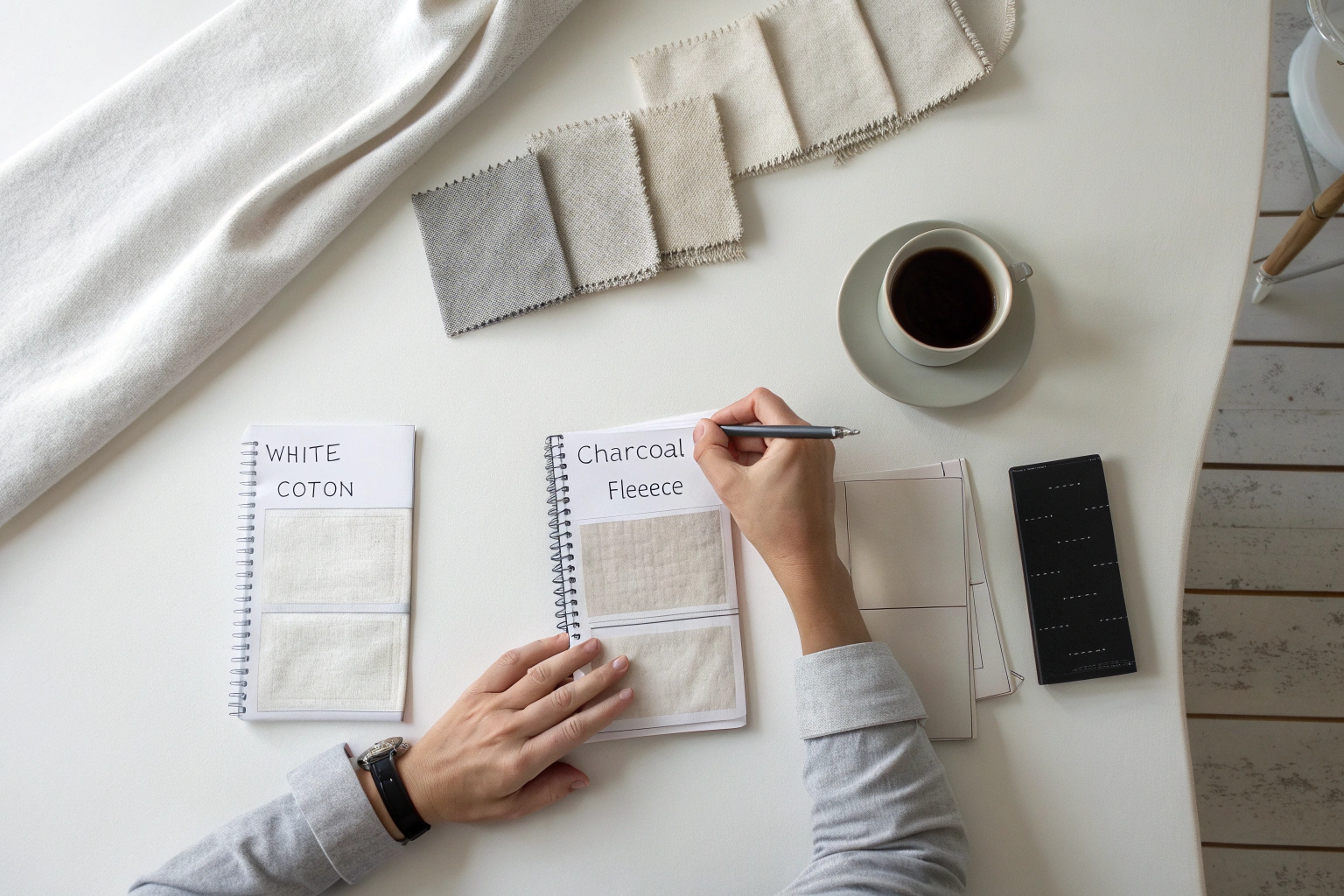
You now have seven swatches on your desk: White Poplin, Black Jersey, Neutral Fleece, Heavy Twill, Rib Trim, Sheer Chiffon, and Melange Slub. You’ve squeezed them, stretched them, scratched them, held them up to the light, and maybe even sat on them. The final step is translating these physical impressions into a structured evaluation that justifies your sourcing decision—to your boss, to your financial controller, or to your own internal checklist.
The Diagnostic Seven are not about finding the "prettiest" fabric. They are about finding the supplier who makes the fewest invisible mistakes.

What Is a "Pass/Fail" Scorecard for Non-Creative Buyers?
You don’t need to grade on a curve. Each swatch has one primary pass/fail criterion that predicts bulk performance. If a supplier passes all seven, you have a manufacturing partner. If they fail two or more, you have a risk that your procurement budget cannot afford.
Here’s the scorecard we recommend to our US procurement clients:
| Swatch Type | Primary Test | Pass Indicator | Fail Indicator |
|---|---|---|---|
| White Poplin | Light Test | Opaque, snow-white, no yellow cast. | Translucent, creamy, dirty-looking. |
| Black Jersey | Stretch Test | Stays deep black when stretched; no white grin-through. | Reveals white core; turns reddish-brown after wash. |
| Neutral Fleece | Nail Scratch | Fibers stay flat; no pills or loose fuzz. | Fibers lift into visible pills with one scratch. |
| Heavy Twill | Chair Test | Creases are sharp, surface has no shine after sitting. | Shiny abrasion marks; flattened weave lines. |
| Rib Trim | Snap Test | Recovers to 95%+ of original width within 5 seconds. | Stays stretched out; "bacon neck" effect. |
| Sheer Chiffon | Pinch Test | Drapes into soft, even folds; no angular creases. | Holds sharp fold lines; selvedge is rippled or curled. |
| Melange Slub | Wash Test | Slub texture remains consistent after 5 washes; no pilling. | Slubs break down into pills; fabric loses character. |
I had a procurement manager from a Midwest uniform company visit our showroom in November 2024. He wasn’t a textile guy. He was an operations guy. He brought this exact scorecard, worked through the seven swatches in 20 minutes, and placed a $120,000 order for three core bases. He told me later, "This was the first time I didn’t feel like I was gambling." That’s the power of a systematic approach. If you want to build your own evaluation framework, studying how to create a textile quality scorecard for apparel procurement and sourcing decisions can help you customize the criteria for your specific product category.
When Should You Reject a Supplier Based on Swatches Alone?
Reject them immediately if the black jersey shows white grin-through on the stretch test. This is a structural dyeing failure that cannot be fixed with a conversation. The mill lacks either the equipment for deep penetration dyeing or the discipline to run proper reduction clearing. Either way, this is non-negotiable.
Reject them if the white poplin is cream-colored or translucent. These are signs of either poor raw material selection or weak finishing capability. A mill that can’t deliver a clean white cannot deliver a clean pastel or a true neutral either. White is the easiest of the difficult colors. If they fail the easiest, they will fail the harder ones spectacularly.
Reject them if the rib trim doesn’t snap back within five seconds. This is a knitting precision and spandex feeding problem that will generate customer returns on every garment with a collar or cuff. You cannot fix bad knitting with good stitching.
The swatches that deserve a conversation are fleece with slight surface fuzz—this can sometimes be fixed by adjusting the brushing machine parameters—and twill with borderline shine, which might be an over-starching issue that a different finishing recipe can solve. But the structural failures—white opacity, black depth, rib recovery—are embedded in the mill’s equipment and culture. If they fail those, walk away. For additional guidance on supplier qualification, exploring how swatch evaluation fits into a broader supplier audit process for textile mills can provide a more complete picture.
Conclusion
A non-creative buyer doesn’t need to know how to design a collection to make a brilliant sourcing decision. You need a diagnostic framework that turns subjective "hand feel" into objective pass/fail criteria. The seven swatches I’ve laid out here—White Poplin for bleaching integrity, Black Jersey for dye depth, Neutral Fleece for brushing quality, Heavy Twill for structure and abrasion resistance, Rib Trim for knitting precision, Sheer Chiffon for finishing courage, and Melange Slub for spinning consistency—are not random suggestions. They are a deliberate, battle-tested protocol we’ve used with procurement managers from Los Angeles to London who don’t have a fashion background but do have a budget, a timeline, and a zero-tolerance policy for customer returns. Each swatch answers one critical question: can this supplier execute the invisible engineering that separates a garment people keep from a garment people return? You don’t need to verbalize yarn counts or finishing formulas. You just need to squeeze, stretch, scratch, and sit on the fabric, then mark the scorecard.
If you want us to assemble your first Diagnostic Seven kit, tailored to your specific product category—whether that’s workwear, children’s wear, athleisure, or hospitality uniforms—reach out to our Business Director, Elaine, at elaine@fumaoclothing.com. She’ll prepare a numbered sample card with each swatch mounted and labeled, plus a blank scorecard you can fill out at your own desk. No jargon, no design school vocabulary required. Just seven swatches, seven tests, and seven answers that tell you whether we’re the right partner for your next order.