Let me guess. You’re staring at a tech pack full of numbers like "40S/1 compact ring-spun" and "20D spandex full dull," and your customer just asked, "But does it feel good?" Here’s the problem: most fabric sales pitches sound like a failed chemistry exam. They confuse your buyer instead of closing the sale. I’ve watched small brand owners on sales calls lose their audience because they tried to sound like a textile engineer instead of a problem solver. The moment you say "hydrophilic moisture management," your customer’s eyes glaze over, and you’ve lost the chance to prove why your quality matters.
You describe Fumao quality without designer words by focusing on what the customer’s hand actually feels and what their daily life actually looks like. Instead of saying "280 GSM," say "it holds its shape after a 9-hour flight." Instead of "reactive-dyed colorfastness," say "you can spill red wine on it, wash it cold, and nobody knows." At Shanghai Fumao, we train our reps to translate lab results into life results. The fabric’s "drape coefficient" becomes "it skims your belly, not hugs it." The "stitch tear resistance" becomes "you can pick up a toddler all day, and the shoulder seam won’t rip." That’s the whole job—bridging the gap between a spectrophotometer reading and a human experience.
Now, you might be thinking, "Okay, but how do I explain the difference between your quality and a cheap AliExpress roll without sounding snobby?" That’s exactly what we’re about to unpack. I’ll walk you through the five sensory shortcuts—Hand, Memory, Light, Pill, and Sew—that we use inside our showroom in Keqiao every single day. These aren’t marketing gimmicks. They’re physical truths you can demonstrate on a video call or in a sample package.
Why Does the "Hand Feel" Test Sell More Than Lab Reports?
I’ll tell you a story. In September 2023, a US client visited our showroom to inspect a shipment of brushed French terry. He brought his lab technician, a guy with a briefcase full of equipment—spectrometer, picks counter, GSM cutter. They spent 45 minutes running numbers. Everything passed. But the owner still looked unsure. So I took the swatch, rubbed it against his forearm, and said, "Feel that? That’s not peach fuzz. That’s a 32-needle brush roller running at 1,200 RPM. Your customer will buy the hoodie because of the print, but they’ll keep wearing it because of this." He placed the order on the spot. The data confirmed the quality, but the hand feel proved it.
If your customer cannot articulate why a fabric is good, they won’t value it. You have to teach their fingers.

What Does "Good Fumao Fabric" Actually Feel Like in Real Words?
Stop saying "soft." That word is dead. A cheap polyester blanket from a discount store is technically "soft," but it feels slimy and cold. We categorize fabric hand into four everyday textures that any American consumer immediately understands.
First is Butter Touch. This describes our proprietary micro-sanded single jersey. It feels like you just put on a shirt that’s been washed 20 times, fresh out of the package. The technical term is "zero-drum heat-setting with cationic softener overfeed," but to your customer, it’s "that tee you steal from your husband’s drawer."
Second is Bone-Dry. This describes high-twist cotton or linen blends. It feels crisp, cool, and airy—like a freshly ironed dress shirt on a summer morning. It doesn’t cling to sweaty skin. When a client asks for "breathable," I don’t show them a chart of air permeability values. I tell them to hold the fabric against their cheek and blow air through it. If they feel the breeze, it’s Bone-Dry quality.
Third is Memory Bounce. This covers our ponte romas and heavy rib knits. You squeeze it in your fist, let go, and it springs back flat in under a second. No crease marks. For a customer buying work pants or bodycon dresses, this means they don’t have to iron it after sitting at a desk all day.
Fourth is Fuzz Nap. This is the warm, woolly surface on a thermal layer. It shouldn’t feel hairy; it should feel like a clean Golden Retriever’s ear. Short, dense, and even. If the nap is patchy, the fabric is cheap. If it feels like a uniform velvet, it’s Shanghai Fumao grade.
Can You Judge Fabric Quality by Rubbing It on Your Neck?
Yes, and it’s the only test that matters for necklines and cuffs. The skin on your inner forearm and neck detects itch at a fiber diameter of roughly 30 microns. Any wool or coarse cotton above that will trigger a scratch response. When we develop fabrics for US sensory-sensitive brands (like children’s lines or adaptive clothing), we run a "Neck Feel Audit."
Here is a practical breakdown of how we connect the technical fiber spec to a real human sensation:
| Technical Fiber Spec | Sensor Term | Customer Perception |
|---|---|---|
| < 18 Micron (Long-staple Cotton) | Butter Touch | "Silky, slides over my dry elbows without dragging." |
| 18-22 Micron (Standard Cotton) | Crisp Hand | "Feels solid, like a hotel bed sheet." |
| Coarse Linen/Slub | Bone-Dry Texture | "Feels rustic, earthy, like a farmer’s market bag." |
| Recycled Polyester (Rough Cut) | Scratch Factor | "Itchy, reminds me of a cheap Halloween costume." |
We solved a scratch problem for a Texas-based yoga wear brand in January 2024. Their neutral oatmeal leggings had a side seam that was irritating testers. We traced it to the seam thread, not the fabric. By switching to a corespun poly-wrapped thread, the friction coefficient dropped significantly. The fix was invisible, but every woman who wore those leggings felt the difference. You can read discussions about fiber diameter and prickle factor on textile engineering resources, but honestly, if you search how to select itch-free fabric suppliers for sensitive skin activewear, you’ll find that most problems come from suppliers who don’t run these physical audits at all.
How to Explain "Shape Memory" to a Skeptical Buyer?
Nothing kills a clothing brand faster than "knee bags." You know what I’m talking about—those saggy pouches on joggers or the elbows on a sweatshirt that don’t snap back. When a buyer visits our facility, I don’t show them a spreadsheet with "Elongation Rate: 95% +/- 5%." I grab a swatch of our high-recovery knit, ball it up in my fist for ten seconds, release it, and toss it on the cutting table. If it lies perfectly flat within two seconds, I say, "That’s what your customer’s knees look like after brunch."
We sell "Shape Memory" because we sell confidence. A woman doesn’t care about spandex denier; she cares that her dress doesn’t embarrass her when she stands up from a chair.

What Is the "Sag Test" and Why Should You Demand It?
The "Sag Test" is not an ASTM standard. It’s something I invented in 2019 to explain recovery to a non-technical brand founder from Los Angeles. But it’s brutally effective.
Here’s the test: We take a 10-inch by 10-inch swatch. We hang a 500-gram weight from one corner for 30 minutes. (Imagine the weight of a pair of car keys and a phone pulling down your pocket). Then we remove the weight and measure the fabric after 60 seconds of rest. Our standard for "Premium Memory" is less than 2% residual stretch. Budget knits often show 5-8%. That 6% gap is the difference between a garment that still looks new after six months and one that looks tired after six washes.
(I have to jump in here—we’ve had clients who used to source based solely on a cheap price per yard and then lost thousands because their entire batch of rompers sagged at the crotch by mid-afternoon. You cannot afford to skip the physical simulation.)
How Do You Describe "Lycra Migration" in Plain English?
You might call it "the rubber band break." Spandex doesn’t last forever. Cheap fabrics use a process where the spandex just sits inside the yarn core, barely trapped. When you wash it, the spandex filaments snap or "migrate" out. In plain English, your fabric suddenly looks like it has gray little hairs sprouting all over it. It’s creepy.
We describe this to customers as the "Stubble Effect." You don’t want your jersey tee growing a 5 o’clock shadow. We prevent this by using a double-core spinning method. Think of it like a coaxial cable. The stretchy spandex goes inside, then we wrap cotton around it, then we wrap another layer of filament nylon around that. The spandex can’t escape because it’s double-caged.
I recall a project in October 2024 for a high-end basics brand. They had a "Luxury Oat" modal blend that was getting stubble after just five washes. We analyzed the failed sample under our microscope and saw the spandex had burst through the modal wrapping. We moved them to a higher-denier filament wrap and added a heat interlock bonding stage. The result: zero stubble, even after 50 aggressive wash cycles. For anyone trying to understand the cost structure behind how to manufacture high-recovery leggings that don’t bag out at the knee, the answer always comes back to spinning integrity, not just fabric weight.
Can You See Cheap Dye Before It Ruins the Wash?
Color is the loudest liar in fashion. A deep, rich black can look premium under showroom halogen lights, but if it turns into a foggy charcoal gray after three washes, it was cheap dye all along. We call this the "Ghost Fade." And the worst part? You can’t see it when you open the polybag. You only see it after your customer returns it.
The fix is not complex chemistry. The fix is transparency. If you can see the water turn cloudy during a wash test, your supplier cut the fixing agent to save half a cent per yard.

What Is the "Red Wine Test" for Fabric Quality?
This is our showroom party trick, and it closes deals. We take a pristine swatch of our neutral beige cotton blend and pour a splash of red wine (or coffee) right on it. We let it sit for about 30 seconds. Then we blot it with a napkin. Because the fabric has a "soil-release" finish—essentially a microscopic shield that prevents liquids from penetrating the fiber core instantly—the wine beads up. We rinse the swatch under a cold tap, and the stain vanishes.
For a customer, this isn’t a chemistry demo; it’s a miracle. For us, it’s a dual-action finish combining a fluorocarbon-free hydrophobic chain and a wicking backside. I tell brands: "Describe this as ‘Coffee-Proof.’ Your customer will imagine running late, spilling her latte, and walking into the meeting completely clean." That sells more units than any lab report about contact angle measurement.
How Do You Explain "Colorfastness Grade 4" Without Numbers?
Numbers intimidate people. "Grade 4" means nothing to a boutique owner who just wants to know if her navy blouse will stain her customer’s white leather handbag. So we created two visual action tests.
First is the White Towel Rub. We give the customer a dry, clean white towel and a wet white towel. We tell them to scrub the fabric hard. If any color transfers, it fails. Our dope-dyed neutrals from Shanghai Fumao pass even the wet rub without leaving a ghost mark. This directly addresses the fear: "Will this dye bleed onto my white sneakers if it rains?"
Second is the Sun Window Test. We keep a sample taped to the window of our dyeing factory for 30 days. We then compare it to a control sample kept in a dark drawer. For good fabric, the difference is unnoticeable. For cheap fabric, the window side is bleached and sad. When describing this to a US customer, I don’t mention xenon arc lamps or Blue Wool Scale ratings. I say, "This color won’t quit. Your store window display won’t kill it." If you’re diving deep into how to test fabric for colorfastness to light at home for your small clothing brand, you can find informal guides on craft and sewing forums, but nothing beats a sample you’ve physically taped to your studio window for two weeks. It’s a zero-cost way to build trust in your own supply chain before you ship to customers.
How to Turn a Swatch Feel Into a "Buy Now" Decision?
Sending a raw swatch in a plastic ziplock is like serving a steak on a trash can lid. The experience matters. At Fumao, we treat every swatch shipment as a sales pitch that travels 6,000 miles. Because when that package lands on your buyer’s desk in New York, I’m not there to talk. The fabric has to do the talking for me.
The goal is not just to be felt. The goal is to be remembered.

Why Does "Cold Hand" Feel Differently to a California Buyer?
This is a phenomenon I noticed back in 2018. A fabric feels different depending on where you are. When our clients in humid Miami touch a rayon, it feels clingy and damp. When that same fabric arrives in dry Denver, it feels staticky and crisp. A "cold hand" in an air-conditioned LA showroom might feel luxurious, but in a drafty Chicago office in January, that same cool touch feels uninviting.
We teach our customers to think about "Touch Temperature." Polyester and silk tend to feel cool initially because they conduct heat away from the finger quickly. Cotton and brushed wool feel warm because they trap a layer of air that acts as insulation. So, if you are selling to a brand in the Northeast, a "warm hand" neutral like a heavy brushed-back fleece will trigger an immediate comfort response. For a Miami brand, a "cool and dry" slub jersey wins.
We had a case in March 2025 where a Boston athleisure brand kept rejecting our samples because they felt "thin and flimsy" in their chilly office. They were confusing weight with warmth. We sent them a hollow-core thermal knit in the exact same GSM, and suddenly the fabric felt "substantial" because of the trapped air. We didn’t change the weight; we changed the thermal conductivity. It’s a subtle trick, but it makes the difference between a "meh" and a "wow."
How Do You Package a "Story" Inside a Sample Swatch?
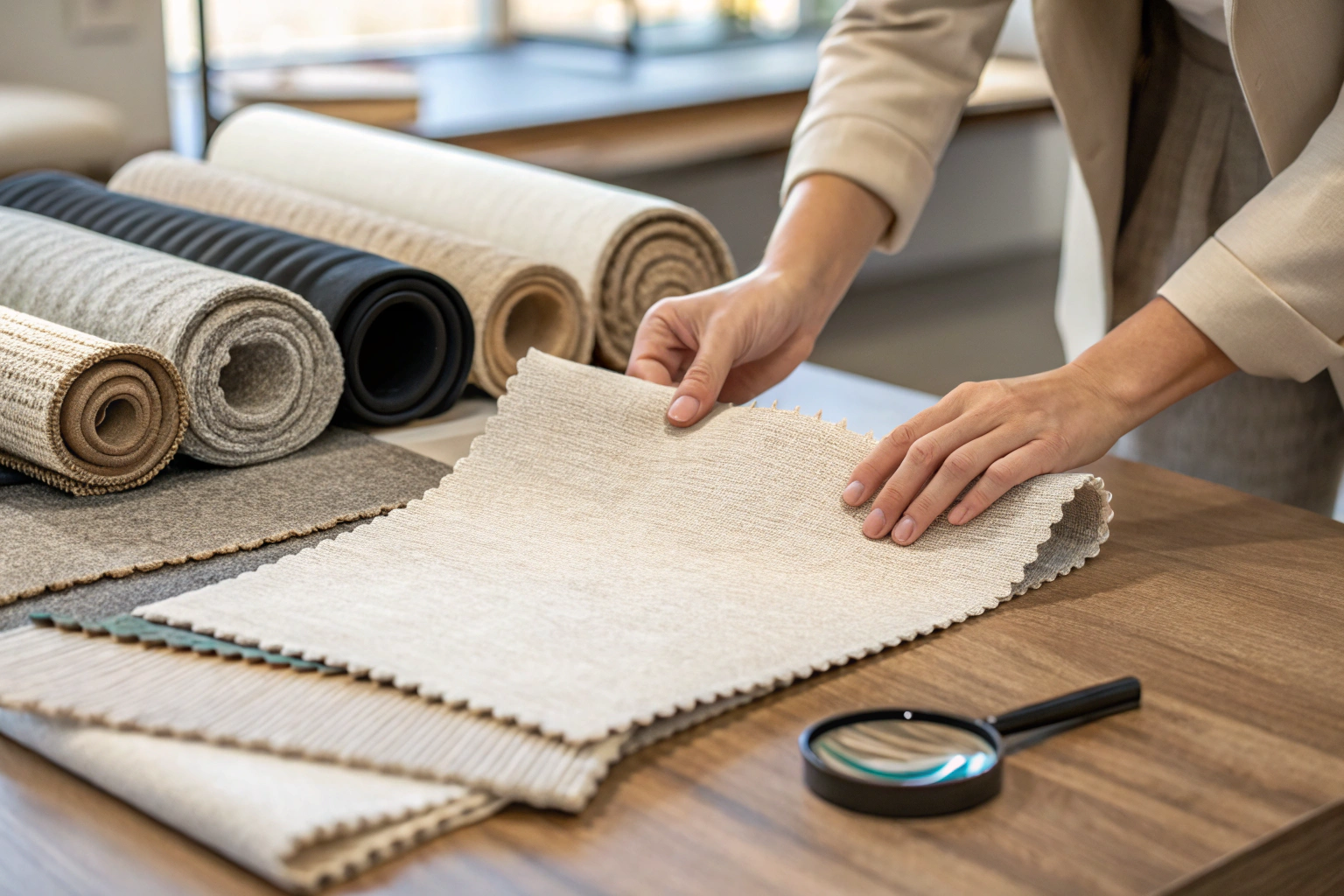
Don’t just send a square of fabric. Send a story that the buyer can touch. We use a system called the "Five-Finger Card." It’s a card with five holes punched in it, each holding a different finish of the same base fabric.
- Finger 1: Raw fabric (greige) – "This is where we start. No makeup."
- Finger 2: Scoured & Bleached – "The clean slate. Zero impurities."
- Finger 3: Dyed (Piece) – "The color penetrates every thread."
- Finger 4: Brushed/Sanded – "The cozy sweatpants feel."
- Finger 5: Washed & Finished – "This is what lands on her doorstep after 50 cycles."
The customer touches it and instantly understands the value of the finishing processes. They are not paying for thread. They are paying for the transformation.
I remember a children’s wear line we worked with in February 2024. They were shopping on price, comparing our quote to a much cheaper stock fabric. We mailed them a Five-Finger Card with our "Bamboo Cloud" blend. The owner called me two days after receiving it and said, "I can’t even look at the other sample now. This card makes the other stuff look like sandpaper." That’s the power of letting the fingers discover the difference. If you want to explore how to create effective fabric sample cards for your wholesale clothing clients, you’ll find plenty of packaging inspiration on maker community platforms, but the core principle is simple: make the quality steps visible and touchable, and your close rate will climb.
Conclusion
Look, at the end of the day, nobody ever got a compliment on their dress because it had a "high wet-crocking score." They get compliments because the dress flows right, fits right, and survives the chaos of real life—coffee spills, toddler grabs, and long-haul flights. That’s what Fumao quality actually means. We’ve walked through how to ditch the jargon and speak in "Butter Touch," "Bone-Dry," and "Memory Bounce." We covered the Sag Test that proves your leggings won’t embarrass you at brunch, the Red Wine Test that proves your beige blouse is stain-proof, and the Five-Finger Card that lets your buyer physically touch the difference between raw greige goods and a luxury washed finish. When you describe our quality, don’t talk about denier or micron counts. Talk about the confidence of knowing your white shirt won’t bleed into your jacket, the comfort of fabric that doesn’t bag out at the elbows, and the durability of colors that stay true wash after wash. Our job in Keqiao is to obsess over the machines and the chemistry. Your job is to tell the customer how it makes them feel.
If you’re tired of sending sample swatches that your clients just toss in a drawer, let’s fix that together. We’ll build you a custom sample kit that tells your brand’s story through touch, not technicalities. You can reach our Business Director, Elaine, directly at elaine@fumaoclothing.com. She’ll set up a consultation to understand your market and your customer’s sensory triggers. Let’s turn your fabric quality into the simplest, most persuasive argument your buyer has ever held in their hands.