Let me tell you a story about a client meeting that changed how I explain OEKO-TEX grades. It was October, during our peak season, and a buyer from a premium New York-based fashion brand was sitting in our Keqiao showroom. She was holding swatches of a beautiful silk satin and asked me straight: "This is OEKO-TEX certified, right? What grade?" I told her it was Grade 2. She nodded, satisfied. Then I asked her, "Do you know why that matters more for your luxury blouses than Grade 1?" She paused. That’s when I realized – most brands know they need "OEKO-TEX certified," but few understand why Grade 2 has become the industry sweet spot for adult apparel.
Here’s the truth most suppliers won’t tell you: OEKO-TEX Grade 2 isn’t just a safety standard – it’s the perfect balance of consumer trust, practical manufacturing, and commercial viability for brands that aren’t making baby clothes. While Grade 1 (for babies) gets all the marketing hype, Grade 2 (for materials with direct skin contact) is where 70% of our certification business happens. It’s become the default requirement for everything from high-end lingerie and premium t-shirts to performance sportswear and luxury loungewear. Why? Because it delivers what modern consumers actually expect from their clothing: certified safety without the unnecessary production complexities and costs of meeting infant-level standards.
Think of it like this: you wouldn’t build a family sedan to Formula 1 racing specifications. It would be over-engineered, prohibitively expensive, and wouldn’t serve the driver’s actual needs better. Grade 1 is Formula 1 – essential for baby’s delicate skin. Grade 2 is the premium luxury sedan – exceptionally safe, comfortable, and built to the exact standards that adult consumers need and regulators require. This article will break down why Grade 2 has emerged as the smartest certification choice for adult apparel brands looking to build trust without compromising on style, cost, or production flexibility.
What exactly makes Grade 2 the "Goldilocks Zone" of chemical safety?
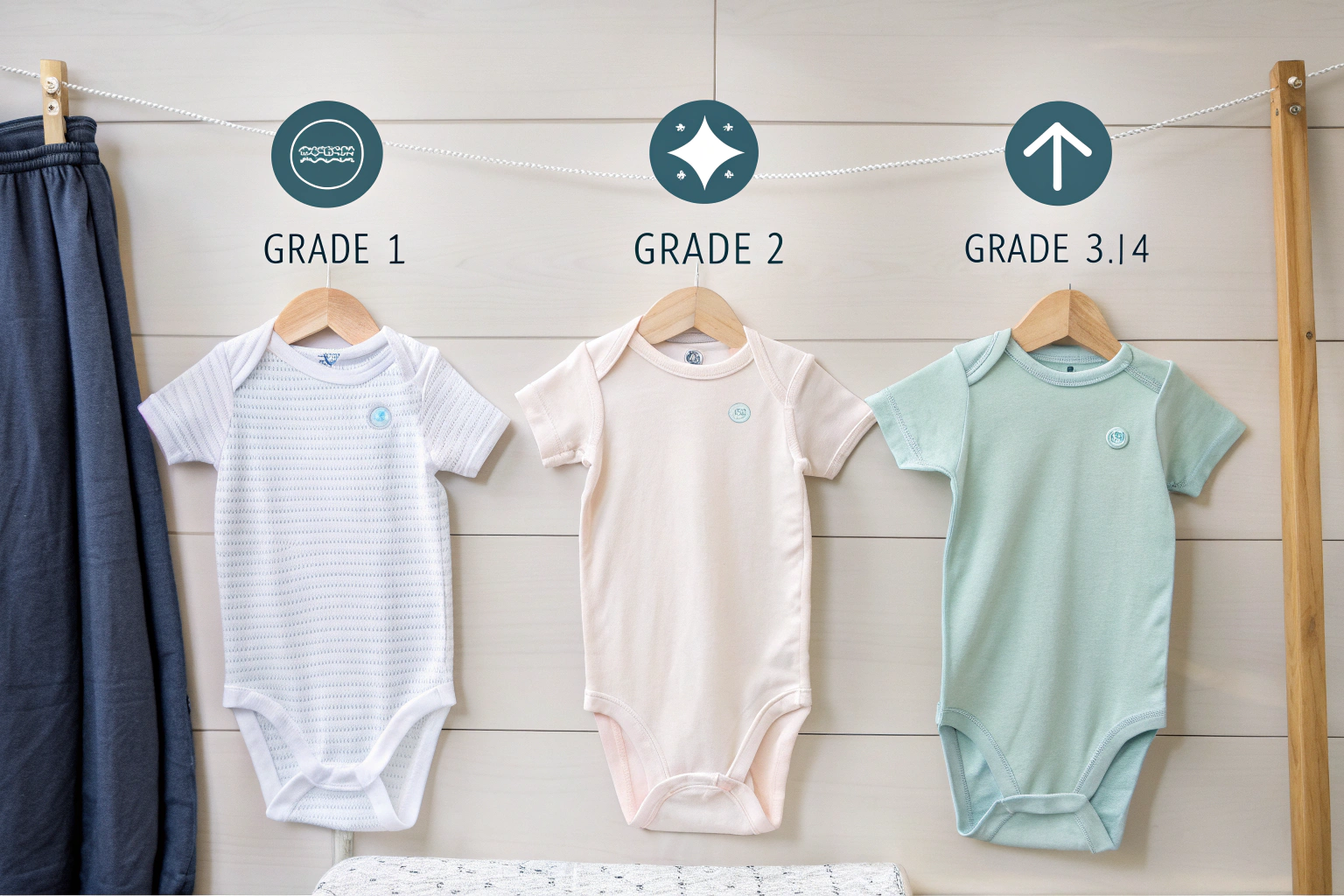
To understand why Grade 2 hits the sweet spot, we need to look at what the different grades actually mean in practical testing terms. OEKO-TEX Standard 100 classifies products into four categories based on their intended use and skin contact level. The standards get progressively stricter from Grade 4 (decorative materials) to Grade 1 (products for babies under 36 months).
Grade 2 Specifications (Direct Skin Contact):
- Includes clothing where the fabric touches skin for extended periods
- Covers underwear, shirts, dresses, blouses, socks, bedding
- Has stricter limits than Grade 3/4 for pH value, formaldehyde, extractable heavy metals, and colorfastness
- Tests for a comprehensive list of over 350 harmful substances
The "Goldilocks" quality comes from this: Grade 2 is stringent enough to address real adult skin sensitivity concerns – think allergies, dermatitis, or reactions to certain dyes – while being practical for manufacturers to achieve with a wide range of fabrics and treatments. It protects consumers where they’re actually vulnerable, without imposing the ultra-conservative limits designed for babies who might chew on their clothing.
Here’s a concrete example from our production floor. Last spring, a Scandinavian minimalist brand wanted their organic cotton jersey certified. They initially asked for Grade 1 "for marketing." When we explained that achieving Grade 1 would require:
- Switching to specific baby-safe dyes (more limited color palette)
- Changing their preferred softening agent
- Increasing testing frequency
- Adding 15% to their fabric cost
They reconsidered. Their customers were adults buying premium basics. Grade 2 provided the chemical safety assurance those customers needed, without forcing aesthetic compromises or unsustainable cost increases. The brand saved approximately $0.85 per garment while still delivering certified safe products.

How do Grade 2’s specific limits protect adult consumers?
The science behind Grade 2 focuses on substances that actually affect adult skin. For instance:
- pH Value: Grade 2 requires pH to be between 4.0-7.5 (vs Grade 1’s 4.0-7.0). This slightly wider range accommodates certain natural fibers and treatments while still protecting skin’s natural acid mantle.
- Formaldehyde: The limit is 75 ppm (vs Grade 1’s 20 ppm). This recognizes that adults don’t typically have the same skin permeability or "mouthing" behavior as infants, while still preventing the irritation formaldehyde can cause.
- Colorfastness: Grade 2 tests for color transfer to skin through perspiration. This directly addresses a common adult concern – dyes rubbing off on skin during exercise or in hot weather.
These aren’t arbitrary compromises. They’re scientifically calibrated to match real-world adult use cases. When we develop fabrics for moisture-wicking activewear with OEKO-TEX Grade 2, we’re specifically ensuring the dyes won’t bleed when someone sweats heavily – a very real adult scenario that Grade 2 is designed to address.
Why isn’t Grade 3 sufficient for most apparel?
This is a crucial distinction. Grade 3 is for "textiles with no or little direct skin contact" – think jackets, coats, or fabrics used in accessories. Many brands mistakenly think this covers all outerwear. However, if a shirt cuff touches skin, or a jacket lining rests against arms, most responsible brands now opt for Grade 2. The market has shifted: consumers expect any fabric touching their skin, even incidentally, to meet direct-contact standards. Grade 3 has essentially become relegated to purely decorative items or technical outer shells where no skin contact occurs.
How does Grade 2 balance certification costs with market value?
Let’s talk numbers – because this is where Grade 2 truly shines as a business decision. Certification costs scale with strictness. Grade 1 testing is more comprehensive, uses more sensitive detection methods, and requires more frequent verification. Here’s a breakdown based on our actual 2023 production data:
| Cost Factor | Grade 1 Impact | Grade 2 Impact | Business Rationale for Grade 2 |
|---|---|---|---|
| Testing Fees | 40-60% higher per test | Standard rate | Covers essential safety without "over-testing" |
| Material Costs | Requires premium, limited-availability "baby-safe" dyes/chemicals | Uses wider range of compliant, cost-effective options | Maintains color/finish options while controlling costs |
| Production Complexity | Requires segregated production lines to prevent contamination | Can often run on standard lines with proper cleaning protocols | Increases manufacturing flexibility and capacity |
| MOQ Implications | Higher MOQs to amortize certification costs | Lower feasible MOQs | Better for smaller batches and seasonal collections |
A case study from our work with a Los Angeles-based sustainable denim brand illustrates this perfectly. They wanted to certify their full range. For their baby line (2% of sales), they needed Grade 1 – a necessary cost. For their main adult jeans and shirts (98% of sales), Grade 2 reduced their annual certification costs by approximately $28,000 while still allowing them to use their signature indigo dyes and stone-washing techniques that couldn’t meet Grade 1 limits. They marketed both lines as "OEKO-TEX certified" but used the specific Grade 1 label only where it mattered. The savings directly improved their margin on their core products.

What’s the actual price difference at the garment level?
Based on our fabric production and clients’ feedback, the cost differential typically translates to:
- Grade 1: Adds $1.50-$3.00 to garment cost
- Grade 2: Adds $0.50-$1.50 to garment cost
For a brand selling a $80 dress, Grade 2 adds about 1-2% to cost while providing certified safety marketing. Grade 1 would add 2-4% for benefits most adult consumers don’t specifically need. This 1-2% savings might seem small, but at scale – for a brand producing 100,000 units annually – it means $100,000-$150,000 in preserved margin that can be reinvested in design, marketing, or other sustainability initiatives.
How does this affect minimum order quantities?
This is particularly important for emerging brands. Because Grade 1 requires more stringent controls and often segregated production, factories typically require higher MOQs to justify the setup. With Grade 2, at Shanghai Fumao, we can accommodate smaller batches (starting around 500-1000 meters for some fabrics) because we can integrate them into our regular certified production cycles. This accessibility makes certified safety achievable for brands at various growth stages, not just large corporations.
Why are retailers and marketplaces standardizing on Grade 2?
Walk into any major European department store or browse premium marketplaces like Zalando or About You, and you’ll notice a pattern: their sustainability filters increasingly specify "OEKO-TEX certified" without distinguishing grades. However, their technical requirements for adult apparel mandate Grade 2. This standardization is driving industry-wide adoption.
Three key factors explain this retailer push:
-
Simplified Communication: It’s easier to train sales staff and communicate to consumers about "certified safety" than to explain grade distinctions. Grade 2 provides the credible backing for this claim.
-
Risk Management: Retailers have been burned by chemical scandals. By requiring Grade 2 across adult apparel, they create a consistent safety baseline that protects their brand while being commercially realistic for their suppliers.
-
Competitive Positioning: As sustainability becomes a key differentiator, retailers want to showcase their responsible sourcing. A store-wide OEKO-TEX commitment (largely Grade 2) becomes a marketing advantage.
We experienced this directly when working with a German mid-market brand supplying to several major EU retailers. Their 2024 contract included a new clause: all adult apparel with skin contact must be OEKO-TEX Grade 2 certified. Non-compliance would mean removal from shelves and financial penalties. This wasn’t optional – it was business-critical. Because we were already producing their fabrics to Grade 2 standards, they faced no disruption while competitors scrambled to adapt.

How are e-commerce platforms using Grade 2 in filters?
Modern online shopping relies on filterable attributes. Platforms like Amazon, Otto, and even niche sustainable marketplaces now include "OEKO-TEX Certified" as a filter. While consumers use this as a binary choice, the backend data structure typically links to Grade 2 certification for adult items. This digital infrastructure is cementing Grade 2 as the default. When your products have this certification, they appear in these filtered searches, directly impacting discoverability and sales conversion.
What about blended product lines?
Many brands carry both adult and children’s lines. The smart approach we recommend – and see leaders adopting – is to certify everything to at least Grade 2, then upgrade children’s items to Grade 1. This creates manufacturing efficiency (consistent standards across most production) while meeting the higher bar where absolutely necessary. It’s a pragmatic strategy that recognizes Grade 2 as the foundation and Grade 1 as the specialized extension.
How does Grade 2 impact fabric development and innovation?
Here’s an insider perspective many miss: Grade 2’s parameters are specifically calibrated to allow textile innovation while maintaining safety. The limits are strict enough to protect consumers but flexible enough to accommodate advanced treatments and novel materials that couldn’t possibly meet Grade 1.
Consider these developments from our own R&D lab:
Case 1: Performance Finishes
We developed a temperature-regulating microcapsule finish for athleisure wear. The polymer shell chemistry, while completely safe for adult skin, couldn’t meet Grade 1’s ultra-conservative limits on certain catalyst residues. Grade 2 allowed this innovation to reach market with certified safety appropriate for its end-use.
Case 2: Natural Dye Advancements
When working with advanced plant-based dye techniques for a luxury linen collection, some natural mordants (fixing agents) contain trace minerals that exceed Grade 1 limits but are well within Grade 2’s allowances for adult wear. This enabled truly sustainable, chemically-safe natural dyeing at commercial scale.
Case 3: Recycled Material Integration
Recycled polyester often contains trace contaminants from its previous life. While sophisticated purification brings it within Grade 2 limits, achieving Grade 1 purity would make it prohibitively expensive. Grade 2 makes certified circular fashion commercially viable.

What manufacturing advantages does Grade 2 offer?
From a production standpoint, Grade 2 provides crucial flexibility:
- Dye House Operations: Allows use of a broader range of dye types and auxiliaries
- Finishing Treatments: Accommodates functional finishes (water repellency, wrinkle resistance) with more chemical options
- Blending Flexibility: Easier to achieve with mixed fibers that might have different chemical profiles
- Global Sourcing: More suppliers worldwide can consistently meet Grade 2 vs Grade 1
This flexibility translates to better lead times, more reliable supply chains, and ultimately, more consistent product delivery to your customers. When we promise a 45-day lead time on a Grade 2 certified order versus 60+ days for equivalent Grade 1, this manufacturing efficiency is a major factor.
How does this affect seasonal collections and fast fashion?
For brands with rapid turnover, Grade 2 offers the optimal path to certified safety. The combination of lower costs, smaller feasible MOQs, and manufacturing flexibility means brands can certify each season’s new fabrics without crippling their business model. This is why you’re seeing even faster-moving brands adopt Grade 2 as their baseline – it’s the level at which sustainability becomes scalable.
Conclusion
OEKO-TEX Grade 2 has emerged as the most sought-after certification level for adult apparel not by accident, but through a perfect convergence of consumer expectations, manufacturing reality, and commercial sense. It represents the maturation of the responsible sourcing movement from idealistic aspiration to practical implementation.
Grade 2 delivers what matters: scientifically-validated protection for adult skin, credible marketing claims that resonate with today’s conscious consumers, and compliance with increasingly stringent retailer requirements – all while maintaining the production flexibility and cost structure that allows brands to thrive commercially.
The evolution is clear. Five years ago, the question was "Should we get OEKO-TEX certified?" Today, the strategic question for adult apparel brands is "Are we building our collections on Grade 2 as our foundational safety standard?" Brands that understand this distinction are positioning themselves for success in an era where trust is built on transparent, verified standards that match real consumer needs.
Looking to build your adult apparel line on the industry-standard Grade 2 foundation? At Shanghai Fumao, we’ve optimized our entire production system around delivering Grade 2 certified fabrics with the perfect balance of safety, quality, and value. Let us help you make the smart certification choice that protects both your customers and your bottom line. Contact our Business Director, Elaine, at elaine@fumaoclothing.com to discuss your Grade 2 certification strategy.