You’ve built your brand with care—selecting designs, crafting your story, connecting with customers. But when it comes to production, how can you be absolutely sure the garments you put your label on are as safe and clean as you promise? With growing consumer awareness and strict retailer requirements, choosing just any factory isn’t enough anymore. The hidden risk of harmful substances in textiles is real, and it’s your brand’s reputation on the line if something goes wrong.
Choosing an OEKO-TEX® certified factory for your private label production isn’t just about getting a certificate; it’s about partnering with a facility that has built a systematic, verifiable commitment to product safety from the ground up. It means your products are manufactured in an environment where every chemical input is controlled, every process is monitored, and the final output is guaranteed to meet stringent, internationally recognized human-ecological standards. For a private label, this certification becomes part of your product’s DNA—a trust signal you can communicate with confidence.
In this article, I’ll break down what OEKO-TEX® certification really means on the factory floor, beyond the marketing logo. I’ll show you how this choice directly protects your brand, simplifies your compliance headaches, and can even save you money in the long run by preventing costly rejects and recalls. Let’s look beyond the label.
What Does OEKO-TEX® Certification Actually Test For?
Many brands think OEKO-TEX® is just about formaldehyde or azo dyes. That’s the starting point. The reality is far more comprehensive. Think of it as the most rigorous health check-up your fabric and garments can get, looking for hundreds of potential issues you’d never find on your own.
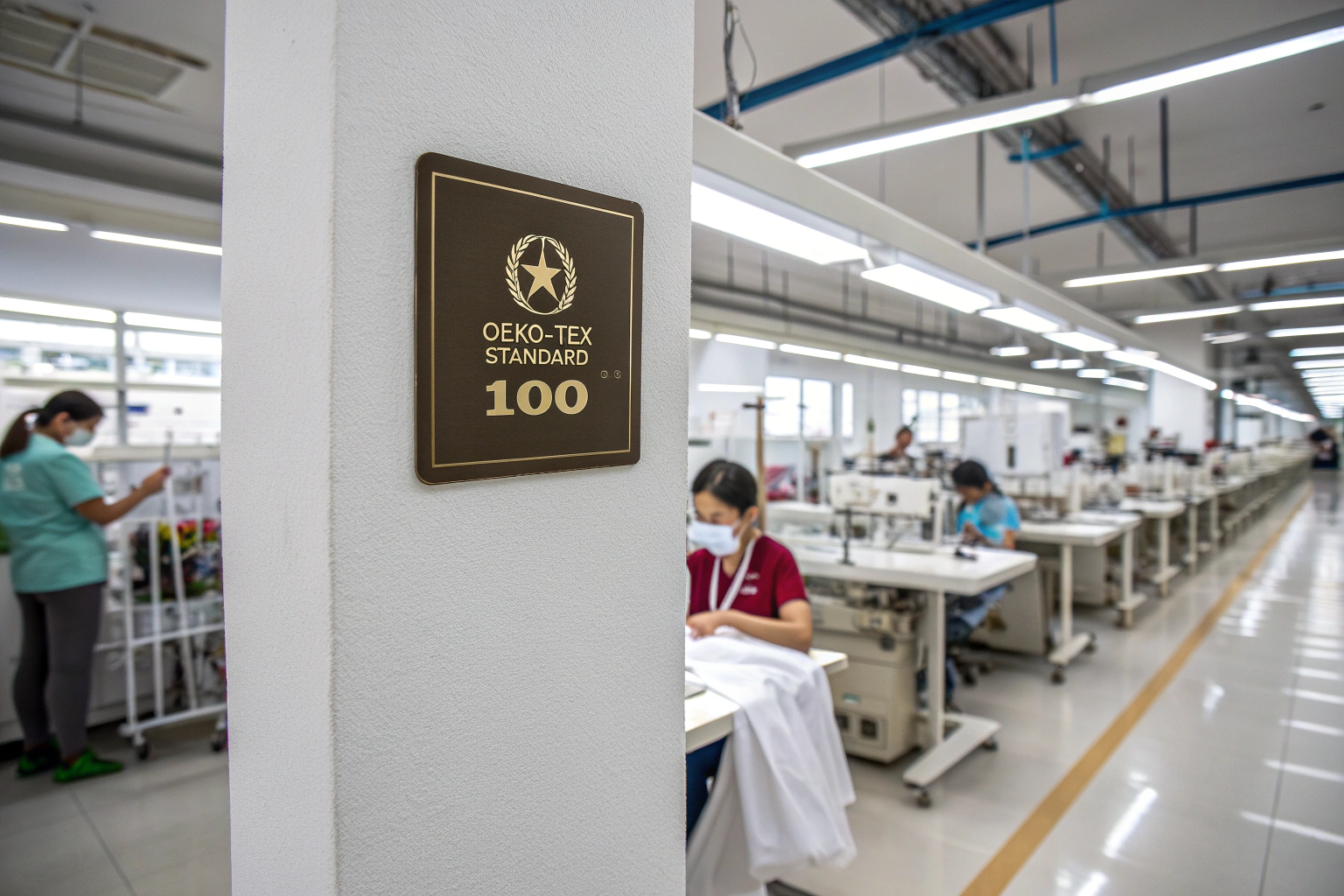
The OEKO-TEX® STANDARD 100 certification tests for over 350 individual harmful substances, grouped into categories that cover every conceivable risk. This includes regulated substances like heavy metals (cadmium, lead), pesticides, and chlorinated phenols. But crucially, it also proactively bans or limits many chemicals that are not yet regulated by law but are of scientific concern—like allergenic dye stuffs, plasticizers (phthalates), and PFAS (perfluorinated chemicals). The testing is done on the final, ready-to-sell product, accounting for all processes and accessories. Even the sewing thread, labels, and prints are included. It’s a holistic safety net.

How does the product class system work (I-IV)?
This is a key feature that makes OEKO-TEX® so relevant. Not all products pose the same risk, so the standard doesn’t treat them the same. It divides products into four classes based on human ecological sensitivity:
- Product Class I: Articles for babies and toddlers up to 3 years old (clothing, toys, bedding). This has the strictest limit values.
- Product Class II: Articles with direct, prolonged skin contact (e.g., underwear, shirts, socks, bedding for adults).
- Product Class III: Articles with little or no direct skin contact (e.g., jackets, coats, decorative textiles).
- Product Class IV: Furnishing materials for decoration (e.g., curtains, tablecloths, upholstery fabrics).
A factory certified to produce Class I items has proven it can operate at the highest safety tier. When you source private label babywear from a factory holding a valid Class I certification, you have a level of assurance that is gold standard. We at Shanghai Fumao ensure our key finishing partners are certified for the classes relevant to our clients’ needs, and we can provide the specific certification documents for your product type.
Are tests done on every single production batch?
This is a critical operational detail. The certification body does not test every batch—that would be impractical. Instead, they audit the factory’s management system and conduct initial, extensive tests on the articles to be certified. After certification is granted, the factory is obligated to perform regular in-house checks and submit products for external monitoring tests at the certifying institute at defined intervals. More importantly, they must have a robust quality assurance system to ensure consistency. If they change a chemical supplier or a dye recipe, they must re-evaluate compliance. This system-based approach, backed by surprise audits, is what makes it reliable. It’s like a restaurant’s health grade: they don’t inspect every meal, but the systems (storage, hygiene, training) ensure safety day-to-day.
How Does This Certification Protect My Brand & Simplify Compliance?
In today’s market, brand protection is risk management. An OEKO-TEX® certification from your factory acts as a powerful shield. It shifts the burden of proof and due diligence onto a recognized, independent third-party system. For you, this translates into fewer headaches and stronger market positioning.
First, it simplifies compliance with complex regulations like EU REACH, US CPSIA, or California Prop 65. While these are legal requirements, OEKO-TEX® often encompasses and exceeds them. Having the certificate means you already have a strong baseline compliance document for many of these laws. Second, it meets the sourcing requirements of major retailers. Most large EU and US retailers now require some form of third-party safety certification, and OEKO-TEX® is the most widely accepted. It streamlines your onboarding process with them. Finally, it gives you a clear, consumer-friendly story. You can confidently market your products as "independently tested for harmful substances," which resonates with conscious shoppers.

Can it prevent costly recalls and retailer rejections?
Absolutely, and this is where the investment pays for itself. A recall or a shipment rejection at port due to failed safety testing is catastrophic—costing you not just the product value, but shipping, tariffs, storage, and irreparable brand damage. The OEKO-TEX® system is designed as a preventive barrier. In 2023, a US-based athleisure startup came to us after their previous non-certified factory produced a batch of yoga pants that failed a major retailer’s test for nickel releases from the metal drawcord ends. The entire container was rejected. They switched production to our OEKO-TEX® certified partner network. We implemented a full component pre-approval process as per the standard’s requirements. Their next 6 shipments passed all retailer audits with zero issues. The certification framework forced the discipline that prevented the problem.
How does it build consumer trust for my private label?
Trust is the currency of modern DTC brands. An OEKO-TEX® label on your hangtag or product page is not just a logo; it’s a shorthand for responsibility. It tells your customer, "I have done the hard work to ensure this product is safe for you and your family." It answers unspoken questions parents have about baby clothes, or athletes have about performance wear next to their skin. This trust converts to loyalty and reduces returns. You’re not just selling a garment; you’re selling peace of mind. Promoting this certification through your marketing channels can significantly enhance your brand’s perceived value.
Beyond the Logo: What Should I Audit in a Certified Factory?
The certificate is the result, not the process. A smart private label brand looks behind the logo to understand how the factory maintains its certification. This is where you assess if they are a true partner or just paying for a piece of paper.
Your audit should focus on their internal management systems. Ask to see: 1) Their Chemical Inventory & Positive List: OEKO-TEX® requires them to maintain a list of approved chemicals and auxiliaries. Is it detailed, updated, and are the MSDS sheets available? 2) Training Records: Are workers handling chemicals trained on safety and procedures? 3) In-House Testing Equipment & Logs: Do they have basic pH meters, colorfastness testers, and do they keep daily process control records? 4) Sample Management for External Tests: How do they select and send samples for their mandatory annual monitoring tests? The answers reveal their operational integrity.

What questions separate a good certified factory from a great one?
Move beyond "Are you certified?" to deeper operational questions:
- "Can you walk me through what happened the last time you changed a dye supplier? How did you re-verify OEKO-TEX® compliance?"
- "How do you control and certify the trims and accessories from your sub-suppliers to ensure they also meet the standard?"
- "Can you show me the corrective action report from your last certification body audit?" (Every audit finds minor non-conformities; a professional factory will have acted on them).
- "For my product (e.g., baby socks), what specific parameters in your process are tightened versus making an adult t-shirt?"
A great factory will have clear, documented answers and will see you as a partner in maintaining the system. A mediocre one will just point to the certificate on the wall.
How does their lab facility support consistent compliance?
An in-house lab is the factory’s first line of defense. It shouldn’t just be for show. A strong OEKO-TEX® certified partner will use their lab for daily pre-checks. For example, they should be testing:
- pH of wet processed fabrics after every wash to ensure skin-friendliness.
- Colorfastness to perspiration and saliva (crucial for Class I & II).
- Dimensional stability to prevent post-wash issues.
Our cooperative dyeing factory, for instance, runs a pH check on every batch before it leaves for finishing. This simple, daily discipline prevents an entire batch from failing later at an external lab—saving weeks of time and thousands of dollars. It’s this granular, process-level commitment that makes the certification meaningful.
Is an OEKO-TEX® Factory More Expensive? (Cost vs. Value Analysis)
The initial quote might be 5-15% higher than a non-certified factory. This is the visible cost. The real question is: what is the cost of the alternative? Let’s break down the value equation. The premium covers the certification fees, the cost of approved (often more expensive) chemicals, more rigorous testing, and system management. It’s an investment in predictability.
Consider the hidden costs of a non-certified source: the internal staff time managing compliance, the risk premium of potential recalls, the cost of third-party testing every batch yourself, and the opportunity cost of delayed shipments or lost retailer partnerships. When you factor these in, the certified factory often provides a lower total cost of ownership and far less risk.

Does it lead to better overall product quality?
In our two decades of experience, the correlation is strong. A factory disciplined enough to maintain a complex chemical management system for OEKO-TEX® is almost always disciplined in other areas. Their attention to detail spills over. They tend to have better stitch consistency, more accurate cutting, and neater finishing. The mindset of "systematic control" applies across operations. For a European lingerie brand we worked with in early 2024, choosing our OEKO-TEX® certified knitting partner didn’t just guarantee safe fabric; it resulted in a 40% reduction in needle line defects because the machine maintenance and lubrication logs (part of the general housekeeping ethos) were impeccable. You’re not just buying safety; you’re buying a culture of quality.
Can it actually speed up my time-to-market?
It seems counterintuitive, but yes, it can. Here’s how: the certification provides a pre-approved compliance framework that retailers accept. This eliminates weeks of back-and-forth submitting your own test reports for retailer approval. Furthermore, because the factory’s processes are controlled, the incidence of production errors that require re-work is lower. The product is right the first time. Finally, with brands like Shanghai Fumao, our certified supply chain is integrated. We have pre-approved fabric bases, so your development time is faster—you’re not starting from zero with an unknown mill. The initial setup might have a step for verification, but the entire production and approval pipeline runs more smoothly and predictably.
Conclusion
Choosing an OEKO-TEX® certified factory for your private label is a strategic business decision, not just an ethical one. It is a direct investment in your brand’s credibility, operational stability, and long-term viability. It transforms the opaque, risky part of your business—manufacturing—into a transparent, managed, and marketable asset.
In a world where consumers read labels and retailers demand proof, this certification provides the language of trust that all parties understand. It allows you to focus on what you do best: building your brand and connecting with customers, knowing that the foundation of your product is unshakably secure.
Ready to build your private label on a foundation of verified safety and quality? Partner with a source that embeds these standards into every step. At Shanghai Fumao, we connect you with our network of OEKO-TEX® certified production partners and manage the entire process to ensure your label goes on a product you can be proud of. Contact our Business Director, Elaine, to discuss how we can make your next collection both beautiful and confidently safe. Email Elaine at: elaine@fumaoclothing.com.