Let me ask you a direct question. When your customer picks up a garment from your brand, what are they really holding? They’re holding cotton, sure. But more importantly, they’re holding a promise. A promise that this product is good—good for them, good for the people who made it, good for the planet. In today’s world, that promise is fragile. Greenwashing headlines appear weekly. "Sustainable" labels are slapped on everything. So how do you, as a brand, make your promise unbreakable? How do you build trust that converts browsers into loyal advocates? The answer lies not in shouting louder, but in proving more. And that’s where BCI traceability comes in—not as a buzzword, but as a verifiable backbone for your brand’s integrity.
Trust isn’t built on feelings; it’s built on evidence. BCI traceability provides that evidence in a language everyone understands: data and verification. It moves your sustainability claim from the vague realm of marketing ("eco-friendly!") to the concrete world of supply chain management. It tells your customer, "We care enough to know where our materials come from and to ensure they meet rigorous standards." I saw this power firsthand with a Scandinavian minimalist brand we worked with in 2023. They switched to BCI cotton for their core linen-cotton blend. They didn’t just change the label; they created a simple webpage tracker showing the journey from BCI farm to finished garment, using the Transaction Certificate ID as a reference. Their customer service inquiries about sustainability dropped by 70%, and product return rates on those items fell by 15%. Why? Because trust was established before the purchase was even completed.
So, how does this technical system of credits and certificates translate into the emotional currency of trust? It bridges the immense gap between the cotton field and your customer’s closet. Let’s trace that connection step by step.
How Does BCI Move Beyond "Greenwashing" Claims?
"Greenwashing" is the killer of trust. It happens when a claim is broad, unverified, or misleading. Saying a garment is "made with sustainable cotton" is a classic example—it’s meaningless without proof. BCI traceability attacks greenwashing at its root by replacing vague language with a specific, auditable system.
The BCI system isn’t something you can self-declare. It requires membership, licensing, and adherence to a global standard. When you claim BCI, you’re pointing to an entire ecosystem of verification. You’re saying, "Don’t just take my word for it. Here is a transaction certificate with a unique ID from an independent, multi-stakeholder nonprofit." This third-party validation is crucial. It takes the burden of proof off your marketing team and places it on a respected system. For your customer, it’s the difference between a friend assuring you a restaurant is good and seeing that restaurant has a 5-star health inspection grade posted on the door. One is an opinion; the other is a verified fact.
At Shanghai Fumao, we see this shift in the questions brands ask us. Five years ago, it was "Do you have an eco-fabric?" Today, it’s "Can you provide the BCI Transaction Certificate and the mill’s license number for this lot?" Brands know their savvy customers might ask for this proof, and they need to be ready. This preparedness itself builds internal confidence, which translates into more authentic external communication.

What specific element of BCI proves it’s not greenwashing?
The Chain of Custody (Mass Balance) model itself is the anti-greenwashing weapon. It acknowledges the complexity of global supply chains while still ensuring impact. Unlike a physically segregated organic system, mass-balance allows for scalability. But here’s the trust key: it’s transparent about its methodology. BCI and its partners don’t hide that it’s a credit system. We explain it to our brand partners, and they, in turn, can honestly explain it to their customers: "We fund and demand more sustainable cotton farming for every meter we use." This honesty about how the system works builds more trust than a perfect-but-impossible claim of physical segregation.
How can a brand communicate this complexity simply?
The best tool is a simple analogy. We tell brands to explain it like renewable energy credits: "When you choose electricity from a ‘green’ provider, the electrons in your grid aren’t all from solar panels. But your purchase guarantees that an equivalent amount of clean energy is fed into the national grid. BCI works the same way for cotton." This familiar analogy, coupled with the tangible certificate, makes a complex system understandable and trustworthy. Resources on effectively communicating textile sustainability to end consumers emphasize this need for clear, honest analogies.
What Tangible Proof Does BCI Provide to an End-Consumer?
The end-consumer doesn’t see the farmer training or the water savings reports. What they can see—and what builds immediate trust—is accessible, digestible proof. BCI enables several concrete touchpoints:
- The On-Product Logo: The blue-and-green BCI logo on a hangtag or label is a recognized signal. It’s a shortcut that says, "This brand has met an external standard."
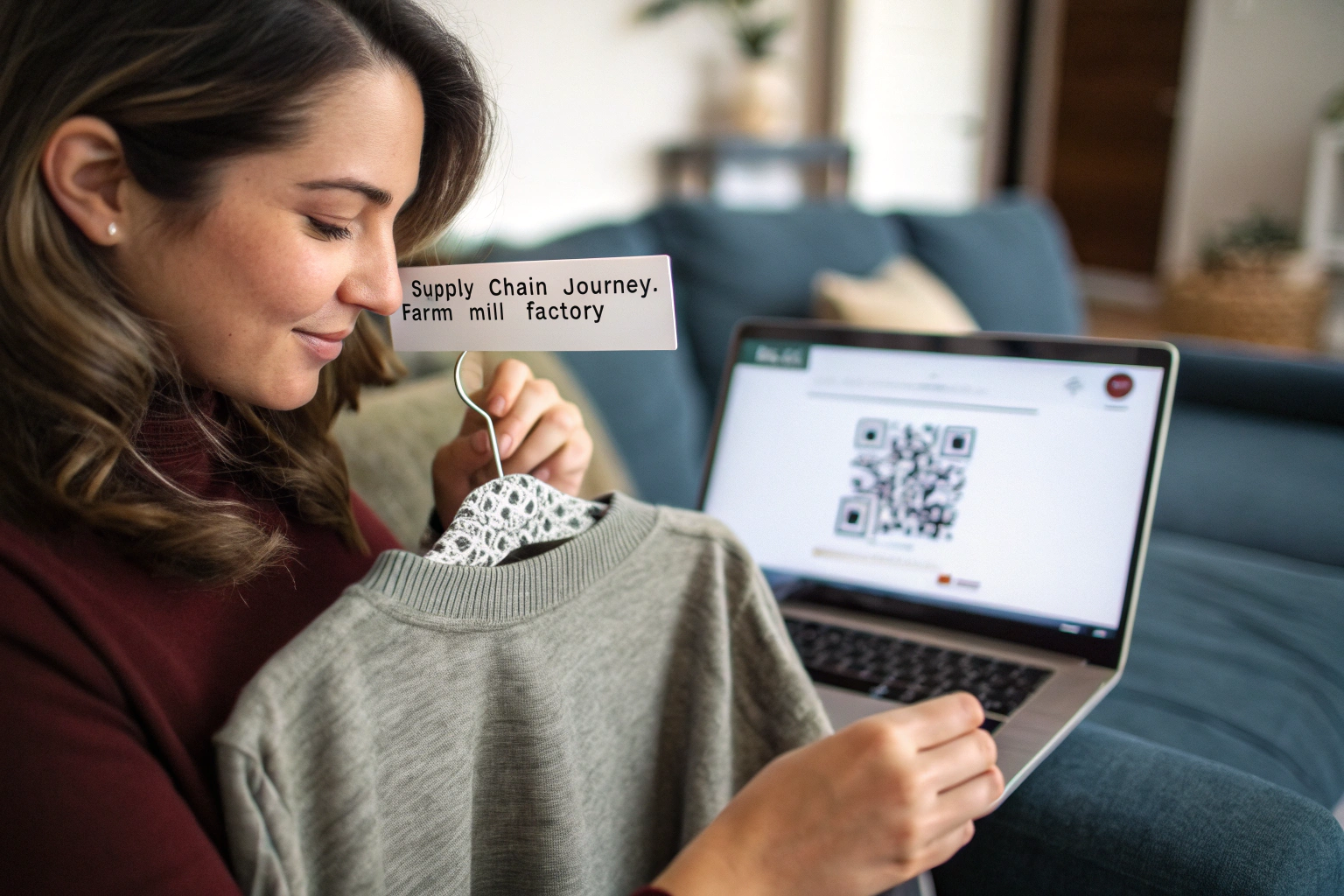
- The QR Code/Link to Traceability: Progressive brands are going further. They use the unique ID from the Transaction Certificate to create a simple landing page or integrate with platforms like TextileGenesis. A customer can scan a QR code and see the journey: BCI cotton sourced from licensed farms -> spun at X mill -> woven/dyed at Y facility (like our partner mills) -> manufactured into their garment. This isn’t sci-fi; it’s what we helped a German direct-to-consumer shirt brand implement last year. Their "Track Your Shirt" feature became a major selling point.
This tangible proof transforms the customer from a passive buyer into an active participant in a positive story. They’re not just consuming; they’re validating a choice they can feel good about. This is an incredibly powerful emotional driver for purchase and loyalty.

Is the QR code traceability feature expensive for brands to implement?
Not necessarily. The heavy lifting is done by the supply chain partners (like us) providing the certified data. Brands can use simple, low-cost website builders or dedicated but affordable SaaS platforms to create a static page that tells this story. The investment is minimal compared to the trust equity it builds. It turns your cost breakdown into a value story. For brands wondering about the logistics, looking into digital traceability platforms for fashion brands is a great start.
How does this proof impact post-purchase behavior?
It reduces "post-purchase dissonance"—that faint feeling of "did I make the right choice?" When a customer can revisit the story of their garment, it reinforces their decision. This leads to higher satisfaction, more positive reviews, and a lower likelihood of returns based on ethical concerns. The product becomes part of their identity as a conscious consumer.
How Does BCI Trust Translate Into Brand Loyalty & Value?
Trust is the foundation of loyalty, and loyalty is the engine of long-term brand value. BCI traceability doesn’t just secure a single sale; it builds a community of believers. When customers trust that your brand’s values are real and backed by action, they move from being one-time buyers to repeat customers and, ultimately, to vocal advocates.
This is where the ROI of traceability becomes crystal clear. Acquiring a new customer is often 5-7 times more expensive than retaining an existing one. A trusted brand reduces acquisition costs and increases customer lifetime value. The BCI story gives you something meaningful to talk about in email newsletters, loyalty programs, and re-engagement campaigns. It’s not just "new collection dropped"; it’s "see how your continued support is improving water use on cotton farms." This deeper narrative fosters connection. An Australian activewear startup we partnered with used their BCI switch as the cornerstone of their loyalty program. Members got exclusive updates on the farm-level impact of their purchases. Their member retention rate skyrocketed by 40% in one year.

Can BCI traceability justify a price premium?
Absolutely, and it does so authentically. Consumers are increasingly willing to pay more for products they perceive as sustainable and transparent—but only if they believe the claim. BCI provides the believability. You’re not charging more for the same opaque product; you’re charging for the verified system, the farmer training, the reduced risk. This allows for honest pricing communication. You can break down the cost: "A portion of this price ensures the cotton was grown under better environmental and social conditions." This transparency about price builds even more trust.
How does it protect brand value during a crisis?
In the age of social media, a supply chain scandal can destroy a brand overnight. BCI traceability acts as a risk mitigation shield. If a question arises about sourcing practices, you have a documented, third-party-verified trail to point to. It proves due diligence. This protects your reputation and, by extension, your entire brand valuation. It’s an insurance policy built on transparency. Understanding building resilient fashion supply chains through transparency is key for modern brand management.
What Are the Practical Steps to Leverage BCI for Trust-Building?
Building trust with BCI isn’t automatic. It requires intentional action from you, the brand, in partnership with your supplier.
- Start with Your Supplier Partnership: Your trust chain is only as strong as its weakest link. Demand full transparency from your fabric supplier. At Shanghai Fumao, we provide a full documentation pack: mill BCI license, our TC, and even details about the finishing facilities. Audit this. Visit if you can.
- Weave the Story into Every Touchpoint:
- Website: Have a dedicated "Our Materials" page explaining BCI in simple terms.
- Product Pages: Feature the BCI logo and a short explanation.
- Packaging: Use the logo on hangtags and include a QR code linking to your traceability story.
- Customer Service: Train your team on what BCI is so they can answer questions confidently.
- Be Honest About the System: Don’t overpromise. Explain the mass-balance model honestly. This humility itself builds trust. Admit that it’s a step on a journey, not the final destination.

What’s a common mistake brands make when launching BCI products?
The biggest mistake is "slap-and-ship"—just adding the BCI logo to an existing product without telling the story. This wastes the trust-building potential. The launch of a BCI product should be a narrative event. Announce why you made the switch, what it means, and how customers can learn more. Make them part of the change.
How can small brands with limited resources do this effectively?
Focus on one hero product and one communication channel. Do a deep-dive Instagram Story series on the journey of that one BCI tee. Create a single, beautiful webpage for it. Use the free assets from the BCI website. It’s about depth and authenticity on a small scale, not breadth. A heartfelt, well-explained story on a single product builds more trust than vague claims across a hundred.
Conclusion
So, why does BCI traceability build trust with your customers? Because it replaces promises with proof, and marketing with mechanics. In a marketplace saturated with noise and skepticism, it provides a clear, verifiable signal of integrity. It transforms your supply chain from a cost center into a cornerstone of your brand’s value proposition.
This trust is the ultimate competitive advantage. It turns customers into allies, justifies value, and fortifies your brand against crises. It’s no longer a "nice-to-have" for ethical brands; it’s a must-have for any brand that wants to thrive in the conscious economy.
At Shanghai Fumao, we don’t just provide BCI fabric; we provide the traceability data and partnership you need to build that trust from the ground up. We’ve seen how this foundation allows brands to grow with confidence, knowing their product story is unshakable.
Ready to build unbreakable trust with your customers? It starts with a transparent supply chain. Contact our Business Director, Elaine, to discuss how we can provide you with fully traceable, BCI-certified fabrics and the supporting evidence your brand story needs. Begin building your trust advantage today at elaine@fumaoclothing.com.