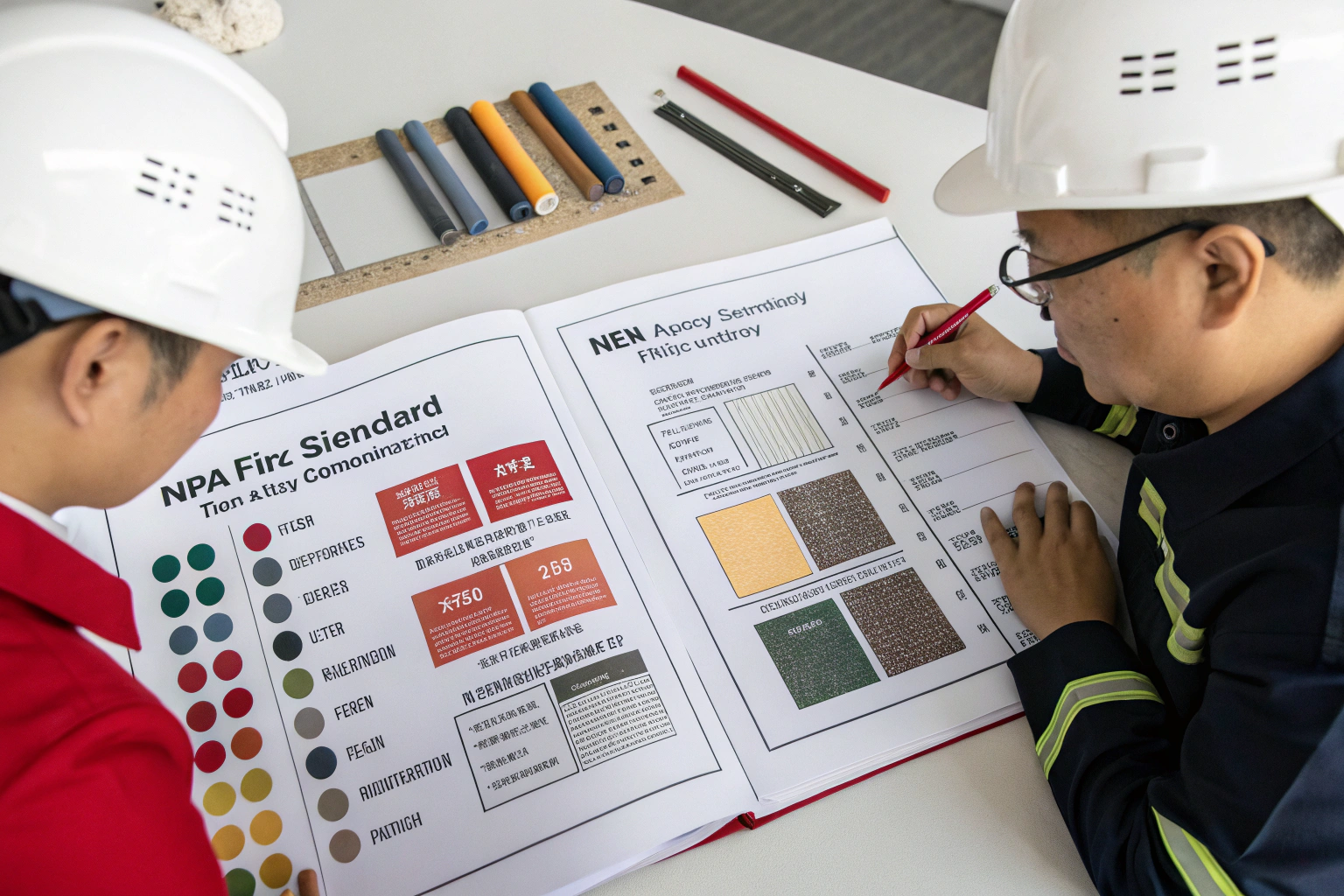
When a Las Vegas hotel failed their fire safety inspection last year due to non-compliant drapery fabrics, the replacement cost exceeded $450,000 and required closing 120 rooms for two weeks during peak season. The root cause? Their procurement team specified fabrics meeting residential standards rather than the commercial NFPA 701 requirements for hospitality venues. This costly mistake underscores why understanding fire standards isn’t just about compliance—it’s about risk management and financial protection.
NFPA (National Fire Protection Association) and EN (European Norm) standards represent the two dominant regulatory frameworks for drapery and upholstery fabrics in commercial applications. NFPA standards primarily govern North American markets, while EN standards apply throughout Europe and many international jurisdictions. Both systems evaluate flame spread, heat release, and smoke production, but through different testing methodologies and performance criteria that aren’t directly interchangeable.
The regulatory landscape has evolved significantly in response to high-profile fire tragedies, with standards becoming increasingly stringent and specialized for different applications. Where once a single fire test might suffice for multiple fabric types, modern requirements demand application-specific testing that accounts for how fabrics are used, installed, and maintained in real-world environments.
What NFPA standards govern drapery and upholstery fabrics?
NFPA standards form the backbone of fire safety regulation for commercial interiors across North America, with specific standards addressing different applications and testing scenarios. The NFPA 701 standard specifically addresses fire tests for flame-resistant textiles and films used in curtains, draperies, and other window treatments in public spaces. This standard has evolved through multiple revisions, with the current NFPA 701-23 edition representing the most rigorous requirements to date.
Beyond NFPA 701, several related standards impact fabric selection and specification. NFPA 260 governs upholstery material fire testing using a cigarette ignition resistance test, while NFPA 261 addresses smoldering ignition from mock-up furniture assemblies. Understanding the complete NFPA ecosystem ensures comprehensive compliance rather than meeting individual standards in isolation.

How does NFPA 701 testing evaluate drapery fabrics?
NFPA 701 employs two primary test methods: the small-scale test (Test Method 1) for lightweight fabrics and the large-scale test (Test Method 2) for heavier materials and assemblies. The small-scale test exposes twelve 6.5" x 2.5" fabric specimens to a controlled flame for 45 seconds, measuring flame spread, afterflame time, and residue characteristics. Fabrics pass if the average afterflame time is ≤2.0 seconds with no individual specimen exceeding 3.0 seconds, and residue length meets specified criteria.
The large-scale test evaluates full fabric assemblies as installed, using a larger ignition source that better simulates real fire conditions. This test assesses both vertical and, if applicable, horizontal configurations, measuring flame spread and structural integrity during and after exposure. The large-scale method is particularly important for complex drapery systems with multiple layers or unusual configurations.
NFPA 701 compliance requirements:
- Specimen Preparation: Conditioning at 70°F ± 5°F and 50% ± 5% relative humidity
- Ignition Source: Specific methane gas flow rate and flame dimensions
- Exposure Duration: Precisely timed flame application
- Performance Criteria: Maximum afterflame time and char length
- Sampling Protocol: Multiple specimens from different production lots
- Documentation: Comprehensive test reports with photographic evidence
What are the NFPA 260 and 261 requirements for upholstery?
NFPA 260 (Standard Methods of Tests and Classification System for Cigarette Ignition Resistance of Components of Upholstered Furniture) and NFPA 261 (Standard Method of Test for Determining Resistance of Mock-Up Upholstered Furniture Material Assemblies to Ignition by Smoldering Cigarettes) address the smoldering combustion hazard that represents the most common ignition scenario for upholstered furniture.
NFPA 260 utilizes a mock-up of the seat and back cushion assembly, placing lighted cigarettes in the crevice between surfaces and evaluating whether sustained smoldering or flaming combustion occurs. The test assesses the complete furniture assembly rather than individual components, recognizing that fabric-filler interactions significantly impact fire behavior. Materials are classified as Class I (high resistance) or Class II (moderate resistance) based on test performance.
NFPA testing protocols for upholstery:
- Mock-up Construction: Precise replication of intended furniture design
- Ignition Source: Standard cigarettes placed in worst-case locations
- Evaluation Period: 45-minute observation for smoldering or flaming
- Damage Assessment: Measurement of char area and penetration depth
- Classification System: Performance-based categorization
- Component Testing: Individual material evaluation when appropriate
What EN standards apply to European markets?
The European EN 13501 classification system represents a fundamentally different approach to fire safety, employing a comprehensive testing and classification framework rather than application-specific standards. EN 13501-1 classifies construction products, including textiles, based on their reaction to fire performance, with classifications ranging from A1 (non-combustible) to F (no performance determined). Drapery and upholstery fabrics typically achieve classifications between B-s1,d0 and D-s2,d2 depending on their composition and treatment.
Beyond EN 13501, several product-specific standards address particular applications. EN 13773 covers curtain and drapery fabrics, while EN 1021-1 and EN 1021-2 address upholstery ignition resistance to smoldering cigarettes and flaming sources respectively. These specialized standards work within the broader EN 13501 framework to provide application-specific guidance.

How does the EN 13501 classification system work?
EN 13501 classification employs a multi-tiered alphanumeric system that communicates comprehensive fire performance through a single designation. The primary classification (A-F) indicates basic reaction to fire performance, while supplementary classifications describe smoke production (s1-s3) and flaming droplets/particles (d0-d2). For example, a B-s1,d0 classification indicates limited combustibility, minimal smoke production, and no flaming droplets.
The testing methodology behind EN 13501 varies by intended classification level, with more rigorous tests required for higher classifications. The SBI (Single Burning Item) test (EN 13823) forms the core assessment for classifications B through D, evaluating heat release, flame spread, smoke production, and flaming droplets under realistic fire conditions. Additional tests including the small flame test (EN 11925-2) and non-combustibility test (EN 1182) complete the assessment framework.
EN 13501 classification parameters:
- Heat Release: FIGRA (Fire Growth Rate) and THR600s (Total Heat Release)
- Lateral Flame Spread: Whether flames reach specimen edges
- Smoke Production: SMOGRA (Smoke Growth Rate) and TSP600s (Total Smoke Production)
- Flaming Droplets: Presence and duration of burning debris
- Ignitability: Response to small flame application
- Classification Integration: Combining multiple test results
What are EN 1021 requirements for upholstered furniture?
EN 1021 consists of two parts addressing different ignition scenarios for upholstered furniture. EN 1021-1 evaluates resistance to ignition by smoldering cigarettes, while EN 1021-2 assesses resistance to ignition by flame equivalents such as matches. Both tests use standardized furniture mock-ups and precisely defined ignition sources to ensure consistent, reproducible results across testing facilities.
The EN 1021-1 test places smoldering cigarettes in various locations on the furniture mock-up, particularly focusing on crevices where ignition risk is highest. The test observes whether sustained smoldering occurs and measures the resulting damage. EN 1021-2 uses a butane gas flame equivalent to a match flame, applying it to different locations and measuring ignition resistance. Furniture components are rated based on their performance in these tests.
EN 1021 testing protocols:
- Mock-up Specifications: Standardized furniture construction
- Ignition Source Precision: Calibrated cigarettes and gas flames
- Application Locations: Worst-case scenario positioning
- Observation Period: Extended monitoring for delayed ignition
- Damage Measurement: Char length and area quantification
- Performance Classification: Pass/fail with performance documentation
How do NFPA and EN standards compare technically?
While both NFPA and EN standards address fabric fire safety, their technical approaches, testing methodologies, and performance criteria differ significantly, making direct comparison challenging. NFPA standards typically employ pass/fail criteria based on specific test scenarios, while EN standards utilize a classification system that ranks materials across multiple performance dimensions. This fundamental difference reflects distinct regulatory philosophies and historical development paths.
The testing apparatus and conditions vary considerably between the systems, with different specimen sizes, ignition sources, exposure durations, and measurement techniques. These differences mean that a fabric passing one standard cannot be assumed to comply with the other without specific testing. Understanding these technical distinctions is crucial for global projects requiring compliance in multiple jurisdictions.

What are the key methodological differences?
The methodological differences between NFPA and EN testing reflect their different safety philosophies and regulatory environments. NFPA 701 employs vertical specimen orientation with direct flame application, focusing primarily on flame spread resistance and afterflame characteristics. In contrast, EN 13501 utilizes the SBI test with a corner configuration that better simulates real fire development in rooms, measuring heat release and smoke production in addition to flame spread.
The ignition sources also differ significantly, with NFPA standards using specific gas flow rates and burner configurations while EN standards employ precisely calibrated wooden cribs or gas burners with different heat outputs. These differences in test geometry, ignition source, and measurement focus mean the standards evaluate somewhat different aspects of fire behavior, explaining why compliance with one doesn’t guarantee compliance with the other.
Key methodological distinctions:
- Test Geometry: Vertical specimens vs. corner configuration
- Ignition Sources: Gas burners vs. wooden cribs with different energy outputs
- Measurement Focus: Flame spread vs. heat release and smoke production
- Specimen Scale: Smaller individual specimens vs. larger assembly testing
- Performance Metrics: Pass/fail criteria vs. multi-parameter classification
- Testing Duration: Short-term exposure vs. extended observation
How can manufacturers achieve dual compliance?
Achieving dual NFPA and EN compliance requires strategic fabric development and testing planning rather than simple retrofitting of compliant fabrics. The most successful approach begins with understanding the specific requirements of both standards, then engineering fabrics to meet the most stringent elements of each system. This often involves selecting inherently flame-resistant fibers or optimizing FR treatments to perform well under both testing regimes.
Dual-compliant fabrics typically leverage high-performance synthetic fibers with inherent FR properties, such as modacrylic or FR-treated polyester, combined with construction techniques that limit air permeability and fuel availability. The development process involves iterative testing against both standards, adjusting fiber blends, fabric construction, and FR treatments until satisfactory performance is achieved across all required tests.
Dual compliance strategies:
- Material Selection: Inherently FR fibers with proven performance
- Construction Optimization: Tight weaves or knits limiting air flow
- Treatment Formulation: FR chemicals effective under both test protocols
- Testing Sequence: Strategic test ordering to minimize development cycles
- Certification Management: Maintaining compliance documentation for both systems
- Production Control: Ensuring batch-to-batch consistency
What certification and labeling requirements apply?
Certification and labeling requirements vary by jurisdiction but generally require third-party verification of compliance with the applicable standards. In North America, UL (Underwriters Laboratories) and Intertek provide NFPA certification services, while in Europe, notified bodies authorized by EU member states oversee EN compliance. The certification process involves initial product testing followed by ongoing factory surveillance to ensure continued compliance.
Proper labeling provides the audit trail necessary for building inspections and insurance requirements. NFPA-compliant fabrics typically include permanent labels indicating the standard met, test method, and certification body. EN-compliant products feature CE marking accompanied by the appropriate classification and notified body identification. Both systems require maintaining comprehensive test reports and technical documentation.

What documentation supports compliance claims?
Compliance documentation extends beyond simple test reports to include comprehensive technical files that demonstrate ongoing conformity to the applicable standards. For NFPA compliance, this includes initial test reports, quality control procedures, material specifications, and production records. EN compliance requires even more extensive technical documentation, including factory production control procedures, initial type testing reports, and declarations of performance.
The documentation must be maintained for the product’s market life and typically includes evidence of regular surveillance testing to ensure continued compliance. This documentation becomes crucial during building inspections, insurance audits, or incident investigations, where the ability to demonstrate compliance can significantly impact liability and insurance coverage.
Essential documentation elements:
- Test Reports: Comprehensive third-party testing documentation
- Technical Specifications: Detailed material and construction specifications
- Quality Manuals: Factory production control procedures
- Certification Certificates: Formal compliance certifications
- Labeling Specifications: Requirements for compliance marking
- Surveillance Records: Ongoing compliance verification documentation
How does ongoing compliance verification work?
Ongoing compliance verification ensures that products continue to meet the standards under which they were originally certified. For NFPA standards, this typically involves quarterly or annual factory audits combined with periodic product testing from production samples. EN compliance requires similar factory production control audits, with the frequency determined by the certification body based on risk assessment.
The verification process examines raw material sourcing, manufacturing processes, quality control testing, and labeling practices to ensure continued conformity. Any changes to materials, suppliers, or manufacturing processes trigger additional verification testing to ensure these changes don’t impact fire performance. This systematic approach prevents "certification drift" where products gradually deviate from their certified specifications.
Ongoing verification elements:
- Factory Audits: Regular assessment of production facilities
- Surveillance Testing: Periodic testing of production samples
- Change Management: Evaluation of material or process changes
- Documentation Review: Verification of record-keeping practices
- Market Surveillance: Monitoring of products in the marketplace
- Complaint Investigation: Response to performance concerns
Conclusion
Navigating the complex landscape of NFPA and EN fire standards requires understanding both the technical requirements and the regulatory frameworks governing drapery and upholstery fabrics in different markets. NFPA standards dominate North American commercial applications with their scenario-specific testing approach, while EN standards provide a comprehensive classification system used throughout Europe and many international markets. The differences between these systems mean compliance with one doesn’t guarantee compliance with the other, necessitating specific testing for each target market.
The most successful compliance strategies begin early in product development, selecting materials and constructions known to perform well under the required standards. For global applications, pursuing dual compliance from the outset proves more efficient than retrofitting products to meet additional standards later. This proactive approach minimizes development time and costs while ensuring market access across multiple jurisdictions.
If you’re specifying or manufacturing drapery and upholstery fabrics for commercial applications, our compliance team can provide guidance on meeting the specific NFPA and EN standards relevant to your projects. We maintain current testing relationships with certified laboratories worldwide and can facilitate the compliance process. Contact our Business Director, Elaine, at elaine@fumaoclothing.com to discuss your specific fire standard requirements.