
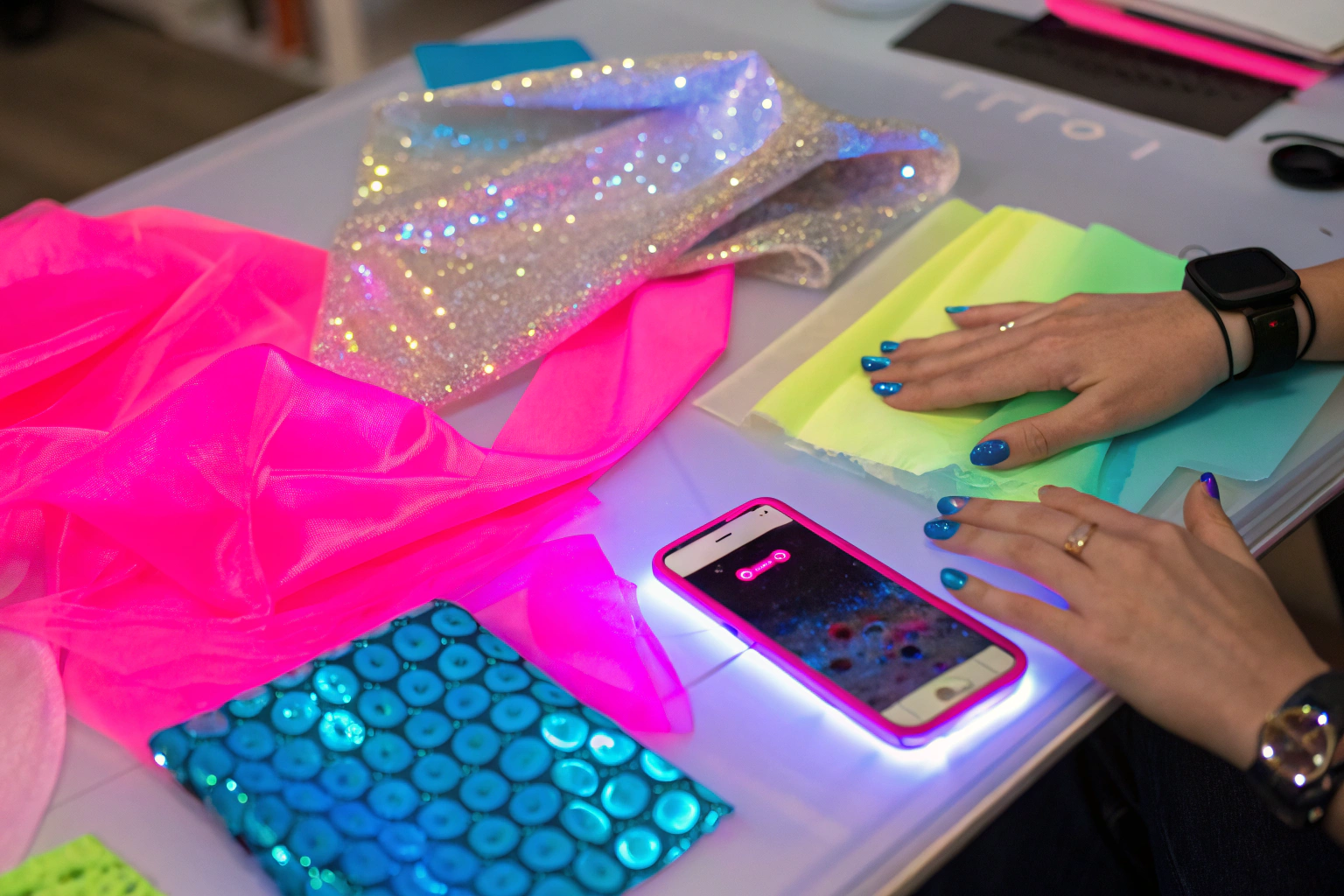
You feel the pressure. The trends cycle every three weeks now, driven by a TikTok sound, a niche Pinterest board, or a Y2K revival aesthetic that appears out of nowhere. Your Gen Z customer doesn’t just want a cotton hoodie. They want a sensory experience—a fabric that makes crunchy sounds, changes color in the sun, or feels like a melted gummy bear. If you can’t deliver that specific, weird, "internet-core" texture in four weeks, they’re swiping to the next brand. I see this anxiety in DMs and emails every single day from brand owners who are stuck with stock fabric swatches that feel like 2018.
At Shanghai Fumao, we don’t just track the trends. We build the yarns and finishes that create them from the ground up. I’m talking about hyper-specific, sensory fabrics: the rubbery-soft "blumarine" matte laminates, the photo-chromic reactive prints that activate on the street, and the textured faux leathers that look like they crawled out of a 2001 video game. We can customize these in 200-meter minimums specifically for agile Gen Z brands who need to test a look without drowning in inventory. I want to pull back the curtain on four fabric directions that are exploding right now, and exactly how we engineer them for speed and maximum visual punch.
Why Is the Y2K Crinkle and Translucent Nylon Resurgence Dominating Streetwear?
If you lived through the early 2000s, you remember the rustling sound of a crinkle parachute pants. But Gen Z is reclaiming this not as nostalgia, but as a futuristic, cyber-streetwear uniform. The key words here are "crunch" and "glass." They want an organza and ripstop nylon that looks like a plastic wrapper but drapes like a liquid. Standard stiff crinkle finishes from a fast-fashion mill will crack after five washes. A real, durable "deadstock" Y2K finish needs to be engineered into the chemical memory of the yarn itself, not just heat-pressed onto the surface at the last minute.
The problem with standard nylon crinkle is the memory retention. If you just stuff standard nylon into a mechanical crinkle machine, it relaxes back to flat in a humid climate. That’s a guaranteed return from a Gen Z buyer who wants to wear the same texture for the whole summer. We spent months refining a specific heat-setting protocol in our dyeing machines to permanently program the irregular pleats into the molecular structure of the nylon. This is physics, not just fashion. When a brand comes to us asking for "that translucent lime green puff jacket shell," they aren’t looking for a standard calendar finish. They’re looking for the specific 380T recycled nylon we calibrate to achieve a "glass-paper" sound when you move. That sound is part of the product’s perceived value.

How Can We Achieve a Permanent Crinkle Memory in Recycled Nylon Shells?
Creating a permanent crinkle in recycled nylon is technically harder than virgin nylon. Recycled fibers have shorter polymer chains because the mechanical shredding process breaks them down. They tend to be brittle. If you apply standard thermal stress to a recycled 6.6 nylon, you risk creating micro-tears that give the fabric a "hairy" look after a few wears. Gen Z hates that. They want that glassy smoothness, but they demand it be recycled.
Our trick to a forever crinkle is a high-temperature pressure decatizing process with a specific overfeed. We don’t just emboss the wrinkles. We blow steam at exactly 132°C into the fabric while it’s compressed in a pleated sandwich of paper templates. The recycled yarn, under this moist heat, hits its glass transition temperature. We physically force the polymer chains to rearrange into the pleated shape. This is the difference between a salon perm and a curling iron. The curling iron (dry heat embossing) washes out. The perm (moist heat setting) stays until you cut it off.
A London streetwear collective came to us in March 2024 with a bizarre brief: "We want a white jacket that looks like crumpled tracing paper." We took our 40D recycled nylon riptstop, which normally wants to be flat as a board, and ran a through a specific 3:1 down-feed on the stenter. The fabric was mechanically pushed back onto itself at a geological speed to form a micro-fold, then immediately quenched with cold air. The result is a permanent, hard-textured crunch. The client sold the jackets for £400 a piece, and I still see them on Depop selling for even more second-hand because the texture didn’t sag. To achieve that, we always warn brands to test the color fastness and finish durability under extreme washing conditions to ensure the "crunch" is forever. You can’t just design a look; you have to blueprint the polymer memory.
What Is the Technical Difference Between Translucent Organza and Matte TPU Lamination?
This is a critical textile education moment because Gen Z buyers know the difference, and they will call you out in reviews. Translucent organza and TPU laminate look vaguely similar on a compressed Instagram story—both are "shiny" and "see-through." But they drape totally differently. Organza is a woven, sheer mesh. It’s stiff, it doesn’t stretch, and it holds a sculptural shape. TPU bonding, on the other hand, is a skin glued to a hard face. It’s soft, drapey, and it sweats.
We run these on completely different production lines. Our translucent organza for Gen Z puff-sleeve tops uses a specially high-twist polyester filament, woven on a 16-shaft dobby with a massive open sett of 15 picks per inch. We chemically finish it with a "frostbite" anti-static agent so it doesn’t cling to the body and flash static sparks, which is a major pet-peeve for the buyer unboxing the garment in a dry apartment.
TPU Matte Lamination is a bonding process, not a weave. We take a 20D nylon tricot jersey and cold-bond a 0.02mm matte thermoplastic polyurethane film. The magic here is the "breathability valve," or lack thereof. Gen Z men’s oversized "fits" for club-wear don’t want the crisp crunch of organza; they want the silent, slick drape of a jellyfish. We produce this lamination in specific "cloudy" tints, like a smoked lavender, by mixing a milky pigment into the glue itself, not the fabric. That way, when you stretch it, the color thins out but doesn’t crack. This is Shanghai Fumao splitting the difference between a garment that looks like a high-end Acronym jacket and something that feels like a trash bag. The texture of the glue, not the thread, is the product.
When Does Yarn-Dyed Plaid and Distressed Denim Become a "Dark Academia" Must-Have?
"Dark Academia" isn’t just a hashtag; it’s a texture profile. It’s 80% about the hand-feel history of the cloth. Your customer wants a blazer that feels like it was stolen from a 1940s Oxford library, or a pair of denim that looks like it survived a war. But the Gen Z twist is that they want this heavy, "lived-in" texture in shapes that are wildly modern—cropped, boxy, or androgynous. So we aren’t just making vintage fabrics; we are making technical vintage replicas that are light enough to move in and strong enough to survive a chaotic urban commute.
The biggest mistake I see is brands trying to achieve the "Dark Academia" look with printed textures on cheap poly-viscose. It photographs okay, but in motion, it fails completely. A printed twill line will never look like a twisted yarn. The academic aesthetic relies entirely on "melange"—the visual heathered effect of mixed color fibers twisted together. At Shanghai Fumao, we build these plaids from the yarn dyed stage, twisting dual-colored strands and then heavily brushing them with a teazle gig to raise a natural woolly nap. This gives the garment a soft, foggy focus even in the high-definition world of Instagram. We aim to create a fabric that doesn’t just have a pattern; it has a visible temperature.

What Is the Difference Between Brushed Flannel and Traditional Worsted Wool Hand-Feel?
Let’s dissect the warmth factor. A worsted wool is sleek, smooth, and cold to the initial touch. It’s for a tailored trouser that swings. A brushed flannel is fuzzy, warm, and slightly sticky to the touch. It’s for a "soft boy" overshirt. Gen Z blazers are almost always flannel because they want the comfort of a blanket but the structure of a jacket.
We create this specific flannel texture by taking a 2/2 twill weave of wool/polyester blend and passing it under a revolving teazle cylinder covered in natural thistle heads. I’m serious—we use actual dried teasels because steel carding rollers are too aggressive and cut the staple fibers. The teasel gently lifts the nap without breaking it. We run this for 4 passes at a slow speed, creating a micro-cloud of fiber on the surface.
Honestly, if you touch a true brushed 80s/20s flannel from us, your hand doesn’t want to leave it. A university merch label approached us in September 2023 wanting a "antique red" plaid that felt like a vintage LL Bean chamois. The first sample was a standard woolen flannel—too heavy, too itchy against the neck. We shaved the weight down by 15% by using a hollow-core conjugated polyester in the weft, and we brushed it three times, not four. The hand-feel became soft, but the hollow fiber trapped the same amount of body heat. The texture stayed vintage; the performance went modern. That’s knowing your end use. A vintage aesthetic can’t sacrifice modern thermal comfort and skin sensitivity standards, especially when Gen Z is hyper-aware of how fabrics feel against their skin.
How Can Laser Distressing Mimic Authentic Selvedge Denim Slubs?
Here is the skinny on slub: Gen Z is obsessed with "authenticity" even if they buy it new. They want the irregular, hairy, "nubby" texture of hand-loomed denim, not the perfect uniformity of a modern projectile loom. We don’t just laser distress denim to create fake whiskers; we actually use the laser to enhance the bumpy, uneven cross-hatch of the cotton yarn.
We start with a "slub yarn." This is a ring-spun cotton where the spinner intentionally varies the twist every few centimeters, creating thick and thin spots. When we weave this into denim, the surface is already alive with texture. But to make it visually "pop" like a 1950s piece of deadstock, we use a 50-watt CO2 laser to vaporize the surface indigo dye. The speed setting is critical. We set the laser to a low-energy fast pulse instead of a high-energy burn. This creates a microscopic "stamping" effect—the dense, thick slubs reflect the blue light differently from the thin, bare cotton peaks.
A major indie raw-denim brand from Austin asked us in early 2024 to make a "no-wash" denim—which is sacrilege, I know, because raw denim guys love breaking in their own jeans. But the Gen Z shopper wanted the look of a 2-year fade right at retail. Our laser carved the exact honeycomb behind the knee and track marks on the thigh with a blade speed of 4000mm/s, but the ingenious part was the post-laser tumble. We washed the jeans in a sealed drum with rubber pumice stones and a cellulose enzyme. The enzyme eats the cut cotton ends the laser left behind, smoothing the whiskers so they look naturally worn, not stenciled. We finished it with a resin spray that crinkles on curing, hard-setting the folds permanently. The brand sold a pair of these for $300, marketed as a "Time Machine Denim." They sold out because the texture wasn’t a costume piece; it was a scientifically accurate replica of time itself. The denim washdown and finishing techniques that define modern premium jeans show the full range of what’s possible with laser and wash combinations.
Is the Irreverent Crochet and Sequin Mesh Trend Scalable for Mass Market?
Gen Z has thrown the "perfect" manual right out the window. The current aesthetic is chaotic, handmade, and emotionally irreverent. You see it in the explosion of granny-square crochet and shimmering sequin mesh colliding in a single garment. This look screams "I made this in my bedroom," even if it was made in a factory of 100 machines. The challenge for a brand is: how do you scale something that looks artisanal? Hand-crocheting a full skirt takes a woman in a village 3 days. You can’t sell that for $79. You have to fake the hand-made look with industrial knitting, and that is incredibly difficult to get right.
At Shanghai Fumao, we create "engineered imperfection." Our warp knitting department uses Raschel machines to replicate crochet granny squares by programmed tuck stitches. A standard knitting sequence creates perfect, repetitive loops. We program randomizing algorithms into the digital file to insert a slight variation every 8th loop, or drop a random stitch. This is not a fault; it’s a "digital hand-touch." Similarly, our sequin mesh isn’t just flat paillettes; we use a high-frequency vibration bowl to feed multi-sized, iridescent sequins onto a net, so the shimmer pattern is totally chaotic, not in neat little rows. The result is a fabric that feels like a joyful explosion, not a math equation. And we can run this 500 meters at a time, giving a mid-market brand the "handicraft" edge at a ready-to-wear price.

How Can We Program "Randomized" Tuck Stitches Into Warp Knits For Hand-Made Aesthetics?
To get that authentic "grandma’s attic" crochet look, the knit must look intentionally messy. Machine knits naturally want to be perfect. We use a multi-bar Raschel machine, and I physically instruct the CAD programmer to insert a "chaos seed." This is a line of code that tells the Jacquard bar to skip a needle or execute a double-tuck once every 20 rotations, but at an unpredictable interval.
The core risk here is laddering. If you just drop a stitch on a warp knit, it runs down the length of the fabric like a stocking, destroying it. To prevent this, we use a specific interlock base with a "binding pillar stitch." This acts like a firebreak. The chaos is trapped within a single 5x5cm square. We run this on a gauge of E18, using a thick, soft cotton-flake yarn to give a bulky, irregular look. A New York City based vibrant evening-wear brand came to us with a post-modern concept of a "destroyed mermaid skirt." They needed the knit to have intentional holes that looked torn, but with edges that wouldn’t fray further. We lasered the holes post-knitting, sealing the synthetic nylon content with the heat. We then attached a backing of holographic sequin mesh inside, so the random holes exposed a blinding flash of sparkle beneath. The juxtaposition of the matte crochet blob and the shiny internal mesh created a signature texture that landed on three magazine covers. The illusion works because we fuse the randomness of hand-making with the structural security of modern warp tech.
What Is the Durability of Bonded Sequin Mesh in Industrial Washing?
Let me address the nightmare: the sequin fallout. The Gen Z customer puts a sequin top into a Zara bag. By the time they get home, their body, the car seat, and the sidewalk are covered in tiny shiny circles. If your sequin durability is weak, your brand gets roasted online as "cheap" in seconds flat.
True durable sequin mesh is about the back-coating chemistry. A sequin is just glued to a net. Old-school glue cracks. We use a hot-melt TPU bonding system. The sequins are fed onto a rotating heated drum that partially melts the back of the sequin, welding it to a nylon mesh sleeve. But even more important is the "sequin lock stitch." We don’t just glue them. For high-durability party dresses, we use a monofilament warp thread running over the sequin string, locking every single piece into place with a clear nylon chain-stitch.
We ran the "washing machine moshpit test" for a British mid-market brand in spring 2024. This test involves dropping a swatch into a domestic machine with 5 golf balls and a pair of heavy jeans for 10 complete 40°C cycles. A standard Chinese sequin mesh loses 25% of its sequins in this test. Our TPU-weld with lock-stitch process resulted in less than 1% particle loss. The fabric was still blindingly shiny. The brand printed "Industrial Strength Sparkle" on the care label. It was a marketing flex, and it was true. The secret was the tensile strength of the glue, yes, but also the engineering of the cut. We laser-cut our sequins, not die-cut them. Die-cut sequins have micro-cracks on the rim. Laser-cut sequins have a smooth, sealed edge that doesn’t propagate tears. That’s the only way to survive a standardized accelerated laundry test like the AATCC 61 without looking like a disco ball exploded in a hurricane. Party clothes should last longer than the party.
Can Bio-Based Pleather and Eco-Leather Offer That Gen Z "Fake-Real" Textural Appeal?
The Gen Z relationship with leather is complicated. They want the look of an oversized blazer, a bustier, or a chunky sneaker, but the customer might be a fierce vegan or a climate activist who checks the material tag before the price tag. At the same time, they love irony. They want fake leather that looks "faker" than real leather—a hyper-glossy patent mirror shine or a strange, mottled texture that screams "man-made." They are romancing the synthetic.
This is a goldmine for textile innovation. We have moved far beyond peeling PVC. At Shanghai Fumao, we customize two distinct directions: the organic-fiber-based "soft-sculptural" pleather (cactus, apple, mycelium blends) and the purely synthetic, futuristic "wet-look" laminates. The bio-based ones offer a beautiful, slightly mottled, peach-skin texture that looks like a natural hide but feels totally chemical-free. The synthetic ones inversely offer a high-definition gloss that no cow could ever produce. I work with Gen Z brands to decide which "fake" story they want to tell. Do you want the shoe to look like a rain puddle? Or do you want the bag to look like a sun-dried clay pot? Both are possible with polymer science and high-temperature pressing plates.

What Is the Real Difference Between Cactus, Apple, and PU Vegan Leathers?
Let’s kill the green-washing myth right here. Most bio-based leathers are still partly polyurethane. You need a binder to hold the plant particles together. The difference is the fill ratio and the texture print. The Gen Z customer can smell "plastic" from a kilometer away, so the surface must have an organic imperfection.
Cactus leather (from Nopal) has a high fiber content and a very hard, cardboard-like base if not plasticized enough. We receive the substrate and emboss it under deep vacuum. To get a true luxury texture, we use a silicone-based coating, not a sticky solvent PU. The silicone has an incredibly low friction coefficient, giving it that expensive "powdered" touch that feels like skin, not plastic.
Apple leather feels different—it’s denser, slightly chunkier, and flecky. Because apple waste has tiny dark specks, the texture is naturally speckled like a birds egg. We enhance this by not using a heavy top-coat; we just seal it with a matte water-based varnish. For a "baggy punk" trouser project we produced for a Berlin designer in January 2024, the apple leather’s natural flecks provided a visual depth that a flat petroleum PU could not. The designer hugged me when she saw the sample roll. On the other hand, pure PU offers the ultimate gloss. It’s plastic, and it’s proud of it. We use an aliphatic PU that doesn’t yellow, and we emboss it with a crocodile stamp under exactly 80 tons of pressure at 180°C. The depth of the scale is 1.5mm. You can count the scales. It’s a technical faux that costs 1/5th of a real croc skin. Gen Z loves the "camp" of a fake animal texture that’s so fake it’s art. That’s exactly the commitment to comparing the texture and sustainability of alternative vegan leathers that helps a brand tell a genuine story, not just a sales pitch.
Can Fumao Provide Granulated or Suede-Finish Recycled PET Leathers?
This is my favorite trick for the "grandpa sneaker" trend. Gen Z sneakerheads are obsessed with the "suede pack" colorways, but they want it crease-free and waterproof. Replicated suede from recycled PET is a non-woven miracle. We take recycled PET bottles, shred them into fiber, needle-punch them into a dense bat, and then impregnate them with a water-based polyurethane binder. The result is a material that looks like the finest nubuck but can be thrown in a lake and emerge completely unchanged.
We create a "granulated" texture by adding a specific blowing agent to the PET binder. During curing, this agent puffs up and creates microscopic bubbles on the surface—like a fine orange peel. This makes the microscopic suede look identical to sanded calfskin but also gives it anti-slip grip. We control the size of the bubbles by adjusting the curing zone temperature in 5°C increments. A larger bubble gives a rugged, hiking-shoe look; a finer bubble gives a luxury dress-boot look.
A startup sneaker brand from Barcelona came to us for a "Y2K cyborg track shoe" in May 2024. We fed their specific "titanium silver" pigment into the PET binder, creating a metallic suede that doesn’t shed microfibers. We then laser-etched a holographic hexagon pattern onto the toe cap. The granulation technique meant the silver surface didn’t look like a flat, plain printed film. It looked like the dust of a moon. The key to a good eco-suede is delamination resistance. The PET staple fibers need a length of 51mm to anchor into the PU. If they are shorter, they pull out in a "wet rub." We run the ISO 105-X12 wet rub test, and we won’t ship if the color transfers more than a grade 4. That’s the standard we set for a recycled product, which is naturally harder to stabilize than a virgin synthetic. And we hit it, reliably, because we needle the bat 2500 punches per minute. A denser bat holds the fibers tighter. It’s just engineering. When exploring these options, brands often need a detailed guide to sourcing sustainable leather alternatives to navigate the technical specs and certifications required for market entry.
Conclusion
The Gen Z fabric market isn’t about "quality" in the traditional sense of just durability. It’s about identity performance. It’s about a "crunch" sound, a "wet" gloss, a "grandma’s attic" hole, or a "moon dust" suede. Every yard of fabric has to be a co-conspirator in the wearer’s story. From the steam-set memory of crinkle nylon to the deliberate, randomized tuck stitch in a crochet machine and the petrochemical commitment to a perfectly fake croc emboss, we craft surfaces that demand to be touched and filmed for short-form video.
At Shanghai Fumao, we bridge the chaos of internet aesthetics with the cold, hard discipline of textile chemistry. We make sure the sequin dress survives a moshpit, the recycled leather doesn’t peel, and the translucent shell keeps its shape. That’s the engine behind the aesthetic. You come with the creative insanity; we supply the industrial backbone to make it wearable, shippable, and scalable.
Ready to turn a weird texture idea into a viral garment? Let’s stop talking about trends and start building yours. Reach out to our Business Director, Elaine, to discuss your Gen Z fabric concept. She’ll get you on the path to a 200-meter pilot run with a completely custom surface. Send your moodboard and texture references to elaine@fumaoclothing.com. The internet moves fast, but our looms and coating lines move faster. Let’s make fabric that breaks the feed.








