
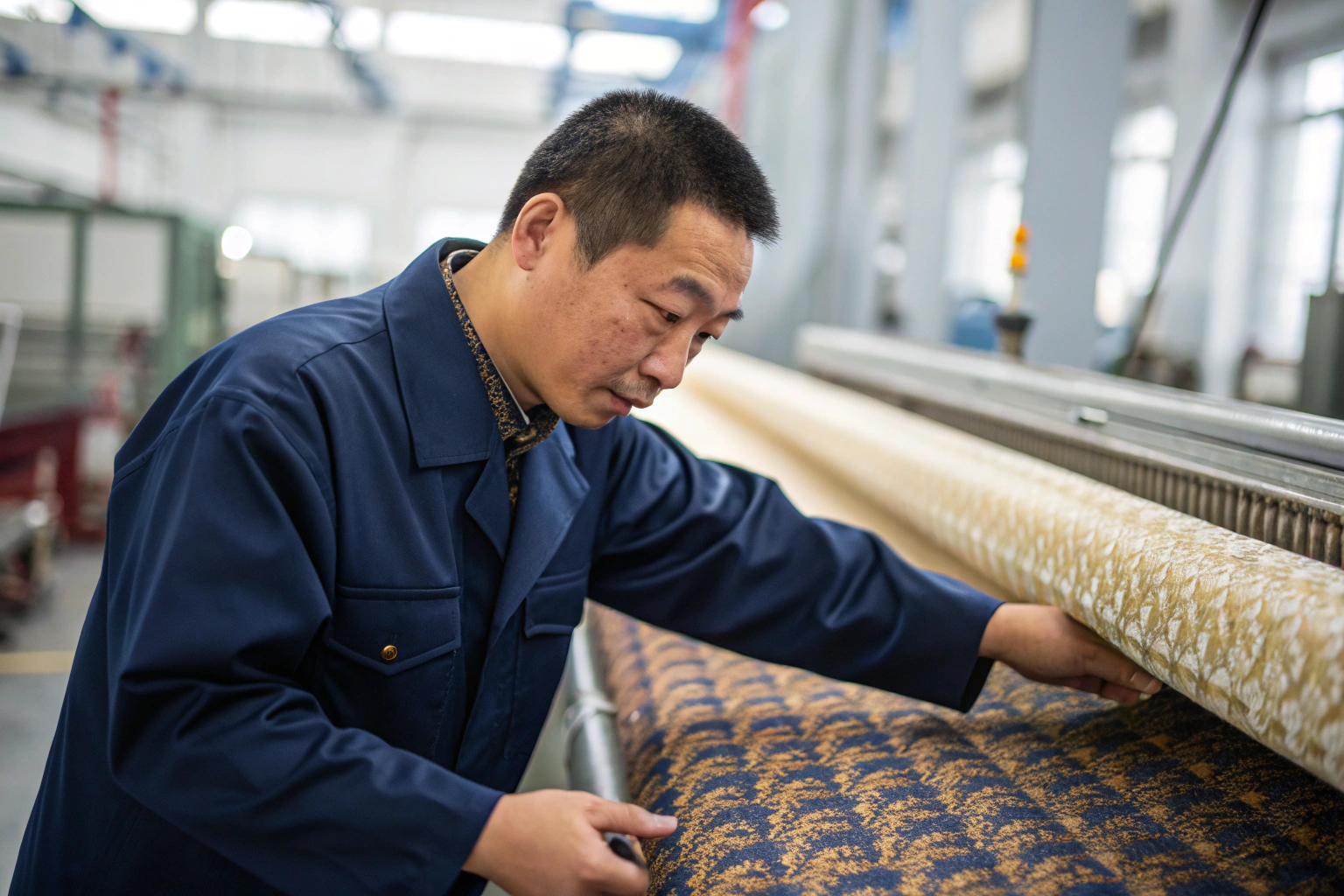
If you are sourcing fabrics right now, you probably feel the same frustration I hear from my clients every week. You spend hours scrolling through Alibaba or Google, and every supplier’s photos look the same. You order a sample, wait three weeks for it to arrive, and the texture is flat, cheap, and nothing like what you saw online. This is a massive waste of your time and money. I know this because I run Shanghai Fumao, a textile production and development company based in Keqiao, China, and I see this problem destroying buyers’ margins every single day.
The secret to getting exclusive, high-end textures isn’t just finding a supplier—it is leveraging the distinct capabilities of five different production lines under one roof to manipulate yarns, weaves, and finishes into something no one else has. At Shanghai Fumao, our integrated system of weaving, dyeing, printing, embroidery, and coating allows us to create multi-dimensional surfaces that fast-fashion suppliers simply cannot replicate quickly or at scale.
I want to walk you through exactly how we use these five processes to build textures that elevate your brand. I will share real technical adjustments, some factory-floor secrets, and a few recent case studies. This isn’t just theory; this is how we help clients from Europe and the US turn "basic fabric" into a best-selling garment. Let me show you how you can stop chasing generic stock and start developing your own signature textiles.
How Can Weaving Density Manipulation Create Unique Fabric Textures?
You might think that a specific weave pattern is all you need to create texture, but if you ignore the density of the yarn arrangement, you miss 90% of the tactile potential. Many designers come to me asking for a "jacquard" or a "dobby," thinking that’s the finish line. But if your factory runs the same 80-pick-per-inch density for everyone, your "exclusive" fabric feels exactly like every other buyer’s stock on the market. That’s a fast track to a generic product.
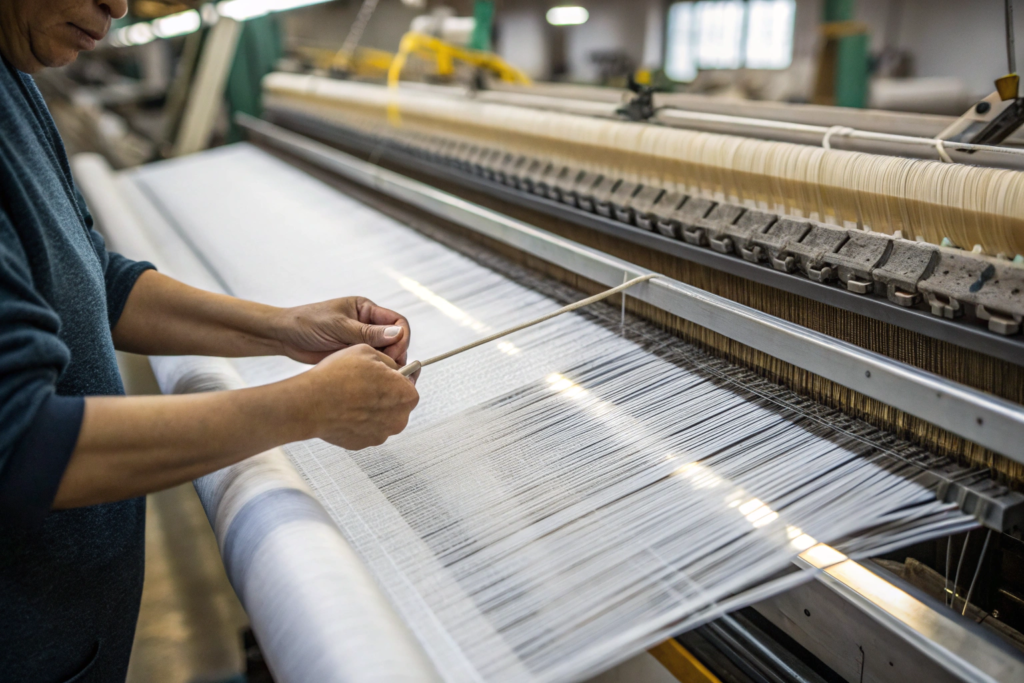
True textural exclusivity starts by telling your loom technician to push the physical limits of the yarn. At Shanghai Fumao, we don’t just select a weave; we engineer the cloth density from the ground up. By adjusting the picks per inch (PPI) and ends per inch (EPI) outside the standard safe zones, we can transform a soft drape into a firm, structured board or a rough, linen-like slab. This isn’t just a design choice; it’s a physics problem we solve on the factory floor.
How Do PPI and EPI Adjustments Transform Fabric Hand-Feel?
Let me break this down simply. EPI is how many threads run vertically (the warp), and PPI is how many run horizontally (the weft). Most standard factories stick to a safe range, say 80×80 for a basic cotton poplin, because it reduces yarn breakage and makes their production faster. But exclusive texture lives in the danger zone.
I remember in March 2023, one of our Scandinavian clients needed a heavy, structured cotton coat that looked rigid but didn’t feel like sandpaper. We took a standard 3/1 twill and ramped up the PPI from 60 to 85. Now, on older machines, that causes immediate warp stops because the reed battens can’t handle the beating force without breaking the yarn. But because we use high-speed rapier looms with a reinforced shedding mechanism, we managed to pack those threads tight.
(Here I have to jump in—our pre-tension adjustment on the creel is the real MVP here.)
The result? The fabric came out dense but with a smooth, almost waxy surface because the tight interlacing compressed the cotton fibers. We checked cross-sections under our lab scope to ensure no internal fiber degradation happened. The client sold out the coat in two weeks. That density adjustment turned a $4.50/m fabric into a $9.00/m premium textile. You achieve that by ignoring the machine’s comfort zone and working right at the edge of the yarn’s tensile strength specs.
What Is the Relationship Between Yarn Twist and Crepe Texture Effects?
Now, let’s talk about twist. If you want a true crepe texture—that gritty, pebbly surface that screams high-end summer suiting—you cannot just rely on a crepe weave. You need high-twist yarn. That’s a non-negotiable rule in our mill.
We use "S" and "Z" twisted yarns to create torque in the fabric. When you combine a 2,200 TPM (twists per meter) yarn with a loose plain weave, the yarn naturally wants to untwist during wet finishing. The fabric shrinks and crinkles in a totally random pattern. But here’s the technical headache: high-twist yarn is incredibly lively. It snarls and loops back on itself the second you take it off the cone.
In April 2024, an Australian resort-wear brand came to me desperate for a Japanese-style rayon crepe that no one else in China could stabilize. The regular run had a 15% shrinkage rate, which is a disaster for garment cutting. Through our cooperative spinning partner, we didn’t just request a high-twist; we specified a balanced twist yarn with a steam-setting process for 40 minutes to partially relax the torque. We inserted the yarn at a lower tension on the loom, letting it float slightly. After an open-width scouring, the texture popped beautifully. We hit a final shrinkage figure of just 2% after three washes, tested in our CNAS-certified Shanghai Fumao lab. That’s the alchemy of knowing how much twist the fabric can take before it tears itself apart.
Why Does Dyeing Technology Hold the Key to High-End Surface Effects?
Dyeing is often treated as just a color service. You send a greige fabric, and two weeks later it comes back blue. But if you treat dyeing as a surface engineering tool, you open up a whole new dimension of texture. Many buyers don’t realize that the temperature ramp rate of a dyeing machine can physically alter the surface roughness of a fabric. I have seen fast heating rates ruin a $5-per-yard viscose surface, turning it into a hairy, pilled mess before even hitting the cutting table.
The secret to high-end surfaces in dyeing lies not just in the dyestuff, but in the mechanical action and bath ratio control. At Shanghai Fumao, our cooperative dyeing house uses low-liquor-ratio airflow machines specifically for delicate fibers. These machines minimize the friction that causes surface hairiness on blends like Tencel™/linen. By controlling the liquor turbulence instead of just the temperature, we create a "wet-pebbling" effect that gives flat woven goods a natural, papery hand-feel without any chemical softeners. This is physical texture created by hydraulic force.
How Does Controlled Shrinkage in Dyeing Develop 3D Surface Structures?
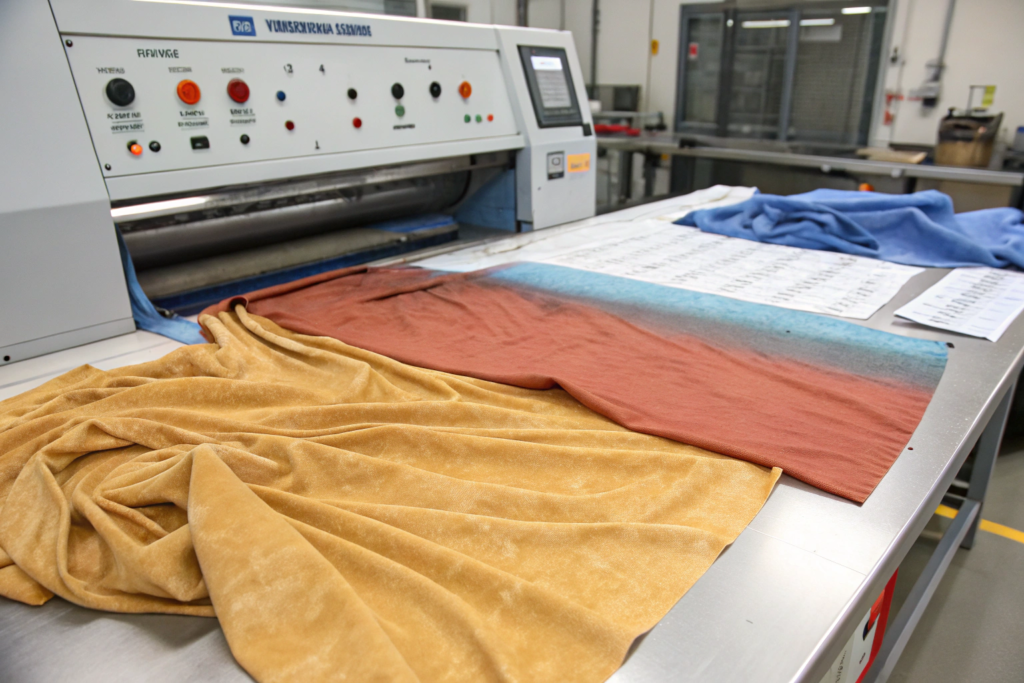
This is a trick I love sharing, but few factories execute it well because it threatens their efficiency metrics. You can use the dyeing process to create a controlled, irreversible shrinkage that wrincles the fabric permanently. This is the core of creating 3D seersucker or bubble textures without specialized looms.
Imagine you have a double-layer fabric where one layer is tight-twist cotton and the other is a loose rayon. You don’t want to weave a crinkle structure; you want the dye bath to do it for you. We wash a greige tube at a 1:15 material-to-liquor ratio at 110°C. The rayon layer wants to shrink 8%, but the cotton only 1%. Because they are interlaced, the fabric contracts violently and forms a permanent, uneven pleat.
A client from the American streetwear market came to us in late 2022 wanting a vintage "deadstock" polyester satin that looked crumbled but wasn’t coated with polyurethane. (Editor’s note: PU coating is the lazy way to get a crinkle look; it peels in three washes.) We reversed the logic. We ran a polyester/nylon bicomponent yarn through boiling water dyeing at exactly 98°C for 1 hour at our partner facility. The lower-melt nylon component curled at the micro-level instantly. We need to stress that we had to keep the bath scrupulously clean—no residual acids—so the fabric didn’t weaken. The result was a crunchy, noisy texture that looked like 1980s track suits. The Japanese market also went wild for it. That was 100% a dye-vat texture innovation, not a weaving one.
What Are the Texture Differences Between Reactive and Pigment Dye Finishes?
Let’s talk chemistry for a second—but the kind that affects your fingers, not just your eyes. The binder system in pigment dyeing versus the ring-dyeing effect of reactive dyes creates wildly different surfaces. You need to pick the method not just for the color fastness, but for the touch.
Pigment dyes don’t penetrate the fiber. The color sticks to the surface like a coat of paint. This is perfect if you want a distressed, "stone-washed" texture on cotton canvas, and I saw a classic case back in August 2023. A UK workwear brand was trying to replicate a "vintage mechanic’s jacket" look. We recommended a pigment dye process with a specific polyurethane binder that had a high glass transition temperature (Tg), meaning it stiffens the fabric significantly. After the wash, the binder cracks in a precise, linear-weakened pattern, giving a genuine worn-out texture instantly.
On the flip side, a deep, wet-crawling texture requires fiber-reactive dyes. These dyes form a covalent bond deep inside the cellulose, leaving zero surface residue. This is critical for silky "peach-skin" texture treatments, which are actually micro-sanding followed by reactive dyeing. If you try to micro-sand a pigment-dyed fabric, the binder just pills up into sticky balls. You need the fiber to be "naked" for the sanding roller to tease out the micro-fuzz. Our technicians always run a AATCC 8 crocking test kit right on the shop floor to confirm there’s no surface pigment waiting to ruin the sueding rollers.
A tip from my floor manager: if you want to check if a fabric supplier really understands texture, ask them about their reduction clearing process after dyeing polyester. If they skip that step, the oligomers stay on the surface, making the texture sticky and dull. That’s a sign of an amateur.
What Unique Textures Can Digital and Rotary Printing Add to Fabrics?
Printing is not just about graphics. Let me say that again: printing is not just about graphics. I get so many tech packs asking for a "leopard print on viscous jersey," and designers treat the print like a sticker. But each print method leaves a distinct physical footprint on the cloth. If you ignore this, you are leaving texture on the table. At Shanghai Fumao, our two distinct printing workshops allow us to pivot between coating textures and penetrating dyes, and that choice defines the luxury level of the garment.
Digital printing, for instance, is often considered "flat" and without hand-feel. That’s true only if your operator is lazy. By using pre-treatment that combines sodium alginate with a high-viscosity urea mix, we can actually keep the ink sitting slightly proud of the surface on a tightly woven polyester satin. The result? A nearly imperceptible, breathable "shell" around the print area that catches the light differently from the background, creating a visual texture that looks like a cut velvet shadow when moved.
Can CMYK + Spot White Printing Create Raised or 3D Textures?
Yes, and we do this almost weekly for activewear brands. Traditional digital printing uses CMYK with no physical depth. But we run hybrid print lines with a 3D white underbase station. This is a game changer for texture. We layer a high-density matte white ink—think of it like piping icing on a cake—in a single pass, and then print the color on top.
Last July, a Brazilian swimwear label needed a textured "puff" print, but they had a minimum order of only 500 pieces, which made traditional screen setups too expensive due to the screen fees. I suggested our digital spot-white technique. We dialed up the waveform on our piezoelectric print heads to eject droplets of white pigment at a rate of 80 picoliters, creating a 0.2mm thick raised base. We used a scratch-off test with a 5H pencil hardness gauge in our lab to ensure the white wouldn’t crack after 20 stretch cycles at 40% elongation.
The texture was so tactile that buyers at a Miami trade show thought it was a flocking process. We achieved a three-dimensional surface with zero setup cost. The client’s feedback was that the garment looked like an expensive high-end heat transfer but survived 40 machine washes without peeling. That’s the power of blending ink chemistry with printer mechanics. By the way, our R&D team is currently testing a matte-ball gel ink that creates a rubbery, grip-texture for yoga wear, which is totally distinct from the flat feel of standard CMYK.
How Does Flocking and Gold Foiling Interact with Base Fabrics?
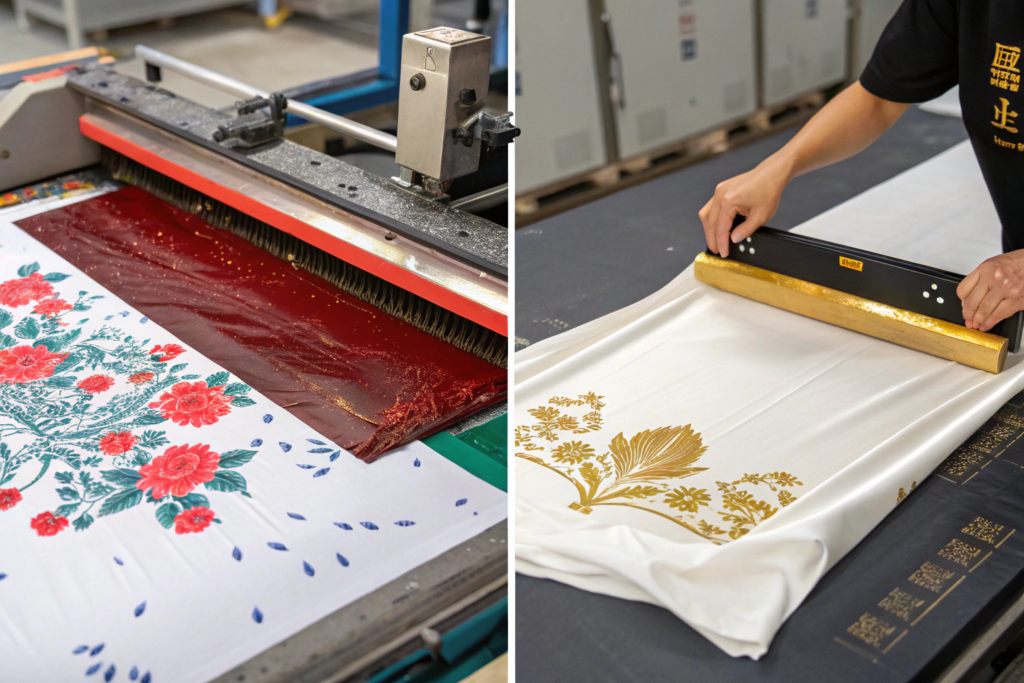
Now we move into our rotary screen lines—this is where the heavy texturing really happens. Flocking is the process of depositing millions of tiny fibers vertically onto an adhesive-coated fabric using an electrostatic field. It creates a suede-like, fuzzy pile effect. But here’s the trick: the density of the flock—measured in decitex (dtex)—determines if it feels like cheap velour or premium Italian suede.
A recent case from February 2024: a European luxury lingerie brand needed a specific "shadow stripe" on lace netting. We used a 1.0 dtex, 0.5mm long nylon flock in our embroidery and coating facility. Shanghai Fumao’s operator adjusted the electrostatic voltage down to 30kV to ensure the fibers stood up straight and didn’t bury themselves in the adhesive. If you use too much voltage, the flock pierces the glue and lies flat, losing that velvet texture. We ran it through a beating machine post-cure to shake out the loose fibers that cause irritation.
Gold foiling is the opposite—it’s flat but reflective. To make it a "texture" you need to emboss it. The foil must be applied to a silicone release paper first, then stamped under 120 tons of pressure onto a fabric that has a soft backing (like felt) to accept the embossing die. We learned the hard way; back in 2021, we tried cold-peel foil on a thin georgette, and the texture was so stiff it could stand up on its own.
(I must add, don’t ever foil on a textile with loose twist—it’s a waste of money.)
The best combination we did was a "flock and foil" burnout on a rayon/polyester base. We printed the adhesive for the flock and the foil side-by-side, then burned out the background rayon with a sodium hydroxide paste. The final texture was an alternating matte fuzz and glossy metallic stripe on a sheer mesh base. That fabric went straight to a Parisian couture house.
How Do Coating and Embroidery Synergize to Redefine Fabric Surfaces?
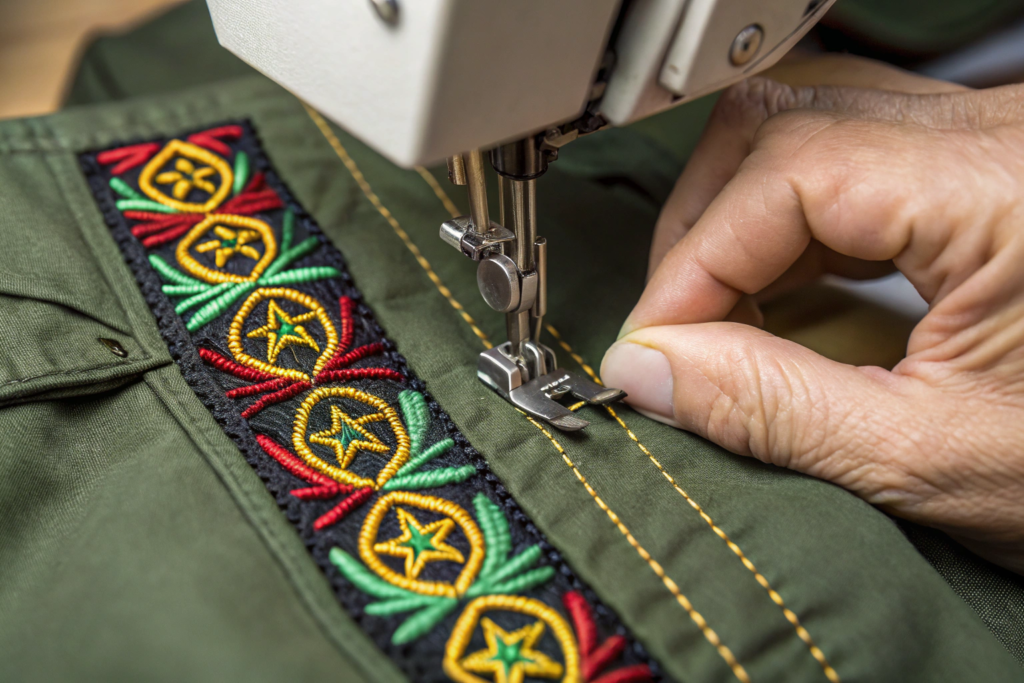
I often tell my clients: if you really want to win a market, mix the unnatural with the ultra-natural. This means combining heavy industrial coatings with intricate embroidery. Most of our competitors keep these departments separate—they outsource coating to one village and embroidery to a workshop 5 kilometers away. That split communication kills the chance for a cohesive, multi-layer texture. Because we have both lines under our operational control, we can fuse a waterproof seal with a three-dimensional stitch pattern in a way that feels absolutely intentional and seamless.
This is about tension dynamics. A coating usually seals a fabric, stabilizing it. Embroidery, conversely, punctures the fabric thousands of times and pulls it tight. If you sequence this wrong—say, embroider first, then coat—the silicone coating pools in the embroidery holes like a puddle of plastic. It looks awful. For a bomber jacket project we ran for a German streetwear brand in October 2023, we did the opposite. We laid down a matte black PU solvent-free coating first, fully cured it at 160°C, and then embroidered heavy 600-denier polyester threads right through the film. The needle penetration caused a controlled micro-cracking of the outer coating edge, giving a distressed, "cracked earth" texture around the logo. The brand’s designer cried when she saw the first strike-off. That’s the reaction we aim for.
Can Coupling Agents Improve the Adhesion Between Coatings and Fibers?
We absolutely need to get into the chemistry of bonding here, because texture without durability is just a liability. The nightmare scenario is "de-lamination"—where that expensive PU coating peels off the polyester base like a sunburned skin. To stop that, you need a coupling agent, specifically an isocyanate-based crosslinker, in your coating paste.
In our coating factory, we perform the "scratch test" on every batch. We use a sharpened copper coin and perform 40 double rubs. If the coating merely shines and doesn’t lift, the texture is locked. But the real "exclusive texture" trick is to control the "slip," which is the coefficient of friction.
For a 2024 autumn/winter collection for a Canadian outerwear brand, we mixed a small percentage of hollow glass microspheres into the PU topcoat. These microspheres lower the surface friction while creating a sound-texture—the fabric rustles like high-end nylon, not squelches like cheap vinyl. When we embroidered over this slick surface, the tension of the upper thread needed to drop by 15% compared to normal polyester to prevent puckering. Our technicians adjusted the tensioners on our Japanese multi-head machines in real-time. The result is a waterproof, whisper-quiet shell with a burnished physical shine that didn’t look greasy.
What is the Role of Laser Engraving in Modern Embroidery and Coating?
Laser engraving is the silent fourth dimension of texture, bridging the gap between flat coats and high embroidery. Instead of sewing yarn onto a surface, we etch the surface away. This is a high-risk, high-reward process. If the laser frequency is wrong, you just burn a hole in the cloth.
We treat laser as an "etching tool." On coated fabrics, a CO2 laser beam can vaporize the PU coating without touching the polyester base underneath—if you dial in the exact focal length. We set this at 50.8 mm for our 100W machines. The result is a ‘semi-transparent’ effect where the opaque coating is etched into a delicate, lace-like pattern.
One of the coolest projects we did was combining laser etching with embroidery for a high-end furniture upholstery job in November 2023. We coated a black base cloth with a metallic silver PU. Then, we lasered a damask pattern, revealing the black cloth below. After that, our embroidery team stitched a bright red matte thread exactly into the lasered-out channels. The registration accuracy had to be within 0.5mm because a wandering laser path would mean the red thread sat half on the silver and half on the black, which looks cheap. We used a visual positioning system on the embroidery machine to scan the lasered registration marks. We produced 2,000 meters without a single accuracy defect, meeting the strict ASTM D2261 standard for tear strength across the lasered zones by cooling the fabric immediately with an air jet after the beam hit it.
That blend of shiny metal, deep black shadow, and matte embroidery thread creates a 3D texture that none of the three processes could achieve independently. It’s the ultimate testament to keeping these lines talking to each other.
Conclusion
We have walked through the factory floor together today, from the beating of the loom reeds and the chaos of high-twist yarn, to the steam of the dye vats, the precision of digital print heads, and the sharp bite of the laser cutter. The takeaway is simple: exclusive texture doesn’t come from a catalogue. It comes from friction—literally. It’s the friction between tight yarn geometries, chemical reactions, ink surface tension, and the physical puncture of a needle.
For over 20 years in Keqiao, we’ve learned that a fabric’s true value isn’t just in the fiber content. It’s in those barely-perceptible micro-adjustments that make the textile look and feel like nothing else on a competitor’s rack. Whether it’s ramping the PPI up to the breaking point for a Scandinavian coat or laser-etching registration marks for French lace, every step requires a willingness to push the machine to its limits without destroying the yield.
If you are tired of touching fabric samples that all feel the same and losing bids because your product looks "basic," stop buying stock lots. Let’s build your texture from the ground up. I want you to reach out to our Business Director, Elaine. She can walk you through our minimums, our development lead times, and how we can engineer a custom milled surface specifically for your next collection. Don’t just design a garment; design the fabric.
Contact Elaine for a custom texture consultation at elaine@fumaoclothing.com. We’re ready to run your first strike-off and show you the Shanghai Fumao difference in texture and quality.








