
Let me guess. You have a sketchbook full of original textile designs, but you’re terrified to send that artwork to a Chinese factory. You’ve heard the horror stories. A buyer emails a custom floral placement print to a supplier. Two months later, that exact same print appears on a competitor’s dress, hanging on a rack in a downtown Los Angeles boutique, sold to them by the very factory you trusted. You feel like you have to choose between accessing good manufacturing and protecting your intellectual property. That’s a sickening choice to have to make.
I want to answer this fear directly. At Shanghai Fumao, your original design is a legal and ethical boundary we will not cross. Protecting your artwork isn’t a "favor" we do for you; it’s a concrete, multi-layered security protocol built into our contract system, our digital infrastructure, and our factory floor access. We combine NDA enforcement, encrypted file management, exclusive cylinder and mold ownership, and a "blackout" production cell to ensure your custom jacquard, dobby, or engineered print never leaks to a middleman, a competitor, or a fast-fashion copycat. I’m going to walk you through the exact, actionable defenses we build around your intellectual property, so you can sleep soundly while we weave.
How Can a Binding NDA with Chinese Suppliers Secure My Fabric Prints?
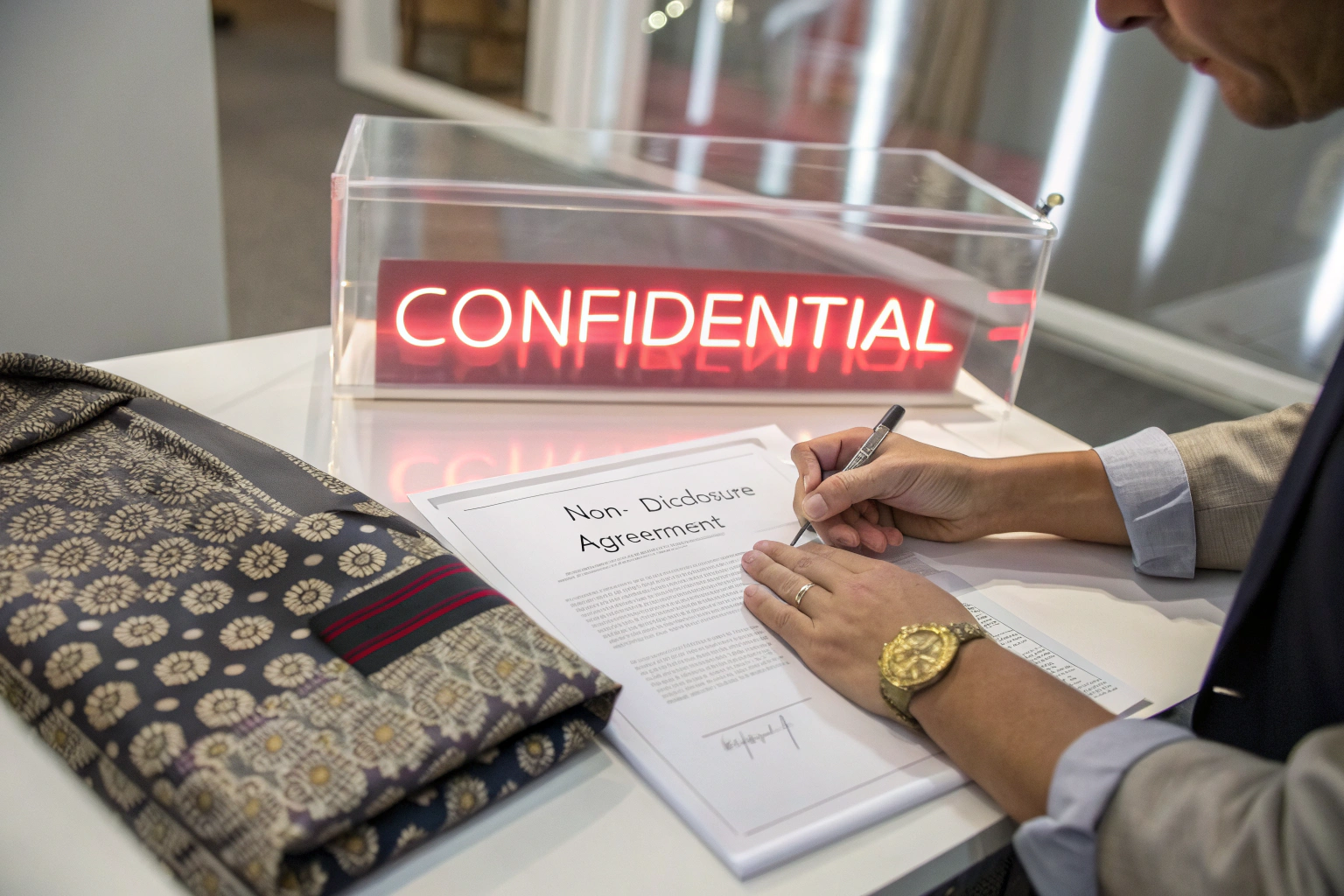
An NDA with a Chinese factory is not a magic spell. If you simply download a generic agreement off the internet and ask a sales agent to stamp it, you might as well be protecting your design with a paper napkin. Enforceability in China hinges on specificity, the legal status of the signatory, and a bilingual translation that holds up in a local court. I’ve seen several clients walk in assuming a casual email chain counts as "protection," and they learn the hard way when a leaked design can’t be traced back to a specific breach.
At Shanghai Fumao, we don’t just sign your NDA; we insist on a rigorous, reciprocal protocol. We use a bilingual Chinese-English "Non-Disclosure, Non-Use, and Non-Circumvention Agreement" (NNN Agreement) that explicitly lists the registration number of your artwork files. We attach a greyscale, time-stamped copy of your design to the contract appendix as a legally valid "Schedule A." Our corporate legal representative stamps this document with our registered company chop. This isn’t a rubber stamp from a salesperson; it’s a seal registered with the Chinese Public Security Bureau, which carries significant weight in a dispute under Chinese contract law. We also add a liquidated damages clause—a specific financial penalty for the breach—rather than relying on vague "proportional" damages, which are notoriously slow to litigate. This creates a concrete, immediate cost to any internal leak, which acts as a massive deterrent.
What Contractual Language Prevents Sample Leakage to Third-Party Sellers?
Standard NDAs often prevent a factory from "selling" your design. But what about "showing" it? Leakage rarely happens through a formal invoice to a competitor. It happens when a salesman carries your gorgeous new swatch to a different trade show in Paris and uses it as an "attention grabber" to hook other buyers. Technically, they didn’t sell it. Technically, they breached your trust and ruined your exclusivity.
We specifically address this with a "No-Show" clause. Our standard agreement contains explicit language preventing any representative of Shanghai Fumao from displaying your custom physical samples, digital renders, or production photos in any public exhibition, showroom, catalog, social media post, or e-commerce listing, for a period of five years from the date of final delivery. That’s a non-negotiable lockout.
I recall a case from early 2024 that highlights why this matters. A Los Angeles activewear brand sent us a textured, optical-illusion print for a yoga legging line. Leggings are a cutthroat market; a print goes viral for 8 weeks and then it’s dead. We signed an agreement that even prevented us from placing the bolt of finished fabric on a shelf visible to other visiting clients during factory tours. We kept it in a sealed, opaque bin. Six months later, that print was still exclusive to that one brand on the US market. Their CEO emailed me saying that alone paid for their development costs, knowing they weren’t competing against their own factory’s sales team. To give you a deeper understanding, reviewing the basics of what makes a Chinese NDA enforceable is a critical first step before sending any artwork overseas. That knowledge protects you before we even sign.
How Do We Digitally Lock Design Files in Pre-Production Communication?
The digital pipeline is actually where 90% of leaks happen, and it’s not usually malicious. It’s casual negligence. A merchandiser forwards your high-resolution Adobe Illustrator file via an unencrypted WeChat account to a color separator who works part-time at home. The separator’s kid uses the laptop for games; a virus sniffs the file. Five weeks later, your "exclusive" print is for sale on a print-on-demand website in Bulgaria. That’s the modern supply chain nightmare.
We cut that risk by moving all design file transfer off standard chat apps. We use a client-specific, password-protected portal on our server. Your login grants access to a specific project folder. We rarely send original vector master files to external subcontractors. Instead, our internal CAD team generates a "low-res, non-editable watermark" proof for initial comments, and only the production-ready separated film goes to the engraver, locked to a specific laser setting via a 256-bit encrypted flash drive. Our lab technicia plugs the drive directly into the engraving machine; the file can’t be copied off, only printed and deleted after one execution. This "air-gap" method means that even if someone stole the flash drive, they can’t retrieve your design without our specific machine password. For valuable engineered prints, this digital vaulting is something we insist on, just as much as the physical security. And to handle sensitive textile-specific disputes, we often align our internal protocols with guidance on how to protect textile designs under intellectual property law from global best practices, ensuring we aren’t just making up rules on the fly.
Who Owns the Engraving Cylinders and Jacquard Software After Production?
This is the most overlooked question in custom manufacturing, and if you don’t ask it before you pay the deposit, you are effectively gifting your supplier thousands of dollars in tooling that they can use against you later. A rotary screen cylinder or a set of specialty jacquard harnesses is a physical asset. It’s expensive to make, but once it’s made, you can print or weave a million meters from it. So, who holds the key to that mold?
At Shanghai Fumao, the answer is simple: you own the tooling, even if it sits inside our factory. We treat the engraved copper cylinder for your print or the proprietary .jc5 weave file for your jacquard as your property, held under a legal bailment agreement. This means we are the "bailee" and you are the "bailor." We have a fiduciary duty to maintain and secure your asset and we absolutely cannot use it for any purpose other than manufacturing your specific purchase orders. This ownership is explicitly transferred in writing upon your first tooling payment. If our partnership ends for any reason, you have the right to demand the physical return of the cylinders, screens, and harnesses, or demand a certified certificate of their destruction with photo evidence. This prevents the nightmare scenario of a brand switching suppliers, but their "old" factory keeps running their signature stripe in a cheaper quality, flooding the market.
How Does a Fiduciary Tooling Agreement Prevent Back-Door Production?
Back-door production works like this: a factory makes 1000 meters for you. They make an extra 500 meters that night, on the same cylinder, and sell it under the table to a discount off-price retailer. Your "exclusive" luxury print ends up on a $9.99 t-shirt at a discount bin, destroying your brand’s premium perception. The only true defense is a combination of legal teeth and physical security.
A fiduciary agreement creates a paper trail of ownership that’s distinct from a simple purchase contract. It classifies the illicit sale of those extra 500 meters not just as breach of contract, but as conversion—a civil tort akin to selling stolen goods. Our agreement also includes a clause for "anchor marking." We can embed a microscopic, repeating logo "slug" or a covert security thread, physically in the fabric, that only you know to look for. If you find a fabric in the market with your exclusive print and that hidden marker is missing, it might be a generic copy. If that marker is present? It’s 100% a back-door run from a stolen fiduciary tool. That becomes irrefutable proof.
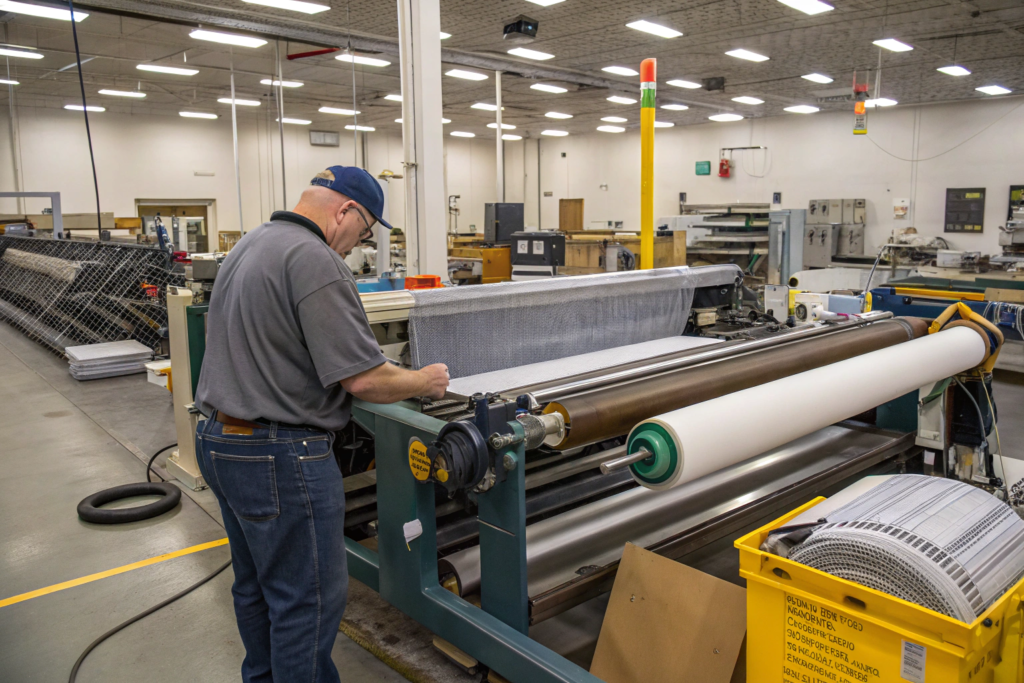
We don’t just rely on the law. We rely on the lock. The cylinder room in our printing factory has key-card access with a digital audit trail. Every time a specific cylinder is locked onto a print machine, the operator must scan the barcode, and the system logs the exact time, duration, and meter count on the clutch counter. This digital log is compared against the meter reading at the end of the run. If the machine spun 5200 meters but only 5000 were logged to your shipping docs, the discrepancy triggers an automatic alert for the plant manager. That prevents the unofficia "ghost shift" production that standard factories can hide. This physical-logical parity gives you service intelligence on your own fabric, not just a delivery note. More and more international brands are incorporating the principles from comprehensive textile safety and management certifications to ensure their supply partnership covers traceability and consistent quality benchmarks.
What Happens to My Jacquard Software Code After My Bulk Order Finishes?
Forget the physical cylinder; what about the digital ghost in the machine? The jacquard software file that controls 10,000 heddles is the DNA of your fabric. If a factory keeps that file without restriction, they can recreate your exact weave texture three years later for another client just by changing the weft color, and you’d never be able to prove it was your structure.
After your order is complete and our quality check is signed off, we escrow the master file. We do not store it in a "live," searchable library that any designer can browse for "inspiration." We archive it in a cold-storage partition with an expiring encryption key. This digital vault is access-restricted to only two senior personnel. To re-access the file for a re-order, the system requires a unique authorization code generated dynamically from our internal system, which logs the reason for access. If your brand requires it, we can also provide a digitally-signed "Code Strip and Zeroization" certificate, proving the master file has been permanently deleted from our active servers, and you hold the sole remaining copy on your encrypted drive. When you re-order next season, you simply send us back the file. This puts the ultimate control of the weave structure’s destiny in your hands. That’s the freedom of truly owning your design, not just renting a factory’s existing archive.
Can Fumao Isolate My Production Batch to Enforce Physical Exclusivity?
A digital vault and a legal contract are essential, but what happens on the physical floor at 2 AM? This is where design theft becomes a visceral reality. In a standard busy dyeing plant, fabric bolts from 50 different brands are piled on the same trolley, pushed down the same hallway, and stitched together on the same stenter frame. A private-label competitor touring the factory for their own inspection might simply walk past your uncured, exclusive print and snap a photo with their phone. That’s not espionage; that’s just a lack of physical discipline.
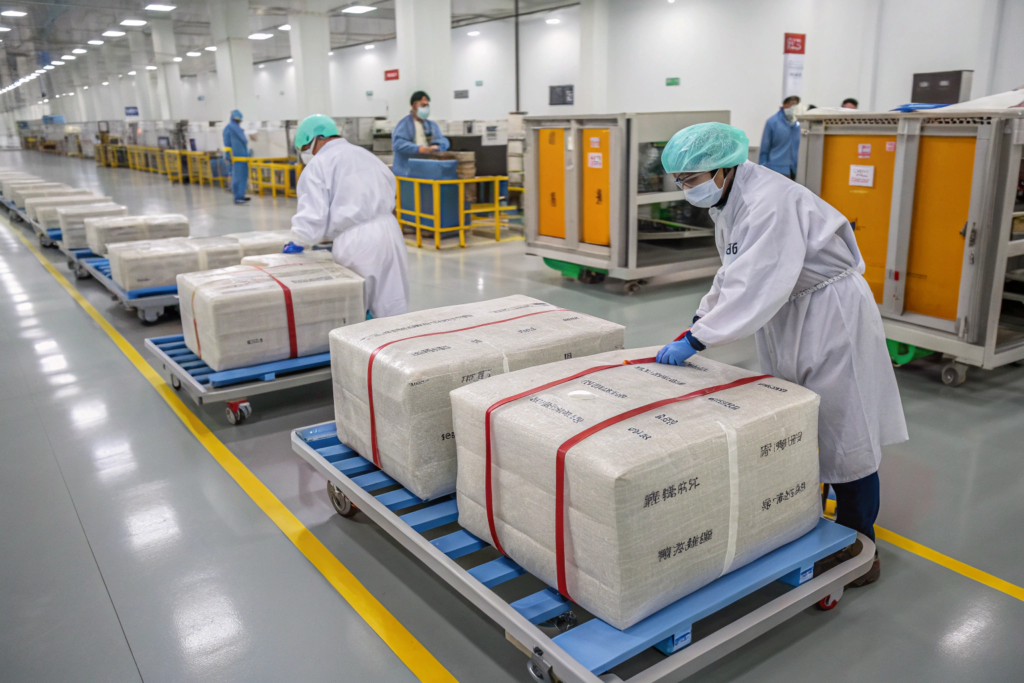
At Shanghai Fumao, we offer an exclusive, scheduled isolation track. We call it "Cell Production Sealing." We don’t just run your fabric; we quarantine the process. When you place an order requiring high intellectual property protection, we schedule your greige goods, dye lot, printing run, and finishing as a single, continuous batch. No foreign textiles are allowed to be processed on the same machine that day. And critically, the work-in-progress is stored in a sealed, lockable trolley with a tamper-evident seal. The seal number is logged. If the seal is broken before the batch reaches the next operation, an internal committee halts production and investigates. It’s a physical chain of custody, much like handling forensic evidence. This prevents "sample replacement"—where a dishonest subcontractor might try to swap your high-cost cotton with a cheaper blend mid-run.
How Does Timed Room Access and Blind-Labeling Prevent Copying?
We aim to turn your fabric into an "invisible object" to anyone who doesn’t have a direct operational need to see it. The simplest but most effective methods are timed-access shifts and blind-labeling.
Blind-labeling means the fabric pallets attached to your work order are not labeled "URBAN LUXE BRAND – GOLD TIGER CAMO SS25." That’s a billboard inviting theft. Instead, we assign a meaningless internal alphanumeric project code: "Project KQ-421-A." Only the Merchandising Manager and the Shift Supervisor know what 421-A actually represents. The cutting table operator, the dye mixer, and the packaging team see a code, not a brand name. They execute the technical instructions without knowing the commercial value or the end client. This removes the "temptation" factor entirely.
Timed room access takes this digital. For highly sensitive developments, like a heavyweight Olympic ceremony fabric we worked on a whisper about, the weaver and the finisher are only granted badge access to the specific production cell during the exact hours the batch is running. The server logs the entry and exit of every worker. If a mobile phone is detected in the zone—our floor managers carry handheld metal detectors for this—it’s a sackable offense. We ran a project in late 2023 for a streetwear giant, and for the specific 48 hours of execution, the designated cell was a "clean zone." No photos, no personal devices. The fabric remained a complete ghost to the outside market until the brand chose to launch it. That’s the lockdown you get when you need to protect a "drop" from leaking on social media before the marketing campaign begins. Understanding standard security protocols within modern garment factories can help you appreciate why these measures are so critical for brand safety.
Are Fumao’s Embroidery and Coating Lines Subject to Third-Party Access?
This is the backdoor no one thinks about. Maybe your main weaving mill is protected, but you have a piece going out for a specialized silicone coating finish. Is that external coating plant secure? If they subcontract it further, your design is dangling in the wind.
We have a massive advantage here because embroidery, print, and coating are integrated into our own operational scope. Your IP doesn’t touch a black-box external vendor. But even if a rare specialized finish requires a partner, we enforce a ‘Master Agent’ protocol. Our team physically escorts the entire batch. The fabric is not mailed or couriered unsupervised. A Fumao logistics controller physically rides with the pallet in our dedicated van. They watch the finishing process like an obsessed art restorer. We use a ‘Before-After Count’—the exact yardage in must equal yardage out plus official documented process waste. If a 100-meter roll goes in and only 95 comes out, we need a 5-meter process-loss swatch physically shown to us and sealed for shredding. Any unaccounted length is treated as a direct security breach. Your design leaves a locked trolley in Keqiao, travels sealed, gets processed under watch, and returns sealed. No middleman gets to keep a souvenir meter. That’s end-to-end physical chain of custody, and it’s how we build a wall around your exclusive development.
What Hidden Markers Can Fumao Weave Into Fabric For Anti-Counterfeiting?
Sometimes legal contracts and locked rooms aren’t enough, especially when your product is a massive global success and counterfeiting syndicates in other countries start reverse-engineering your garment’s shape. How do you prove their fabric is fake and yours is original, without a lengthy legal war? You embed a physical, forensic "fingerprint" into the cloth itself. I’m not talking about a printed logo on the back. I’m talking about markers you can’t see, but you can instantly verify.
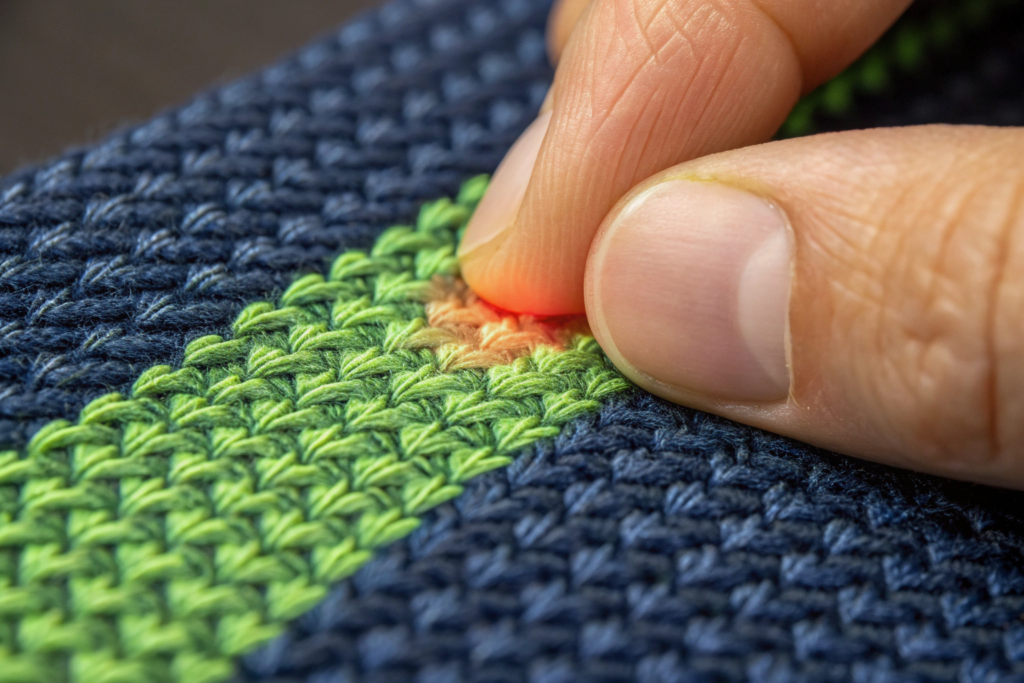
At Shanghai Fumao, we work with Shanghai Fumao chemists and spinners to integrate covert anti-counterfeit features inside the threads. This ranges from taggant-infused fibers that glow under a specific wavelength laser pointer, to DNA-laced inks in the coating that can be swabbed and tested with a proprietary kit. For a more analog approach, we physically engineer "structural watermarking"—a sub-pattern inside the weave repeat that acts like a banknote thread. In a custom jacquard, we can intentionally program a deliberate, microscopically small "error" in the weave—say, a specific float that should be a 3/1 twill but is actually a 4/1 at a predetermined coordinate only you know to look for. To a counterfeiter, it’s a random texture; to you, it’s a hardcoded signature of Fumao’s loom. This transforms your fabric into a physically self-authenticating asset. A simple pocket magnifier with a built-in grid lets your legal team prove the fake is missing the deliberate micro-float. Done. Case closed.
How Does Dual-Wavelength Reactive Stealth Printing Verify Authenticity?
This is a very cool bit of chemistry we deploy for streetwear brands terrified of screen-print knockoffs. Standard UV-reactive inks are useless because counterfeiters can easily buy generic UV glow paste. We need a "dual-factor" authentication. We use a specialized pigment that is inert under normal long-wave UV (like a club blacklight), but fluoresces bright red specifically under a short-wave 254nm UVC pen.
The logic is simple: a counterfeiter tests the garment with a regular UV keychain, sees nothing, and assumes there’s no marker. But you, the brand owner, carry a specific 254nm wand. You hit the fabric, and a hidden code appears—perhaps a string of numbers matching the batch ID embedded inside the coat print.
We tested this extensively for a verified white-label sneaker upper project in collaboration with a blockchain authentication startup. The 254nm reactive pigment is highly sensitive to sunlight degradation, so we couldn’t just mix it in the paste. We had to encapsulate the pigment inside a transparent silica micro-sphere shell during the coating process. This acts like a suit of armor, protecting the dye molecule. The result is a print that looks generic in the shop, but holds a secret that only a specific wavelength can unlock. Your authenticators don’t need a lab; they just need a $60 pen. The counterfeiter can’t source the encapsulated pigment because it’s a controlled substance only sold to verified manufacturers under a non-diversion agreement. This is chemical warfare against theft, and for a market flooded with copies, it’s the ultimate consumer trust insurance.
Can a Deliberate Structural Weave Error Act as a Loom Fingerprint?
Yes, and I absolutely love this method because it requires zero chemicals and zero extra cost—just pure programming prowess. Every jacquard loom has a very slight mechanical personality. But we can exaggerate a deliberate, invisible quirk. This is called a "digital thumbprint."
Imagine your fabric has a large plain satin field. In a tiny 2mm x 2mm area, positioned exactly 10cm from the left selvage and 50cm up the repeat, we program a single warp thread to "float" one pick longer than the satin standard. To the naked eye, this is totally undetectable within the shiny texture. But under a linen tester magnifying glass with a pre-positioned alignment grid template (which you provide to your legal team), that floating thread sticks out like a deliberate fleck. No standard design file would have that; it’s a specific weave error.
A client from a major sportswear label used this for their premium basketball jersey line in Fall 2024. Their jerseys were being counterfeited by a factory that had scanned the physical shirt and re-engraved the jacquard digitally. The fake looked perfect—except for the Fumao thumbprint. The copyist’s scanning software "corrected" the deliberate error because it assumed it was a defect, smoothing it over. Our client’s field agents used a simple credit-card-sized grid to instantly distinguish genuine from fake at retail points. The counterfeit goods were seized because the missing "defect" proved they weren’t made on the original loom. That’s an unforgeable birth certificate woven into every meter. Practical knowledge on modern anti-counterfeiting technologies in textiles shows how these tactics are moving from currency printing directly into the luxury fabric supply chain. Your fabric becomes the witness.
Conclusion
We’ve looked at this from the legal, digital, physical, and even chemical angles. Protecting an original design isn’t a single signature on an NDA. It’s a fortress built from multiple, interlocking walls. The bilingual contract with our registered chop gives you legal standing, the digital escrow gives you data sovereignty, the blackout cell with blind-labeling gives you physical isolation, and the embedded structural watermark gives you an invisible DNA trail that survives any copy. At Shanghai Fumao, we’ve engineered this system precisely because we know that your design is your brand’s core equity.
The sickening risk of finding your artwork on a competitor’s rack must be eliminated, not reduced. With our fiduciary tooling agreements, you own the mold. With our timed, device-free cell access, it stays secret. With our deliberate "loom thumbprints," you can prove the difference between a genuine article and a fake with a pocket magnifier. That is the peace of mind you need to focus on creative design, rather than inventory policing.
Don’t send your next masterpiece into a black box. Let’s surround it with these protocols before a single thread is spun. Talk to our Business Director, Elaine, about implementing a custom IP protection package for your specific project. She can walk you through our NNN agreement, our tooling ownership schedule, and how we physically quarantine a high-security cell just for your launch. Secure your signature textile now by emailing elaine@fumaoclothing.com. Your design deserves more than a promise; it deserves a fortress.








