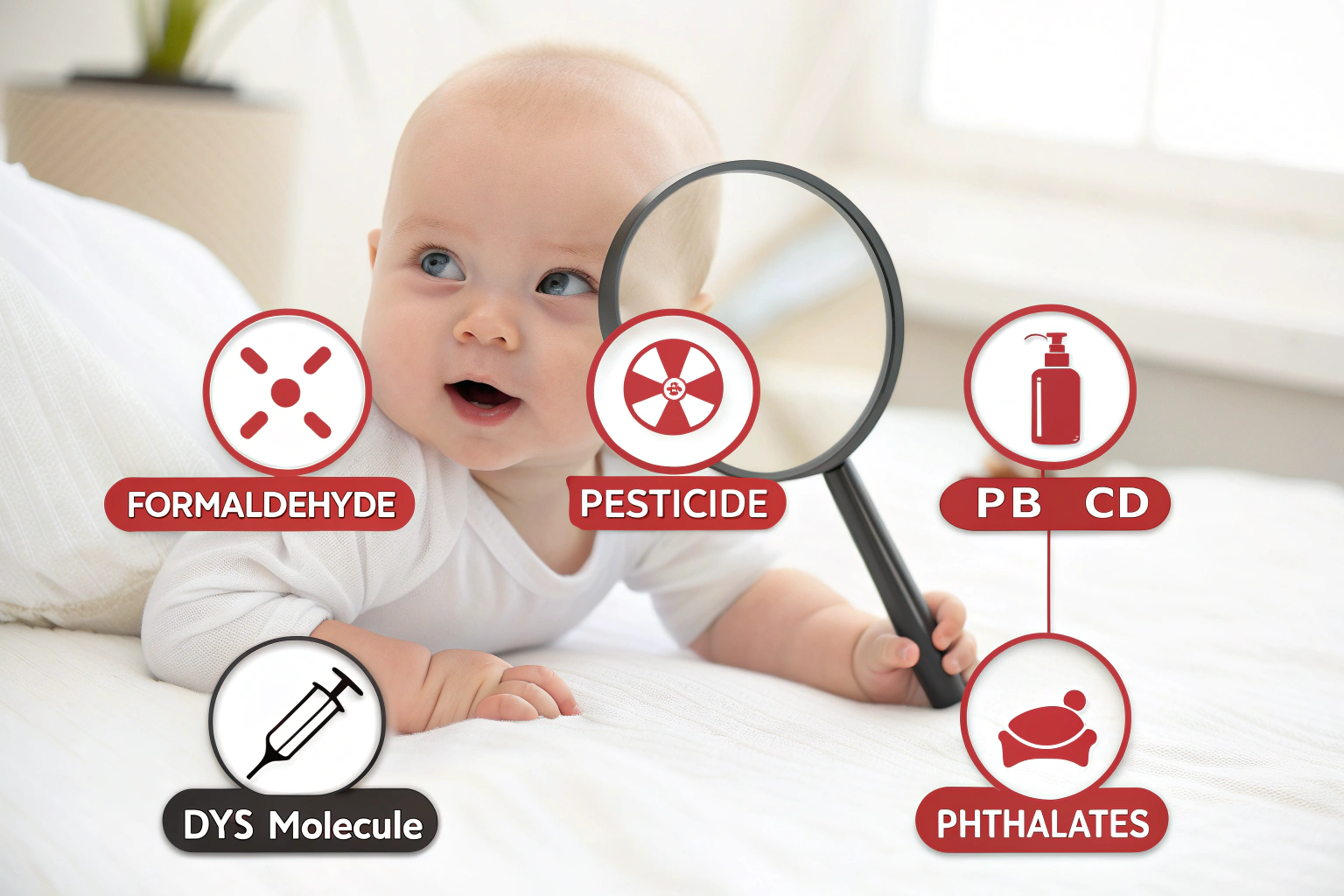
Let’s start with a hard truth: when you’re making clothes for babies and toddlers, you’re not just making small versions of adult garments. You’re dealing with the most sensitive end-users on the planet. Their skin is thinner and more permeable, their organs are still developing, and they have a well-documented habit of putting everything in their mouths—including their clothes. The question isn’t just about what chemicals are used; it’s about what infinitesimal traces of those chemicals are left behind. An ordinary textile processing chemical that’s harmless in an adult jacket can be a real risk in a baby’s onesie.
OEKO-TEX® Standard 100 Class I certification is the textile industry’s most rigorous response to this reality. It doesn’t just set lower limits for known hazards; it proactively bans or severely restricts the use of entire chemical groups based on the precautionary principle. The list isn’t static—it evolves with scientific research, often banning substances years before they appear on national regulatory lists. For brands, this means sourcing from a factory that understands and enforces this prohibitive list isn’t optional; it’s your fundamental duty of care.
In this article, I’ll move beyond the generic "over 350 substances" statement. We’ll dive into the specific chemical families that Class I targets, explain why they are a particular concern for babies, and reveal the practical steps our factory network takes to eliminate them from the production chain. Understanding this is key to sourcing with true confidence.
The Prohibited & Restricted Chemical Families: A Deep Dive
The OEKO-TEX® Class I requirements are exhaustive, but we can group the key prohibitions into several critical families. This is the "blacklist" that governs every input in our production for baby textiles.
- Formaldehyde and Other Carbonyl Compounds: Formaldehyde-based resins are used for easy-care and anti-wrinkle finishes. Class I demands these are not detectable according to the Japanese Law 112 method. Even trace amounts from cross-contamination are unacceptable because formaldehyde is a known skin irritant and sensitizer.
- Heavy Metals: Limits for arsenic, lead, cadmium, mercury, chromium (VI), cobalt, copper, nickel, and antimony are set 30-70% lower than Class II. These can originate from dyestuffs, catalysts, or pigments. Lead and cadmium are of particular neurotoxic concern for developing brains.
- Pesticides and Biocides: The list includes over 50 pesticides (like pentachlorophenol-PCP) and fungicides that might be present in natural fibers from conventional farming. Class I limits are often at the detection limit of the equipment, effectively banning their presence.
- Allergenic Disperse Dyes: A specific list of around 20 disperse dyes known to cause allergic skin reactions is completely banned. These dyes, used mainly on polyester, can migrate from the fabric with sweat.
- Chlorinated Phenols & Organic Tin Compounds (e.g., TBT): Used as biocides and preservatives. They are highly toxic and persistent in the environment, and Class I prohibits them.
- Phthalates (Plasticizers): DEHP, BBP, DBP, and others are banned. These are used to soften PVC prints, plastic appliqués, and some synthetic coatings. They are endocrine disruptors.
- Per- and Polyfluoroalkyl Substances (PFAS/PFCs): Used for durable water repellency (DWR). Long-chain PFCs like PFOA are banned. Class I pushes for the use of short-chain (C6) or, increasingly, PFC-free alternatives.
- Alkylphenol Ethoxylates (APEOs): Common surfactants and detergents used in dyeing and washing. They break down into environmentally persistent and hormonally active compounds. Class I prohibits them.

Why are allergenic disperse dyes specifically targeted for babywear?
Disperse dyes are not water-soluble; they are fine particles that are "dispersed" onto synthetic fibers like polyester. The problem is that not all of these particles chemically bond to the fiber. The unbonded particles can be released through friction, sweat (which mimics saliva), and especially when the fabric is wet and warm—exactly the conditions in a baby’s mouth or a sweaty fold of skin. For an adult, this might cause a minor rash. For a baby with hypersensitive skin, it can trigger significant dermatitis. OEKO-TEX® Class I doesn’t just limit these dyes; it completely bans the known allergenic ones and requires such thorough washing after dyeing that the colorfastness to saliva test is mandatory. We achieve this by using premium, high-fixation dyes and implementing our multi-stage "super-wash" protocol that leaves no loose dye particles behind.
How do pesticide residues from conventional cotton become a Class I issue?
This is a classic hidden risk. You might source "100% cotton," but if it’s not from a certified organic or tracked supply chain, that cotton was likely grown using a cocktail of pesticides, insecticides, and defoliants. Residues of these chemicals remain in the fibers. During the high-temperature dyeing and finishing processes, they can be released or react. Chlorophenols like PCP are particularly concerning as they are toxic and persist through processing. OEKO-TEX® Class I sets limits so low that they effectively force you to use certified organic cotton or cotton from verifiably integrated pest management systems. This is why at Fumao, our go-to for any babywear project is GOTS-certified organic cotton yarn—it eliminates this entire category of risk at the source.
The Practical Challenge: Eliminating These Chemicals in Production
Having a list is one thing. Enforcing it on a noisy, complex factory floor is another. The prohibition must be operationalized. For us, this revolves around three non-negotiable systems: the Positive List, Process Isolation, and Washing Rigor.
Our "Positive List" of Approved Chemicals: This is our proactive shield. We work with chemical suppliers like Archroma and DyStar to pre-select dyes and auxiliaries that are formulated without any Class I prohibited substances. This list is dynamic, updated quarterly. Before any new chemical is approved, our R&D team reviews its full composition dossier, not just the safety data sheet (SDS). For example, we moved to PFC-free water-repellent finishes for all baby outerwear three years ago, long before it became a widespread market demand.
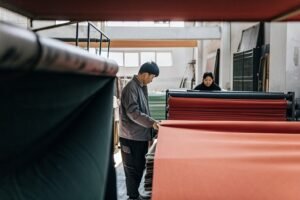
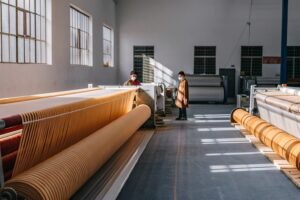
Dedicated Production & Cleaning Protocols: You cannot make OEKO-TEX® Class I fabric on the same machine that just processed a batch of cheap, uncertified polyester without a rigorous intermediate clean. We schedule "baby product runs" in blocks on dedicated lines at our partner dyeing and finishing mills. A documented, signed machine cleaning log is required before and after these runs. This prevents cross-contamination from allergenic dyes, optical brighteners, or softeners used on other product types.

How do you control "non-textile" components like prints and trims?
The garment is a sum of its parts. A perfect fabric can be ruined by a non-compliant print paste or a plastic button. Our control extends here:
- Prints & Embroideries: We mandate that print pastes and embroidery threads come with their own compliance statements. We batch-test prints for phthalates and heavy metals.
- Metal Trims: Any metal component (snap, zipper, button) must be certified nickel-free. We require test reports from the trim supplier.
- Elastics & Threads: Even sewing thread and elastic must be OEKO-TEX® certified or come with a conformity declaration.
We treat these as "critical incoming materials" and audit their suppliers annually. It’s a full-system approach.
What is the role of final washing, and how is it supercharged for Class I?
Washing is where chemical residues are physically removed. For Class I, our washing protocol is intensified:
- Multiple Hot Rinses: We use more rinse cycles at higher temperatures (often above 80°C) to ensure maximum removal of unfixed dyes and chemicals.
- pH Neutralization and Control: The fabric must exit at a skin-neutral pH (4.0-7.5). We monitor this in real-time and adjust with weak organic acids.
- Final Rinse Water Testing: As an inline check, we sometimes test the conductivity of the final rinse water. A high reading indicates residual salts and chemicals, triggering a re-wash.
This process is energy and water-intensive, but it’s non-negotiable. It’s the final, physical guarantee that the theoretical safety of our "Positive List" is realized in the product.
Verification & Traceability: Proving the Prohibition
In the end, trust needs proof. For the brand, the OEKO-TEX® certificate is that proof. But for us, as the manufacturer, our internal verification layers are what ensure we earn that certificate every time.
Our CNAS-Accredited In-House Lab: This is our first line of defense. We perform pre-screening tests that are specifically geared towards Class I pitfalls:
- pH Value: Ensuring perfect skin neutrality.
- Formaldehyde (Water Extraction): Checking for any detectable free formaldehyde.
- Colorfastness to Saliva & Perspiration: Mandatory pre-tests for every baby fabric batch.
- Heavy Metal Screening: Using XRF scanners for rapid screening of lead, cadmium, etc.
These tests give us results in hours, allowing us to correct a batch before it proceeds to costly external certification. Catching a pH issue here saves a 4-week delay from a third-party lab failure.

How does the final OEKO-TEX® certification audit the chemical management system?
When an OEKO-TEX® institute like Hohenstein audits a factory for certification, they don’t just test a fabric sample. They audit the entire chemical management system. They will:
- Review the "Positive List" and check its alignment with the current RSL.
- Audit chemical inventory and storage to ensure only approved chemicals are on-site.
- Examine production records and cleaning logs.
- Interview workers on chemical handling procedures.
This system audit is what makes the certification robust. It’s not a one-time test; it’s a verified operating system. Our integrated network is structured to pass this audit consistently.
What documentation should a brand receive to verify compliance?
You should receive a complete package:
- The OEKO-TEX® Certificate: With the specific certificate number, product description, and valid dates.
- Full Test Report: Showing the numerical results for all parameters.
- Mill Certificates for Yarn: Especially for organic or other certified raw materials.
- Compliance Statements for Trims & Chemicals.
At Fumao, we consolidate this into a Digital Product Passport accessible via QR code on the fabric bale. You can scan and see the entire safety story, from the organic cotton field to the final test report. This level of traceability is the ultimate proof of a clean supply chain.
Conclusion
Understanding what OEKO-TEX® Class I prohibits is the first step. The real work—and the real value of a partner like Fumao—lies in the daily, disciplined execution of eliminating those substances. It’s a culture that prioritizes precaution over cost, transparency over obscurity, and the well-being of the end-user over everything else.
For your brand, sourcing Class I certified textiles is the most concrete action you can take to demonstrate that your commitment to children’s safety is absolute. It moves your brand from marketing language to a scientifically verifiable standard of care.
Don’t just hope your baby clothes are safe. Know they are. Partner with a manufacturer that has engineered the prohibitions out of its process. Let Fumao Clothing be your trusted source for textiles that meet the world’s most stringent safety standards. Contact our Business Director, Elaine, to start your next project on the most secure foundation possible. Email Elaine at: strong>elaine@fumaoclothing.com.