Imagine ordering a classic blue chambray shirt and a vibrant floral print dress. The shirt’s subtle, consistent color feels sturdy and timeless, while the dress bursts with sharp, multi-colored patterns. This fundamental difference in appearance, hand-feel, and performance often boils down to one critical decision made very early in the textile supply chain: yarn-dyed vs. piece-dyed.
For anyone sourcing fabrics—from a startup founder to a seasoned buyer—understanding this distinction is not just academic. It directly impacts your cost, lead time, minimum order quantity (MOQ), color consistency, fabric performance, and the very design possibilities for your collection. Choosing the wrong dyeing method can lead to budget overruns, delayed timelines, or a final product that doesn’t meet quality expectations.
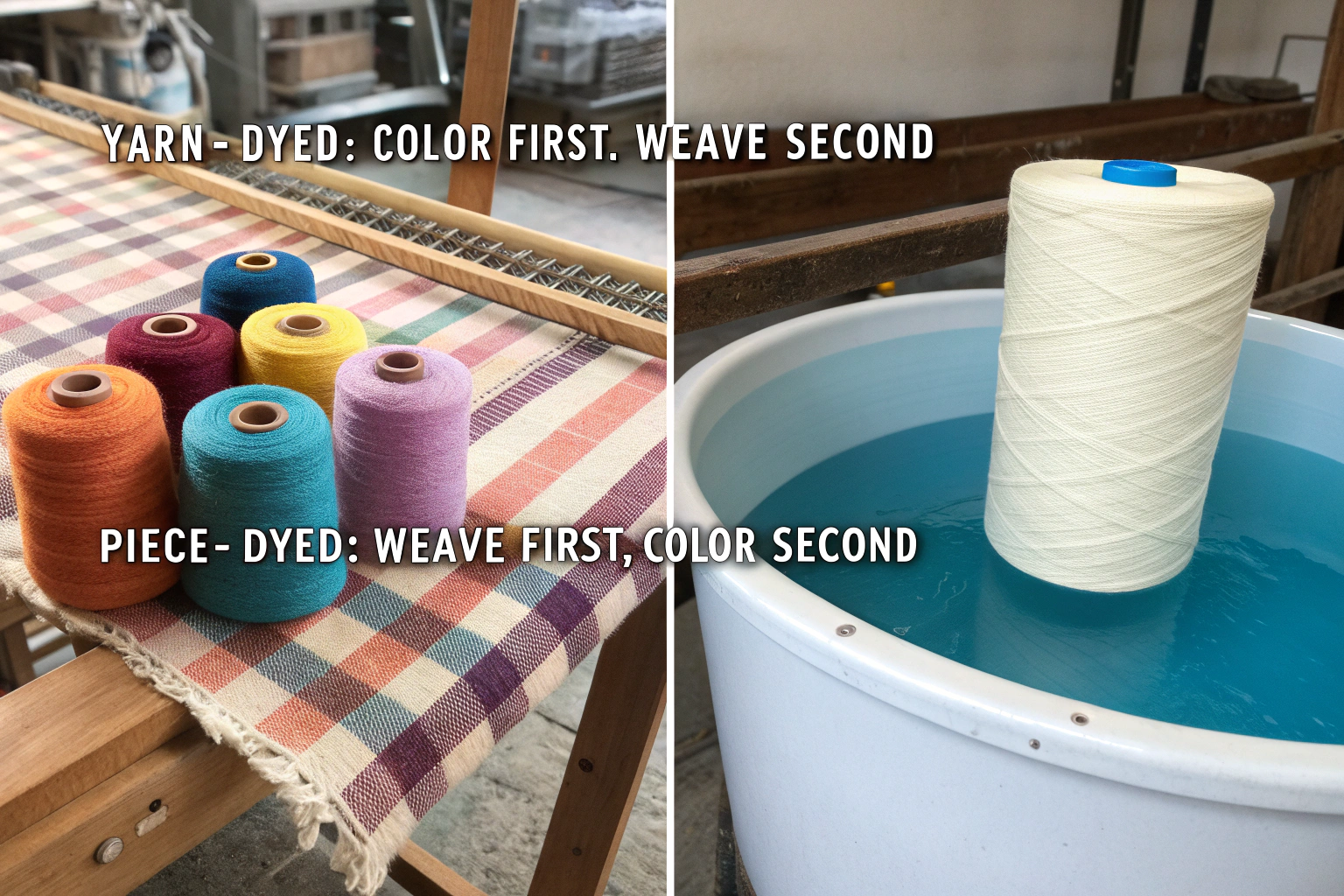
In essence, the core difference is when the dye is applied. Yarn-dyed means the threads (yarns) are dyed before they are woven or knitted into fabric. Piece-dyed means the finished, greige (raw) fabric is dyed after it is constructed. This simple timing shift creates a cascade of technical, aesthetic, and commercial implications that every smart sourcing professional must master to optimize their fabric procurement strategy, especially when working with suppliers in Asia.
What is Yarn-Dyed Fabric and When Should I Use It?
Yarn-dyed fabric is the mark of considered craftsmanship and complex design. In this process, individual yarns—whether the warp (longitudinal) or weft (latitudinal) threads—are dyed to specific colors before the weaving or knitting process begins. This allows for the creation of patterns that are integral to the fabric’s structure, such as stripes, checks, plaids, jacquards, and dobby weaves.
Think of it like a pixelated image: each colored thread is a pixel, and the loom is the printer, placing them precisely to build the final picture. This method is older, more involved, and typically more expensive, but it delivers unique advantages. When you work with a supplier like Shanghai Fumao, our yarn-dyed fabric production leverages this technique for fabrics that demand precision and heritage, like high-end shirting, classic suiting, and durable home textiles.
The key benefits are in the details. Because the color penetrates the core of the yarn, yarn-dyed fabrics exhibit superior colorfastness and resistance to fading. The patterns are clear, sharp, and consistent on both sides of the fabric. There’s also a distinct richness and depth of color, especially in natural fibers like cotton and linen, that piece-dyeing often can’t replicate.

What are the classic examples of yarn-dyed fabrics?
You encounter yarn-dyed fabrics daily in quality garments. Common examples include:
- Shirting Fabrics: Oxford cloth, chambray, gingham, tattersall, and pinpoint oxford. The signature patterns are created by alternating colored yarns.
- Suiting & Tailoring: Many woolens, especially classic stripes, herringbones, and windowpanes.
- Denim: The iconic indigo blue is almost always a yarn-dye, where only the warp yarns are dyed, leaving the weft white, creating the characteristic white undertone when faded.
- Home Textiles: High-quality bed linens with stripes or checks, and durable upholstery fabrics like jacquard damasks.
For a specific case, in early 2023, a Scandinavian menswear brand worked with us to develop a custom yarn-dyed linen-cotton blend for a summer shirt collection. They wanted a unique, small-scale geometric check. By dyeing the yarns in four specific shades before weaving, we achieved a crisp, vintage-inspired pattern with exceptional color saturation that maintained its clarity after repeated washing—a hallmark of a well-executed yarn-dye.
What are the cost and lead time implications?
Yarn-dyeing is inherently more resource-intensive, which translates to higher cost and longer lead times. The process involves multiple steps: sourcing raw yarn, dyeing it in small lots (requiring meticulous color matching for consistency), drying, and then carefully setting up the loom with the precise sequence of colored yarns. This setup is time-consuming and results in higher yarn waste.
Consequently, the Minimum Order Quantity (MOQ) for custom yarn-dyed fabrics is significantly higher, often starting at 1,000 meters per colorway, as the mill must justify the complex setup. The lead time can be 8-12 weeks or more. This method is best reserved for core, repeating patterns in your collection where the investment in quality, uniqueness, and durability pays off over multiple seasons.
What is Piece-Dyed Fabric and What Are Its Advantages?
Piece-dyeing, also known as fabric-dyeing, is the efficient, flexible workhorse of the textile industry. Here, the fabric is first constructed using undyed, greige yarns. The entire bolt of finished cloth is then dyed in a single color by passing it through large dyeing machines or vats. This is the most common method for achieving solid colors.
Imagine a blank canvas being painted one uniform color after it’s stretched. This approach offers tremendous advantages in speed, cost, and adaptability, making it the default choice for vast segments of the apparel market. At Shanghai Fumao, our piece-dyed fabric capabilities allow us to offer rapid turnaround and competitive pricing for a huge range of solid-color basics, from organic cotton jersey for t-shirts to polyester twill for uniforms.
The primary commercial benefit is agility. You can produce a large quantity of neutral greige fabric and then dye it to order based on real-time fashion trends or sales data. This dramatically reduces inventory risk for mills and brands alike. The MOQs are lower, lead times are shorter (typically 3-6 weeks), and the cost per meter is considerably less than yarn-dyed equivalents.

Can piece-dyed fabrics have patterns?
Yes, but the patterns are applied after the fabric is made, through different techniques. This is a crucial distinction from the structural patterns of yarn-dyed fabrics. Common pattern application methods on piece-dyed grounds include:
- Printing: Using screen, digital, or rotary methods to apply colored pigments or dyes onto the surface of the solid fabric.
- Embroidery: Adding decorative thread patterns on top of the base fabric.
- Overdyeing: Taking a pre-existing yarn-dyed or printed fabric and dyeing it again with a solid color to create a unique, tonal effect (e.g., overdyed indigo).
A great example is a popular jersey knit for activewear. The fabric is almost always piece-dyed to a solid black, navy, or grey first. Brand logos or designs are then added via sublimation printing or screen printing. This separation of construction and coloration is key to the fast fashion model’s efficiency.
What are the potential drawbacks to watch for?
While efficient, piece-dyeing has limitations a savvy buyer must manage:
- Color Consistency: Achieving a perfect match between different dye lots (batches) can be challenging. A sky blue from March might differ slightly from one dyed in June. This is why it’s critical to order enough fabric for your entire production run at once and to work with suppliers who have strong quality control labs for lab dip approval.
- Core vs. Surface Color: On thicker fabrics, dye may not fully penetrate to the core, leading to "grinning" (a white core showing through) if the fabric is abraded or stretched. This is less of an issue with modern dyeing machinery but still a consideration for heavy terry cloth or fleece.
- Limited Pattern Complexity: It cannot create woven-in patterns like plaids or jacquards. Those require a yarn-dyed approach.
How Does the Dyeing Method Affect Fabric Quality and Performance?
The point in the process where dye is applied doesn’t just affect looks—it fundamentally influences how the fabric behaves, ages, and feels against the skin. For brands positioning on quality and durability, this is a critical part of the technical specification.
Colorfastness and Durability: Yarn-dyed fabrics generally win here. Since the dye molecules are bound to the individual yarns before the intense friction of weaving, the color is locked in more securely. This results in better resistance to fading from washing and sunlight. A classic yarn-dyed chambray shirt will develop a personal fade pattern over years, while a piece-dyed shirt might show more overall dulling.
Fabric Hand Feel and Structure: The piece-dyeing process involves immersing the entire fabric in liquid, which can sometimes cause shrinkage or alter the "hand" (the tactile quality). Finishes are often applied afterward to restore softness or add performance features like moisture-wicking. Yarn-dyed fabric, having been dyed and set before weaving, often has a more stable, crisp, and defined hand from the start. For instance, the crispness of a yarn-dyed Oxford shirt is a direct result of this process.
Pilling and Abrasion Resistance: This is nuanced. The dyeing process can slightly weaken fibers. In yarn-dyeing, this potential weakening happens at the yarn stage, and the weaving process can then "hide" any minor damage within the fabric structure. In piece-dyeing, the already-woven fabric undergoes chemical and mechanical stress, which can sometimes contribute to a slightly higher propensity for pilling on the surface, especially in knitted fabrics like jersey. However, this is heavily dependent on fiber quality and dyeing techniques.

Which method is more sustainable?
The sustainability comparison is complex and depends on metrics.
- Water and Energy Use: Modern, efficient piece-dyeing facilities can be very optimized. However, yarn-dyeing often requires dyeing smaller batches of yarn, which can be less efficient per kilogram of material dyed if not managed well. The gold standard is working with suppliers who have eco-friendly dyeing certifications (like GOTS, OEKO-TEX STeP) that mandate water treatment and energy recovery, regardless of the method.
- Waste: Yarn-dyeing generates more yarn waste due to loom setup. Piece-dyeing can lead to fabric waste if an entire dye lot is off-color and must be re-done or discarded.
- Longevity: The superior colorfastness and durability of yarn-dyed fabrics can contribute to a longer garment lifespan, which is a major sustainability win.
At our partnered dyeing factories, we prioritize closed-loop water systems and low-impact dyes for both processes, but we are transparent with clients about the trade-offs. For a brand committed to a sustainable textile supply chain, choosing a high-quality, durable yarn-dyed fabric for a staple item might be the more sustainable choice in the long run, despite its higher upfront resource cost.
How do I specify the dyeing method to my supplier?
Clarity is power. Never assume. When requesting a quote or developing a new fabric, include it in your tech pack or brief:
- For a patterned fabric: "We require a yarn-dyed construction for this striped design. Please provide yarn-dyed swatches and MOQ/lead time."
- For a solid color: "We require a piece-dyed solid in the attached Pantone color. Please provide lab dip approval before bulk."
Always ask for the dyeing method to be stated on the invoice and product specification sheet. This is part of your quality control documentation. A reputable supplier like us will automatically provide this information, as it defines the product’s fundamental character.
How Do I Choose the Right Method for My Project?
This is the decisive question. Your choice should be a strategic alignment of design intent, budget, timeline, and volume. Use this as a simple decision framework:
Choose YARN-DYED when:
- Your design involves woven patterns: Stripes, checks, plaids, jacquards, or dobby weaves.
- You prioritize heritage, luxury, or heirloom quality: The fabric is a key feature of the product.
- Color retention is critical: For uniforms, workwear, or items that will be washed frequently.
- You have a stable, core product: You can forecast volume and commit to higher MOQs and longer lead times.
- Budget allows for a higher cost per unit.
Choose PIECE-DYED when:
- You need a solid color fabric.
- Speed and cost-efficiency are paramount: For fast-fashion, trend-driven items, or large-volume basics.
- You need lower MOQs and flexibility: To test the market with a new style or color.
- Your design uses post-construction techniques: Like printing or embroidery on a solid ground.
- You are working with certain fabric structures: Most knits (jersey, rib, interlock) are piece-dyed, as are many pile fabrics like velvet.

Can a fabric be both?
In advanced textile manufacturing, yes, through combination dyeing. A common example is yarn-dyed with piece overdye. A classic fabric like denim is yarn-dyed (indigo warp). Sometimes, after weaving, the entire fabric is given a light "overdye" with a sulfur topcoat to achieve specific vintage or tinted looks (e.g., black-over-blue denim). This combines the structural character of yarn-dyeing with the tonal versatility of piece-dyeing.
What questions should I ask my supplier about dyeing?
To avoid surprises, drill down with these questions:
- "For this striped fabric, is it truly yarn-dyed, or is it a printed simulation?" (Simulated prints are cheaper but lack depth and durability).
- "What is the colorfastness rating (to washing, light, rubbing) for this dyeing method?"
- "What is the MOQ and lead time difference between a yarn-dyed and a piece-dyed version of a similar weight fabric?"
- "Can you provide a lab dip for piece-dye or a strike-off for yarn-dye before bulk production?"
- "Do you use low-impact dyes and have water treatment systems?" (For sustainability).
Conclusion
The choice between yarn-dyed and piece-dyed fabric is one of the most foundational decisions in textile sourcing. It’s the choice between embedded, structural color and efficient, applied color; between investment in timeless quality and agility for the present moment. There is no universally "better" method—only the right method for your specific product, business model, and customer.
Mastering this distinction empowers you to communicate professionally with mills, make cost-effective sourcing decisions, and ultimately deliver products that meet your design and quality benchmarks. It allows you to appreciate why a yarn-dyed Oxford shirt commands a higher price and why a piece-dyed jersey tee is a marvel of scalable efficiency.
At Shanghai Fumao, we guide our clients through these technical choices every day. With our integrated production from yarn to finished fabric, we can provide expert advice and transparent options for both methods. Whether you need the enduring elegance of a custom yarn-dyed jacquard or the rapid, reliable delivery of a piece-dyed performance knit, we have the expertise and supply chain to execute it flawlessly.
Ready to specify your next fabric with confidence? Discuss your project with our team to determine the optimal dyeing method for your needs. Contact our Business Director, Elaine, at elaine@fumaoclothing.com for a consultation. Let’s ensure the color in your vision is built to last.