Let me start with a story that still makes me angry. About two years ago a European client came to us with a problem. They had bought "GRS Certified Recycled Polyester" from a trading company. The price was great. The certificate looked real. They made 10,000 units of activewear. They sold it online with big bold marketing about "Saving the Ocean." Then a consumer watchdog group did an isotope test on the fabric. It came back as Virgin Polyester derived from petroleum not recycled bottles. The brand was publicly shamed fined for greenwashing and had to recall the entire line. They lost over $200,000 and their reputation.
This is the dark side of the sustainability boom. For every legitimate mill like Shanghai Fumao that invests in real GRS certification there are ten brokers who will sell you a fake piece of paper. They know that 99% of buyers will look at the PDF nod their head and never verify it. They count on your trust and your lack of time.
The Global Recycled Standard (GRS) is the most widely recognized certification for recycled content in textiles. But it’s also one of the most Forged . A certificate is just a piece of paper unless you know how to read it and verify it. My goal in this article is to turn you into a forensic auditor. I’m going to show you exactly how we prove our fabric is real and how you can spot the fakes before they cost you your brand.
Verification is not about being difficult. It’s about protecting the integrity of your supply chain. If you claim "Recycled" and you can’t prove it you are committing fraud. The FTC and the EU Commission are cracking down hard. Let’s make sure you’re on the right side of this.
What Information Should a Genuine GRS Certificate Contain
The first line of defense is knowing what a real Scope Certificate (SC) looks like. This is the license that allows a factory to handle and sell GRS certified goods.
A genuine GRS certificate is not a one-page letter. It’s a multi-page document issued by an Accredited Certification Body . Look for logos from Control Union (CU) Ecocert CERES OneCert or SGS . If the logo is blurry or it’s from a company you’ve never heard of be suspicious.
Here are the mandatory data points on a valid SC:
- Certificate Number: A unique alphanumeric code (e.g., CU 123456). This is your key to verification.
- Certified Organization: The Legal Name and Physical Address of the factory. This must match the address on the invoice. If the certificate says "Shanghai Fumao Textile Co. Ltd. / 123 Keqiao Road" but the invoice is from "Best Fabrics Trading Ltd." you have a broken chain of custody.
- Scope of Certification: This is the Most Important Section . It lists the Processing Steps the factory is allowed to do. You need to see words like "Weaving of Recycled Fibers" or "Dyeing of GRS Goods." If it only says "Trading and Storage" this company did not make the fabric. They are a middleman. They may have bought GRS fabric but they cannot manufacture GRS claims.
- Product Categories: This lists the specific materials covered (e.g., "Recycled Polyester Staple Fiber" "Recycled Cotton Yarn").
- Validity Dates: An expiry date. If the certificate is expired it is Invalid .
At Shanghai Fumao we provide our Scope Certificate to every client before they place an order. We don’t hide it behind an NDA. It’s our license to operate and we’re proud of it.

How to Decode the Scope Section of a GRS Certificate
This is where the fraudsters get tripped up. They show you a certificate that says "GRS Certified" at the top and hope you don’t scroll down.
The Scope Section lists specific Processing Categories identified by letter codes. You need to understand what these codes mean.
- A1: Trading of GRS Goods. This means they can buy and sell. They Do Not Manufacture .
- B1: Weaving of GRS Goods. This means they own looms and can weave recycled yarn into fabric.
- C1: Dyeing and Finishing of GRS Goods. This means they can dye recycled fabric without contaminating it.
- D1: Printing of GRS Goods. This means they can print on recycled fabric using approved chemicals.
If a supplier claims "We are a GRS Certified Mill" but their Scope only shows A1 (Trading) they are lying to you. They are a trader. There is nothing wrong with being a trader but you need to know who the actual mill is. If you don’t know the mill you don’t know if the fabric is real.
Here is a quick reference for decoding the scope codes.
| Scope Code | Processing Activity | What It Means for You |
|---|---|---|
| A1 / A2 | Trading / Storage | Middleman. Ask for Mill SC. |
| B1 / B2 | Spinning / Weaving | Yarn or Fabric Producer. Good. |
| C1 / C2 | Dyeing / Finishing | Wet Processing Factory. Good. |
| C3 | Printing | Print on demand. Good. |
| D1 / D2 | Garment Making | Cut and Sew factory. |
Why Does the Expiry Date Matter for Current Shipments
Textile certifications are not lifetime memberships. GRS certificates are issued for One Year . The factory must pass an Annual Audit to renew.
I have seen cases where a factory had a valid certificate in 2022. They let it lapse in 2023 because they didn’t want to pay the audit fee. But they kept using the old certificate PDF to win orders. The fabric they shipped in 2024 was Uncertified .
You must check the "Valid Until" date. If the fabric shipped after that date the certificate is not valid for that shipment.
Also note that the Transaction Certificate (TC) which covers the specific shipment must be issued Within 90 Days of the invoice date. If the TC is dated six months after the fabric arrived it’s likely a backdated forgery.
How to Use the GRS Public Database to Check Suppliers
You don’t have to take the supplier’s word for it. You don’t have to rely on the PDF they sent you. You can verify them Independently in under 60 seconds.
The Textile Exchange (the organization that owns GRS) maintains a Free Public Database of every certified facility in the world.
Here is the exact process I use.
- Go to the Textile Exchange Website and navigate to the "Find Certified Companies" tool.
- Enter the Certificate Number (e.g., CU 123456) from the supplier’s Scope Certificate.
- Click Search.
If the certificate is valid the database will return a result showing the Company Name Address and Scope . Verify that this information Matches Exactly with the PDF they sent you.
If the search returns "No Results Found" you are dealing with a forged certificate. Do not pass go. Do not send money. Walk away.
This is the single most effective fraud prevention tool you have. It takes one minute. I’ve seen brands save tens of thousands of dollars by doing this one simple check. For more information on navigating this tool you can refer to the official Textile Exchange guide on how to verify certification documents using their online database and understanding the difference between Scope and Transaction Certificates.

What Is the Difference Between a Scope and Transaction Certificate
This is the most common point of confusion for new buyers. They are two different documents with two different purposes.
Scope Certificate (SC) = Driver’s License . It proves the factory is qualified to handle GRS goods. It’s valid for one year. It covers the facility .
Transaction Certificate (TC) = Receipt . It proves that a specific shipment of goods is GRS certified. It covers the product .
You Cannot use a Scope Certificate to label your garments as GRS. You need a Transaction Certificate that matches the Invoice Number for that specific batch of fabric.
When we ship GRS fabric to a client we issue a TC that states: "Shanghai Fumao sold 2,500 yards of GRS Certified Recycled Polyester to [Client Name] on Invoice #INV-2024-001." This document travels with the goods. The brand keeps this TC as proof for their own GRS audit.
If a supplier shows you a Scope Certificate and says "This proves it’s recycled" they are either ignorant or lying. You need the TC for the specific order.
How to Spot a Fake Transaction Certificate Number
Fraudsters have gotten sophisticated. They know buyers look for a TC number. So they just Make One Up .
A legitimate GRS Transaction Certificate number follows a strict format defined by the Certification Body. It typically looks like this: CU 123456-2024-001 .
- Prefix: The Certification Body initials (CU ECOCERTO).
- SC Number: The Scope Certificate number of the Seller .
- Year: The year of issuance.
- Sequence: A sequential number.
You can actually Verify a TC just like you verify an SC. The Textile Exchange has a system called the "TC Check" or you can contact the Certification Body directly. They can confirm if a TC with that number was actually issued for that specific shipment.
If a supplier hesitates to provide the TC number or says "We’ll give it to you after you pay" that’s a huge red flag. The TC is part of the shipping documents. It should be provided with the Bill of Lading.
What Lab Tests Confirm Recycled Content in Polyester
Paperwork can be faked. But Chemistry cannot. If you are a large brand or you have been burned before you can send a fabric sample to an independent lab for Forensic Analysis .
There are two main scientific methods to verify recycled polyester content.
The first is Differential Scanning Calorimetry (DSC) . This test measures the Thermal Fingerprint of the polymer. Recycled polyester made from post-consumer bottles has a slightly different crystalline structure than virgin polyester. The melting peak and the crystallization temperature are subtly shifted. A skilled analyst can tell the difference.
The second and more definitive test is Liquid Scintillation Counting (LSC) or Accelerator Mass Spectrometry (AMS) . This test measures the amount of Carbon-14 in the fabric.
Here is the science in simple terms. Fossil Fuels (petroleum) are millions of years old. All the Carbon-14 has decayed away. Virgin Polyester made from petroleum has Zero Carbon-14 .
Plants (like corn or cotton) absorb Carbon-14 from the atmosphere while they are alive. Recycled Polyester made from plastic bottles originally came from petroleum (zero C14). BUT if it is blended with Bio-Based material (like Sorona) it will have detectable C14.
ASTM D6866 is the standard test method for measuring biobased carbon content. If your fabric claims to be "Recycled Polyester" this test can’t directly prove it was a bottle. But it can prove it’s Not Virgin if there is biobased content present.
The most reliable test for recycled content is actually a Chain of Custody Audit combined with a Mass Balance Calculation . This is what the GRS certification itself verifies. The lab test is a backup for when you suspect fraud.

How Does the Mass Balance Approach Verify Recycled Inputs
This is the accounting system behind GRS. It’s how we prove we used X tons of recycled bottles to make Y tons of fabric.
Mass Balance means we track the Weight of certified material as it moves through the factory.
- Input: We purchase 10,000 kg of GRS Certified Recycled Polyester Chips . We receive a TC for this input.
- Process: We melt extrude and spin that chip into yarn. We know that the process has a Waste Factor of 2% (fiber fly lint).
- Output: We produce 9,800 kg of GRS Certified Yarn . We issue a TC for this output.
The numbers must balance. Input (10,000kg) = Output (9,800kg) + Waste (200kg). We are audited on these numbers annually. We have to show the physical inventory of chips and yarn. We have to show the production records.
This is why you can trust a GRS certificate. It’s not just a lab test on a single swatch. It’s a verified accounting of the entire material flow.
What Are the Visual Clues of Genuine Recycled Polyester Fabric
While not a definitive test your eyes can give you hints. Virgin Polyester is perfectly uniform. It’s optically white and has a consistent luster.
Recycled Polyester (post-consumer) often has Imperfections .
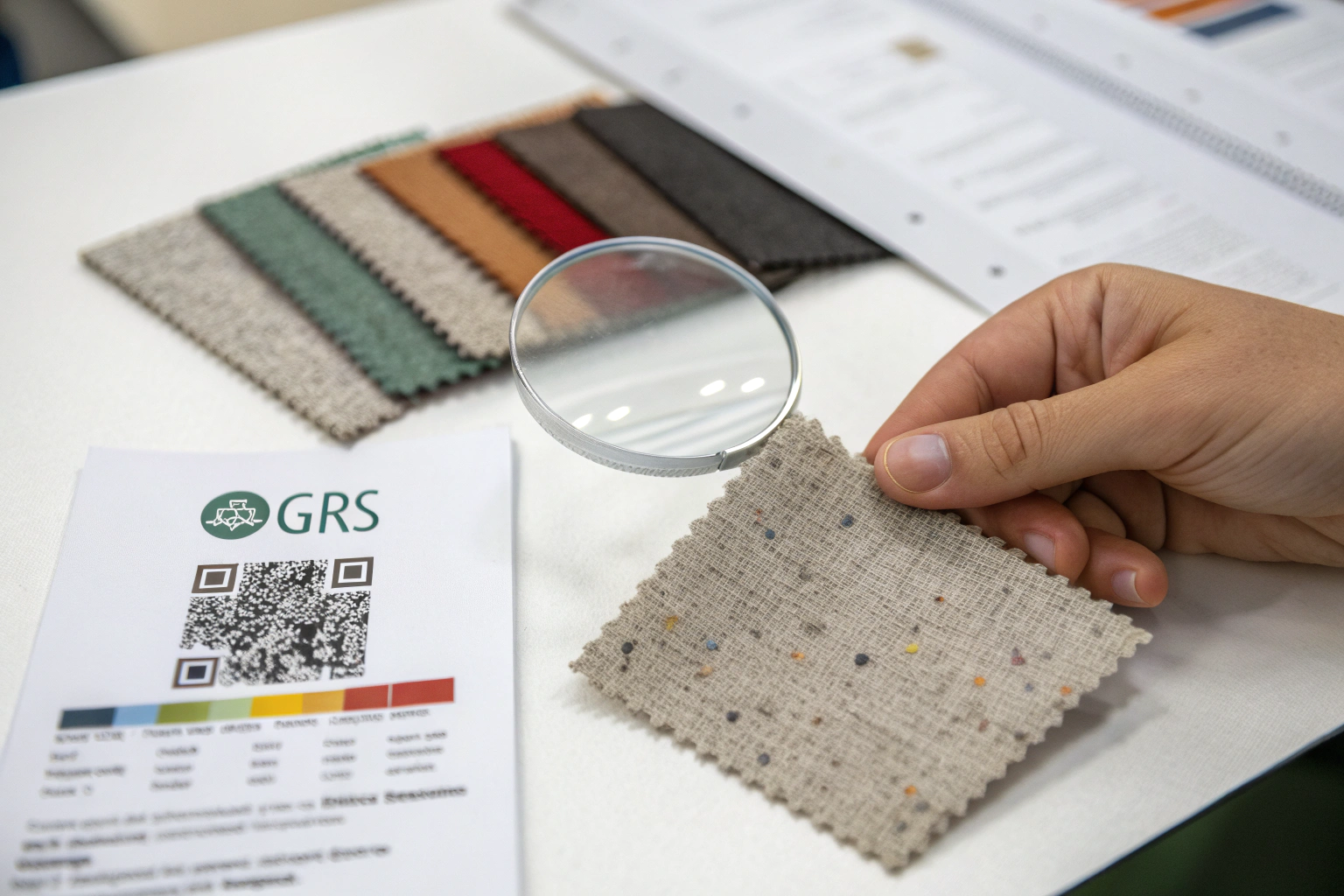
- Color Variation: It’s very hard to get a Pure Optical White from recycled bottles. The base color is often slightly Creamy or Ecru . This is due to trace contaminants in the bottle flake.
- Dark Specks: Sometimes you can see tiny Black Specks in the yarn. These are microscopic bits of label adhesive or cap liner that didn’t wash out of the recycling stream.
- Heathered Appearance: When dyed recycled polyester often has a subtle Mélange or Heathered effect. This is because the dye strikes the fibers slightly unevenly due to variations in polymer viscosity.
If a fabric is "Bright Optical White" and claims to be "100% Post-Consumer Recycled Polyester" I am immediately suspicious. It’s possible with advanced chemical recycling but it’s rare and expensive.
How to Ensure Supply Chain Traceability for GRS Goods
Verifying the certificate is step one. But how do you know the fabric you received is the fabric that was certified ? This is the Traceability Gap . It’s where fraud often happens.
A mill might have a valid GRS certificate. They might buy 5,000 kg of recycled chips. But they also buy 50,000 kg of conventional virgin chips. When the order comes in for "GRS Fabric" they just grab whatever roll is closest. They print a fake TC and ship it. This is called Co-Mingling . It’s strictly forbidden by GRS but it happens.
The solution is Segregation and Labeling .
At Shanghai Fumao we have a Dedicated GRS Storage Area in our warehouse. It’s physically separated from conventional stock by a yellow line on the floor and a locked cage. Only authorized personnel can enter. Every single roll of GRS fabric has a Unique Barcode Label .
That label contains:
- The GRS Logo.
- Our SC Number.
- The Internal Lot Number.
- The TC Number that covers that specific roll.
You can scan that QR code with your phone and it links to a secure portal showing the Chain of Custody for that exact roll. It shows when it was woven when it was dyed and which TC it belongs to. This level of Unit-Level Traceability is the gold standard. It eliminates the risk of co-mingling.

Why Is Segregation of Recycled and Virgin Stock Crucial
Imagine a kitchen. You have a container of salt and a container of sugar. They look identical. If you don’t label them and keep them on opposite sides of the counter you’re going to mix them up.
GRS yarn and conventional yarn look Exactly The Same . They feel the same. They knit the same. The only way to tell them apart is the Paper Trail .
If a factory does not have a strict segregation policy Cross-Contamination is inevitable. A forklift driver is in a hurry. He sees two pallets of white yarn. He grabs the closest one. He doesn’t check the label. Suddenly your "GRS Certified" fabric is 50% virgin.
This is why the annual GRS audit includes a Physical Walkthrough of the warehouse. The auditor checks the barriers the signage and the inventory records. They want to see that segregation is real not just a policy on paper.
What Role Do QR Codes Play in Modern Fabric Tracking
We’ve moved beyond paper hang tags. Paper gets lost. Paper gets swapped.
QR Code Technology is revolutionizing supply chain transparency. At our mill every roll gets a unique digital identity. We scan the roll at every stage:
- Greige Inspection: Scan confirms yardage and weight.
- Dyeing Entry: Scan logs which dye machine it went into.
- Finishing: Scan logs the heat setting parameters.
- Final Inspection: Scan attaches the AQL report and the TC number.
When you receive the fabric you scan the roll. You see that entire history. You see the lab test results. You see the GRS certificate.
This is the future of fabric sourcing. It’s not just about recycled content. It’s about Verifiable Data . For more information on this technology you can explore the implementation of blockchain and QR code traceability systems in the textile and apparel supply chain to combat counterfeiting and ensure ethical sourcing. It’s becoming the industry standard for premium responsible production.
What Are the Consequences of Using Fake GRS Fabric
I don’t want to end this article on a negative note but you need to understand the stakes. This is not a game.
If you sell a product labeled "Made with Recycled Polyester" or bearing the GRS logo and you cannot prove it you are violating Consumer Protection Laws .
In the United States the Federal Trade Commission (FTC) enforces the Green Guides . They can issue fines of up to $50,120 Per Violation . And each garment sold is considered a separate violation. You do the math on a 5,000-unit run. It’s bankruptcy territory.
In the European Union the Empowering Consumers for the Green Transition Directive is even stricter. It bans generic environmental claims like "Eco-Friendly" or "Green" without specific verifiable evidence. You must provide the GRS certificate or equivalent. Failure to do so can result in fines of 4% of Annual Turnover .
Beyond the legal fines there is the Reputational Damage . A class-action lawsuit for "Greenwashing" will be picked up by every fashion watchdog blog and sustainability influencer. Your brand will be defined by the scandal. Consumers are unforgiving on this issue.
This is why verification is so important. It’s not just about doing the right thing for the planet. It’s about protecting your business.

How to Protect Your Brand from GRS Certificate Fraud
There is a simple step-by-step protocol I teach all my clients.
- Verify the Supplier’s SC Online: Use the Textile Exchange Database. Before you pay a deposit.
- Check the Scope Codes: Ensure they are certified for Manufacturing (B1/C1) not just Trading (A1).
- Demand a TC for the Sample Yardage: Even for 5 yards of sampling ask for a Sample TC . If they can’t produce one for a sample they can’t produce one for bulk.
- Audit the Paper Trail: Match the TC number to the Invoice number. Match the dates.
- Conduct a Visual Inspection: Look for the slightly creamy base color and any dark specks characteristic of recycled poly.
- Random Lab Testing (Optional): For high-value orders send a cutting to SGS or Intertek for DSC Analysis .
By following these steps you create a Verifiable Chain of Custody . You can sleep at night knowing your marketing claims are backed by evidence.
What Is the Future of Digital Product Passports for Textiles
The industry is moving toward a solution that will make this entire article obsolete. It’s called the Digital Product Passport (DPP) .
By 2030 the EU will require almost all textile products sold in the region to have a DPP. This is a digital record accessible via a QR code or NFC tag that contains:
- Material composition (verified).
- Recycled content (verified).
- Country of origin.
- Manufacturing facility details.
- Repair and recycling instructions.
The data in the DPP is backed by Blockchain Verification . It cannot be altered or faked. This will fundamentally change how we verify fabric authenticity. It will move us from a system of "Trust Me" PDFs to a system of "Verify Instantly" Digital Tokens.
At Shanghai Fumao we are already piloting DPP technology with our forward-thinking brand partners. We believe transparency is the only sustainable business model.
Conclusion
Verifying the authenticity of GRS recycled fabric requires moving from passive acceptance to active verification. You cannot rely on a PDF alone. You must use the free public database to check the supplier’s Scope Certificate. You must understand the difference between a license to operate (SC) and a receipt for goods (TC). And you must demand transparency in the form of batch-level traceability and QR code tracking.
The consequences of getting this wrong are severe ranging from FTC fines to irreparable brand damage. But the tools to get it right are available to everyone. It takes a little time and a little diligence. It’s the price of admission for operating a responsible and legally compliant brand in the modern textile industry.
At Shanghai Fumao we don’t just sell GRS fabric. We provide the documentation the digital tools and the supply chain transparency to back it up. We believe that sustainability claims are only as strong as the evidence behind them. We’re committed to making that evidence clear accessible and verifiable.
If you’re sourcing recycled fabrics and you want a partner who takes certification compliance as seriously as you do please reach out to our Business Director Elaine. She can walk you through our verification portal show you a sample TC and explain our segregation protocols in detail. Let’s build a transparent supply chain together.
Contact Elaine at: elaine@fumaoclothing.com