
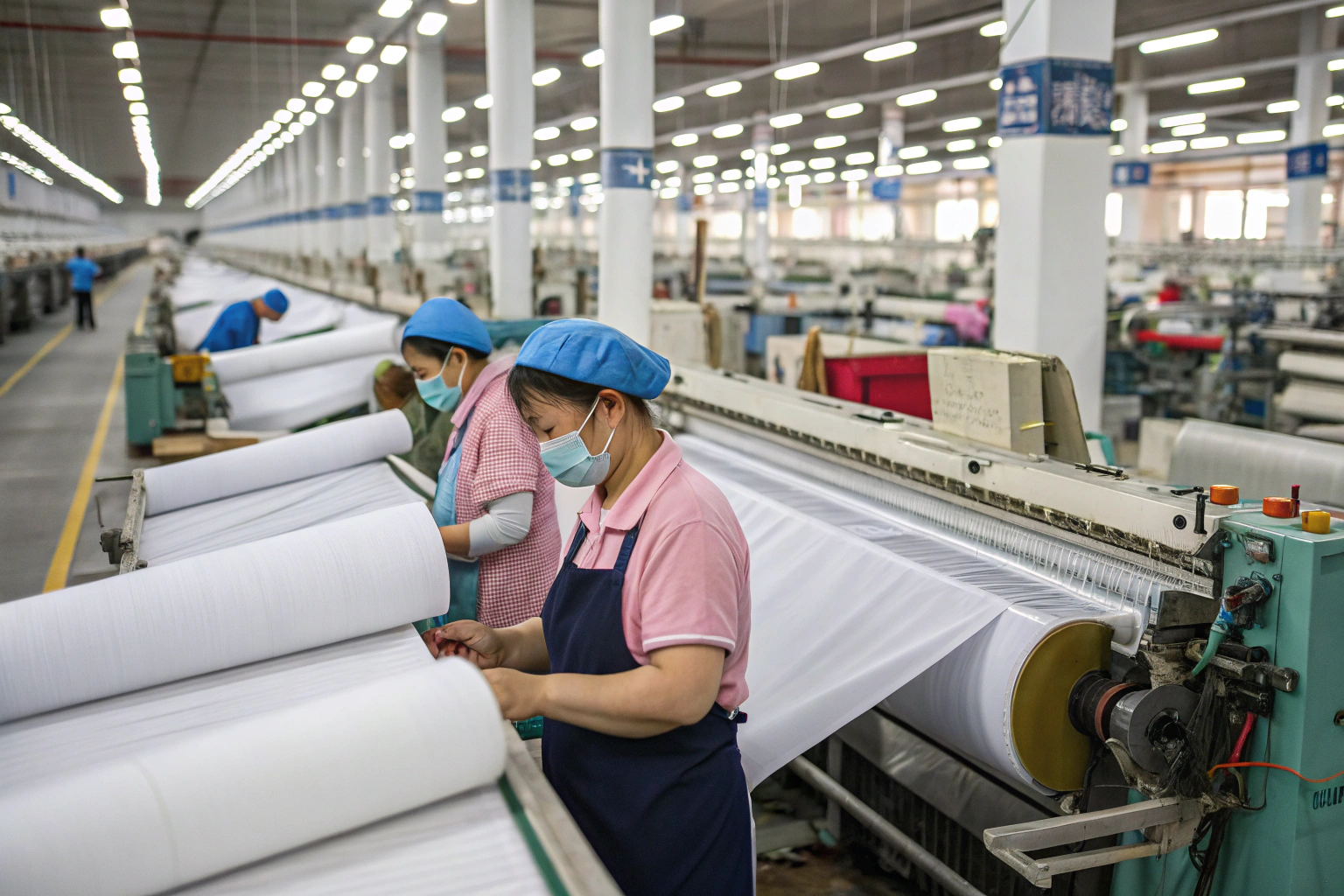
In February 2026, a client called me in a panic because another supplier had quoted them a four-week lead time on custom-dyed anti-static lining, and they were now in week seven with no fabric and no update. The supplier had gone quiet. The production manager was "on holiday." The dye house had "equipment issues." The timeline that looked aggressive but doable in the quote had turned into a fantasy, and the client’s suiting collection launch was now three weeks behind schedule. I hear versions of this story almost every month. The gap between quoted lead times and actual lead times in the Chinese textile industry has widened in 2026, and the buyers who get burned are the ones who plan against the quote instead of planning against reality.
The reality of lead times from Chinese fabric factories in late 2026 is this: standard stock fabric can ship in 5 to 10 days if inventory is available. Repeat orders of standard construction with stock yarn can ship in 3 to 5 weeks. Custom-dyed or custom-finished fabric on a new development order takes 5 to 8 weeks. And a fully customized fabric involving new yarn sourcing, custom color matching, and functional finishing can take 8 to 12 weeks from order confirmation to container loading. These are the achievable, real-world timelines for a well-organized factory with integrated production control. Add 2 to 3 weeks to each of these figures if you’re working with a trading company that doesn’t control the production assets directly, because every handoff between the weaver, the dyer, and the finisher introduces communication delay and scheduling friction.
The lead time pressure in late 2026 is being driven by several converging factors. The Chinese textile industry has consolidated significantly, with smaller, less efficient mills closing and larger mills running at high utilization. The available capacity is tighter, and the scheduling windows are narrower. Environmental compliance inspections have intensified, which can temporarily shut down dyeing and finishing operations with little notice. And the global logistics volatility we discussed in the freight article means the shipping window is less predictable, which adds buffer to the total door-to-door timeline. Understanding these structural factors is the difference between planning a production calendar that works and one that falls apart on the first delay.
How Long Does Custom-Dyed Anti-Static Lining Actually Take in Q4 2026?
Custom-dyed anti-static lining involves three sequential production stages, each with its own timeline and its own bottlenecks. The greige weaving stage takes the conductive yarn and the polyester filament and weaves them into the base fabric. This stage, for a standard construction that the mill has woven before, takes 10 to 15 days from yarn allocation to finished greige roll. The dyeing stage takes the greige fabric, scours it, dyes it to the custom color, and heat-sets it. This stage takes 7 to 10 days for the dyeing process itself, plus 2 to 3 days for the lab dip approval cycle. The finishing stage applies any functional finishes—softener, anti-static coating if applicable, dimensional stabilization—and takes 3 to 5 days. The total production time, from yarn to finished fabric, is 22 to 33 days. But the total lead time is longer because of scheduling gaps between stages.
Each production stage has a queue. The greige weaving queue might be 3 to 5 days before your order gets loom allocation. The dyeing queue depends on whether the dye house is running your color family that week—if your custom navy can be batched with other navy orders, the queue is short; if it requires a dedicated bath setup, the queue is longer. The finishing queue is usually the shortest, but it’s also the stage most vulnerable to environmental inspection shutdowns. The cumulative queue time across three stages in a busy Q4—October through December, the peak export season—typically adds 7 to 14 days to the pure production time. The realistic total lead time for custom-dyed anti-static lining in Q4 2026, from order confirmation to ex-factory, is 5 to 7 weeks for a factory that controls all three stages under one roof or in a tightly integrated network. For a trading company coordinating three independent factories, add 2 to 3 weeks for the coordination overhead.
The factory that controls the weaving, dyeing, and finishing under one production planning system beats the trading company by three weeks on the same fabric.
At Shanghai Fumao, our integration advantage is the tight coupling between our in-house weaving, our long-term cooperative dyeing partners, and our finishing lines. The production schedule is managed as a single project plan with dependencies, not as three independent orders with three independent timelines. The handoff between greige weaving and dyeing is scheduled before the greige is even finished, so the fabric moves directly from the loom to the dye bath without sitting in a warehouse queue. This integration shaves about 10 days off the typical trading company timeline, and it’s why our Q4 delivery commitments are consistently shorter than the industry average. (Let me insert the editor’s note here: we really do track this metric. Our average Q4 custom-dyed lead time in 2025 was 34 days from order confirmation to ex-factory, versus an industry average of 48 days for comparable product.)

What Is the Lab Dip Bottleneck and How Can You Avoid It Adding Weeks?
The lab dip is the color approval process, and it’s the single most common cause of lead time delays on custom-dyed fabric. The dyer produces a small sample of the fabric dyed to the requested color, the client reviews it against their standard, and the cycle repeats until the color matches. Each lab dip cycle takes 3 to 5 days: one day to prepare the dye formulation, one day to dye the sample, one day for finishing and quality check, and one to two days for shipping and client review. If the first lab dip doesn’t match—and it often doesn’t, especially on difficult colors like navies, blacks, and brights—a second or third cycle adds 3 to 5 days each. A three-round lab dip process adds two to three weeks to the project timeline before bulk production even starts.
The lab dip bottleneck can be compressed with three strategies. First, provide a physical color standard at the time of order, not a Pantone reference or a digital photo. A physical swatch lets the dyer match under their own controlled lighting and eliminates the "it looked different on my screen" problem. Second, use a spectrophotometer reading of your standard to provide the dyer with the spectral reflectance data—the Lab* coordinates—which gives them a numerical target to hit on the first formulation attempt. The combination of a physical standard plus a spectrophotometer reading dramatically improves first-pass success rates. Third, accept a commercial tolerance on the lab dip. Insisting on a perfect match that is visually indistinguishable under three different light sources adds cycles. A commercial match—Delta E below 1.0, visually acceptable under D65 and TL84 lighting—is achievable in one or two cycles for most colors. For detailed technical guidance on specifying color tolerances and communicating color standards to dye houses, textile color management forums and color science resource sites provide practical protocols that bridge the gap between designer expectations and dyer capabilities.
Why Does Environmental Compliance Enforcement Disrupt Dyeing Schedules in Late 2026?
China’s environmental enforcement on textile dyeing and finishing operations has been tightening for a decade, and the trend has accelerated in 2025-2026. Dye houses use large volumes of water and chemicals, and their wastewater discharge permits require continuous monitoring and periodic inspection. When an inspection finds a violation—effluent parameters out of spec, unpermitted discharge, improper chemical storage—the authorities can suspend operations until the violation is remedied. The suspension affects all orders in the dye house queue, not just the orders from the specific production run that triggered the inspection.
The suspensions are unpredictable in timing and duration. They can last from a few days to several weeks depending on the severity of the violation and the speed of remediation. The impact on lead times is not just the suspension duration itself, but also the queue of backed-up orders that the dye house must process when they resume operations. A one-week suspension can add two to three weeks to the effective lead time because of the backlog. The risk is higher in Q4 2026 because the government has announced an intensified enforcement campaign targeting the textile sector in Zhejiang and Jiangsu provinces, where the majority of China’s fabric dyeing capacity is concentrated. The mitigation strategies for buyers are to work with dye houses that have strong compliance records and integrated wastewater treatment systems, to build an extra two-week buffer into timelines for orders placed during Q4, and to work with suppliers who can switch dye house allocation if their primary dye house is suspended.
What Is the Real Gap Between Trading Company and Factory-Direct Timelines?
The trading company model adds layers to the supply chain that cost both money and time. A trading company receives your order, sends it to a weaving factory they work with but don’t own, receives the greige fabric, sends it to a dyeing factory, receives the dyed fabric, sends it to a finishing factory, receives the finished fabric, and then coordinates inspection and shipping. Each handoff introduces communication delay, transportation time between factories, and scheduling misalignment. The pure production time might be the same as a factory-direct order, but the coordination overhead adds 2 to 4 weeks to the total timeline.
The factory-direct model, where the supplier owns or tightly controls the weaving, dyeing, and finishing assets, eliminates the handoff delays. The production planning is integrated. The greige fabric doesn’t need to be transported to a different facility—it moves internally. The schedule for the dye house is coordinated with the schedule for the looms, so there’s no gap between greige completion and dyeing start. The quality control is a single unified process rather than a series of inspections at each handoff. The result is a lead time that’s 20% to 40% shorter than the trading company model for the same product specification. At Shanghai Fumao, our in-house weaving capacity combined with our long-term exclusive dyeing and finishing partnerships gives us the integration advantage of the factory-direct model without owning every asset. We schedule across the three stages as if they were one factory, and our lead times reflect that integration.
A trading company adds a week of communication delay for every handoff. With three handoffs, that’s three weeks of time that a factory-direct supplier doesn’t lose.
The challenge for buyers is distinguishing a genuine factory-direct supplier from a trading company that claims to be a factory. The verification methods we discussed in the supplier audit article apply here. Ask for the factory address and the production floor photos with the current date. Request a live video walk-through of the weaving floor. Ask where the dyeing is done and request the dye house’s environmental permit number. A genuine factory-direct supplier can answer these questions instantly and provide evidence. A trading company will hedge, delay, or provide vague answers. The verification effort upfront pays back in weeks of saved lead time on every order. For more detailed guidance on verifying supplier claims and distinguishing factory-direct from trading company operations, textile sourcing communities on platforms like Reddit’s supply chain forums have practical checklists and shared experiences from buyers who have conducted supplier audits in China.

How Do Integrated Supply Chains in Keqiao Reduce Handoff Delays Between Processes?
Keqiao, where we’re headquartered, is the densest textile manufacturing cluster in the world. Within a 20-kilometer radius, you can find yarn suppliers, weaving mills, dye houses, printing factories, coating facilities, and finishing operations—often literally across the street from each other. The geographic density creates a supply chain where a roll of greige fabric can move from the loom to the dye house in an hour on a flatbed tricycle, not in a day on a truck crossing provincial boundaries.
The Keqiao advantage is the compression of transportation time and the cultural integration of production planning. The mill managers know each other. The dye house scheduler and the weaving factory scheduler speak the same local dialect and often have worked together for decades. The scheduling isn’t an arms-length transaction conducted through a trading company intermediary; it’s a direct conversation between people who understand each other’s production constraints. When we schedule a custom-dyed order at Shanghai Fumao, the dye house allocation is confirmed before the greige weaving starts. The greige fabric doesn’t go into a queue; it goes directly to the dye house that has reserved capacity for it. The physical proximity enables this integration, and the integration compresses the schedule. A Keqiao-based integrated supply chain can deliver custom-dyed fabric in 4 to 5 weeks that a geographically dispersed supply chain coordinated by a trading company in a distant city would take 7 to 9 weeks to deliver. The location advantage is real and measurable, and it’s one of the reasons we’ve stayed rooted in Keqiao for 20 years.
Why Do Some Suppliers Quote 3 Weeks When the Real Timeline Is 6?
The optimistic quote is the bane of the fabric sourcing industry. The supplier knows the real timeline is 6 weeks. The buyer wants to hear 3 weeks. The supplier, afraid of losing the order to a competitor who might quote 3 weeks, quotes 3 weeks. The order is placed, and the "unexpected delays" begin. It’s a pattern that damages trust and disrupts production schedules, and it persists because the incentives are misaligned at the quoting stage. The supplier’s incentive is to win the order. The truthful timeline penalty—losing the order to an optimistic competitor—is immediate and concrete. The timeline overrun penalty—an angry client in 6 weeks—is distant and can be managed with excuses.
The solution for buyers is to demand a timeline breakdown, not a single number. A supplier who says "5 to 6 weeks" and can break that down into greige weaving (10-14 days), dyeing and finishing (14-18 days), and quality control and packing (5-7 days) is likely being honest about the total. A supplier who says "3 weeks" and can’t or won’t provide a stage-by-stage breakdown is probably quoting the timeline they think you want to hear. The breakdown also gives you a project management tool to track progress against the plan. If the greige weaving was supposed to take 12 days and it’s day 16 with no greige sample, you know the schedule is slipping before the dye house even starts. The breakdown forces transparency and creates accountability at each stage. At Shanghai Fumao, our standard quotation includes a milestone schedule with target dates for each production stage, and we update the client at each milestone completion. This transparency has eliminated the "unexpected delay" conversation from our client relationships.
What Strategies Can Brands Use to Compress Fabric Lead Times Legitimately?
Lead time compression that doesn’t compromise quality or ethical standards is a combination of preparation, relationship, and process design. The strategies that work are not shortcuts—they’re ways of removing the slack from the system without cutting corners. The most effective compression strategies address the pre-production phase, because that’s where the most compressible time resides.
Strategy one is to place orders early and schedule later. The fabric order can be confirmed and the production slot reserved before the color and finish details are finalized. This separates the production queue time from the specification decision time. The greige weaving can start while the lab dip is still in process, provided the yarn and construction are locked. The dyeing allocation can be reserved pending the color approval. The total timeline compresses by running the specification process in parallel with the early production stages rather than sequentially. Strategy two is to use stock greige fabric rather than weaving from scratch for each order. If the supplier maintains an inventory of popular greige constructions—the 50D polyester taffeta base, the 75D recycled polyester base—in their standard widths, the custom-dyed order skips the weaving stage entirely and starts at dyeing. The lead time drops from 5-7 weeks to 2-3 weeks for the same custom color. The greige inventory carries a carrying cost for the supplier, but the time savings for the buyer are dramatic.
The fastest way to compress lead time is to separate what you’re waiting for from what you’re deciding. Start production on the locked parts while you finalize the variable parts.
Strategy three is to build a rolling forecast with the supplier. Instead of placing discrete orders with no visibility into future demand, share a quarterly forecast of expected volume by fabric type. The supplier can pre-position yarn inventory, reserve loom capacity, and schedule dye house allocation against the forecast. When the actual order is released, the pre-positioned resources compress the timeline. The forecast doesn’t need to be a binding commitment—a non-binding projection with a reasonable accuracy tolerance gives the supplier enough confidence to invest in inventory and capacity without excessive risk. For more strategies on collaborative production planning and rolling forecast implementation with Chinese textile suppliers, supply chain management resources and lean manufacturing forums offer practical templates and case studies.

How Can Stock Greige Inventory Programs Slash Custom Dye Orders to 15 Days?
A stock greige program means the supplier maintains an inventory of undyed, unfinished base fabric in the most commonly ordered constructions. When a custom dye order comes in, the supplier pulls the greige fabric from inventory and sends it directly to the dye house, bypassing the weaving stage entirely. The total lead time becomes dyeing plus finishing plus quality control, which for a standard anti-static lining construction can be as short as 12 to 15 working days from color approval to ex-factory.
The program works for fabrics where the base construction is standardized and the customization is in the color and finish. The supplier needs to forecast which constructions will be in demand and stock greige accordingly, which requires a close partnership with buyers who share their forward demand visibility. The buyer benefits from dramatically shorter lead times on reorders and from the ability to test new colors without committing to a full weaving minimum. The supplier benefits from higher inventory turns and a competitive differentiation based on speed. At Shanghai Fumao, we maintain stock greige inventory of our top 20 anti-static lining and suiting constructions, which together represent about 80% of our custom color orders. For these constructions, our custom-dyed lead time is 15 to 18 working days after lab dip approval. The program is the single biggest lead time advantage we offer, and it’s the reason several of our European suit brand clients have shifted their sampling and small-batch production to us from suppliers who can’t match the greige availability.
What Role Does Pre-Production Planning with Your Supplier Play in Hitting Tight Deadlines?
Pre-production planning is the collaborative process that happens after the order is confirmed but before production begins, and its quality determines whether the production schedule is realistic or fictional. A proper pre-production meeting or video call covers the material availability, the production capacity allocation, the milestone schedule, the quality control checkpoints, and the contingency plans for the most likely failure modes—the lab dip doesn’t match, the dye lot fails, the finishing line goes down.
The meeting produces a documented production plan that both parties agree to and can track against. The plan identifies the critical path—the sequence of dependent tasks that determines the total timeline—and the float on the non-critical tasks. The plan also identifies the decision deadlines for the buyer: when the lab dip must be approved, when the bulk sample must be signed off, when the inspection must be scheduled. The buyer’s failure to meet these internal deadlines is a common cause of timeline slippage that gets blamed on the supplier. The pre-production plan makes the buyer’s responsibilities explicit and the consequences of delay transparent. At Shanghai Fumao, we conduct a pre-production planning session for every custom order above $10,000, with a shared digital project plan that both the client and our production team can access. The planning session takes 30 minutes. The schedule certainty it produces saves days of back-and-forth and weeks of avoidable delays.
Conclusion
The lead time reality from Chinese fabric factories in late 2026 is shaped by structural factors that buyers need to understand and plan around rather than fight against. The consolidation of the textile industry into larger, better-utilized mills has tightened capacity and lengthened queues. Environmental compliance enforcement has introduced an unpredictable disruption variable into dyeing and finishing schedules. The gap between trading company quotes and factory-direct timelines has widened as coordination overhead in a capacity-constrained market has grown. And the persistent gap between optimistic quotes and real timelines continues to catch buyers who don’t demand stage-by-stage breakdowns.
The achievable timelines for well-managed production are clear. Stock fabric ships in 5 to 10 days. Repeat orders on stock greige with custom dyeing ship in 3 to 5 weeks. New development orders with custom everything take 5 to 8 weeks, and fully customized orders with new yarn sourcing push to 8 to 12 weeks. The Q4 peak season adds 1 to 2 weeks of queue time across all categories. These are the numbers to plan against, with an additional buffer for the unpredictable—the environmental inspection, the lab dip that needs a third round, the container that gets rolled to the next vessel.
The strategies for legitimate lead time compression are not secrets—they’re disciplines. Separate specification decisions from production starts so they run in parallel. Use stock greige programs to skip the weaving queue on custom color orders. Build rolling forecasts that let the supplier pre-position yarn and reserve capacity. Invest in pre-production planning that identifies the critical path and the decision deadlines. And verify that your supplier is a factory-direct operation or a tightly integrated network, not a trading company adding weeks of handoff delay.
At Shanghai Fumao, our integration—in-house weaving, long-term exclusive dyeing and finishing partnerships, and location in the Keqiao textile cluster—gives us the lead time advantages of the factory-direct model with the product range of a major supplier. Our stock greige program covers our most popular constructions for anti-static lining and suiting fabrics. Our milestone-based production tracking gives clients real-time visibility into where their order is in the pipeline. And our pre-production planning process ensures that when we commit to a delivery date, the date is based on a real schedule, not a sales wish.
If you’re planning your production calendar for the remainder of 2026 and 2027, and you need reliable lead time commitments backed by transparent milestone tracking, reach out to our Business Director, Elaine, at elaine@fumaoclothing.com. She can provide current lead time estimates for your specific fabric specifications, discuss our stock greige program availability, and coordinate a pre-production planning session that maps your order to a realistic timeline you can count on.








