I’ve been shipping fabric from Keqiao to North America for over twenty years. And I’ve watched the Incoterms pendulum swing back and forth. For a long time it was all FOB (Free on Board). The buyer controlled the freight. They had their own forwarder. They thought they were saving money. But in the last three years I’ve seen a seismic shift. Almost every new distributor and large brand we sign now requests one thing upfront: DDP (Delivered Duty Paid) .
The reason is simple math and less headache. The chaos at the ports during the pandemic broke the old model. Importers watched their containers sit on the water for weeks accruing Demurrage and Detention charges that they had no control over. They got surprise bills from customs brokers for Section 301 Tariffs that wiped out their margin. They realized that "saving" 5% on freight by managing it themselves was a false economy when the hidden costs and the time suck of logistics management were factored in.
DDP changes the game. It shifts the risk and the responsibility from the buyer to the seller. That’s us. At Shanghai Fumao we now offer DDP as our standard recommendation for North American clients. Not because it’s easier for us it’s actually more work for us. But because it’s Better for the Client Relationship . When we control the logistics from our dock to their warehouse we eliminate the finger-pointing. If there’s a delay there’s only one neck to choke and it’s mine. I’m okay with that because I have the team and the systems to manage it.
In this article I want to explain exactly why this shift is happening what the real cost comparison looks like and how you can navigate a DDP agreement to make sure you’re actually getting a fair deal and not just a padded freight quote. Let’s break down the new reality of importing fabric.
What Does DDP Shipping Actually Mean for Fabric Importers
Let’s get the definition crystal clear because Incoterms are confusing and using the wrong one can cost you a fortune.
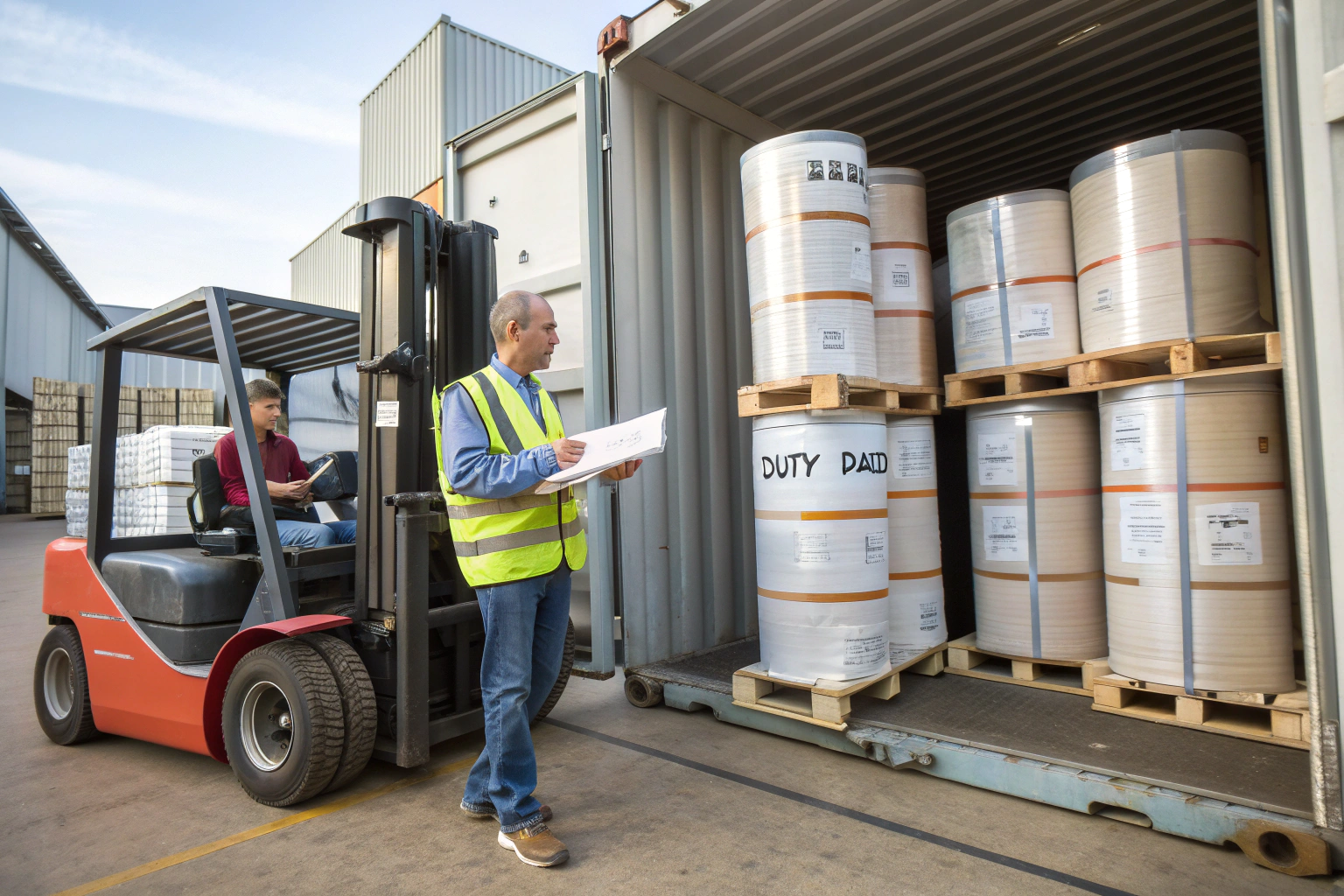
DDP (Delivered Duty Paid) means the Seller (Shanghai Fumao) is responsible for Everything . We arrange the truck from our factory. We book the ocean freight or air freight. We handle Export Clearance in China. We handle Import Clearance in the US or Canada. We pay the Duties . We pay the Taxes . We pay the Trucking from the port to your warehouse door. All you do is open the door and sign for the delivery.
This is the opposite of FOB (Free on Board) where your responsibility starts the moment the container hits the water.
For a fabric importer DDP turns an international supply chain into a domestic purchase order. You know the Landed Cost of that roll of fabric to the penny before it ships. There are no surprises. No call from the port saying "We need a $1,500 Customs Exam fee to release your container." That call comes to me and I deal with it.
This is particularly valuable for distributors who are quoting prices to their own retail customers. They need Price Stability . They can’t go back to a boutique owner three months after the order and say "Sorry the tariff rate changed I need another $2 per yard." DDP allows them to lock in their margin.

How Does DDP Differ from DAP and CIF in Practical Terms
These three terms get mixed up all the time. Here is the real-world difference based on a shipment to Los Angeles.
CIF (Cost Insurance Freight) : We pay to get the container to the Port of LA . The moment it’s unloaded from the ship it’s your problem. You pay for port handling you hire the broker you pay the duty. This is the old-school model. It creates a gap in responsibility right at the most congested point in the supply chain.
DAP (Delivered at Place) : We pay to get the container to your Warehouse Door . But You Pay the Duty and Taxes . The truck shows up but the driver won’t unload until you provide a Duty Payment Receipt . This often causes delays because the broker hasn’t cleared the entry yet.
DDP (Delivered Duty Paid) : We pay to get it to your door Including Duty . The truck shows up you sign the Proof of Delivery and you’re done.
For North American distributors the "Duty Paid" part is the magic. US Customs and Border Protection (CBP) requires the Importer of Record to have a Continuous Bond . If you don’t import regularly you don’t have a bond. Getting a bond takes time and costs money. Under DDP we act as the Importer of Record using our own bond. You don’t need one. This opens up importing to smaller brands and distributors who previously found it too complex.
At Shanghai Fumao we have a dedicated customs compliance team and a continuous bond with CBP. We clear dozens of containers a month. We know the HTS codes for every type of fabric we sell. This volume gives us efficiency that a small importer just can’t match.
Why Is the Importer of Record Responsibility So Critical
This is the legal heart of the matter. The Importer of Record (IOR) is the entity legally responsible to the US Government for the accuracy of the entry documents and the payment of duties.
If the HTS code is wrong the IOR gets the penalty. If the fabric is detained for forced labor concerns the IOR gets the notice of seizure.
Many small distributors don’t want this legal exposure. They want to buy and sell fabric not become customs law experts. By using DDP they transfer this legal liability to us.
We are comfortable with this liability because we know our product intimately. We know the exact fiber composition. We have the mill certificates. We can defend the classification. This is a value-added service that goes far beyond just paying for the freight.
How Does DDP Reduce Hidden Costs in the Supply Chain
The price you see on an FOB quote is a lie. It’s not the price you pay to get the fabric on your cutting table. The real cost includes a dozen accessorial charges that you only find out about when the container is already held hostage at the port.
Here are the "Hidden Costs" that DDP eliminates from your life:
- Terminal Handling Charges (THC) : The port fee for moving the container off the ship. $150 – $300.
- Chassis Fee : The fee for renting the wheels that the container sits on. $25 – $50 per day.
- Demurrage : The penalty for leaving the container at the port past the "free days." This can be $200 – $500 per day after day 4.
- Detention : The penalty for keeping the container chassis at your warehouse too long. $150 – $300 per day.
- Customs Exam Fee : If CBP pulls your container for an X-ray or intensive exam you pay for the drayage to the exam site and the labor to unload it. $500 – $2,000+.
Under FOB these charges are Your Problem . If the port is congested and you can’t get a trucker appointment for 10 days you eat the demurrage. If you’re unlucky and get flagged for a textile exam you eat the exam fee.
Under DDP these charges are Our Problem . Because we control the logistics pipeline we have the leverage and the relationships to Minimize these fees. We have contracts with truckers that prioritize our containers. We have brokers who can expedite exams. We budget for these costs in our DDP quote and because we operate at scale our cost per container is lower than what you would pay as a one-off importer.

How to Calculate the True Landed Cost with DDP vs. FOB
Let’s do a real-world math example based on a 40ft container of cotton jersey fabric from Keqiao to Dallas TX.
| Cost Component | FOB Quote (You Arrange) | DDP Quote (We Arrange) |
|---|---|---|
| Fabric Cost (Ex-Mill) | $25,000 | $25,000 |
| Ocean Freight | $3,800 (Market Rate) | $2,900 (Contract Rate) |
| Insurance | $150 | $100 |
| US Customs Duty (12%) | $3,000 | $3,000 |
| Merchandise Processing Fee | $50 | $35 |
| Port Handling & Chassis | $450 | $250 |
| Customs Broker Fee | $175 | $85 |
| Trucking to Dallas | $1,800 | $1,350 |
| TOTAL LANDED COST | $34,425 | $32,720 |
In this example DDP is Cheaper by $1,705 even though the seller is taking on more risk and work. How? Volume Discounts . We ship 100 containers a year. You ship one. The steamship line gives us a better rate. The trucker gives us a better rate. We pass a portion of that savings on to you and we keep a small margin for our logistics team. It’s a win-win.
What Are the Risks of Under-Declaring Value on DDP Shipments
This is a trap that some unscrupulous suppliers use to make their DDP quote look artificially cheap. They offer you a DDP price of $2.50 per yard landed. You think "Wow that’s cheap!" Here’s what they do. They Under-Declare the Value on the Commercial Invoice to Customs.
Instead of declaring the true value of $3.00 per yard they declare $0.80 per yard. The duty they pay is lower so their DDP cost is lower.
This is Illegal . It is Customs Fraud . And even though the seller is the Importer of Record on a DDP shipment the Buyer (you) can still be held liable for aiding and abetting if you knew or should have known the value was false.
If CBP audits the shipment and finds the value is too low they will seize the fabric. They will fine the seller. And they will put Your Company Name on a watch list. Every future shipment you import will be scrutinized. You do not want to be on that list.
At Shanghai Fumao we declare the Actual Transaction Value on every DDP shipment. Our DDP quote is based on the real duty rate calculated on the real fabric price. We will not risk our bond or our license for a few dollars in duty savings. Integrity in logistics is non-negotiable.
What Role Do Section 301 Tariffs Play in the DDP Shift
If there is one single policy that drove the adoption of DDP in North America it is the Section 301 Tariffs on Chinese goods. These tariffs ranging from 7.5% to 25% on apparel and textiles add a massive layer of cost and complexity.
For a distributor importing under FOB terms the tariff bill arrives weeks after the goods have already been delivered. You’ve already priced the fabric to your customers. You’ve already cut the POs. And then you get a bill from Customs for 25% of the value of the shipment. That’s a margin killer.
Under DDP the tariff is Baked Into the Price . We quote you a DDP price that includes the 301 tariff. There is no surprise bill. There is no cash flow crunch. You pay one price and it’s done.
Furthermore we are experts in Tariff Engineering . This is the legal practice of structuring a product’s supply chain to minimize duties. For example if we source the yarn from Vietnam and weave it in China the origin rules might change the HTS classification. Or we might use a blend of fibers that qualifies for a lower tariff rate. We do this analysis upfront and factor it into the DDP quote. A small importer doesn’t have the resources to do this.
This tariff certainty is the single biggest reason distributors are switching. They are trading a volatile variable cost for a fixed landed cost.

How Does De Minimis (Section 321) Interact with DDP for Samples
This is a valuable loophole for small shipments. Section 321 De Minimis allows shipments valued at Under $800 USD to enter the US Duty Free and Tax Free .
If you are just ordering sample yardage or a few rolls for a photo shoot the value is likely under $800. In this case we can ship DDP via Express Courier (FedEx/DHL) and the shipment clears customs instantly with no duty bill.
This is a huge advantage for product development. You can get 50 yards of fabric delivered to your door in 3 days with zero customs paperwork. It’s frictionless.
However you must be careful not to Structure Shipments to avoid duties. That is breaking up a $5,000 order into seven $715 shipments to stay under the $800 limit. CBP considers this fraud. We strictly comply with the "Single Shipment" rule.
For more detailed information on navigating this specific provision I recommend reading the official CBP guidelines on Section 321 De Minimis entry and the restrictions on consolidated shipments for e-commerce and sample imports. It’s essential reading for any small brand.
What Is the Impact of the UFLPA on DDP Fabric Shipments
The Uyghur Forced Labor Prevention Act (UFLPA) is the new reality for any textile containing cotton or originating from Xinjiang.
Under UFLPA CBP presumes that any cotton product from China is made with forced labor unless proven otherwise. This shifts the Burden of Proof to the Importer of Record.
For a small distributor this is a nightmare. You have to provide a Supply Chain Traceability Map from the cotton field to the finished fabric. You have to prove the cotton did not come from Xinjiang. If you can’t CBP seizes the goods.
Because we are the Importer of Record under DDP this burden falls on Us . At Shanghai Fumao we have built a robust UFLPA Compliance File for our fabric supply chains. We use cotton from India and Turkey for our US-bound goods. We have the GOTS certificates and the transaction certificates to prove the origin. We submit this documentation electronically with the entry.
This is a service that is almost impossible for a small buyer to replicate. DDP with a compliant mill is the only safe way to import cotton fabric into the US right now.
How to Vet a Supplier’s DDP Capabilities Before Committing
Just because a supplier offers DDP doesn’t mean they are good at it. I’ve seen suppliers quote DDP and then use the cheapest slowest freight forwarder who loses paperwork and causes delays. The DDP promise is only as good as the logistics team behind it.
Here is the vetting checklist I would use if I were a buyer.
Question 1: Who is your US Customs Broker? They should be able to name a Licensed Customs Broker with a physical office in the US. If they say "We use a freight forwarder who handles it" that’s a yellow flag. You want a direct relationship with a broker.
Question 2: Can you provide a continuous bond number? We have a Continuous Import Bond on file with CBP. This is a financial guarantee. If a supplier doesn’t have one they are probably filing Single Entry Bonds which are more expensive and slower. Or worse they are using Another Company’s Bond which is a compliance violation.
Question 3: Do you provide container tracking? We provide a link to a Live Tracking Portal . You can see exactly where the ship is the estimated arrival date and the customs clearance status.
Question 4: How do you handle Customs Exams? Ask them: "If my container is selected for an Intensive Exam who pays the exam fee?" Under DDP the Seller Pays . If they hesitate or say "We share the cost" they don’t understand DDP.
Here is a quick reference table for vetting a DDP supplier.
| Vetting Question | Strong Supplier Answer | Weak Supplier Answer |
|---|---|---|
| US Broker Name? | "C.H. Robinson / Expeditors / [Name]" | "Our forwarder handles it in China" |
| Bond Type? | "Continuous Bond #123456" | "We use single entry" or "No bond needed" |
| Tracking? | "Live link to vessel tracker" | "We will email you updates" |
| Exam Fees? | "Included in DDP price" | "We split the cost" |

Why Is Transparency in Freight Quotes Essential for Trust
This is my personal pet peeve. Some suppliers use DDP as a way to hide a Massive Logistics Markup . They quote a fabric price of $5.00 FOB and a DDP price of $8.00. The fabric is the same but they just added $3.00 for "Logistics."
At Shanghai Fumao we Unbundle our DDP quote. We show you the Ex-Mill Fabric Price and the Logistics & Duty Charge as separate line items. This is transparency. You know exactly what the fabric costs and exactly what it costs to get it to your door.
This allows you to do an apples-to-apples comparison. If our fabric is $0.20 more than a competitor but our logistics is $0.50 less you can see the value. Transparency builds trust. Hidden freight markups destroy it.
How Does DDP Improve Cash Flow and Inventory Planning
This is a subtle but powerful benefit. Under FOB you pay for the fabric when it leaves China. Then you wait 4-6 weeks for it to arrive. Your cash is tied up in Goods in Transit . You can’t sell it you can’t use it.
Under DDP we can often offer Extended Payment Terms or Letter of Credit at Sight tied to the Delivery Date not the shipment date. This aligns your cash outlay with your receipt of the goods.
Also because we control the logistics we can provide Accurate Estimated Time of Arrival (ETA) . You can plan your production schedule and your marketing launch with confidence. There is no "Where is my container?" panic.
Conclusion
The shift to DDP terms among North American fabric distributors is a rational response to a complex and volatile global trade environment. It’s a move away from managing logistics headaches and towards securing price certainty and legal compliance. By consolidating the supply chain under a single responsible party DDP eliminates the finger-pointing the surprise accessorial charges and the crippling tariff uncertainty that have plagued the industry.
For a distributor the value proposition is clear. You get to focus on what you do best selling fabric and serving customers. You outsource the messy complicated world of customs brokerage drayage and trade law to a partner who has the scale and expertise to manage it efficiently. The total landed cost is often lower and the peace of mind is infinitely higher.
At Shanghai Fumao we have invested heavily in our DDP infrastructure. We have a dedicated US customs broker a continuous bond a team of logistics coordinators and a commitment to transparent pricing. We believe DDP is the future of our industry because it aligns our interests perfectly with our clients’ interests. We only succeed when the fabric arrives on time on budget and without drama.
If you are a North American distributor or brand looking to simplify your supply chain and lock in your landed costs I invite you to speak with our Business Director Elaine. She can provide a sample DDP quote broken down by fabric cost and logistics cost and walk you through our compliance documentation for UFLPA and Section 301.
Contact Elaine at: elaine@fumaoclothing.com