When you’re sourcing textiles for your brand, seeing an OEKO-TEX® certification is reassuring. But have you ever looked closer and noticed the product class? That small detail—Class I or Class II—makes a world of difference in the actual level of safety and compliance you’re getting. Choosing the wrong class for your product isn’t just a technical error; it can expose your brand to significant risk, especially if you’re making items for babies or sensitive skin.
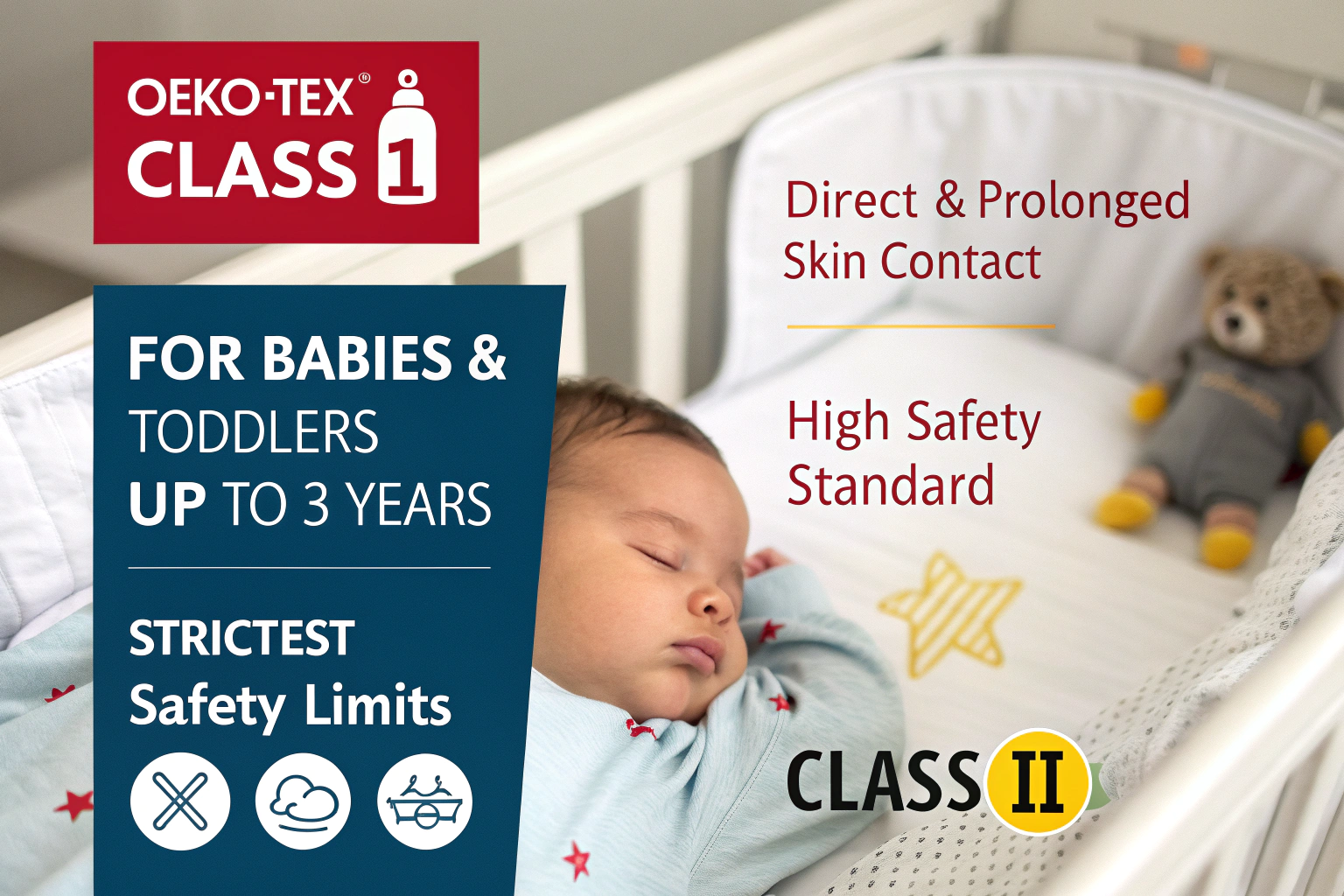
The core difference between OEKO-TEX® Class I and Class II is the level of human-ecological safety required, dictated by the product’s intended use. Class I is for articles for babies and toddlers up to 3 years old and has the strictest permissible limit values for harmful substances. Class II is for articles with direct and prolonged skin contact (like underwear or t-shirts) and has slightly higher, but still very strict, limit values. In essence, Class I represents the highest safety benchmark in the textile industry, while Class II is the high standard for general apparel.
Think of it like food safety grades: Class I is the "baby food" standard—hyper-vigilant and conservative. Class II is the "restaurant-grade" standard—excellent and safe for daily consumption by the general public. Confusing the two can lead to using a fabric that, while safe for an adult t-shirt, may not meet the stringent requirements for a baby’s onesie. Let’s break down exactly what this means for your sourcing decisions.
Why Are The Limit Values Stricter for Class I?
The stricter limits for OEKO-TEX® Class I are not arbitrary; they are a direct, science-based response to the unique vulnerabilities of babies and young children. Their bodies are developing rapidly, their skin is more permeable, their metabolic systems are less mature at detoxifying substances, and they have a much higher tendency to put textiles in their mouths. The standard adopts a precautionary principle to minimize any potential exposure to harmful chemicals during this critical developmental stage.
The differences are concrete and measurable. For example, the allowed limit for formaldehyde in Class I is virtually undetectable (non-detectable according to the test method), while Class II allows a very small, strictly limited amount. Similarly, the requirements for colorfastness to saliva and perspiration are mandatory for Class I (since babies drool and sweat), whereas they are part of a broader set of tests for Class II. The list of regulated substances is also more comprehensive for Class I, paying special attention to allergens and substances of very high concern. It’s a completely different tier of scrutiny.

How do the testing methods for saliva and perspiration differ?
This is a key operational difference that impacts the fabric’s performance. For Class I, colorfastness to saliva is a mandatory test. The fabric sample is immersed in an artificial saliva solution and assessed for any color transfer. This is critical because babies chew on their clothes. For Class II, saliva fastness is not required unless the product is specifically intended for such use. Instead, perspiration fastness (both acid and alkaline) is a core test for both classes, but the assessment criteria are stricter for Class I. The grey scale rating for color change and staining must be higher (i.e., less fading or transfer) to pass for baby articles. We once had a client who sourced a beautifully dyed organic cotton jersey that passed Class II general tests. When they decided to use it for a toddler line, we had to re-engineer the dyeing process with different, more stable dyes to achieve the Class I saliva fastness rating. The fabric looked identical, but its safety performance was upgraded significantly.
What specific substances have vastly different limits?
The disparity is most pronounced in several key categories:
- Formaldehyde: Class I aims for "not detectable" (based on Japanese Law 112). Class II allows ≤75 mg/kg.
- Heavy Metals: Limits for antimony, arsenic, lead, and cadmium are typically 30-50% lower in Class I.
- Pesticides & Allergenic Disperse Dyes: The list of banned or limited substances is longer, and the acceptable thresholds are lower for Class I, acknowledging the higher sensitivity.
- PH Value: The acceptable pH range for Class I is a narrower, more skin-neutral band (4.0 to 7.5) compared to Class II (4.0 to 8.0).
These aren’t minor adjustments. They require the factory to use higher-purity raw materials, more controlled chemical inputs, and more thorough washing and finishing processes. It fundamentally changes the production recipe.
What Products Fall Under Class I vs. Class II?
Understanding the product scope is crucial for correct application. The classification is based on the product’s intended use, not just its fiber content or style.
OEKO-TEX® Class I Products: This category is explicitly for all articles for babies and toddlers up to 36 months of age. This includes:
- Clothing (onesies, rompers, pajamas, socks)
- Bedding (sheets, blankets, crib bumpers)
- Soft toys (plush animals, cloth books)
- Terry products (towels, washcloths, bibs)
- Any other textile item clearly intended for this age group.
OEKO-TEX® Class II Products: This covers articles that come into direct and prolonged contact with the skin. The contact area is typically large. Examples include:
- Underwear, bras, t-shirts, leggings
- Shirts, blouses, dresses
- Socks (for older children and adults)
- Bed linens for adults (sheets, pillowcases)
- Bathrobes and similar items.
It’s a common mistake to assume all "organic cotton" items automatically qualify for Class I. The fiber is just the starting point; the entire manufacturing process must comply with the Class I standard.

Can a fabric be certified for both classes?
Yes, but it’s uncommon and challenging. A fabric would need to pass all tests using the stricter Class I limit values. In practice, most mills and factories will certify a fabric for a specific class based on its most common application. If you are a brand that produces both adult basics and a children’s line, you should explicitly source fabrics certified to Class I for your baby/toddler items. Using a Class II certified fabric for a baby product means you are not meeting the OEKO-TEX® standard for that article, even if the fabric itself is "certified." The responsibility for correct application falls on the brand. At Shanghai Fumao, we always ask our clients about the end-use so we can recommend and supply the appropriately certified material from our network.
What about products for older children (3+ years)?
This is a gray area that requires careful judgment. For children older than 3 but who still have sensitive skin or might chew on clothing, the prudent choice is to use Class I certified materials. For general apparel for older children (e.g., a 5-year-old’s t-shirt), Class II is typically applicable and sufficient, as it covers direct skin contact. However, many responsible brands targeting the "kids" market (up to age 12) choose to adopt Class I as their internal standard to provide maximum assurance to parents. It’s a powerful marketing stance. We helped a Scandinavian brand make this transition in 2023, and they leveraged it in their messaging, resulting in a 20% increase in customer trust scores on post-purchase surveys.
How Does Sourcing for Each Class Impact Cost and Lead Time?
Choosing Class I over Class II has tangible implications for your supply chain beyond just safety. The stricter requirements naturally influence both cost and production scheduling.
Cost Impact: Class I certified fabrics typically cost 5% to 20% more than their Class II equivalents. This premium covers:
- Higher-purity, more expensive dyes and chemicals that are free from restricted substances.
- More extensive laboratory testing (including the mandatory saliva test).
- Often, the need for dedicated production runs or lines to prevent cross-contination with Class II or non-certified products.
- The certification fees themselves, which are higher for Class I due to the expanded test scope.
Lead Time Impact: Sourcing Class I materials can add 1-2 weeks to your timeline. Reasons include:
- Specialized Production: Factories may need to schedule a "clean" run after thoroughly cleaning machinery.
- Longer Testing Cycles: The comprehensive testing protocol takes more time.
- Material Traceability: The requirement for full traceability of inputs (yarn, dyes) can mean sourcing from specific, approved suppliers, which may have longer procurement cycles.

Is the cost difference always justified?
From a pure business perspective, yes, if your product requires Class I. The cost is the price of accessing the highest safety tier and the associated risk mitigation. The consequences of using an under-specified material (Class II for a baby product) can be catastrophic: product recalls, retailer fines, brand reputation damage, and legal liability. The premium is an insurance policy. For example, a US client avoided a potential six-figure recall in 2022 because we flagged that their intended fabric was only Class II certified, while their product was a baby sleeping bag. We sourced a suitable Class I alternative. The unit cost increased by 8%, but it protected their brand from an existential risk. That’s a justified cost.
How can I plan my production to accommodate Class I requirements?
Advanced planning is non-negotiable. Here’s a practical checklist:
- Communicate Early: Tell your supplier at the inquiry stage that you need Class I certification for the end-product.
- Request Proof: Ask for the actual OEKO-TEX® certificate for the specific fabric, and verify the product class listed.
- Sample Validation: Ensure your approval samples (lab dips, strike-offs) are made using the Class I compliant process, not just a color match from a standard line.
- Buffer Your Timeline: Add the extra 1-2 weeks to your critical path for fabric production and testing before cutting.
- Audit the Chain: Consider a visit or a virtual audit to confirm the factory has separate procedures for Class I production. A reputable partner like Shanghai Fumao manages this complexity within our integrated network, giving you a single point of accountability.
What Are The Legal and Marketing Implications of Misclassification?
Misclassifying your product—intentionally or accidentally—carries serious consequences. Legally, you are making a false claim. Marketing a baby garment with a Class I hangtag when it’s made from Class II fabric is misleading advertising and can violate consumer protection laws in regions like the EU and North America.
From a compliance perspective, many large retailers have their own rigorous standards that often reference or require OEKO-TEX® Class I for baby products. Submitting a Class II certificate for a baby item during a compliance audit will result in rejection, delaying your shipment and potentially suspending your ability to sell to that retailer. Your brand’s integrity is built on trust, and a misstep here can destroy it. The OEKO-TEX® label is a promise; breaking that promise has ramifications.

How do retailers verify the certification class?
Retailers are savvy. They don’t just take your hangtag on faith. During the vendor onboarding process, they typically require:
- A copy of the full OEKO-TEX® certificate for the product, not just a summary.
- The certificate must clearly show the certificate number, product description, and most importantly, the product class.
- They may cross-reference the certificate number in the OEKO-TEX® online database.
- For high-risk categories, they may conduct spot-testing on purchased samples. If their test finds a substance exceeding the Class I limit, you will be held liable.
A European department store permanently delisted a brand in 2023 after random testing found formaldehyde levels in baby socks that exceeded Class I limits, despite the brand claiming certification. The investigation revealed they had used a Class II certified fabric. The financial and reputational loss was total.
Can I market my Class II product as "baby-safe" or "extra gentle"?
You must be extremely careful with language. You cannot use the OEKO-TEX® Class I logo or claim "OEKO-TEX® Certified for Babies" on a Class II product. You can, however, market the safety benefits of a Class II certification for products intended for older children or adults with sensitive skin, using phrases like "OEKO-TEX® Standard 100 certified for skin contact" or "tested for harmful substances." The key is that your marketing claims must accurately reflect the scope of the certification you actually hold. Transparency is your best policy. When in doubt, consult the OEKO-TEX® guidelines for label use directly.
Conclusion
The difference between OEKO-TEX® Class I and Class II is fundamental, not incremental. It defines two distinct tiers of safety designed for two different levels of human-ecological need. Class I is the uncompromising standard for the most vulnerable users—our babies. Class II is the robust, responsible standard for everyday wear against our skin.
For brands, understanding this distinction is critical for responsible sourcing, accurate compliance, and honest marketing. Choosing the correct class protects your customers, your retailer relationships, and ultimately, your brand’s legacy. It’s a decision that requires clarity, intention, and a supply chain partner who understands the depth of what these labels mean.
At Shanghai Fumao, we guide our clients through these nuances every day. Our integrated network includes factories certified for both classes, and we provide the documentation and traceability you need to be confident in your choice. Don’t leave this critical detail to chance. Whether you’re launching a baby line or elevating your basics, let’s ensure your fabrics meet the exact right standard. Contact our Business Director, Elaine, to discuss your project’s specific needs. Email Elaine at: elaine@fumaoclothing.com.