I once handed two seemingly identical white cotton poplin swatches to a buyer from a luxury shirt brand. He touched both, held them up to the light, and instantly picked ours. He couldn’t articulate why. He said, "This one just feels expensive." When pressed, he guessed it was a higher thread count. He was wrong. The competitor’s fabric actually had a higher nominal thread count by 12 threads per inch. His fingers had detected something deeper than a marketing number. They had sensed the fiber alignment, the surface friction coefficient, and the compressional resilience—all invisible to the naked eye but screamingly obvious to the tactile nervous system.
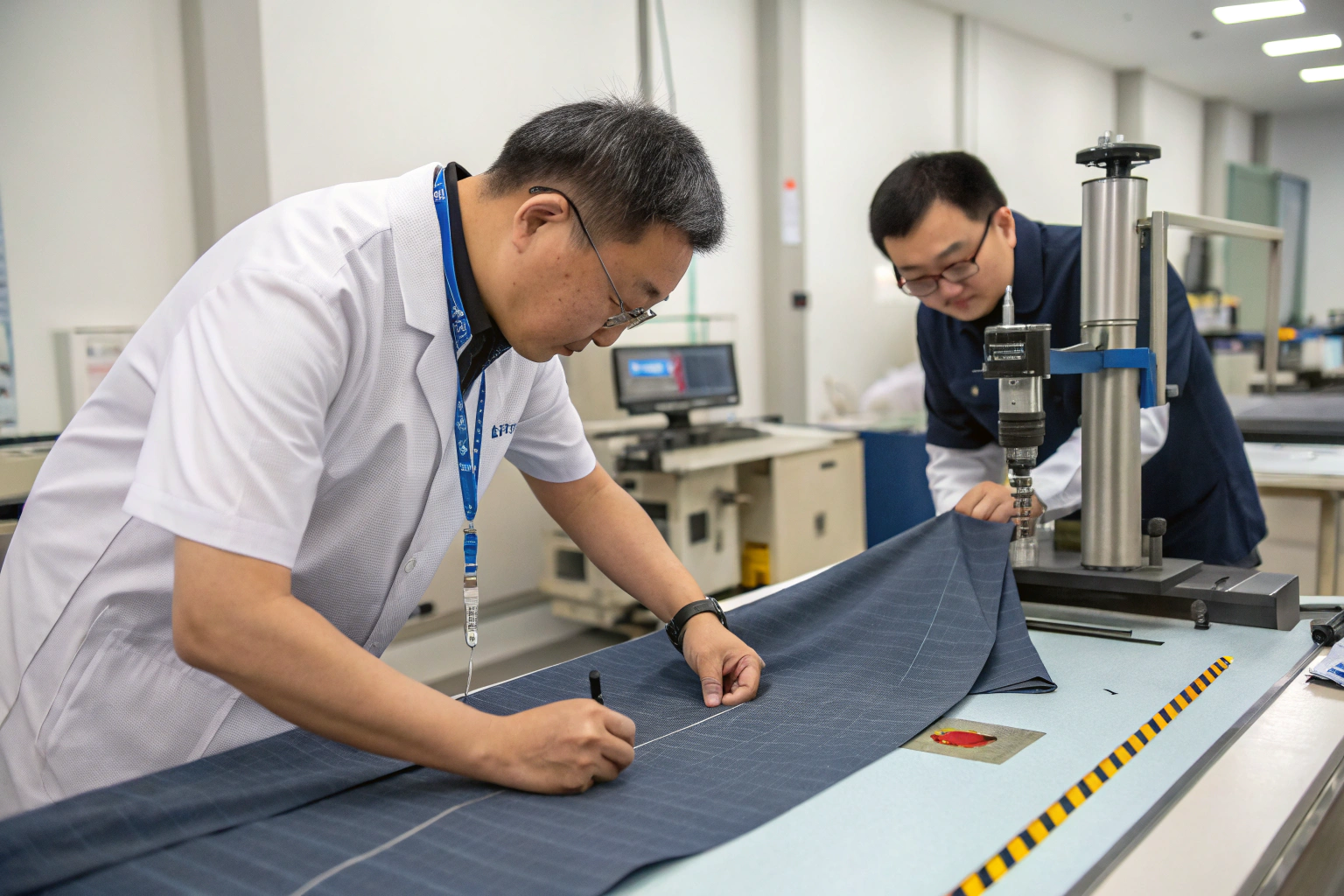
Shanghai Fumao engineers premium hand feel as a measurable, repeatable, physical science, not an aesthetic opinion. We quantify "premium" through the Kawabata Evaluation System (KES), which mechanically measures the 16 physical parameters the human hand subconsciously evaluates: bending rigidity, surface friction, compressional energy, tensile linearity, shear stiffness, and surface roughness. Our cotton poplin achieves a KES Bending Rigidity of 0.065 N·cm²/cm and a Surface Friction MIU of 0.18, placing it in the "crisp with a powdery glide" quadrant that luxury Italian shirting mills target. We achieve these numbers through specific, named mechanical processes: singeing at 800°C to remove surface fuzz, mercerization under 28°Bé caustic soda to swell and round the cotton fiber, and a final calendar pressing at 120°C with precisely 40 Newtons of pressure. These are not secrets. They are engineering choices that cost 15% more than standard finishing and produce a fabric that feels structurally different from the first touch.
If you want to understand why some fabrics feel like luxury and others feel like commodity, I’ll break down the specific finishing machinery, the measurable surface parameters, and the yarn engineering decisions that separate a premium hand feel from an average one. This is the physics of touch.
How Does Mercerization Change the Microscopic Surface of Cotton Fibers?
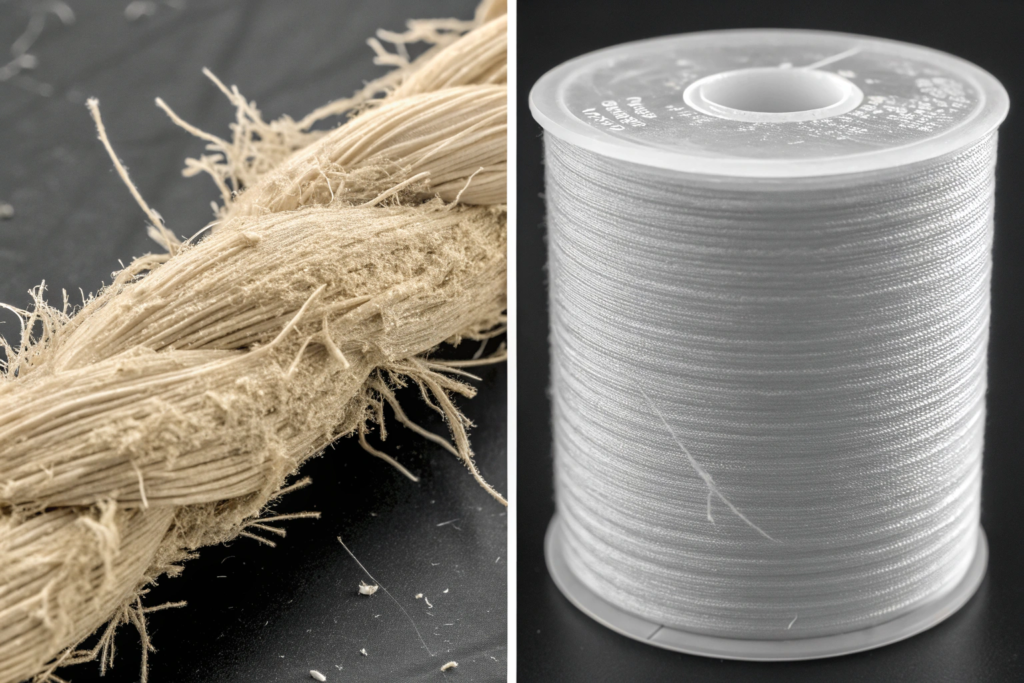
Raw cotton fiber, under an electron microscope, looks like a wrinkled, collapsed drinking straw. It’s a hollow tube that twists along its length, with a rough outer surface covered in tiny fibrils and a kidney-shaped cross-section. This irregular, twisted ribbon structure scatters light randomly, producing a dull, matte appearance. The roughness creates high surface friction against the skin, which the brain interprets as "scratchy" or "cheap." The collapsed tube also means the fiber has low strength and uneven dye uptake.
Mercerization, invented by John Mercer in 1844 but refined into a precision industrial process, transforms this collapsed straw into a smooth, round, swollen cylinder. We immerse the cotton fabric or yarn in a 28°Bé (approximately 24% concentration) sodium hydroxide solution at a controlled temperature of 15-18°C. We keep it cold. If the temperature rises above 20°C, the swelling is insufficient and the luster gain is minimal. The caustic soda penetrates the cellulose crystal lattice, breaking the hydrogen bonds between the polymer chains. The fiber swells dramatically, increasing in diameter by 20-30%. The hollow lumen collapses completely. The twisted ribbon shape straightens into a uniform cylinder. The cross-section, which was kidney-shaped, becomes almost perfectly round. When we wash out the caustic soda under tension, the hydrogen bonds re-form in this new, swollen, cylindrical configuration. The result is permanent. The fiber is now rounder, smoother, and 25-30% stronger. The round surface reflects light directionally rather than scattering it, creating a subtle, silken luster. The smoothness reduces the surface friction coefficient (MIU) by about 30%, which the human hand reads as "softer" and "more luxurious." This single finishing step, performed correctly with precise concentration and temperature control, is the foundation of premium cotton hand feel. The chemistry and physics of this process are explored in a detailed scientific explanation of the mercerization process and its effects on cotton fiber morphology, tensile strength, and optical luster at the molecular level.
What Happens to the Fabric Hand If the Caustic Soda Temperature Drifts Above 20°C?
The mercerization reaction is exothermic. It generates heat. If the caustic soda bath is not actively chilled, the temperature drifts upward naturally. At 22-24°C, the sodium hydroxide still penetrates the fiber, but the swelling is less uniform. Some sections of the fiber swell fully. Others remain partially collapsed. The result is an inconsistent hand feel—patches of smooth, lustrous fiber mixed with patches of dull, rough fiber.
At 30°C and above, the mercerization effect is negligible. You’re essentially giving the fabric an expensive caustic wash that removes some surface waxes but does not transform the fiber morphology. The fabric will feel cleaner but not premium. Many low-cost mills run "pseudo-mercerization" at ambient temperature without proper chilling, ticking the "mercerized" box on the spec sheet without delivering the structural benefit. We monitor the bath temperature with an inline probe that feeds data to our SCADA system. The chiller automatically engages if the temperature crosses 18.5°C. The batch log records the temperature curve for every run, and we archive it with the lot number. A buyer can audit this data and see that their fabric was mercerized within the correct thermal window. The difference in hand feel between a properly chilled mercerization and an ambient-temperature fake mercerization is immediately obvious to an experienced hand, even if the chemical invoice looks the same. This sensitivity to processing parameters is a key quality differentiator, as discussed in a technical analysis of the critical process control points in caustic soda mercerization of cotton and their impact on final fabric hand feel uniformity.
Why Does Double Mercerization Exist, and Is It Worth the Additional Cost?
Double mercerization—mercerizing the yarn before weaving, then mercerizing the finished fabric again—is the nuclear option for cotton hand feel. It’s expensive, time-consuming, and reserved for the highest-tier shirting and bedding fabrics. The yarn mercerization swells and rounds each individual cotton fiber before it’s woven. The fabric mercerization swells and locks the weave intersections, creating a flat, uniform surface.
The combined effect is a fabric with a hand feel that approaches silk. The surface friction is so low that the fabric feels cool and fluid. The luster is deep and reflective. The tensile strength increase stacks, resulting in a fabric that can be woven to a finer, lighter weight without sacrificing durability. We produce a double-mercerized 100/2 poplin for a Swiss shirting brand that achieves a KES MIU of 0.12—smoother than some silk qualities. The cost is approximately 22% higher than single mercerization due to the extra chemical, energy, and handling. Whether it’s worth it depends on your market positioning. If your shirt retails for $295, the $2.50 per meter additional cost is negligible and the hand feel justifies the price point. If your shirt retails for $49, it’s over-engineering. We guide clients through this cost-benefit analysis honestly rather than pushing the most expensive process. The technical and commercial rationale for double mercerization is explained in a comparison of single versus double mercerization processes for premium cotton shirting fabrics and the measurable differences in surface friction and tensile strength.
What Role Does Yarn Twist Play in Perceived Fabric Softness?
Most buyers fixate on fiber content. "Is it 100% cotton? Is it Supima? Is it Egyptian Giza?" Fiber origin matters, but it’s only half the story. The same extra-long-staple Giza 87 cotton can feel like sandpaper or like silk, depending entirely on the twist level inserted during spinning. Twist is the parameter that translates raw fiber into usable yarn, and it dictates whether the fabric surface will be fuzzy and soft, smooth and crisp, or harsh and rope-like.
Yarn twist is measured in TPI (turns per inch) or, more precisely for scientific comparison, by the Twist Multiplier (TM), which normalizes for yarn count. A low twist (TM 3.0-3.4) leaves the individual cotton fibers loosely bound. The fiber ends protrude freely from the yarn surface, creating a fuzzy, soft, warm hand feel—ideal for a cozy flannel or a brushed fleece. A medium twist (TM 3.5-4.0) packs the fibers more tightly, smoothing the surface and increasing durability, suitable for a crisp poplin or a standard twill. A high twist (TM 4.2-4.8) compresses the fibers into a dense, hard, almost wiry structure. The surface is extremely smooth, almost glossy. The fabric resists creasing, drapes fluidly, and feels cool to the touch. This is the twist range used for luxury Egyptian cotton shirting and high-end percale bedding. Our premium shirting uses a TM of 4.5 on a 80/2 combed cotton yarn. The hand feel is "dry, crisp, and cool," with a papery rustle that signals quality to the consumer’s ear as well as their hand. We choose the twist multiplier deliberately for each fabric end-use, and we specify it on the internal spec sheet. The relationship between twist and hand feel is fundamental, and a textile spinning engineering guide to the relationship between yarn twist multiplier, fiber alignment, and the resulting fabric surface friction and hand feel characteristics explains why twist is often more important than fiber origin in determining perceived quality.

How Does the "Twist-On-Twist" of Two-Ply Yarns Enhance the Premium Sensation?
A two-ply yarn—two single yarns twisted together—adds another dimension of engineering. The individual singles are twisted in one direction (usually Z-twist, clockwise). The two singles are then plied together in the opposite direction (S-twist, counter-clockwise). This reverse twist balances the inherent torque of the singles, creating a yarn that hangs straight without kinking.
The "twist-on-twist" geometry also creates a microscopic surface texture. The two singles nestle together, and the outer surface of the plied yarn has a subtle, regular, rope-like spiral. This spiral catches light in a series of tiny highlights, producing a sophisticated luster that a single yarn cannot replicate. The plied structure also increases the yarn’s roundness and compressional resistance. A single yarn flattens under pressure; a two-ply yarn pushes back, giving the fabric a "body" that feels substantial. This is why a two-ply poplin feels heavier and more luxurious than a single-ply poplin of the same GSM. The weight on the scale is identical, but the compressional behavior under the fingers is different. The two-ply fabric resists the pinch; the single-ply collapses. The consumer’s brain interprets this resistance as "quality." We use two-ply yarns for the warp in all our premium shirting because the warp is the backbone of the fabric, and the plied structure provides the structural integrity that the long floats of a poplin weave require. The engineering principles are detailed in a technical analysis of two-ply cotton yarn construction and its contribution to fabric body, crease resistance, and surface luster compared to single-ply equivalents.
Can Over-Twisting a Yarn Make a Fabric Feel Harsh and Papery?
Yes, and this is the trap that some "premium" mills fall into. They equate "high twist equals premium" and push the TM to 5.0 or above. The yarn becomes over-twisted, or "kinky." It wants to untwist. It snarls. The resulting fabric feels harsh, stiff, and brittle. It rustles loudly, which initially sounds crisp, but it lacks the slight give that makes a fabric feel organic and comfortable against the skin.
There is a sweet spot, and it varies by fiber length and fineness. For a long-staple Giza cotton with a fiber length of 35mm, the optimum TM for a crisp-but-not-harsh shirting is 4.2-4.5. Beyond 4.6, the marginal gain in smoothness is outweighed by the sharp increase in bending rigidity. The fabric starts to feel like typing paper, not like fine cloth. We determine the correct TM for each development by running a "Twist Ladder" trial. We spin five mini-cones of the target count at twist multipliers from 3.8 to 4.8, knit or weave sample swatches, and measure the KES Bending Rigidity and Surface Friction. The buyer receives the data and the physical samples, and we jointly select the TM that balances crispness and comfort. This avoids the "over-engineered" premium fabric that looks good on a specification sheet but feels unpleasant in a garment. The calibration of twist to end-use is an iterative process, as explored in a guide to optimizing cotton yarn twist levels for specific fabric end-uses to balance softness, durability, and surface texture.
How Does Post-Weaving Finishing Physically Reshape the Fabric Surface?
Greige fabric straight off the loom is not premium. It’s hairy, rough, stiff, and full of spinning oils and sizing waxes. The hand feel is industrial, not luxurious. The transformation from loom-state to premium occurs in the finishing department, through a sequence of three physical processes: singeing, mercerization, and calendering. Each process removes or reshapes a specific undesirable characteristic of the greige surface.
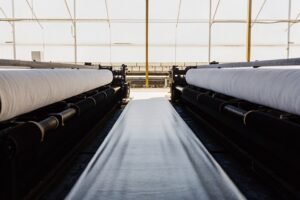
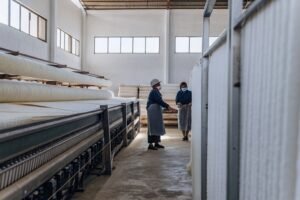
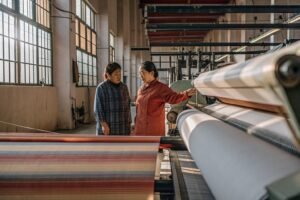
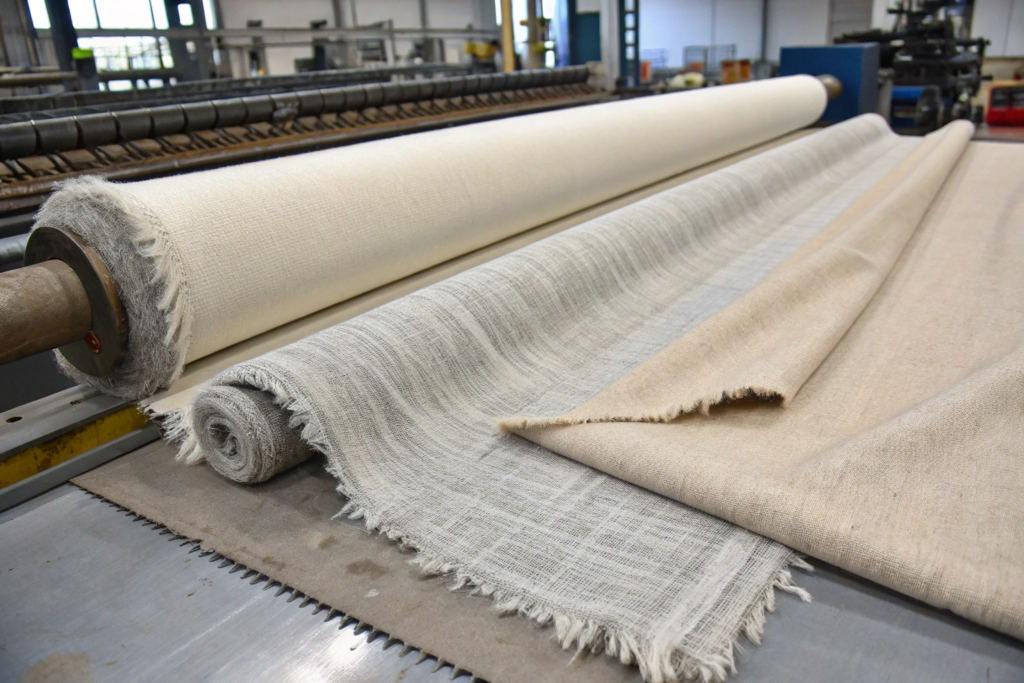
Singeing is the first step and the most dramatically visible. The greige fabric passes at high speed (80-120 meters per minute) over a row of gas flames burning at 800-900°C. The surface hairs—the tiny fiber ends protruding from the yarn—flash-burn instantly. The main yarn body, being denser and having more thermal mass, does not reach ignition temperature in the fraction of a second it’s exposed to the flame. The result is a fabric surface that is clean, smooth, and free of fuzz. If you look at a singed fabric under a magnifying glass, the yarn surface looks shaved clean. An unsinged fabric looks like a meadow of tiny fiber stalks. After singeing comes mercerization, which swells and rounds the fibers as I described earlier. Finally, the fabric enters the calender, a set of heavy, polished steel rollers heated to 120-140°C. The fabric passes between the rollers under high pressure (40-60 Newtons). The heat and pressure iron the swollen, rounded fibers flat into a uniform, aligned surface. The microscopic hills and valleys of the weave are leveled. The surface becomes glossy and smooth. This three-step sequence—burn, swell, iron—is the physical alchemy that turns agricultural cotton cellulose into a surface that feels engineered. To visualize this process, a step-by-step guide to textile finishing machinery including singeing, mercerizing, and calendering equipment and their sequential role in developing premium cotton fabric hand feel provides a thorough engineering overview.
What Is the Difference Between a "Chased" and a "Felt" Calender Finish?
Not all calendering is the same. The roller surface and the way the rollers interact with the fabric create fundamentally different finishes. A standard calender uses a polished steel roller against a softer cotton or paper-filled bowl roller. This configuration imparts a uniform gloss but does not create a distinctive tactile surface pattern.
A "chased" calender finish uses a stack of multiple steel rollers that rotate at slightly different speeds. The fabric passes through the stack, and the differential speed between the rollers burnishes the fabric surface, creating a deeper, more three-dimensional luster. A "felt" calender uses a felt-covered roller that compresses the fabric into a flat, papery smoothness. For our premium shirting, we use a chased finish with five rollers, the last two at differential speeds. The result is a subtle, almost pearlescent luster that looks "alive" rather than flat. For hotel bed linens, we use a felt calender to achieve a smooth, crisp, "crackly" hand that signals freshness and cleanliness to the guest. The choice of calender configuration is determined by the end product and the sensory message the brand wants to communicate. This nuance is often lost on buyers who simply request "calendered fabric," not realizing there are multiple distinct finishes. The distinction is clarified in a textile finishing guide to the different types of calendering processes—chased, felt, friction, and Schreiner—and their specific effects on fabric luster and hand feel.
Can Over-Calendering Destroy the Natural Texture of the Fabric?
Yes. Calendering is a compressive, high-heat process. If the temperature is too high (above 150°C) or the pressure is too aggressive, the cotton fibers are permanently flattened. The fabric loses its natural, organic grain and becomes a featureless, plastic-like sheet. This is the "over-finished" look that some cheap uniform fabrics have—smooth, yes, but dead.
The art of finishing is knowing when to stop. We target a specific KES Surface Roughness (SMD) value, not a visual gloss level. A premium cotton poplin should have an SMD around 3.5-4.0 microns. Below 3.0, the fabric starts to feel synthetic. Above 5.0, it feels unfinished. We measure SMD on every finishing batch and adjust the calender pressure accordingly. If the greige is naturally smoother because the yarn twist was higher, we reduce pressure to avoid over-finishing. This closed-loop control is what separates a thoughtful finisher from a "crank it through at maximum speed" commodity mill. The fabric retains its identity—you can still see the weave structure and feel the cotton’s natural warmth—but the surface is refined and intentional. The balance between refinement and over-processing is a central theme in a discussion of premium textile finishing and the risk of over-calendering in destroying the natural tactile properties of cotton and linen fabrics.
What Objective Measurements Define a "Luxury" vs. "Commodity" Hand Feel?
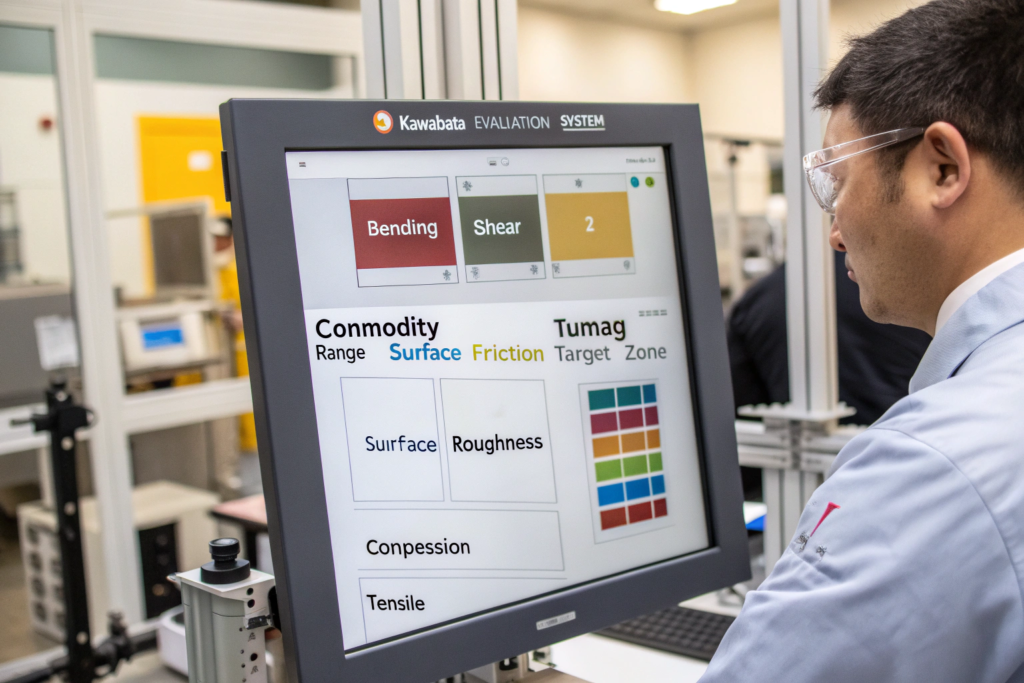
"Luxury hand feel" is not a mystical property. It’s a specific region on a six-dimensional KES parameter map. A fabric that feels premium occupies a defined zone of bending rigidity, shear stiffness, surface friction, surface roughness, compressional energy, and tensile linearity. Fabrics that fall outside this zone feel either too stiff, too limp, too rough, too slick, too spongy, or too papery. The subjective experience of "this feels expensive" correlates with measurable physical data.
Our internal "Premium Hand Feel Standard" is a set of KES parameter ranges that we have refined over a decade of correlation with buyer preference testing. For a premium cotton shirting, the target ranges are: Bending Rigidity (B) 0.05-0.09 N·cm²/cm (crisp but not stiff), Surface Friction (MIU) 0.15-0.20 (smooth with a slight tooth), Surface Roughness (SMD) 3.0-4.5 microns (refined but not plastic), Compressional Energy (WC) 0.15-0.25 N·cm/cm² (resilient body), Shear Stiffness (G) 0.4-0.8 N/cm·degree (drapes fluidly but holds structure), and Tensile Linearity (LT) 0.6-0.8 (natural fiber give, not rigid). If a fabric’s parameters all fall within these ranges, it will feel like a premium cotton to a trained hand. If one parameter is outside—say, MIU is 0.12, which is too slick—the fabric will feel synthetic, even if it’s 100% cotton. We measure every new development against these targets and share the radar chart with the buyer. This turns a subjective "I like it" into an objective "It meets spec." The buyer can see why a fabric feels premium and can articulate that reason to their own quality control team. The scientific framework behind this approach is documented in a research-based introduction to the Kawabata Evaluation System and the defined mechanical parameter ranges that correlate with subjective assessments of fabric luxury and comfort.
Can KES Data Predict How a Fabric Will Feel After 20 Wash Cycles?
The KES data on a raw, finished fabric predicts the initial hand feel. It does not predict durability of that hand feel. A fabric can measure perfectly in the premium zone on day one and drift out of that zone after five washes due to surface fuzz development, fiber swelling, or finish removal.
We perform a "Wash Durability KES" protocol on every new development. The fabric is washed 10 times according to AATCC 135, then re-measured on the KES. The premium range targets still apply after the wash cycles. If the MIU increases by more than 15% (indicating surface roughening from pilling), the yarn twist or fiber length is insufficient, and we adjust the spinning specification. If the Bending Rigidity drops by more than 20% (indicating loss of body from finish wash-out), the resin finish or the mercerization depth is inadequate, and we adjust the finishing recipe. This wash-durability testing is what separates a showroom premium fabric from a real-world premium fabric. The garment must feel luxurious on the 50th wear, not just on the hanger. We archive the wash-cycled KES data with the initial data so the buyer sees the full lifecycle hand feel prediction. This long-term perspective on hand feel durability is discussed in a study on the correlation between initial KES fabric hand measurements and retained tactile properties after repeated laundering, and its implications for premium garment longevity.
Can Two Fabrics With Identical KES Numbers Still Feel Subjectively Different?
Yes, and this is the frontier of hand feel science. The KES measures 16 mechanical parameters, but it does not measure thermal sensation (cool/warm to the touch) or moisture regain (how the fabric absorbs skin humidity). Two fabrics with identical bending, shear, and surface friction numbers can feel different if one is a polyester with low thermal conductivity and the other is a linen with high thermal conductivity.
The polyester will feel "warm and clammy" because it traps body heat and doesn’t absorb moisture. The linen will feel "cool and dry" for the opposite reason. The fingers are sensing thermal flux and humidity, not just mechanical deformation. This is why we supplement KES data with a "Subjective Panel" test for high-stakes developments. We recruit five trained internal evaluators who rate the fabric on a scale for "Cool-Warm," "Dry-Clammy," and "Smooth-Rough" after a controlled acclimatization period in a standard atmosphere (21°C, 65% RH). Their consensus adds a qualitative layer to the quantitative KES data. The combination of mechanical measurement and thermal-moisture perception gives a complete picture of why a fabric feels premium. The limitations of purely mechanical measurement are acknowledged in a critical review of the Kawabata system and the role of thermal conductivity and moisture regain in the holistic perception of textile quality and comfort.
Conclusion
Premium hand feel is not a matter of opinion handed down by a fabric guru. It is a definable, measurable, reproducible set of physical surface and mechanical properties engineered through specific, named processes. We have dissected the three pillars of premium touch: the mercerization vat at a tightly controlled 15-18°C that swells a collapsed cotton ribbon into a smooth, reflective cylinder; the twist multiplier of 4.5 on a two-ply yarn that creates a crisp, dry surface with a subtle spiral luster; and the sequential finishing gauntlet of 800°C singeing, caustic swelling, and chased calendering that burns away the fuzz, swells the fiber, and irons the surface to a 3.5-micron roughness. We showed that the Kawabata Evaluation System translates "this feels amazing" into a radar chart with six parameter ranges, and that wash-cycle durability testing ensures the hand feel survives 50 launderings, not just the first unboxing. These are not marketing claims. They are machine settings, chemical concentrations, and test data that you can audit.
The difference between commodity and luxury is about 15% in finishing cost and 100% in engineering attention.
If you want to understand what your specific product category should feel like—whether it’s a crisp poplin, a fluid charmeuse, or a brushed flannel—and you want to see the KES data that proves it, I invite you to reach out. Contact our Business Director, Elaine, at elaine@fumaoclothing.com. She will send you our Premium Hand Feel Reference Kit with 20 calibrated swatches and their corresponding KES radar charts. Touch the data. Measure the luxury. Then let’s build something that feels unforgettable.