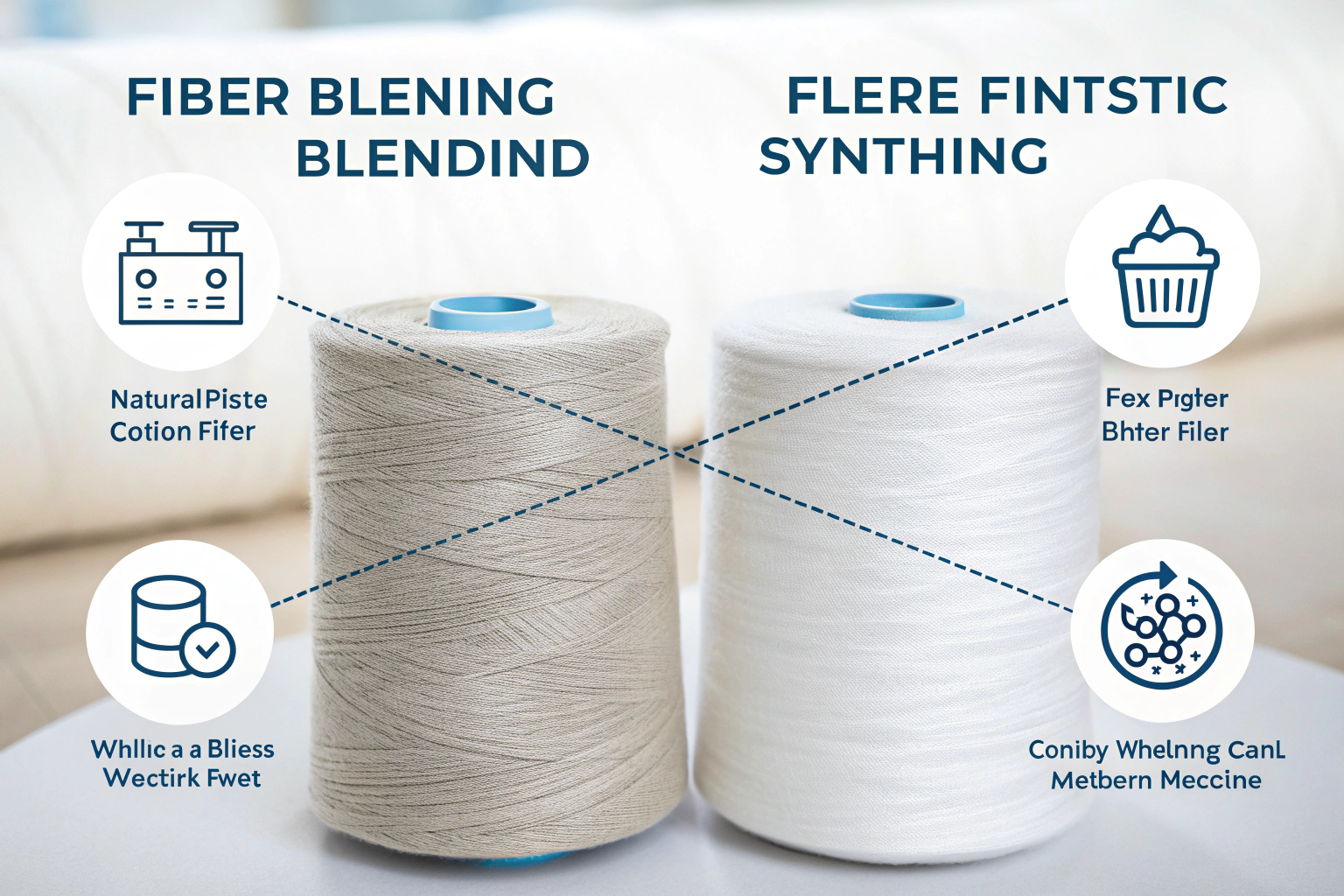
Ever wished you could take the best qualities of two different fabrics and merge them into one perfect material? That’s exactly the promise of blended fabrics. You love the breathability of cotton but hate how it wrinkles and takes forever to dry. You adore the warmth of wool but find it itchy and difficult to care for. Blending fibers like polyester with cotton or acrylic with wool isn’t a compromise—it’s a strategic engineering solution to create textiles that outperform their pure counterparts in real-world use.
So, what are the real benefits of blended fabrics? In essence, blending allows you to combine the desirable properties of different fibers while mitigating their individual weaknesses. A poly-cotton blend offers the comfort and absorbency of cotton with the durability, wrinkle resistance, and quick-dry ability of polyester. A wool-acrylic blend delivers the insulating warmth and natural feel of wool with the reduced cost, lighter weight, and easier care of acrylic. It’s about creating a more balanced, functional, and often more affordable fabric.
Blends aren’t "cheap imitations"; they are intelligent responses to specific consumer and manufacturing needs. From high-performance sportswear to durable work uniforms and cozy knitwear, blended fabrics dominate the market for good reason. Let’s dissect the science and strategy behind these ubiquitous and versatile materials.
How Do Blends Enhance Performance and Functionality?
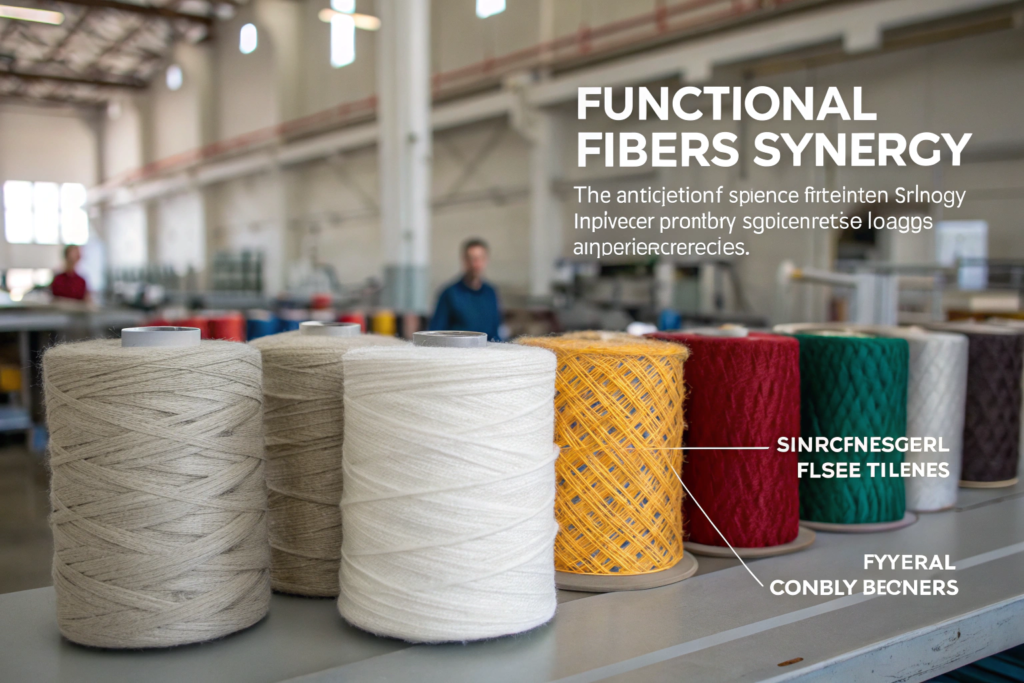
The core value of a blend is functional synergy. Each fiber type brings its innate chemical and physical properties to the mix. By blending them, you’re not just averaging these traits; you’re often creating new behaviors where one fiber’s strength compensates for another’s weakness at a fundamental level. This is particularly crucial for apparel and textiles that face demanding conditions, whether it’s the stress of an athlete’s movement or the daily wear-and-tear of a uniform.
Understanding this synergy allows you to engineer fabrics for precise applications. For instance, a small percentage of spandex (5-10%) blended into a woven cotton or polyester creates "stretch" fabrics that have revolutionized denim, chinos, and shirts. The benefit isn’t just comfort; it’s enhanced mobility and a better fit that lasts throughout the day.
What Specific Improvements Does Poly-Cotton Offer?
The 65% polyester / 35% cotton blend (or similar ratios like 50/50, 80/20) is arguably the world’s most successful blend for good reason. It fundamentally upgrades everyday cotton:
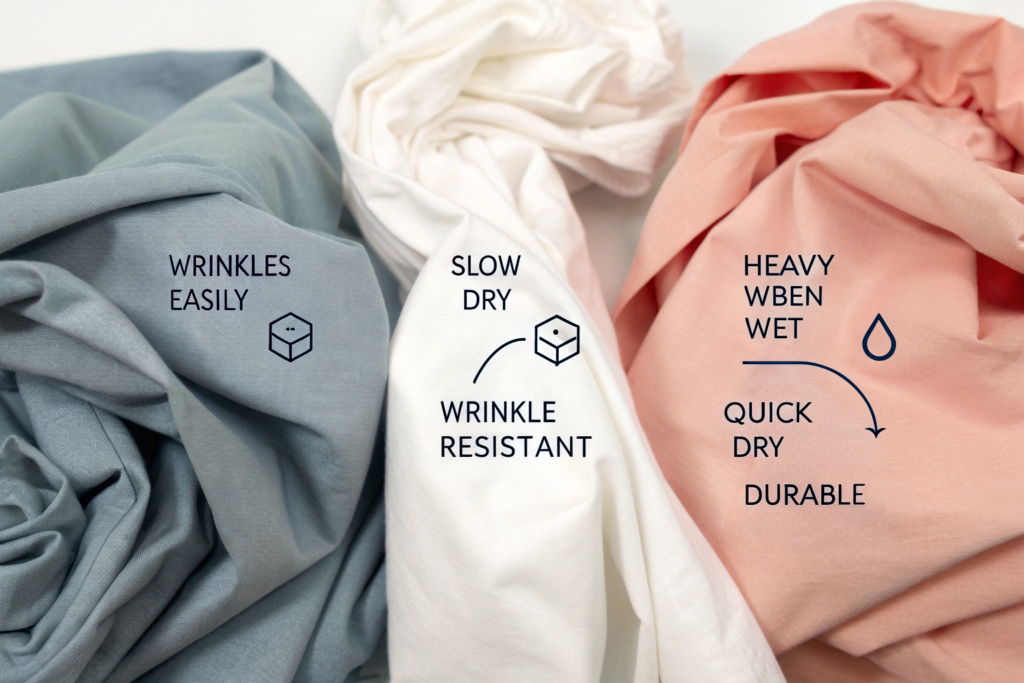
- Durability & Strength: Polyester fibers are significantly stronger than cotton. Adding polyester dramatically increases the fabric’s tensile strength and abrasion resistance, making garments last longer. This is why poly-cotton is the standard for hotel linens, workwear, and school uniforms.
- Wrinkle & Shrink Resistance: Polyester is highly resilient and less prone to wrinkling. It also doesn’t absorb water and swell like cotton, which is the primary cause of shrinkage. A poly-cotton shirt comes out of the dryer ready to wear, with minimal ironing needed.
- Faster Drying & Moisture Management: While pure cotton feels absorbent, it holds moisture against the skin. Polyester wicks moisture away and dries rapidly. In a blend, you get cotton’s initial comfort with polyester’s ability to move sweat away, making it excellent for everyday activewear and casual sports apparel.
We worked with a European hospital group in 2023 to upgrade their staff scrubs. Pure cotton scrubs were comfortable but became heavy with sweat, wrinkled easily, and faded quickly. We developed a 60% Polyester / 37% Cotton / 3% Spandex blend. The result was a uniform with the soft hand of cotton, superior stain release, minimal wrinkling for a professional appearance all shift, and just enough stretch for mobility. The feedback was overwhelmingly positive, and their laundry costs reportedly dropped due to lower ironing needs. This is a perfect case of designing functional textiles for professional uniforms.
Why Blend Acrylic with Wool?
Wool is a premium, natural insulator, but it has drawbacks: cost, weight, potential for itching (coarser grades), and susceptibility to moth damage and felting in the wash. Acrylic, a synthetic fiber, was originally designed to mimic wool.
- Cost Reduction: Acrylic is significantly cheaper than wool, making warm knitwear more accessible.
- Lightweight Warmth: Acrylic fibers are hollow, providing excellent insulation without the heaviness of wool. A wool-acrylic blend sweater is often warmer for its weight than a pure wool one.
- Easy Care & Durability: Acrylic is machine washable, doesn’t felt, and is highly resistant to moths, mold, and sunlight. It adds dimensional stability, reducing the risk of a sweater stretching out of shape.
- Softness: Fine acrylic fibers can be very soft, mitigating the itch factor of coarser wool grades.
A US-based retailer for budget-conscious families sources a 70% Acrylic / 30% Wool blend for their winter children’s sweaters. The blend provides ample warmth, is completely machine-washable (a must for kids), and retails at a price point pure wool could never reach. For those looking into sourcing affordable yet warm knitwear fabrics, wool-acrylic blends are a market-tested solution.
How Do Blends Affect Cost and Production Efficiency?
From a brand’s perspective, blends aren’t just about end-user benefits; they’re also a powerful tool for managing cost of goods sold (COGS), streamlining production, and achieving consistent quality. The economic logic of blending is compelling and often drives its adoption at scale, especially in fast fashion and volume-driven markets.
Blending can make premium characteristics more accessible and reduce the impact of raw material price volatility. For a manufacturer, processing blended yarns can also be more efficient than handling pure natural fibers, which can be more delicate or variable.
What is the Cost-Saving Advantage?
This is the most straightforward benefit. Expensive fibers are "extended" or partially replaced by more affordable ones.
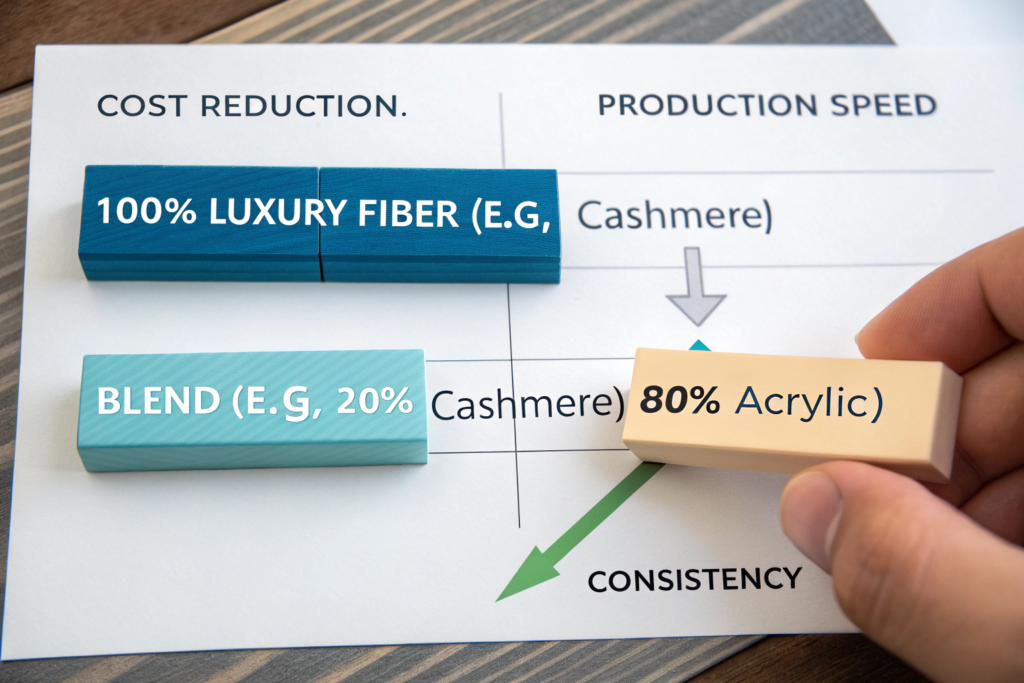
- Premium Fiber Extension: Adding 20-30% of a luxury fiber like cashmere, silk, or merino wool to a base of cotton, acrylic, or polyester creates a fabric that carries the premium feel and marketing story at a fraction of the cost of a 100% luxury item. A 55% Cotton / 35% Polyester / 10% Cashmere sweater feels luxuriously soft but is far more affordable and durable than a pure cashmere one.
- Stability Against Price Fluctuation: Natural fiber prices (especially cotton and wool) can swing wildly based on harvests, weather, and geopolitics. Blending with a synthetic, whose price is tied to the more stable petroleum market, buffers these swings, leading to more predictable costing.
A notable case was during the 2021 cotton price surge. Several of our mid-market apparel clients reformulated their bestselling chino fabric from 98% Cotton / 2% Spandex to a 78% Cotton / 20% Recycled Polyester / 2% Spandex blend. The hand feel and appearance remained nearly identical, but the fabric cost per meter dropped by over 15%, protecting their margins without a noticeable change to the consumer. This is a key tactic in managing textile sourcing costs during material shortages.
Are Blends Easier to Manufacture and Dye?
In many cases, yes, which translates to better consistency and yield.
- Improved Processing Strength: Pure cotton yarns can be weak and break during high-speed weaving or knitting. Polyester fibers add strength, reducing breakages and machine downtime, leading to higher production efficiency and lower defect rates.
- Dyeing Advantages: Different fibers require different dyes (disperse dyes for polyester, reactive dyes for cotton). Piece-dyeing a poly-cotton blend can yield heather or cross-dyed effects. However, for solid colors, it’s more complex. Often, the yarn is dyed before blending (solution-dyed polyester) or the fabric is put through multiple dye baths. A skilled supplier, like our partner mills, has the expertise to achieve uniform, colorfast results. For brands, this means you can achieve vibrant, lasting colors on a durable fabric base.
For a high-volume basics brand, consistency is king. They switched from 100% combed cotton jersey to a 95% Combed Cotton / 5% Polyester jersey. The tiny polyester addition gave the yarn enough strength to run on knitting machines at higher speeds with fewer breaks, increasing output by about 8%. The fabric also had less shrinkage variation from batch to batch, simplifying their garment sizing. Understanding yarn engineering for high-speed textile production is a behind-the-scenes superpower of blending.
What Are the Environmental and Care Considerations?
The sustainability narrative around blends is complex and often misunderstood. While they offer durability (a key sustainability factor) and can incorporate recycled content, their end-of-life presents challenges. Similarly, care instructions for blends are a hybrid, often simplifying the process compared to pure natural fibers but requiring attention to temperature.
Consumers are increasingly asking about circularity. A 100% organic cotton T-shirt has a clear, compostable end-of-life. A poly-cotton blend does not, as the fibers are difficult to separate for recycling. This is a critical point for brands building a circular economy strategy.
Are Blended Fabrics More Sustainable?
The answer is: It depends on the perspective and lifecycle stage.
-
Pros (Positive Impact):
- Durability: Longer-lasting garments = less frequent replacement = lower overall consumption. A durable poly-cotton work shirt that lasts 3 years is arguably more sustainable than a pure cotton one that wears out in 1.
- Recycled Content: Both polyester and acrylic can be easily made from recycled materials (rPET). You can have a 50% Recycled Polyester / 50% Organic Cotton blend, combining post-consumer waste with responsibly grown cotton.
- Water & Energy in Care: Wrinkle-resistant blends require less ironing (saving energy at home). Quick-dry blends may encourage line-drying over machine drying.
-
Cons (Challenges):
- End-of-Life/Recyclability: Mechanical recycling requires pure fiber streams. Blends are notoriously difficult and costly to separate, so they often end up in landfills or are downcycled into low-value products like insulation.
- Microfiber Shedding: Synthetic components (polyester, acrylic, nylon) shed microplastics during washing, which enter waterways.
A forward-thinking athleisure brand we collaborate with uses a blend of Repreve® recycled polyester (from bottles) and Tencel™ Lyocell. This combines recycled content with a biodegradable natural fiber. While still a blend, it tells a more holistic sustainability story focused on responsible inputs. Navigating eco-friendly fabric blend options for conscious brands is an active area of innovation.
How Should You Care for Blended Fabrics?
Care is typically easier than for pure delicate fibers but follows the "weakest link" rule.
- Temperature Guidelines: Always wash and iron according to the most delicate fiber in the blend. If a fabric is 60% Polyester (can handle high heat) and 40% Wool (shrinks with heat), you must treat it as wool—use cool water and low heat.
- General Rule: Most common blends like poly-cotton are machine washable and tumble dryable on medium heat. They tolerate a wider range of conditions than pure silk, wool, or linen.
- Always Check the Label: The care label is legally binding and based on testing. A 50/50 wool-acrylic blend will happily tolerate machine washing, whereas a wool-cashmere blend might require hand washing.
This simplified care is a major consumer benefit. It makes garments more practical for everyday life, which contributes to them being worn more often—another unofficial sustainability metric. For brands, providing clear care instructions is part of the product promise. Shanghai Fumao includes recommended care instructions with all our fabric specifications to guide our clients.
How to Choose the Right Blend for Your Product?
With all these factors in mind, selecting a blend becomes a strategic decision-making process. It’s a formula where you input your design goals, price point, target market, and brand values to output the ideal fiber ratio and construction. There is no one-size-fits-all, but there are industry-standard starting points that you can then customize.
Working with a knowledgeable supplier is invaluable here. They can show you physical swatches, provide technical data, and even create custom blend samples based on your brief. Don’t just ask for "a poly-cotton"; specify the hand feel, weight, drape, and performance needs.
What Are Common Blend Ratios and Their Uses?
- For Shirts/Blouses/Sheeting:
- 60/40 or 65/35 Poly-Cotton: The workhorse. Optimal balance of comfort, durability, and easy care.
- 50/50 Poly-Cotton: Slightly softer, more cotton-like feel, but wrinkles a bit more.
- For Knitwear/Sweaters:
- 70/30 or 80/20 Acrylic-Wool: Affordable, warm, easy-care winter wear.
- 55% Cotton, 35% Acrylic, 10% Alpaca: A premium-feeling yet affordable blend for soft scarves or lightweight sweaters.
- For Stretch Wovens (Denim, Pants):
- 98% Cotton, 2% Spandex: Classic stretch denim.
- 70% Cotton, 28% Polyester, 2% Spandex: A more durable, shape-retaining stretch chino.
What Questions Should You Ask Your Supplier?
- "Can you provide a test report for shrinkage, colorfastness, and pilling?" Blends should be tested as a final composite.
- "What is the origin and certification of the fibers?" (e.g., BCI Cotton, GRS Recycled Polyester).
- "Can you produce a custom blend sample, and what is the MOQ?" For development, MOQs can be as low as 100kg for a custom blend yarn.
- "How does this blend behave in dyeing? Can we achieve a solid color?"
A startup creating travel clothing came to us with a brief: "Wrinkle-free, odor-resistant, breathable, and derived from recycled materials." We proposed and sampled a blend of 45% Recycled Polyester, 45% Tencel™ Lyocell, and 10% Silver-ion Polyester (for odor control). The Tencel™ provided breathability and a luxurious hand, the recycled poly provided structure and quick-dry, and the silver additive tackled odor. It was a bespoke blend solving a multi-faceted problem. This is the power of collaborative fabric development with a technical supplier.
Conclusion
Blended fabrics represent the intelligent evolution of textile design, offering practical solutions that pure fibers often cannot. The benefits are clear: enhanced performance and durability, significant cost savings and production efficiencies, and simplified care for the end consumer. While environmental considerations, particularly around end-of-life recycling, present an ongoing challenge, blends also contribute to sustainability through longevity and the incorporation of recycled materials.
The key to leveraging blends successfully is to approach them with clear intent. Understand the functional profile you need, communicate it precisely to your supplier, and validate the chosen blend through rigorous sampling and testing. Whether you’re sourcing the ubiquitous poly-cotton for reliable basics or engineering a novel blend for a technical application, these hybrid materials offer a powerful toolkit for innovation and value creation.
If you are looking to explore the vast potential of blended fabrics for your next collection—from optimizing cost to enhancing performance—we have the expertise and supply chain access to guide you. At Shanghai Fumao, we can source industry-standard blends or collaborate with you to develop custom solutions tailored to your unique brand needs. Contact our Business Director, Elaine, at elaine@fumaoclothing.com to discuss how blending can work for you.