Sourcing garments from China that are both ethically compliant and efficient feels like a constant trade-off. You want the speed and cost-effectiveness China is known for, but your customers now demand proof of responsible production. The Better Cotton Initiative (BCI) offers a powerful solution, but navigating its implementation across a complex garment supply chain can slow you down dramatically. The key isn’t to choose between ethics and efficiency—it’s to find a partner who has baked BCI compliance into an already optimized production system, turning what could be a bureaucratic hurdle into a streamlined competitive advantage.
Yes, you can source ethical BCI garments from China efficiently. The secret lies in partnering with an integrated supplier who manages the certification as part of their core workflow, not as an add-on service. This means your BCI order follows the same rapid sample development, clear communication channels, and reliable production scheduling as any other order, but with the verified documentation automatically generated at each step. Efficiency comes from consolidation and expertise, not from cutting corners on compliance.
Let’s map out the practical, step-by-step process to achieve this, avoiding the common pitfalls that cost time and money.
What’s the First Step in Building an Efficient BCI Supply Chain?
The first step is Partner Selection, Not Product Selection. Don’t start by asking for BCI fabric swatches. Start by vetting suppliers on their systemic ability to handle BCI orders efficiently. Your goal is to find a partner who is a licensed BCI supplier themselves, not just someone who can buy BCI fabric from a mill. This single factor eliminates a huge layer of complexity, miscommunication, and delay.
A licensed supplier like Shanghai Fumao holds BCI credits in their own account and has the authority to issue Transaction Certificates (TCs) directly to you. This means the certification trail is short, clear, and managed in-house. When you ask "Can you make this shirt in BCI cotton?" they aren’t making external calls to check availability; they’re checking their own integrated inventory of fabric and credits. This internal control is the bedrock of efficiency. We saved a US-based activewear brand nearly 4 weeks in lead time in Q1 2024 because when their original cut-and-sew factory struggled to source certified fabric, we stepped in as the licensed fabric supplier and garment coordinator, using our in-house system to lock down materials and begin sampling immediately.

How do I verify a supplier’s true BCI capability?
Go beyond the Alibaba profile badge. Ask for their unique BCI license number and request to see a sample Transaction Certificate (TC) from a previous order (with sensitive data redacted). A credible supplier will provide this instantly. Then, ask specific process questions: "Walk me through your steps from receiving my BCI order to issuing the TC." Their answer should reveal an integrated system. Do they have a dedicated team or software for credit tracking? Can they explain the Mass Balance model clearly? In our case, we show clients our digital dashboard—it’s not a secret. This level of transparency is what you need for efficiency. A supplier who is vague or only talks about fabric, not the chain of custody, will become a bottleneck.
For brands new to this, understanding the official BCI platform for licensee verification is a crucial first step. Additionally, learning to interpret a BCI Transaction Certificate correctly prevents misunderstandings later in production.
Should I source fabric and garment production separately for BCI?
Almost always no. This is the most common efficiency trap. Sourcing BCI fabric from one factory and then shipping it to a separate garment factory for cutting/sewing creates massive logistical and documentary inefficiencies. You double your management time, risk fabric damage in transit, and most critically, you break the chain of custody. The garment factory, unless also BCI-licensed, cannot issue you the final TC for the finished product.
The efficient model is an integrated supplier or a tightly managed vertical partnership. At Shanghai Fumao, we operate on a "fabric-plus" model. We provide the BCI-certified fabric and manage the entire garment production process through our vetted network of partner factories that we audit and train on BCI documentation flow. You have one point of contact, one QC standard, one shipment, and one clean set of TCs. The time and risk you save are immense. (Trust me, managing the shipping of greige fabric between three different Chinese provinces is a full-time job you don’t want.)
How to Plan Timelines and Logistics for BCI Garments?
Planning for BCI garments requires adding one key component to your standard China production timeline: Credit and Material Reservation. Think of BCI credits as a finite raw material, like a special dye lot. Once you approve development samples, your efficient supplier should immediately "lock" the required amount of BCI credits and physical fabric for your order. This prevents your production slot from being allocated to another client.
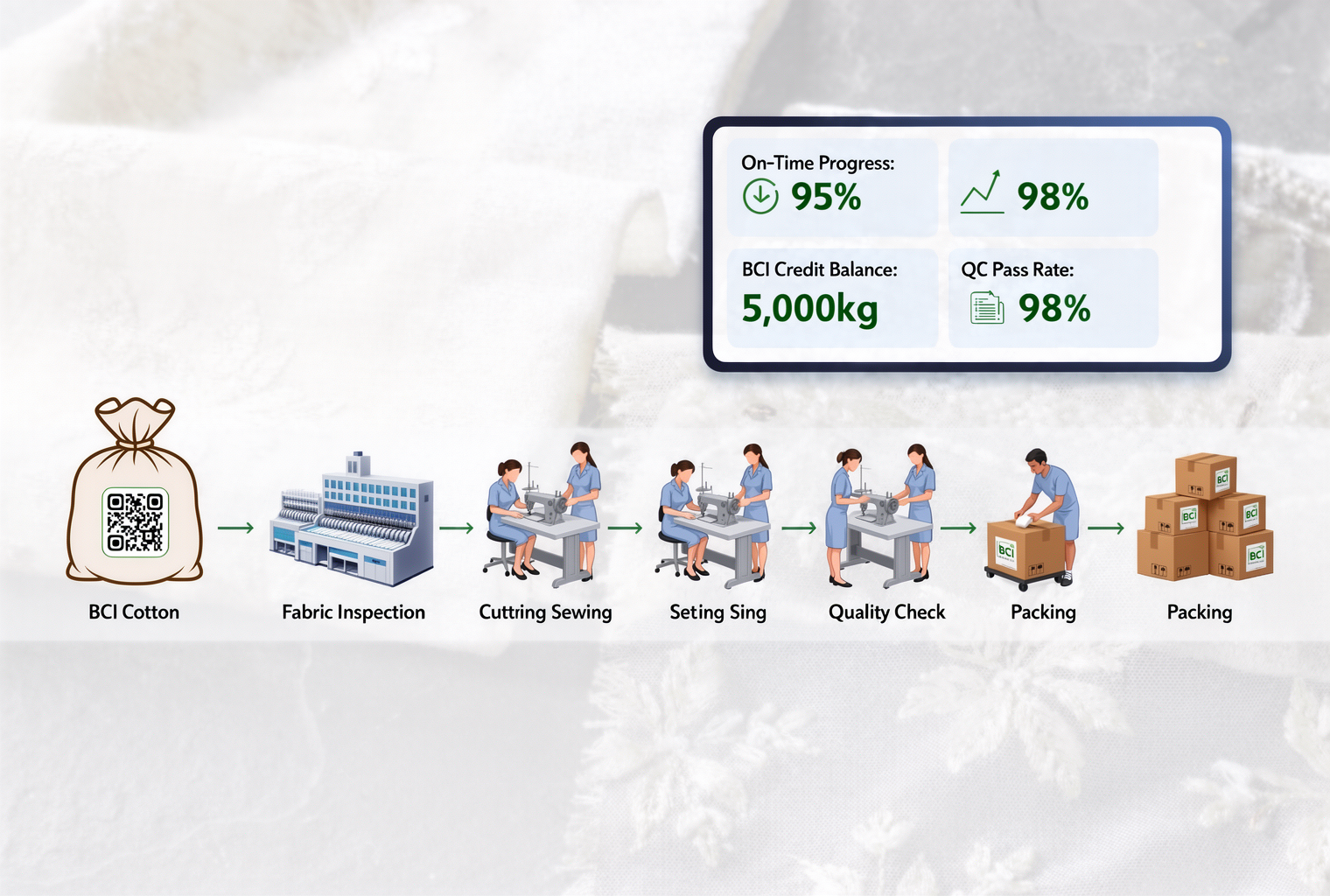
Your timeline should then mirror a standard order, with clear checkpoints for TC generation. An efficient partner will have this mapped out. For example, a standard timeline for a 5,000-piece BCI cotton polo shirt order with us looks like this:
- Week 1-2: Sample development & approval (with lab dip made from BCI stock).
- Week 2: Critical Step: Bulk fabric production & BCI credit reservation confirmed.
- Week 3-5: Garment cutting, sewing, finishing.
- Week 6: Final QC, packing, and simultaneous generation of shipping documents AND BCI Transaction Certificates.
- Week 7: Goods shipped.
Notice the TC isn’t an afterthought; it’s generated in parallel with packing. This parallel processing is a hallmark of efficiency.

How do Chinese holidays impact BCI garment lead times?
They impact them significantly, and planning is everything. The golden rule is: Your bulk fabric must be produced and your BCI credits locked BEFORE major holidays. Chinese New Year is the big one. If your fabric is not woven and dyed before the 3-4 week shutdown, your entire project is on hold. An efficient supplier will warn you about this the moment you discuss dates.
We advise clients to have their BCI bulk fabric order placed at least 8 weeks before Chinese New Year. For instance, for CNY 2024, a German sustainable brand finalized their BCI jersey fabric order with us by early December 2023. This allowed us to produce and ship the fabric to the garment factory in January, ensuring production could start immediately after the holiday in late February. They received their goods in April as planned, while competitors who missed the fabric deadline were delayed until June. Proactive holiday planning is non-negotiable for efficiency.
What’s the most efficient shipping and documentation method?
Consolidated Sea Freight (FCL) with pre-cleared documentation. For BCI garments, your commercial invoice, packing list, and BCI Transaction Certificate must be perfectly aligned. The most efficient method is to have your supplier handle all of this, shipping a full container load directly to your port or warehouse.
The advantage is single-point responsibility. We ensure the BCI TC details (weight, volume) match the customs documents exactly, avoiding delays at port. For a UK retailer we worked with in late 2023, we shipped a 40ft container holding 35,000 units of BCI-certified loungewear. We provided them with one master Bill of Lading, one master commercial invoice, and one master BCI TC covering the entire shipment. Their logistics team had one clean set of papers for customs, saving them days of administrative work compared to piecing together multiple LCL (Less than Container Load) shipments. Efficiency in logistics is about reducing touchpoints and documents.
How to Maintain Quality Control and Compliance Throughout?
Efficiency without quality is wasted effort. For BCI garments, QC has two layers: Physical Product Quality and Documentary Compliance Quality. An efficient system audits both in parallel, not sequentially.
Our in-house QC team conducts inspections at three critical stages, checking both aspects:
- Fabric Inspection (Pre-Production): We check for defects per 100 yards and take a small cut to test against the tech pack specs. We also verify the fabric batch is logged against our BCI credit reserve.
- During Production (DUPRO): We check sewing quality, sizing, and trims. We also confirm the factory is using the correct, segregated BCI fabric rolls.
- Final Random Inspection (FRI): We check finished garments against AQL 2.5 standards. Simultaneously, our compliance team finalizes the BCI TC data based on the actual net weight of the shipped goods.
This integrated approach means a quality failure or a documentation error is caught early, when it’s cheaper and faster to fix.

What are the critical checkpoints for BCI compliance during production?
Create a simple compliance checklist and demand evidence at each point:
- Checkpoint 1: Fabric Receipt at Garment Factory. Your supplier should provide a photo/video of the fabric roll labels showing the unique lot number, alongside the BCI material documentation.
- Checkpoint 2: Cutting Table. Confirm that only the BCI-approved fabric is being used for your order, especially if the factory runs multiple lines.
- Checkpoint 3: Labeling & Packing. The most common error is incorrect hangtags or care labels. The BCI logo must be used according to BCI’s branding guidelines. A final photo of the packaged cartons with shipping marks is essential.
In a project for a Scandinavian children’s wear brand, our DUPRO inspection found the sewing factory had accidentally used a non-BCI fabric for 200 pieces of a 5,000-piece order (a leftover roll from another client). Because we caught it at the sewing stage, we could isolate those pieces, re-cut with the correct fabric, and only delay that style by 3 days—without affecting the overall shipment or TC. Early, vigilant checkpoints save fortunes.
To build a robust system, researching standardized quality inspection procedures (AQL) for garment production is essential. Furthermore, ensuring ethical factory auditing beyond just material certification is crucial for true end-to-end responsibility.
Can I use my own third-party QC firm for BCI orders?
You can, but you must brief them thoroughly on the compliance checks, not just the quality checks. Most third-party QC firms are experts in stitching and sizing, but not in BCI chain-of-custody verification. This can lead to inefficiency—they might pass the physical quality but miss a documentary flaw that later holds up your shipment.
The most efficient model is to use your supplier’s integrated QC team (if they are reputable and you trust them) or to insist your third-party inspector uses a custom checklist you provide that includes the BCI compliance points. Clear communication here prevents a costly second inspection or post-shipment disputes about certification.
How to Negotiate Costs and MOQs Effectively?
BCI garments do carry a cost premium, but it’s often smaller than buyers fear and can be managed through smart sourcing. The premium covers the farmer license fee, system administration, and often a slightly higher cost for cotton grown under better practices. For a standard cotton garment, expect a 3-8% increase in FOB cost compared to a conventional equivalent.
The key to efficient cost negotiation is transparency and volume consolidation. Ask your supplier to break down the BCI premium per garment. A good partner will show you. Then, work to consolidate your orders. Instead of making five small orders for different styles across the year, combine them into two larger orders. This gives you more negotiating power on the base price, which dilutes the relative impact of the fixed BCI premium. We consistently find that brands who plan their BCI sourcing holistically achieve costs within 1-2% of their conventional targets.

What are realistic MOQs for BCI garment production?
MOQs are determined by the garment factory, not the BCI system. However, an integrated supplier can help you meet lower thresholds. A typical Chinese garment factory might have an MOQ of 500-1000 pieces per style/color. For BCI, this is generally feasible. The challenge is the fabric MOQ. This is where our model at Shanghai Fumao adds efficiency: we can often use our standing inventory of BCI fabrics (like jersey or poplin) to fulfill smaller garment orders, bypassing the 3000-meter minimums that standalone mills require. For a startup eco-brand in California, we enabled a BCI capsule collection with an MOQ of only 300 pieces per style by leveraging our stock fabric program and combining their order with another small batch in the cutting plan.
How do payment terms differ for BCI orders?
They shouldn’t, if you’re working with a financially stable supplier. Efficient, ethical sourcing is built on trust. Standard terms like 30% deposit, 70% before shipment still apply. Be wary of suppliers who demand full payment upfront for BCI orders—it often indicates they lack the capital to purchase the BCI credits and fabric on your behalf, which is a red flag for future delays. Our partnerships with local banks allow us to extend stable terms to our clients, ensuring cash flow doesn’t hinder your ethical sourcing project.
Conclusion
Sourcing ethical BCI garments from China efficiently is a matter of strategy, not sacrifice. It requires moving from a transactional, multi-vendor approach to a strategic partnership with an integrated, licensed supplier. This partner becomes the engine of your efficiency, managing the complex interplay of material sourcing, certification logistics, quality control, and compliance documentation within a single, streamlined framework.
The result is a supply chain that is not only faster and more reliable but also transparent and defensible. You gain the ability to respond to market demands quickly without compromising your ethical standards, building a brand reputation that is both agile and solid.
Ready to streamline your ethical sourcing? The journey begins with a conversation focused on systems, not just swatches. Contact our Business Director Elaine to discuss how our integrated BCI garment sourcing model can bring speed, clarity, and integrity to your next collection. Reach her at: elaine@fumaoclothing.com.