Let me tell you about a call I got last month. A frantic buyer from Poland had sourced "OEKO-TEX® certified" baby romper fabric from a new supplier at a 20% lower cost. His garment factory just finished 5,000 pieces. As a final check, he randomly sent one to a lab. The report came back: formaldehyde, heavy metals detected. The certificate PDF the supplier sent? A sophisticated forgery. The supplier vanished from Alibaba, and the buyer was left with $40,000 in unsellable—and potentially dangerous—inventory. This isn’t a rare horror story; it’s a weekly occurrence in our industry. The question isn’t if certificate fraud exists, but how you, as a buyer, can armor yourself against it.
The key is to shift your mindset from "trust but verify" to "verify relentlessly, then trust." Avoiding suppliers who falsify certificates requires a proactive, forensic approach that goes far beyond accepting a PDF as proof. You must become an expert in the verification tools provided by certification bodies, learn to audit the systems behind the certificate, and structure your orders to de-incentivize fraud. It’s not about finding perfect suppliers (they don’t exist), but about identifying which ones have invested in real, verifiable compliance systems that make fraud both difficult and illogical for them.
You might think this level of scrutiny is only for giant corporations. I argue it’s even more critical for SMEs who can’t absorb a single catastrophic loss. This guide will walk you through a practical, step-by-step defensive strategy. We’ll cover how to conduct online verification like an investigator, perform a "certificate audit" during supplier evaluation, use production orders to test authenticity, and recognize the behavioral red flags that often accompany document fraud. I’ll share the exact protocols we use at Shanghai Fumao to verify our own upstream suppliers, because if we don’t get it right, our clients pay the price.
Step 1: Master the Art of Online Verification – Don’t Just Look, Investigate.
The first and most powerful line of defense is at your fingertips. Every legitimate certificate from a major body (OEKO-TEX®, GOTS, BCI, BSCI, ISO) has a unique number and is listed in a public online database. Your job is to find that database and cross-check every detail. This 5-minute step filters out 80% of lazy forgeries. The most common scam is the "borrowed certificate"—a real certificate from a different company or product is edited. The second is the "expired certificate." Online verification catches both.
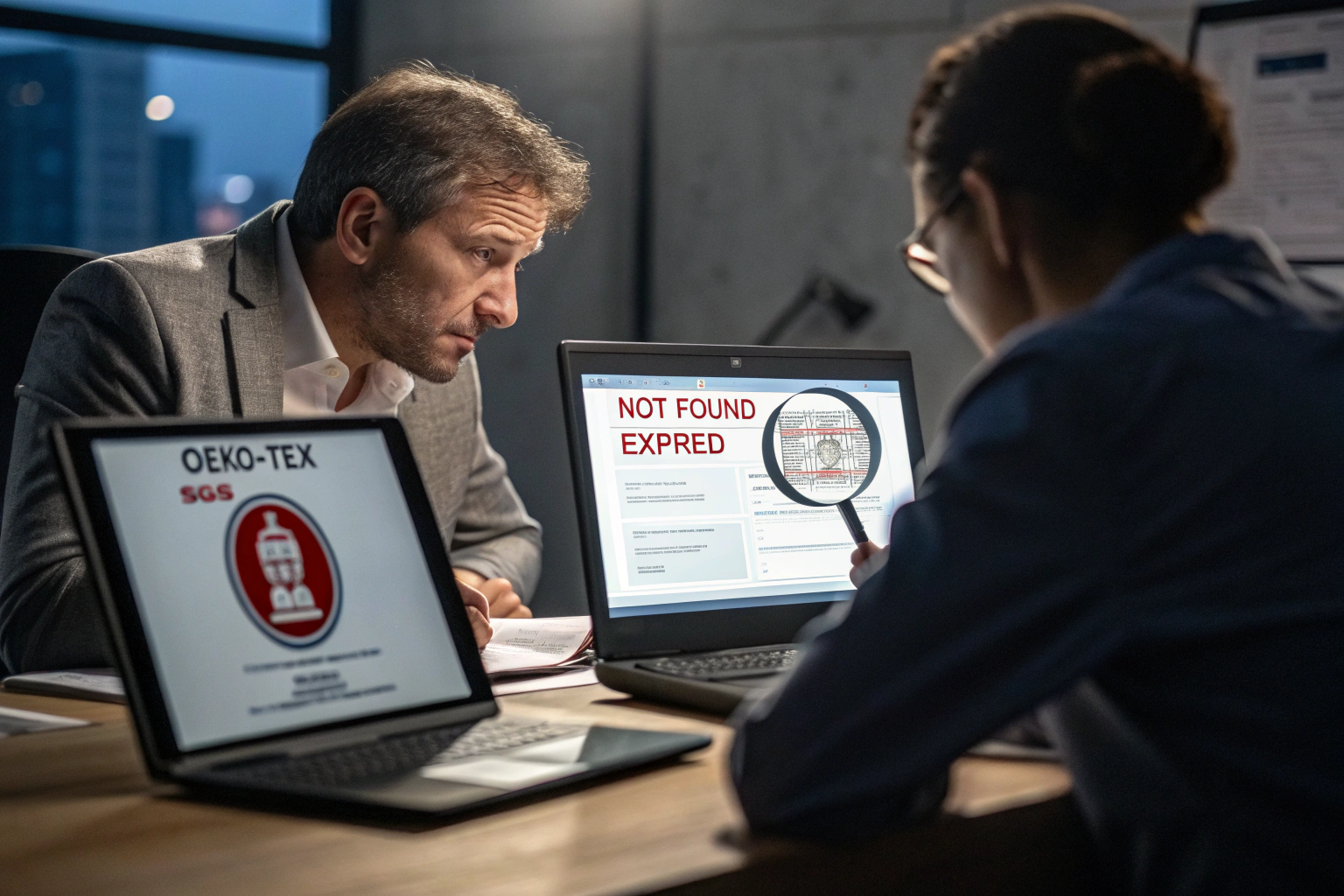
Start by asking the supplier for the full, clear certificate file (not a screenshot) and the direct link to the verification page on the issuer’s website. If they hesitate or send a blurred image, that’s Red Flag #1. Then, independently navigate to the certification body’s official site. Don’t Google "check OEKO-TEX cert"—go directly to www.oeko-tex.com and find their "Certificate Check" tool. Enter the certificate number and the supplier’s company name exactly as it appears on their business license.

What Specific Details Must Match Perfectly?
When you pull up the official record, it must be a mirror image of the PDF the supplier sent. Scrutinize:
- Company Legal Name and Address: Is it 100% identical? A difference of "Co., Ltd." vs. "Limited" could be okay, but a different city or street name is a major red flag.
- Certificate Holder: Is the supplier you’re talking to the actual certificate holder? If the certificate is held by "XXX Textile Mill," but you’re dealing with "YYY Trading Company," you need a valid Transaction Certificate (TC) linking the trader to the mill’s certified batch. No TC = no valid claim.
- Product Description & Scope: Does the certified product exactly match what you’re buying? A certificate for "Polyester Knit 180gsm" does not cover "Polyester Knit 220gsm" or "Polyester Woven."
- Validity Dates: Is the certificate current? Certificates typically last one year and require renewal. An expired certificate is invalid.
- Testing Institute/Notified Body: Which organization issued it (e.g., TESTEX for OEKO-TEX® in China, Control Union for GOTS)? Verify that this institute is indeed authorized by the certification scheme.
Bookmark the verification pages for the standards you care about. For example, you can verify BSCI reports on the BSCI Platform, and GOTS certificates on the GOTS Public Database. Make this your non-negotiable first step for every new supplier.
How to Verify When There’s No Public Database?
Some audits or reports (like specific SGS quality tests) may not be in a public database. In these cases, you must request a verification method. This usually means:
- Asking the supplier to provide the original email from the auditing body with the report attached.
- Contacting the local office of the certification body (e.g., SGS Shanghai) directly with the report number and supplier details to confirm authenticity. Reputable suppliers will not fear this; they will facilitate it.
- For test reports, ensure they are issued by a certified laboratory (with a lab accreditation number like CNAS, ILAC). You can verify the lab’s accreditation status online.
If a supplier says "the database is private" or "we can’t share that link," be extremely skeptical. Transparency is the hallmark of a legitimate operation.
Step 2: Conduct a "Certificate & System" Audit During Supplier Evaluation.
A valid certificate is necessary, but not sufficient. It proves a product or system passed a test at a point in time. The real question is: does the supplier have an operational system to ensure ongoing compliance? This is what separates authentic suppliers from those who might have gotten one batch certified just to have a document. You need to audit the system behind the seal.
This can be done virtually or in person. Schedule a dedicated meeting, not with sales, but with their quality control or compliance manager. Prepare a list of technical questions. Their ability to answer fluently and provide evidence is telling.

What Questions Reveal a Real Management System?
Ask these process-oriented questions:
- "How do you ensure that every batch of this certified fabric meets the standard?" Look for answers like "we batch-test key parameters in-house," "we only source from certified dyehouses," or "we use a mass balance system."
- "Can you show me your material tracking system?" A real system will track certified raw material from receipt through to shipping, often with lot numbers. Ask them to share a sample record (blurring confidential info).
- "What happens if an incoming material fails your internal check?" A good answer describes a quarantine and return/rejection procedure.
- "How do you train your staff on the requirements of this standard?" They should have records or descriptions of training.
For example, when we at Shanghai Fumao are audited by clients, we show our digital fabric tracking system. Each roll has a QR code. Scanning it shows the OEKO-TEX® certificate, the test report, the dye lot, and even which loom it came from. This level of traceability is hard to fake and demonstrates a living system.
How to Spot Physical Red Flags During a Factory Visit?
If you visit, go beyond the conference room.
- Ask to see the certified products in the warehouse. Are they stored separately or mixed with non-certified goods? Are the rolls labeled with certification info?
- Visit the QC lab. Do they have basic equipment (pH meter, colorfastness tester) to do internal checks? A lab that looks unused is a bad sign.
- Ask to see the posted certificate. Most standards require the certificate to be displayed at the certified site. Is it the original? Does the date match?
- Observe general housekeeping. A chaotic, dirty factory is unlikely to have the discipline for rigorous chemical management.
A supplier with a fake certificate will often avoid these deep-dive discussions or factory tours. They’ll keep the conversation on price and vague promises.
Step 3: Structure Your First Order as a Authenticity Test.
Your trial order is your most powerful verification tool. Don’t use it to produce your easiest, most generic item. Use it to stress-test their certification claims. Structure the order in a way that makes fraud difficult and unprofitable for the supplier.
Strategy 1: The "Batch-Specific" Request. When ordering, explicitly state: "Please supply from your OEKO-TEX® certified stock for product code XYZ, and provide the Transaction Certificate (TC) for this specific batch upon shipment." A TC is a one-time document issued for a specific quantity of certified material sold to a specific buyer. It’s the legal link between the master certificate and your goods. A supplier with a fake master certificate cannot produce a valid TC from the certification body. If they balk or provide a doctored TC, you have your answer before you pay the balance.
Strategy 2: The "Third-Party Check" Clause. In your contract or PI, include a clause: "Final payment is contingent upon the passing of a random verification test conducted by a third-party lab (e.g., SGS) on pre-shipment samples. The test will verify compliance with the claimed standard [e.g., OEKO-TEX® STANDARD 100]. Costs of a failed test will be borne by the supplier." This puts your money where their mouth is. Fraudulent suppliers will often reject this term or suddenly become "unavailable."

What If They Pass the Small Order But Fail Later?
This is a common "bait-and-switch" tactic. They perform perfectly on a small, monitored trial order to win your trust and the large follow-up order, then cut corners on the big one. To prevent this:
- Maintain Random Testing: Don’t stop testing after the first order. Schedule unannounced inspections and random lab tests for large orders. The ongoing threat of discovery is a deterrent.
- Build in Traceability: Use unique identifiers. For instance, ask for specific care labels or batch codes to be sewn into the garment, which can be matched back to the TC and production records.
- Develop a Relationship with Their QC Personnel: Communicate directly with their factory’s QC manager, not just the salesperson. This creates an additional layer of accountability.
We had a client who discovered this the hard way with another supplier. Now, for their orders with us, they randomly select one carton from every shipment of over 1000 units and send a garment to a lab. We welcome this. It’s the cost of doing transparent business. Over three years and dozens of tests, we’ve had a 100% pass rate. That’s the track record you need to look for.
How Can Payment Terms Protect You?
Use staged payments that align with verification milestones. A classic secure structure for a new supplier is:
- 30% deposit after contract signing.
- 40% payment after approval of pre-production samples and receipt/verification of all component certificates (fabric, trim, etc.).
- 30% balance after passing a pre-shipment inspection and receiving the batch-specific Transaction Certificate.
Never pay 100% upfront. The financial leverage is a key part of your risk management. Fraudsters prefer large upfront payments.
Step 4: Recognize the Behavioral and Commercial Red Flags.
Often, the signs of potential fraud are visible in how the supplier communicates and conducts business long before you see a certificate. Train yourself to spot these patterns.
Red Flag Cluster: The "Too Good to Be True" Offer.
- Prices significantly (15%+) below known market rates for certified materials.
- Ability to supply any certification instantly, with no lead time or cost premium.
- Reluctance to provide detailed company information, videos of the facility, or contact information for existing long-term clients.
Red Flag Cluster: Evasive Communication.
- Inconsistent answers to technical questions. Salespeople who constantly say "I need to check with the factory" for basic compliance questions.
- Pressure to decide quickly, using "limited stock" or "special discount today only" tactics.
- Avoidance of video calls or live factory walkthroughs. Excuses about "poor internet" or "factory is too busy."
Red Flag Cluster: Document Irregularities.
- Certificates that are low-resolution, have blurred text, or look "photoshopped."
- Inability to explain the details on their own certificate.
- Providing certificates in a non-standard format (e.g., a Word document instead of a secured PDF from the issuer).

What About Suppliers Who Badmouth Certifications?
Be wary of suppliers who say things like: "Certificates are just for marketing, our quality is the same without it," or "That standard is too strict and not necessary." While there can be discussions about the cost/benefit of various certs, a wholesale dismissal of industry-recognized safety standards demonstrates a fundamental disregard for the compliance requirements that you, the buyer, must meet. It signals they are not a strategic partner for regulated markets.
The Green Flags of a Authentic Supplier.
Conversely, look for these positive signs:
- Proactive Transparency: They offer verification links without being asked.
- Educational Approach: They explain the standard, its value, and their process.
- System Focus: They talk about their QC processes, testing equipment, and training.
- Long-Term Perspective: They are interested in your business and compliance needs, not just the immediate order.
- Invests in Infrastructure: They have their own lab, tracking software, or dedicated compliance team.
A supplier like Shanghai Fumao will invite you to verify, will walk you through our CNAS lab, and will see your scrutiny not as an insult, but as a sign of your professionalism. We know our systems can pass the test.
Conclusion
Avoiding suppliers who falsify textile certificates is a continuous process of diligent verification, systemic auditing, smart ordering, and pattern recognition. It requires moving from a passive recipient of documents to an active, informed investigator. The cost of failure is not just financial; it’s the risk to your brand’s reputation and, in the case of children’s or safety-critical products, the risk to human health.
The most powerful shield you have is knowledge and a systematic approach. By mastering online verification, conducting deep audits of the compliance system, using your trial order as a forensic test, and understanding the behavioral economics of fraud, you can dramatically reduce your risk. Remember, legitimate suppliers have nothing to hide and will view your thoroughness as a mark of a serious, valuable partner.
Building a transparent, compliant supply chain is the ultimate competitive advantage. If you are looking for a partner who not only holds real certificates but operates a verifiable system behind them, let’s connect. At Shanghai Fumao, we have built our reputation on this transparency. Contact our Business Director, Elaine, to start a partnership where verification is welcomed and trust is built on evidence. Reach her at: elaine@fumaoclothing.com.