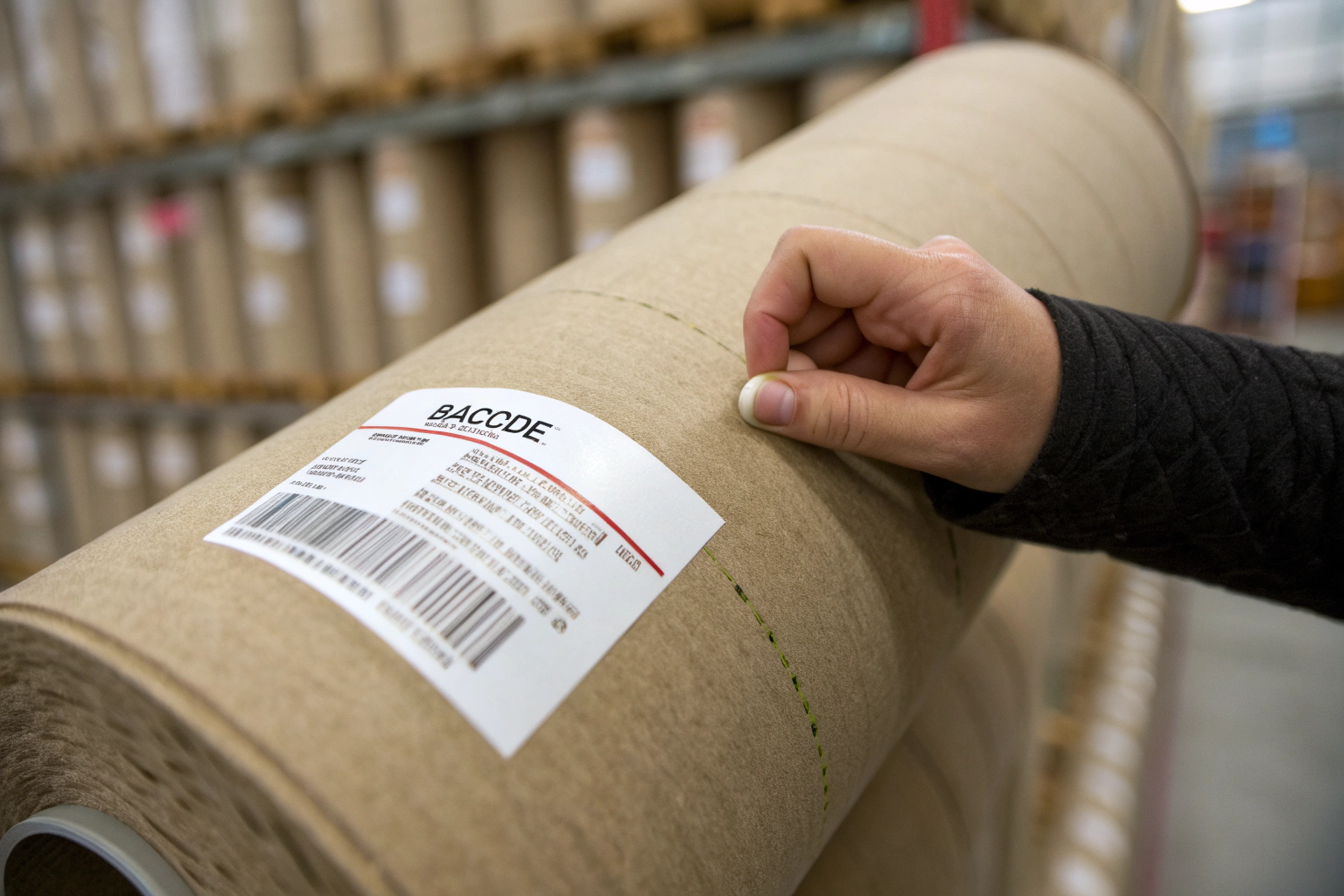
You just received a shipment of 5,000 yards of fabric from your supplier. It looks beautiful on the truck. You sign the papers. The truck leaves. Now it’s just you and a warehouse full of brown cardboard rolls. How do you know what’s actually inside those rolls? I’ll tell you a secret that separates the seasoned importers from the rookies who lose their shirts. The sticker on the end of that bolt—that little piece of paper with the barcode—is a legal contract, a lab report, and a treasure map all rolled into one. Ignore it, and you’re gambling with your production schedule. Learn to read it like a pro, and you’ll catch a 10% width shortage or a dye lot mismatch before it hits the cutting table and costs you thousands in wasted labor.
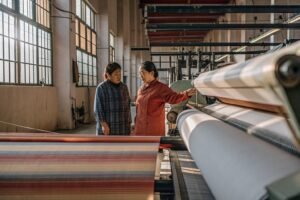
At Shanghai Fumao, we ship thousands of bolts a month to over 100 countries. We don’t just slap a "Color: Blue" sticker on there and call it a day. Our label is the final handshake between our CNAS lab, our weaving floor, and your cutting room. Reading it correctly is the single most important skill you can learn to protect your bottom line. It tells you exactly who made it, when it was inspected, whether it meets the spec you paid for, and how to re-order the exact same thing six months from now.
I’m going to break down the anatomy of a professional fabric bolt label—specifically the kind we use at Fumao—so that you never get fooled by a short roll or a shady dye lot switch again. Let’s open up that roll and look at the end cap.
What Information Is Legally Required on a Textile Bolt
Let’s start with the non-negotiable stuff. Depending on where you’re selling the final garment, there are laws that dictate what must be on that label. In the US, the Federal Trade Commission (FTC) has rules under the Textile Fiber Products Identification Act. In the EU, it’s Regulation (EU) No 1007/2011. If your bolt label doesn’t have this information, or if it’s wrong, you can’t legally sell the garment made from it.
Here’s the bare minimum a professional label (and the invoice that matches it) should provide:
- Fiber Content (%): Listed in descending order of weight. "100% Cotton" or "65% Polyester / 35% Viscose." Generic names only (no trademarked names like "Lycra" unless followed by the generic "Spandex").
- Country of Origin: Where the fabric was woven or finished. For us, that’s "Made in China."
- Manufacturer/Importer ID: The RN number (US) or CA Number (Canada) or the name of the responsible company. This is the trail back to us.
- Care Instructions: Usually a reference to the recommended care method (e.g., "Care: Dry Clean Only" or symbols).
At Shanghai Fumao, we go way beyond the legal minimum. Our label includes the full CNAS test report number. That’s not required by law, but it’s required by smart business. It’s the proof that the "100% Cotton" claim is real.

Why Is the RN Number Important on a Bolt Label
The RN number (Registered Identification Number) is like a fingerprint for the business. It’s issued by the FTC in the US. If you see an RN number on a bolt from China, that means that company has formally registered with the US government as a textile importer or manufacturer.
Why should you care? Liability and Traceability. If you buy fabric from a random booth at a trade show and the label only says "Polyester," and then your shipment gets seized at customs for false labeling, who do you call? Ghost number. But if that bolt has an RN number (Shanghai Fumao’s is on every bolt we ship to the US), customs can trace it back to a real, accountable entity.
It also shows that the supplier understands the US market. A mill that doesn’t know what an RN number is probably doesn’t know what a CPSIA certificate is either. That’s a red flag. You can verify any RN number yourself using this official FTC search tool for Registered Identification Numbers. If the number on the label doesn’t match the company name, run.
Does the Bolt Label Have to Show Fabric Width
Legally? Not always for consumer labeling, but commercially? Absolutely essential. If a bolt label doesn’t show the Cuttable Width in inches and centimeters, you are being set up for a short cut.
Width is how fabric yield is calculated. You buy fabric by the linear yard or meter, but you use it by the square inch. If you order 58/60" wide fabric and the bolt arrives at 56" wide, you just lost 5% of your usable fabric. Your pattern pieces won’t fit.
On a Fumao bolt label, we print the Finished Width prominently. And it’s not a guess. It’s measured by our inspection machine laser at three points (beginning, middle, end of roll). We also note the tolerance: "Width: 58" (+/- 1")". Pro tip: Always check the narrowest point of the roll. That’s your real cuttable width. For a deeper dive into fabric measurements, this guide on how to calculate fabric yield based on cuttable width is a lifesaver.
How to Decode GSM and Weight on a Fabric Sticker
Weight is where I see the most "creative math" in this industry. Some mills will tell you the weight of the greige fabric (before dyeing and finishing). Some will tell you the weight with the cardboard tube included (yes, really). Reading this part of the label correctly ensures you’re not paying for water, starch, or cardboard.
The standard unit is GSM (Grams per Square Meter) . For US buyers, it’s often Oz/Yd² (Ounces per Square Yard) . A good label will show both.
Here’s the trick: The number on the label should match the Finished Weight. That means the weight of the fabric after it has been washed, dyed, softened, and heat-set. That’s the fabric you’re actually cutting. If the label says "180 GSM" but the fabric feels like tissue paper, pull out a scale. (We’ll get to that in a second).
Another critical piece of data on the Fumao label is the Tolerance. We print: "GSM: 180 (+/- 5%)". That means the fabric can legally weigh between 171 and 189 GSM. If you’re making a structured jacket, that 189 GSM fabric will be stiffer than the 171 GSM sample you approved. Knowing that range helps you plan for slight variations in drape.

What Does "Oz Per Square Yard" Mean on Denim
If you’re sourcing denim, you’ll see "10 Oz" or "14 Oz." This is the weight of a piece of fabric that is 36 inches long by 36 inches wide. It’s a very American measurement.
Here’s a rough conversion guide we use in the office:
- Lightweight Denim: 5-8 Oz. (Shirting, summer dresses). Feels like a heavy poplin.
- Midweight Denim: 10-12 Oz. (Standard jeans). This is the sweet spot.
- Heavyweight Denim: 14+ Oz. (Raw denim, workwear). Will stand up on its own.
I had a client from Los Angeles last spring who ordered "12 Oz Denim" based on a sample from another supplier. When our production arrived, he panicked because the label said "11.5 Oz." He thought he’d been shorted. But here’s the nuance: The industry allows a 5% tolerance. 11.5 Oz is within the acceptable range for a 12 Oz spec. We had to send him the ASTM D3776 standard to prove it. Now he knows to specify "12 Oz minimum" if he wants a guaranteed weight floor. For more on this specific topic, check out this explanation of denim weight and how it affects garment performance.
How Can I Verify the Weight Claim on the Sticker
Trust, but verify. That’s my motto. You can do a "poor man’s weight check" right in your warehouse without a fancy lab. You need:
- A digital kitchen scale that reads in grams.
- A pair of scissors.
- A ruler.
Step 1: Cut a perfect 10cm x 10cm square of fabric. That’s 100 square centimeters.
Step 2: Weigh that square in grams. Let’s say it weighs 1.8 grams.
Step 3: Multiply by 100. That gives you 180 Grams per Square Meter (GSM) .
If the label says 180 GSM and your test shows 180 GSM, pop the champagne. You have an honest supplier. If it shows 150 GSM, pick up the phone. For a more detailed walkthrough, this step-by-step video guide on calculating fabric GSM at home is a great resource. (I should note: our CNAS lab uses a pneumatic cutter for perfect circles, but the square method is close enough for a warehouse check).
Why Is the Dye Lot Number the Most Critical Data Point
If you only look at one thing on the entire label, look at the Lot Number (sometimes called Batch Number or Dye Lot). This six-to-ten digit code is the single most important piece of information for preventing a garment construction disaster.
Every time we put fabric into a dye bath, it gets a unique Lot Number. Even if we use the exact same recipe, the exact same dye, and the exact same machine, there will be microscopic variations in shade between Batch #240501 and Batch #240605. It’s the nature of chemistry. If you cut the front of a dress from Lot A and the back from Lot B, you might not see the difference under your warehouse lights. But under the bright lights of a retail store, or worse, daylight, that dress will look like a two-tone color-block experiment.
This is why garment factories have a strict rule: Never mix dye lots in the same garment. The bolt label is your defense against this. Before you issue fabric to the cutting table, sort the bolts by Lot Number. Cut all the Size Mediums from Lot A, and all the Size Larges from Lot B. Never cut a sleeve from one lot and a bodice from another.

Can Two Bolts with the Same Color Name Look Different
Absolutely. And this is the trap that gets beginners. A color name is a marketing term. "Navy Blue" is subjective. One person’s Navy is another person’s Midnight. The Dye Lot Number is the scientific identifier.
At Fumao, we might have a color called "Deep Indigo" (our internal code: FUM-IND-09). We might dye 10,000 yards of it for a big order. That whole 10,000 yards will have one Lot Number. Six months later, we get a re-order. We dye another 10,000 yards. It will have the same color name but a new Lot Number.
If you are a brand making a restock of your best-selling item, you must check the new lot against the old lot. We keep a physical swatch of every lot for 3 years just for this purpose. We call this "Shade Banding." We will send you a swatch of the new lot to approve against your existing inventory before we ship the bulk. This is the kind of service that separates a professional mill from a commodity trader. For more on managing this process, read this guide to understanding and controlling shade variation in textile production.
What If the Bolt Label Has Multiple Lot Numbers
This is a Red Flag. A single bolt of fabric should only contain fabric from one dye lot. If a label says "Lot: 2405-01 / 2405-02," that means the mill has joined two different rolls of fabric together to make one long bolt.
Sometimes this is legitimate (e.g., a "mill join" with a sticker marking the splice). But if the label just lists multiple lots without a clear physical marker on the fabric, it means the roll is a "Crazy Quilt" of leftovers. You might start cutting and find the shade changes halfway down the roll.
We never do this at Fumao without explicit client permission. We cut out the splice and start a new bolt. A clean bolt = a clean cutting room. If you want to see how a proper mill handles this, check out this discussion on fabric roll splices and how they affect apparel manufacturing.
What Does the Inspection Grade on a Sticker Mean
You’ll often see a letter or number grade on the label, or a colored sticker. "Grade A." "First Quality." "Q1." What does this actually mean? It’s the mill’s internal verdict on the fabric’s visual appearance.
Most mills use a system based on the 4-Point System for fabric inspection. This is a standard method where points are assigned to defects based on their size:
- 1 Point: Defect 3 inches or less (small slub, tiny oil spot).
- 2 Points: Defect 3-6 inches.
- 3 Points: Defect 6-9 inches.
- 4 Points: Defect over 9 inches or a hole.
The inspector looks at 100 square yards of fabric. They add up all the points. If the total points are below a certain threshold (usually 40 points per 100 sq yards for apparel), the fabric passes and gets a "Grade A" or "First Quality" sticker. If it’s over that threshold, it’s "Seconds" or "Grade B."
At Shanghai Fumao, we don’t just slap a "Grade A" sticker on there and call it a day. Our label shows the Actual Points per 100 Yards. "Points: 12/100yds." That level of transparency tells you exactly how clean this specific roll is.

What Is the Difference Between First Quality and Seconds
- First Quality (Grade A): Meets all specifications. Defects are within the acceptable industry limit (usually <40 points/100 yds). This is what you use for main body pieces of a garment.
- Seconds (Grade B/C): Exceeds the defect limit. May have a noticeable stain, a recurring weaving bar, or a selvage issue. The price is usually 30-60% cheaper.
There is a time and place for Seconds. If you’re making pocketing, interlining, or toiles (muslins for fitting), Seconds are a great way to save money. But you must know you’re buying Seconds.
The danger is when a supplier sells you Seconds at First Quality prices and puts a fake Grade A sticker on the bolt. How do you catch this? Pull a few yards off the roll and inspect it yourself. If you see a defect flag (a little colored tape sticking out of the selvage) every 10 yards, that roll is full of defects and should have been graded B. For a deeper understanding of how the math works, check out this detailed explanation of the 4-point fabric inspection system.
Does the Label Show the Shrinkage Test Result
This is a premium feature of a Fumao bolt label. Most cheap mills don’t put this on the label because they don’t want you to know how much the fabric will shrink until after you’ve washed it.
We print the Dimensional Stability result directly on the sticker. For example: "Shrinkage: W= -3%, F= -2%." That means the fabric will shrink 3% in the Width direction and 2% in the Length (Filling) direction after washing.
Why is this on the bolt? So your cutting room foreman sees it immediately. If the fabric shrinks 3% in width, they know they need to add 3% to the marker width to get the correct final garment size. If they don’t know this, they cut a perfect size 10 dress, and it comes out of the wash as a size 8.
We had a client in Canada who was having constant sizing issues with a specific linen blend. We showed them the shrink label. They had been ignoring it. Once they adjusted their cutting markers by the -4% we predicted, the sizing issues vanished overnight. That’s the power of reading the fine print. If you want to understand the test behind the number, read this guide to AATCC 135 dimensional stability testing for woven fabrics.
Conclusion
Reading a fabric bolt label like a pro isn’t about being a nitpicker. It’s about taking control of your supply chain. That little white sticker is the story of the fabric’s life—from the fiber blend and the country of origin, to the exact moment it came out of the dye bath and passed under the inspection light. It tells you the weight, the width, the shrinkage, and the cleanliness of the roll.
By understanding the legal requirements (like the RN number), the technical specs (GSM and width), the critical traceability code (Dye Lot), and the quality grade (Inspection Points), you stop being a passive recipient of fabric and become an active, informed partner in the production process. You catch the width shortage before you unroll it. You prevent the two-tone garment by sorting the lots. You adjust for shrinkage before the first stitch is sewn.
At Shanghai Fumao, we put all this information on the bolt because we want you to succeed. We want the fabric that arrives in your warehouse to perform exactly as the sample did on your design table. An informed customer is our best customer.
If you have questions about a spec on a Fumao bolt label, or if you’re looking at a label from another supplier and something looks fishy, we’re happy to be a second set of eyes. We’ve seen it all.
For help interpreting a fabric spec sheet or to request a sample bolt with our standard professional labeling, reach out to our Business Director, Elaine. She knows the label format better than anyone. Email her at: elaine@fumaoclothing.com. Let’s make sure you’re reading the fine print like a pro.