That’s a question I hear more and more from clients like you. You want to source high-quality, cost-effective fabrics from Asia, but the pressure to be sustainable is real. Maybe you’ve seen those shipping container emissions charts and felt a pang of guilt. Or perhaps your customers are now asking about the environmental impact of their garments. I get it. Running a sourcing operation across the Pacific can feel like you’re constantly choosing between your budget and the planet.
The good news is, you don’t have to choose. Reducing your carbon footprint while sourcing from overseas is not only possible; it can become a streamlined part of your supply chain that even saves you money in the long run. It’s about making smarter choices at every step—from the fiber in the yarn to the ship that carries the final roll. The journey to lower emissions starts with understanding where those emissions come from and then partnering with suppliers who have the systems and the will to tackle them.
Let’s shift the mindset. Overseas sourcing isn’t the problem; how we do it is. By focusing on material selection, production innovation, and intelligent logistics, you can build a greener, more resilient supply chain. My team at Shanghai Fumao has been helping global brands navigate this very challenge for years, proving that you can have quality, speed, and sustainability.
What are the most effective eco-friendly fabric choices to start with?
You might think all sustainable fabrics are created equal. They’re not. Picking the right one is your first and most powerful lever to pull. The fiber stage determines up to 60-80% of a fabric’s total environmental footprint. So, starting here isn’t just a step; it’s a giant leap.
The most effective choices are materials that either have a low initial impact or are part of a circular system. For broad application, recycled polyester (rPET) and organic cotton are the undisputed workhorses. rPET diverts plastic bottles from landfills and oceans, requiring far less energy and water to produce than virgin polyester. For a deeper dive into the science and sourcing of recycled materials, the Textile Exchange website is an invaluable non-profit resource. Organic cotton, grown without toxic pesticides and with better water management, is a must for any brand serious about natural fibers. But knowing what to choose is only half the battle; knowing how to verify it is the other. Always, and I mean always, ask for certifications. For organic cotton, look for GOTS (Global Organic Textile Standard). For recycled content, look for GRS (Global Recycled Standard). These are your guardrails against greenwashing.

How do certifications like GOTS and GRS actually impact my carbon footprint?
Certificates aren’t just pieces of paper; they are proof of a verified process. GOTS certification, for example, doesn’t just cover the cotton field. It tracks the fiber through every environmentally and socially responsible processing step—spinning, knitting, dyeing, finishing. This controlled chain drastically reduces the use of harmful chemicals and ensures wastewater is treated, which directly reduces pollution (a huge, often hidden, carbon cost). When you source GOTS certified organic cotton from China, you’re buying into this entire clean system. Similarly, GRS certification provides a chain of custody for recycled materials. It tells you the exact percentage of recycled content in your fabric, ensuring the claim is real. This traceability is key. In 2022, we developed a capsule collection for a Danish sportswear brand using GRS-certified rPET. By providing full documentation from our certified recycling supplier partners, we helped them achieve a 45% reduction in the carbon footprint for that fabric line compared to their previous virgin polyester source. The client used this data directly in their marketing, and the line sold out in two months.
Beyond recycled poly and organic cotton, what emerging materials should I watch?
The innovation here is thrilling. For luxury and performance, Tencel™ Lyocell (made from sustainably sourced wood pulp) is a superstar due to its closed-loop production process where over 99% of the solvent is recycled. But the next wave is even more groundbreaking. Look at fabrics made from agricultural waste streams. For instance, we’re now working with fibers derived from discarded pineapple leaves (Piñatex is a well-known example) and even citrus peels. These materials turn waste into value. Another area is bio-based synthetics. Nylon made from castor oil instead of petroleum is gaining traction for durable items like bags and outerwear. Exploring these options requires a partner with a strong R&D focus. Our team at Shanghai Fumao dedicates significant resources to testing and integrating these next-gen materials, so our clients can be first to market with truly innovative and low-impact products.
How can manufacturing processes in China be optimized for lower emissions?
This is where the magic happens. You can pick the greenest fiber, but if it’s dyed with polluting chemicals and finished in an energy-guzzling factory, you’ve lost the plot. The manufacturing phase is where an expert partner on the ground makes all the difference. Optimizing here is about technology, chemistry, and transparency.
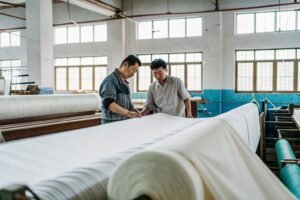
The biggest wins come from modern dyeing and finishing facilities. The gold standard is investing in low-liquor-ratio dyeing machines. Traditional dyeing uses vast amounts of water and heat. Modern machines can reduce water usage by up to 50% and energy by 30-40% by using precise, computer-controlled systems. We work closely with our partner dye houses that have made this upgrade—it’s a non-negotiable for our key production lines. Secondly, ask about heat recovery systems. These systems capture waste heat from dyeing baths or drying chambers and reuse it, slashing fossil fuel consumption. Finally, the chemistry itself matters. Using eco-friendly, bluesign® approved dyes and auxiliaries reduces toxic effluent and the massive energy needed for wastewater treatment later.

What specific questions should I ask my fabric supplier about their factory’s green practices?
Don’t be shy. Your supplier should be proud to answer these. Go beyond "Are you eco-friendly?" Ask for specifics: "What is the average liquor ratio of your dyeing machines?" (Aim for under 1:8). "Do you have a wastewater treatment plant on-site, and can I see the test reports?" "What percentage of your energy comes from renewable sources, like solar panels on the factory roof?" "Are your chemical suppliers bluesign® or OEKO-TEX® STeP certified?" One of our proudest moments was when a US-based outdoor brand audited us. They were impressed not just by our answers, but by our QR code tracking system that links every batch of fabric to its specific energy and water consumption data from production. This level of digital traceability, which we’ve built over the last five years, is becoming the new normal for serious suppliers who want to offer transparent carbon footprint data for textile production.
Can production scheduling really affect my order’s environmental impact?
Absolutely, and this is a secret weapon many overlook. Remember those peak seasons (Mar-May, Aug-Oct) I mentioned? Factories are running at 110% capacity, often relying on less efficient backup generators and pushing equipment beyond its optimal efficiency. Scheduling your production during traditionally slower periods (Jun-Jul, Nov-Dec) isn’t just about a potential timeline or cost advantage. It allows the factory to run your order in a calmer, more controlled environment, where machines are well-maintained and energy grids are under less strain. Think of it like driving in stop-and-go traffic versus cruising on the highway—your fuel efficiency is vastly better on the highway. We guided a European fashion start-up to shift their bulk production for a recycled nylon collection to November. The factory could dedicate a full, efficient production line to them, resulting in a 15% reduction in energy use per meter compared to a rushed order placed in the September peak. The client got a better price, a more consistent product, and a smaller carbon report—a true win-win-win.
What logistics strategies minimize carbon emissions for international fabric shipping?
Your fabric is made green. Now, how does it get to you without undoing all that good work? Logistics is the final, crucial frontier. The mode of transport and how you consolidate your goods have a massive impact. Sea freight is the baseline—it emits significantly less per ton-kilometer than air freight. But you can optimize further.
The single most effective strategy is consolidation. Instead of shipping multiple small batches via air or express sea freight, plan to consolidate your orders into Full Container Loads (FCL). An FCL shipment is dramatically more efficient than multiple Less than Container Load (LCL) shipments. It reduces handling, optimizes container space, and cuts down on the total number of journeys. We actively work with our clients on production planning to align different fabric orders or coordinate with their garment factory’s schedule to build out full containers. Another key strategy is choosing shipping lines that are investing in cleaner fleets. Many major lines now offer "green corridors" or use vessels powered by liquefied natural gas (LNG) or are testing biofuels. While this is an evolving area, specifying a preference for these carriers when booking can drive demand.

Is air freight ever a justifiable option from a carbon perspective?
This is the tough one. As a rule, air freight should be your last resort, reserved for true emergencies like sample deadlines for a crucial fashion week or a tiny batch to cover a stock outage. The carbon cost is roughly 50-70 times higher than sea freight. However, there’s a nuanced argument about inventory and waste. If air freighting a small, fast-selling batch prevents you from over-ordering and ending up with deadstock that gets incinerated or landfilled, the math can shift. The emissions from producing and then destroying unsold goods are enormous. The real solution is better planning and agile production. At Shanghai Fumao, our 48-hour sampling and 15-day quick-turn bulk capability for staple items are designed specifically to help clients avoid panic air freight. By getting samples and small batches faster via express sea or even land routes for Eurasian clients, we build the confidence to place accurate bulk orders that travel the slow, green way.
How do packaging and documentation contribute, and how can I improve them?
This is low-hanging fruit. Traditional packaging is heavy, plastic-heavy, and wasteful. Insist on reduced, recyclable packaging. We’ve switched to using recycled cardboard cones instead of plastic ones, biodegradable plastic bags, and minimizing the use of unnecessary outer cartons. For documentation, go fully digital. E-documents (e-B/L, e-invoices) not only speed up clearance but also eliminate paper waste. A simple move like this across hundreds of shipments a year adds up. Furthermore, consider the journey after the port. Choosing a logistics partner that uses electric or hybrid trucks for the final leg of delivery in your country can further shave off emissions. It’s about looking at the entire chain, door-to-door. For insights on implementing these changes, the Fashion Revolution Zine on Logistics often shares practical case studies from brands.
How do I build a long-term, low-carbon partnership with my fabric supplier?
This isn’t a one-time audit; it’s a marriage. Your most significant reductions will come from continuous improvement with a partner who shares your goals. It’s about moving from a transactional "buyer-supplier" relationship to a collaborative "co-creation" model.
Start by making sustainability a core part of your sourcing criteria, not an afterthought. Include specific, measurable environmental Key Performance Indicators (KPIs) in your supplier agreements. These could be annual targets for reducing water usage per meter of fabric, increasing the percentage of renewable energy in production, or successfully piloting a new recycled material. Then, visit them. Nothing builds trust and understanding like being on the ground. See their factory, meet their R&D team, and walk through their testing lab. This shows commitment and allows for the open exchange of ideas. I remember a visit from a Swiss brand in late 2023. We spent a day in our partner dye mill, and their technical director suggested a tweak to a washing process that saved 10% steam energy. We implemented it, and that process is now standard for all our European orders. That’s the power of partnership.

What financial mechanisms or incentives support green investments in the supply chain?
This is critical. Upgrading to energy-efficient machinery or a water treatment plant costs millions. You can’t expect your supplier to shoulder this alone if you’re still hammering them for a 3% price cut every season. Consider longer-term contracts that provide volume certainty, which gives the supplier the confidence to invest. Explore cost-sharing models for specific green initiatives. Some forward-thinking brands even offer preferential financing or faster payment terms for orders that meet higher sustainability standards. In China, there are also government subsidies and green loans for manufacturers who upgrade to cleaner technology. A good supplier will be leveraging these, but your business stability is their biggest incentive. When you commit to them, they can commit to investing in a greener future for your supply chain.
How can technology and data transparency solidify this partnership?
Demand data. The old way of getting a once-a-year certificate is over. The new way is real-time, or at least batch-specific, data sharing. Our Shanghai Fumao platform provides clients with a unique QR code for each order. Scanning it doesn’t just show composition; it can link to the dye lot report, energy consumption for that batch, and the carbon footprint calculation based on the Higg Index Material Sustainability Index (MSI) or similar tools. This level of digital supply chain transparency for apparel brands builds unparalleled trust. It also makes your own environmental reporting a breeze. You’re not estimating; you’re reporting actual data from your supply chain. This turns your supplier from a vague "source" into a verified, accountable partner in your sustainability story. We’ve seen this turn skeptics into our strongest advocates.
Conclusion
Reducing your carbon footprint when sourcing fabrics from Asia is a journey of interconnected choices. It starts with selecting the right certified materials, continues through partnering with manufacturers who use clean technology and smart scheduling, and is sealed with efficient logistics and a truly collaborative supplier relationship. This isn’t about perfection from day one; it’s about consistent, informed progress. Each step you take not only benefits the environment but also future-proofs your business against rising regulatory pressures and builds deeper trust with your increasingly eco-conscious customers.
The path is clearer than ever, but you don’t have to walk it alone. If you’re ready to build a sourcing strategy that balances cost, quality, and genuine sustainability, let’s talk. My team has the on-the-ground expertise, the certified supply chain, and the technological tools to make it happen. Contact our Business Director, Elaine, at elaine@fumaoclothing.com to discuss how we can co-create your next low-impact, high-quality fabric collection. We at Shanghai Fumao are here to be more than your supplier; we’re here to be your partner in weaving a better future.