
You‘ve just received a shipment from us with a stack of certificates—OEKO-TEX, GRS, SGS test reports. The fabric is perfect. But now what? For many brand buyers, these documents feel like a “nice to have” that gets filed away. That‘s a massive missed opportunity, and frankly, a risk. In today‘s market, our certificates aren‘t just proof of what you bought; they are active tools you can leverage to build your own compliance fortress, reduce internal audit costs, and even market your products with confidence. Your supplier‘s certificate is your first line of defense, not the last.
The short answer is: use our certificates as the foundational evidence in your own due diligence process. Think of Shanghai Fumao‘s certifications as the verified raw data. Your job is to integrate this data into your brand‘s compliance narrative for retailers, regulators, and consumers. A certificate from a reputable supplier with an accredited lab (like our CNAS lab) is far more than a piece of paper—it‘s a transfer of trust and a delegation of risk mitigation. It means you don‘t have to reinvent the wheel or test every single SKU from scratch. You can build upon our work.
Let me be direct. The old way was to treat supplier certificates as a box to check during sourcing. The new way, which we help our partners implement, is to use them as living documents that feed into your digital product passports, satisfy ESG reporting requirements, and pre-answer the tough questions from major retailers like Target, Walmart, or Amazon. I‘ve seen brands waste thousands on third-party testing because they didn‘t know how to properly present and cross-reference our existing certificates. My goal here is to show you how to turn our certification into your competitive advantage and compliance shield.
How to Integrate Our OEKO-TEX or GOTS Certificate into Your Tech Pack & Spec Sheet?
Your tech pack is the birth certificate of your garment. Embedding our certificate information here from the start ensures compliance is designed in, not inspected in later. This is proactive risk management at its best.
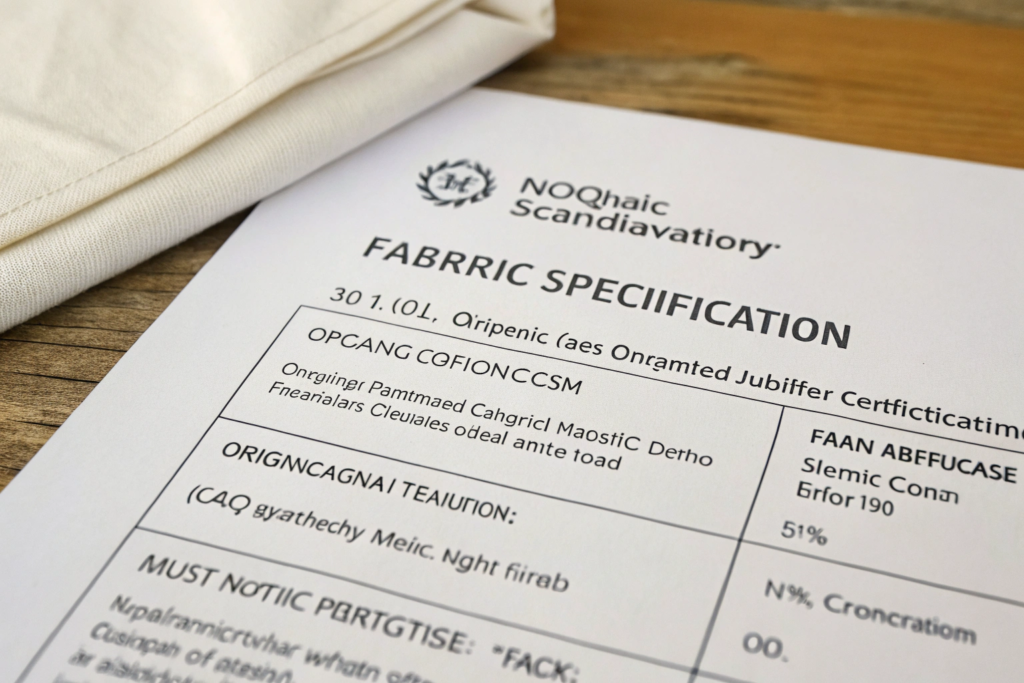
Don‘t just attach our certificate PDF as a separate file in a folder called “Supp Docs.“ Reference it directly in the material specification section. For example, in the fabric details, write: “Fabric: 30/1 Organic Cotton Jersey, 180gsm – Must be supplied with valid GOTS Certificate (Reference: GOTS-CN-XXXXX) from certified supplier Shanghai Fumao.“ This instructs your garment factory and any downstream auditors exactly where the compliance evidence originates. It creates an unbroken chain of custody. In early 2024, we worked with a Scandinavian minimalist brand that did exactly this. They referenced our OEKO-TEX certificate number in their tech packs for a new loungewear line. When their appointed third-party auditor visited the cut-and-sew factory in Vietnam, the factory manager presented our certificate. The auditor was able to verify its authenticity online in minutes, streamlining the entire social compliance audit. The brand saved a full audit day‘s cost.
Can You Use Our Certificate to Justify Reduced In-House Testing?
Absolutely, and this is where you save real money. Many brands have a policy of testing incoming fabrics. If you source from a supplier with robust, accredited in-house testing and valid third-party certificates like ours, you can implement a “risk-based testing“ protocol. Instead of testing every single batch, you can perform periodic “validation testing“ (e.g., once per quarter) to verify our continued compliance, and then rely on our certificates for the interim shipments. Document this rationale in your Quality Manual: “Due to the supplier‘s CNAS-accredited laboratory and active OEKO-TEX STANDARD 100 certification covering the product class, incoming testing frequency is reduced to quarterly audits.“ This is a standard practice recognized by major retailers. Resources like the American Apparel & Footwear Association (AAFA)‘s Quality Guidance provide frameworks for establishing a risk-based quality assurance program for apparel sourcing.
What Specific Data from Our Certificate Should You Extract for Your PLM System?
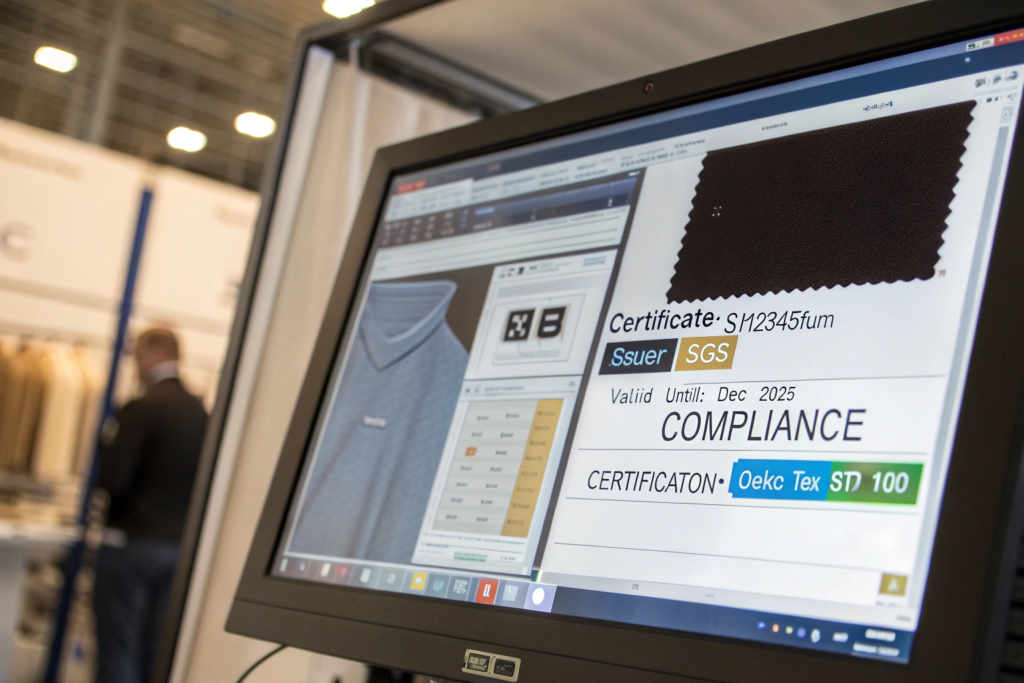
Your Product Lifecycle Management (PLM) system should ingest key data fields from our certificates to automate compliance checks. The crucial fields are:
- Certificate Number & Issuing Body: (e.g., OEKO-TEX® 123456, issued by TESTEX).
- Product Class & Scope: (e.g., “Class II: Articles worn close to skin“).
- Valid From/To Dates: To set automated expiry alerts.
- Applicable Standard/Test Methods: (e.g., complies with STANDARD 100 by OEKO-TEX®, Appendix 6).
- Supplier Name & Address: Ours, which links back to the source.
By inputting this, your PLM can flag any product nearing certificate expiry or being developed with a material whose certificate doesn‘t cover the intended end-use (e.g., using a Class II fabric for babywear, which requires Class I). We provide this data in structured formats (like XML or CSV) upon request to make this integration seamless for tech-savvy brands.
How to Present Our Certificate During a Social or Environmental Audit?
When the auditor arrives, chaos shouldn‘t. Your supplier documentation should be organized, accessible, and verifiable. Our certificates are your primary evidence for the “Environmental“ and “Product Safety“ sections of most audit protocols (like BSCI, SMETA, or brand-specific codes).
Create a dedicated “Supplier Compliance Dossier“ for each key material. The dossier for “Organic Cotton Jersey“ should start with our current, valid GOTS certificate and transaction certificate (TC). Include behind it our supplier‘s GOTS certificate (the mill that spun the yarn), creating a visible chain. During an audit for a German mid-market brand last year, the auditor specifically asked for evidence of recycled content claims. The brand presented our GRS certificate and the corresponding Transaction Certificate matching the order volume. The auditor cross-checked the certificate number on the Textile Exchange‘s publicly accessible certification database, confirmed it in real-time, and closed the finding without any further questions. It was a textbook example of using supplier documentation effectively. Forums like Supplier Ethical Data Exchange (SEDEX)‘s knowledge base offer great tips on preparing for a SMETA audit with effective documentation.
What If the Auditor Says “We Need to Test It Ourselves“?
This is common, but you can often negotiate. Auditors have the right to test, but you have the right to present prior evidence. Calmly explain that the fabric is from a vertically integrated supplier (Shanghai Fumao) with an accredited in-house lab and a valid, product-specific certificate from an international body like OEKO-TEX. Offer to provide the full test report from the certification body (which we can supply, not just the certificate). Propose that if they must test, they test for a reduced set of parameters not covered by the existing certificate, or test only one SKU as a representative sample. This demonstrates your understanding and can significantly reduce testing costs. Your confidence comes from our rigor.
How to Use Our Certificates for ESG Reporting and SDG Alignment?
This is where certificates transform from cost centers to value drivers. For your Environmental, Social, and Governance (ESG) report, our GRS certificate quantifies your use of recycled materials (a key metric for SDG 12: Responsible Consumption). Our OEKO-TEX certificate supports claims about safe products (SDG 3: Good Health). Don‘t just list the certificate names; cite the specific data. For example: “In 2024, 35% of our polyester volume was sourced as GRS-certified recycled polyester from partner Shanghai Fumao, diverting an estimated [X] kg of plastic waste from landfills.“ This turns a supplier document into a compelling brand story. The Global Reporting Initiative (GRI) Standards provide the framework for incorporating sustainable sourcing data into corporate reporting.
Can You Use Our Certificate for Your Own Labeling and Marketing Claims?
This is the golden ticket, but it must be done correctly. Yes, you can leverage our certificates to make legally compliant marketing claims, but you cannot simply slap our certification logo on your hangtag. You must follow the license rules of the certification body and ensure the claim is accurate for the final product.
For OEKO-TEX STANDARD 100, if the certified fabric constitutes at least 90% of the final product‘s weight, you can apply for a license to use the label on your finished garment. We provide the supporting documentation you need for this application. For GOTS, the rules are stricter: the entire production chain (spinning, weaving, dyeing, finishing, and cut-and-sew) must be GOTS certified. If you use our GOTS-certified fabric but sew it in an uncertified factory, you cannot claim the final garment is GOTS-certified. You can, however, make a truthful claim like: “Made with GOTS-certified organic cotton fabric (Certification no. XXX).“ This is a crucial distinction that prevents greenwashing accusations. In 2023, a direct-to-consumer athletic brand we supply used our OEKO-TEX and GRS certificates to support a “Clean & Conscious“ product line. They worked with their legal team to craft precise claims: “Skin-safe fabrics certified by OEKO-TEX“ and “Contains 85% recycled polyester (GRS-certified).“ The transparency boosted their conversion rates significantly.

What Are the “Do‘s and Don‘ts“ of Using Certification Logos?
- DO: Obtain a license from the certification body before using the logo.
- DO: Use the correct, current version of the logo.
- DO: Include the certificate number and product class if required.
- DON‘T: Alter the logo‘s colors or design.
- DON‘T: Use it on products outside the certified scope (e.g., a Class II logo on babywear).
- DON‘T: Imply the certification applies to your entire company if it only applies to specific products.
We guide our clients through this process. The OEKO-TEX® Label Guide and GOTS Labelling Guide are essential reading for correctly applying eco-labels to finished apparel products.
How to Build Consumer Trust with Certificate Transparency?
Go beyond the logo. Consider QR codes on your hangtags. Link the QR code to a webpage that shows our actual certificate (or key details from it), explaining what OEKO-TEX “Class I“ means for baby safety. This radical transparency turns a compliance document into a trust-building tool. It shows you have nothing to hide and that your claims are backed by verifiable, third-party data from your source, Shanghai Fumao.
How to Leverage Our Certificates to Negotiate with Retailers and Insurers?
Major retailers have mandatory compliance protocols. Your ability to meet them efficiently often depends on your suppliers‘ documentation. Our certificates are your bargaining chip to streamline onboarding and secure better terms.
When a retailer like Target asks you to complete their “Vendor Compliance“ portal, having our pre-verified certificates at hand allows you to upload them immediately. This can shave weeks off the approval process. More importantly, it positions you as a professional, low-risk vendor. For insurers, especially those covering product liability, demonstrating that you source from certified suppliers with rigorous QC (like our CNAS lab) can lower your premium. It reduces the insurer‘s risk of a recall due to product safety failures. Present a dossier showing that your key material suppliers are OEKO-TEX certified for the relevant product classes. This is tangible evidence of your risk management. We had a client in the home textiles sector use our suite of certificates (fire retardancy, OEKO-TEX) to successfully get listed with a major US department store, bypassing several rounds of additional testing the store typically requires.
Can Our Certificates Help with US CPSIA Compliance for Children‘s Products?
This is critical. The US Consumer Product Safety Improvement Act (CPSIA) requires third-party testing for children‘s products. However, the CPSC accepts “component part testing.“ Our fabric, when certified for a children‘s product class (e.g., OEKO-TEX Class I), can serve as a certified component. Your garment manufacturer can then use our certificate and test report as evidence, potentially reducing the scope and cost of the final product‘s third-party test. You must ensure the certificate explicitly covers the correct product class and that no subsequent processing (like printing with unverified inks) invalidates it. We provide specific guidance on this for our clients in the children‘s wear sector. The Consumer Product Safety Commission (CPSC) website has detailed rules on leveraging component part testing for CPSIA compliance.
How to Use Certificates in Supplier Tiering for Better Sourcing Strategy?
Internalize this: not all suppliers are equal. Use the strength and scope of supplier certificates as a key metric in your supplier scorecard. A supplier like Shanghai Fumao with in-house lab accreditation, multiple product certificates, and digital traceability should be tiered as a “Strategic Partner.“ This tier gets priority in sampling, better payment terms, and collaborative forecasting. It incentivizes good behavior across your supply base. It turns compliance from a tax into a strategic advantage. This approach is championed by supply chain experts and discussed in communities focused on building a resilient and responsible apparel supply chain.
Conclusion
A certificate from your fabric supplier is not the end of your compliance journey; it‘s the fuel for it. By strategically integrating our OEKO-TEX, GOTS, GRS, and other certificates into your tech packs, audit preparations, marketing claims, and retailer negotiations, you transform them from static files into dynamic tools that reduce cost, mitigate risk, and build brand equity. The key is to move from passive receipt to active management—understand the scope, respect the licensing rules, and build a transparent chain of evidence from our mill to your customer.
At Shanghai Fumao, we see our role as your compliance partner, not just your vendor. We provide the verified data, the accredited testing, and the traceability you need to tell your product‘s story with authority. In a world where consumers and regulators demand proof, our certificates are your proof. Don‘t let them sit in a folder. Use them to fortify your brand, satisfy your stakeholders, and streamline your operations. Ready to source fabrics with compliance built-in from the fiber stage? Let‘s discuss how our certification framework can be leveraged for your next collection. Contact our Business Director, Elaine, to start the conversation: elaine@fumaoclothing.com.