
Let me be honest with you from the start. When I talk to small brand founders—the passionate entrepreneurs with brilliant designs but tight budgets—this question comes up almost every time. They see the big players like H&M and Adidas touting BCI, and they think, “That’s for the giants, not for me.” I used to believe that too. But after helping dozens of startups and small brands navigate this over the past five years, I’ve seen the reality: Yes, a small brand can absolutely afford BCI manufacturing, but it requires a strategic, smart approach that’s different from how the big brands do it. It’s not about writing a blank check; it’s about making your limited budget work smarter.
The core misunderstanding is about cost. You’re not paying for a magical “BCI fiber.” You’re paying for the system and the traceability behind the conventional cotton you’d likely use anyway. The premium exists, but it’s often between 5-15% at the fabric level, not 50-100%. For a small brand, the question flips from “Can we afford it?” to “Can we afford not to have it if it unlocks a more conscious customer base and future-proofs our brand?” I remember a Brooklyn-based DTC streetwear startup in 2022. They were hesitant, thinking BCI would blow their cost per unit. We worked with them to use BCI in their core heavyweight tee (70% of their line) while keeping accessories standard. The BCI tee cost 12% more but sold out 3x faster and allowed them to raise their average order value by 18%. That’s not a cost; that’s an investment with measurable ROI.
So, if you’re a small brand wondering how to make the numbers work, the answer lies in skipping the one-size-fits-all approach and adopting tactics built for scale. Let’s break down exactly how to make BCI certified manufacturing not just affordable, but a powerful lever for your growth.
Where Does the Real Cost of BCI Sit for Small Brands?
First, let’s demystify the cost structure. The premium isn’t a random tax. It pays for the farmer training, auditing, and chain-of-custody tracking. For you, the brand, the cost manifests in three main areas:
- Fabric Premium: This is the most direct cost, as mentioned (5-15%). It’s the clearest line item.
- Minimum Order Quantity (MOQ) Considerations: Some mills or factories might have higher MOQs for BCI fabrics to justify the administrative work of managing the Transaction Certificates. This can tie up more cash in inventory.
- Administrative Overhead: You need to request and file the BCI Transaction Certificates from your supplier for your own records and potential audits. This is time, not direct cash, but time is money.
The game-changer for small brands is that you can influence all three. You’re not a passive price-taker. For instance, the fabric premium is lower on high-volume, basic fabrics (like a standard cotton jersey) than on a niche, low-volume jacquard. By choosing to apply BCI to your high-volume “hero” product, you dilute the impact. The MOQ challenge can be solved by working with a supplier who aggregates demand from multiple small brands (like we do at Shanghai Fumao), allowing us to place larger yarn orders and pass on the lower MOQ to you. In early 2023, we pooled orders from three independent Australian eco-activewear brands for the same BCI organic cotton blend, hitting a mill MOQ that none could have met alone.
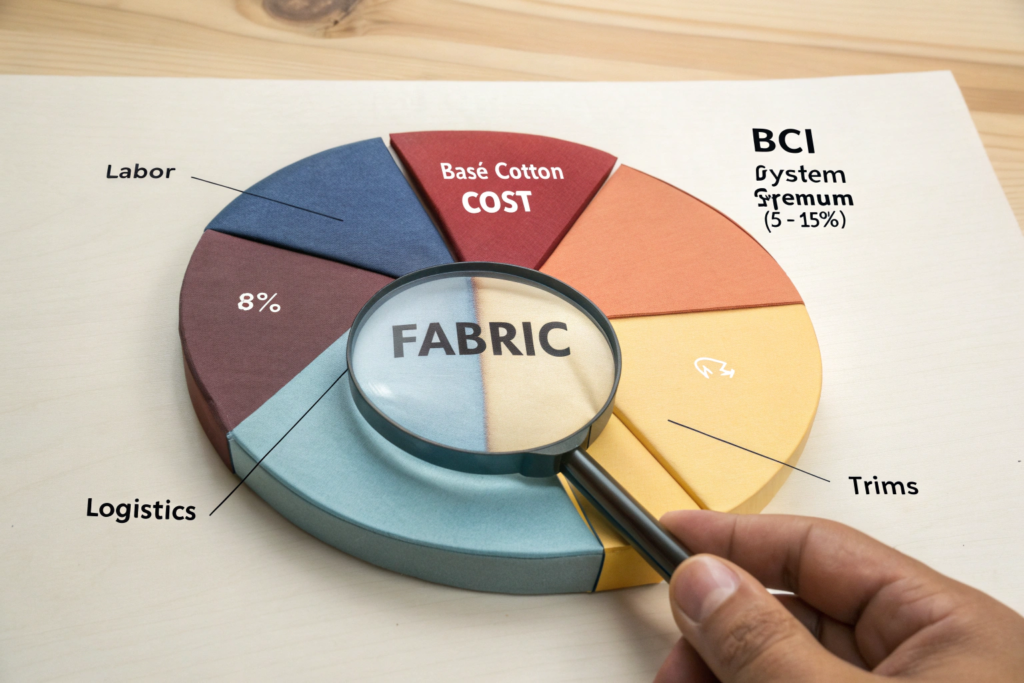
Is the BCI premium per garment as scary as it seems?
Let’s do simple math. Imagine a basic cotton t-shirt.
- Conventional FOB Cost: $5.00
- BCI Fabric Premium (10% of fabric cost, assuming fabric is 50% of FOB): $5.00 50% 10% = $0.25
- New FOB Cost with BCI: ~$5.25
That’s a 5% increase in your cost for a 100% verifiable sustainability story. The question becomes: Can your branding and customer communication justify a $0.25 increase per unit? For most conscious consumers, the answer is yes. The key is communicating this value. You’re not just selling a tee; you’re selling participation in a global system that improves farming.
How do small brands handle the BCI documentation hassle?
You lean on your supplier. A good, small-brand-friendly supplier won’t just give you fabric; they’ll provide the correctly issued BCI Transaction Certificate (TC) as part of the delivery documents. At our company, we provide a digital TC package with every BCI order. Your job is to file it and reference it in your own sustainability communications. It’s a minimal time investment for a major credibility asset. There are great guides on managing sustainability documentation for small fashion brands that can help you set up a simple system.
What Are Smart Sourcing Strategies for BCI on a Budget?
You can’t make your entire first collection BCI. Don’t even try. The smart strategy is selective certification. This is how small brands win.
The “Hero Product” Strategy: Identify the one item that defines your brand, has the highest sales volume, and is made from a relatively simple cotton fabric (jersey, twill, poplin). Apply BCI to this product first. This focuses your extra cost where it will have the biggest impact on your brand story and inventory turnover. A Lisbon-based linenwear brand did this perfectly in 2023. They applied BCI only to their signature cotton-linen blend chore jacket, their bestseller. This became their flagship “responsible” item, and marketing focused on it, driving traffic that also sold their non-BCI pieces.
The “Core Fabric” Strategy: Work with your manufacturer to identify a single BCI fabric (e.g., a 220gsm BCI cotton jersey) that can be used across multiple products in your line—tees, sweatshirts, even dress parts. You buy this fabric in larger quantity, getting a better price and simplifying your sourcing. You then design multiple styles around this one certified fabric. This dramatically reduces complexity and cost. We helped a Seattle-based kidswear brand implement this in 2024. They now use only two BCI fabrics (a jersey and a rib) for 80% of their collection, streamlining their production and amplifying their sustainability message with consistency.
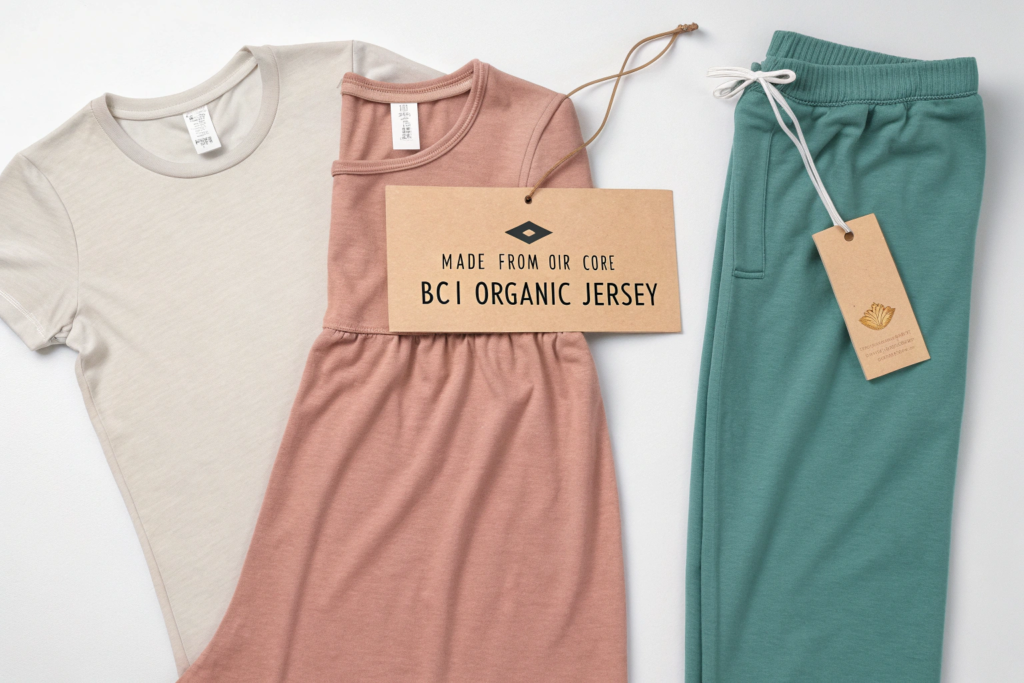
Can you blend BCI cotton with other fibers to reduce cost?
Absolutely, and this is a brilliant tactic. A 50% BCI cotton / 50% conventional cotton blend is still a BCI product (you claim the BCI cotton portion). A 60% BCI cotton / 40% recycled polyester blend is even stronger—it combines two sustainable stories. Blending allows you to make the BCI claim while managing the cost per meter. The key is transparency. You must label accurately (e.g., “60% BCI Cotton, 40% Recycled Polyester”) and your supplier must provide a TC covering the BCI volume used. This approach is detailed in resources about designing cost-effective sustainable blended fabrics.
How important is supplier selection for small brand affordability?
It’s everything. You need a supplier who understands scale—both large and small. Look for:
- Low MOQs on BCI Fabrics: Some mills, especially within integrated clusters like Keqiao, offer lower thresholds.
- Willingness to Provide Samples & Development in BCI: You need to feel and test the actual fabric you’ll sell.
- Transparent Pricing & TC Provision: No hidden fees, and the certificate comes standard.
A supplier who sees your growth potential will invest in helping you start right. At Shanghai Fumao, we’ve built a “Small Brand Launch Package” that includes BCI fabric sampling at cost and consolidated shipping for first orders. We do this because we’ve seen those small brands become big, loyal partners.
How Can BCI Actually Save Money or Drive Revenue?
This is the mindset shift. Stop viewing BCI as a pure cost center. Start viewing it as a marketing and risk mitigation asset that can pay for itself.
1. Reduced Marketing Cost per Acquisition: A clear, certified sustainability story is powerful content. It gives you something authentic to talk about beyond “new design.” This can improve your organic social reach, PR pickup, and conversion rates, effectively lowering what you spend to acquire a customer. A UK-based ethical basics brand reported that after switching their core line to BCI and GOTS, their cost to acquire a customer through Facebook Ads dropped by 22% because their ads resonated more strongly.
2. Higher Customer Lifetime Value (LTV): Customers who buy into a brand’s values are more loyal. They return. They subscribe. They tell friends. A BCI claim helps build this deeper connection, increasing the total value a customer brings over time. That extra $0.25 per garment cost is easily recovered over multiple purchases from a single loyal customer.
3. Protection Against Future Regulations: EU laws are trickling down. Even if you’re not in Europe now, selling BCI-certified goods future-proofs you for potential regulations or retailer requirements in other markets. The cost of retrofitting your supply chain later will be far higher than building it in thoughtfully from the start.

Can BCI improve access to sales channels?
Yes. Many eco-marketplaces, curated retail stores, and corporate gifting platforms now require or heavily prefer certified products. Having BCI can be your ticket into these higher-margin or more stable sales channels that are otherwise closed. It becomes a qualifying criterion, not just a nice feature. For example, getting listed on a platform like Everlane or being selected for a corporate sustainability program often requires this level of documentation.
Does it simplify sourcing decisions?
In a way, yes. Once you commit to BCI for your core items, it narrows down your supplier options to those who are competent in this system. This can actually speed up decision-making and reduce the time spent vetting factories on basic sustainability criteria. You know they have at least a foundational system in place.
What Are the Practical First Steps for a Small Brand?
Feeling overwhelmed is normal. Here’s a simple, actionable roadmap:
- Start with a Conversation, Not an Order: Contact potential suppliers (like us) and ask direct questions: “What are your lowest MOQ BCI fabrics?” “Can you provide samples and a clear cost breakdown?” “How do you handle the Transaction Certificates?”
- Run a Pilot: Don’t redesign your whole line. Choose one product for your next production run. Order the BCI fabric for it. Test the process, the cost, and the customer response on a small, controlled scale.
- Integrate the Story: Work on your packaging, hangtags, and website copy before the goods arrive. Explain what BCI is and why you chose it. Your customer is buying the story as much as the product.
- Analyze and Iterate: After selling the pilot collection, look at the data. Did the BCI item sell faster? Did you get press or social media mentions because of it? Use this data to decide your next move.
Remember, the goal for a small brand isn’t 100% BCI certification. The goal is to start the journey in a financially sane way that builds credibility and connects with your audience. One step is enough.

Where do brands most often stumble in their first BCI order?
The main pitfall is lack of clarity with the factory. Be crystal clear: “This order must be made with BCI cotton fabric, and we require the Transaction Certificate upon shipment.” Get this in writing on your Purchase Order. The second pitfall is not factoring the premium into their cost model and pricing, leading to a nasty surprise. Do the math upfront, like we did earlier.
How can you communicate BCI value without a big marketing budget?
Use the tools you have. A simple hangtag with the BCI logo and one sentence (“This garment uses Better Cotton, supporting farmer training for a healthier environment.”) is incredibly effective. Do an Instagram Story explaining your choice—authenticity trumps production value. Feature it in your “About Us” or “Sustainability” page. This is low-cost, high-impact communication.
Conclusion
So, can a small brand afford BCI certified clothing manufacturing? The resounding answer is yes—if you approach it as a strategic business decision, not just an ethical checkbox.
It’s about selective application, smart supplier partnerships, and understanding that the modest cost increase is an investment in your brand’s authenticity, customer loyalty, and long-term resilience. In today’s market, sustainability is a language of quality and care. Speaking it, even with a limited vocabulary at first, sets you apart.
The brands that will thrive are the ones that see beyond the initial price tag. They see the value in a transparent supply chain, a story that resonates, and a product that stands for more. At Shanghai Fumao, we’ve made it our mission to make this accessible. We believe in growing alongside the visionary small brands that are shaping the future of fashion.
Ready to explore how BCI can fit into your brand’s story and budget? Let’s start with a conversation about your hero product. Contact our Business Director, Elaine, who specializes in helping emerging brands build responsible and profitable supply chains. Begin your strategic journey at elaine@fumaoclothing.com.