You walk the aisles of any major trade show, scroll through supplier catalogs on Alibaba, or review quotes from mills—the acronym “BCI” is everywhere. It’s on fabric tags, in company profiles, and stamped on quotations. This ubiquity begs the question: Is BCI genuinely the most sought-after fabric certification in the global market today, or has it simply become the most commonly mentioned one? For brands and buyers trying to navigate a jungle of labels like GOTS, OCS, GRS, OEKO-TEX®, and more, understanding the hierarchy of demand is crucial for making smart sourcing decisions.
The evidence strongly suggests that, for mainstream apparel and textile sourcing, BCI is indeed the most sought-after and commercially dominant certification at the fiber level. However, this demand is driven by a different set of priorities than those driving demand for other leading certifications. BCI’s dominance isn’t about being the “purest” or “strictest” standard; it’s about being the most scalable, pragmatic, and risk-mitigating solution for the volumes and complexities of global fashion supply chains. It is the certification that has most successfully moved from a niche ideal to a commercial imperative for a vast middle market of brands, retailers, and their suppliers.
Think of it like a city’s public transit system versus a fleet of luxury private cars. GOTS (organic) is the luxury car—superior in specific attributes (purity, no chemicals) but limited in capacity and accessibility. BCI is the efficient, expanding subway system—it moves the maximum number of people (or meters of cotton) toward a significantly better destination (improved practices) with the infrastructure to handle the scale. The “sought-after” title belongs to the system that solves the biggest, most urgent problem for the most people. Let’s analyze the data and drivers behind this demand.
The Demand Drivers: Why the Market is Seeking BCI
The surge in demand for BCI isn’t accidental. It directly responds to three powerful market forces that have converged in the last five years.
1. Retailer Mandates & Mainstreaming of ESG: This is the single biggest driver. Major global retailers and brands—IKEA, H&M, Levi’s, M&S, and dozens more—are not just BCI members; they have publicly committed to sourcing 100% of their cotton from “more sustainable sources” by 2025 or 2030. For their tens of thousands of suppliers worldwide, this isn’t a suggestion; it’s a condition of business. These retailers collectively move millions of garments daily. Their sourcing directives create an enormous, top-down pull for BCI-certified materials through the entire supply chain. If you want to supply to them, you need BCI. This has transformed BCI from an option to a requirement for a huge segment of the industry.
2. The Scalability Advantage Over Organic: Organic cotton (certified by GOTS or OCS) remains highly sought-after for specific premium and niche markets. However, its supply is physically constrained by the 3-year farm transition period, higher costs, and lower yields. The global fashion industry cannot transition to 100% organic cotton at its current scale and price expectations. BCI, with its Mass Balance system and continuous improvement model, offers a pathway to improve the sustainability profile of mainstream cotton volumes without the severe supply and cost bottlenecks. Brands seeking to make a large-scale impact quickly are logically turning to BCI.
3. Risk Mitigation in a Complex World: As discussed in previous articles, BCI provides a verifiable, third-party answer to growing due diligence pressures around environmental impact and social issues in agricultural supply chains. For a procurement manager, specifying BCI is a demonstrable risk management action. It is a defensible, auditable choice that satisfies a growing number of internal and external stakeholders, from compliance officers to ESG investors.
What Do Sourcing Data and Surveys Say?
While proprietary, industry sourcing platforms and reports consistently show BCI as the most frequently requested or specified standard in RFQs (Requests for Quotation) for cotton fabrics, especially from volume buyers. It has become the default starting point for sustainable cotton sourcing conversations. A 2023 survey of European brand sourcing managers showed over 60% had a formal target to increase BCI usage, compared to 40% for organic cotton targets.
The Competitive Landscape: How BCI Stacks Up Against Other Sought-After Certs
To claim “most sought-after,” we must compare it to other heavyweights. Demand is fragmented by need.
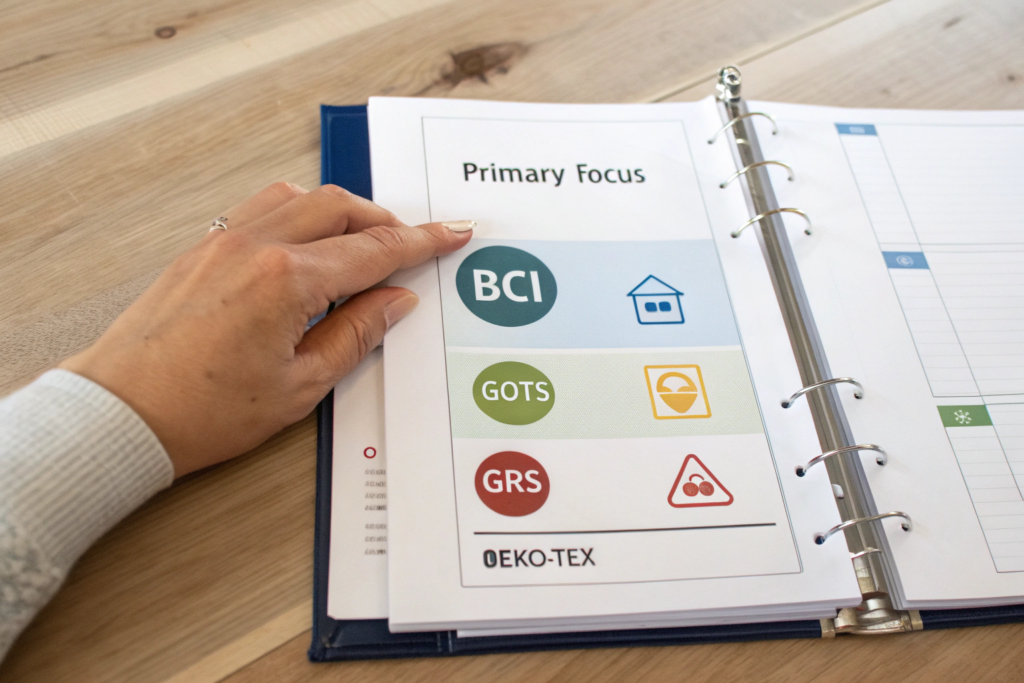
| Certification | Primary Focus | Key Demand Driver | Why It’s Sought | Scale vs. BCI |
|---|---|---|---|---|
| BCI | Improving mainstream cotton farming (environment, social, economic). | Retailer mandates, risk mitigation, scalability. | Pragmatic, large-scale impact, supply chain due diligence. | Highest. Mass market. |
| GOTS (Organic) | Organic fiber integrity & processing. | Brand purity, premium positioning, chemical avoidance. | Guarantees no GMOs, synthetic pesticides, and strict processing controls. | Niche/Limited. Premium market. |
| GRS (Recycled) | Recycled material content & chain of custody. | Circular economy goals, plastic waste reduction. | Verifies post-consumer/pre-consumer recycled content (e.g., rPET). | Growing fast, but for synthetics, not cotton. |
| OEKO-TEX® STANDARD 100 | Finished product safety (harmful substances). | Consumer safety, legal compliance (e.g., REACH). | Guarantees the final fabric is free from harmful levels of regulated chemicals. | Ubiquitous. Often used in tandem with BCI. |
The Crucial Insight: BCI and these other certifications are often complementary, not competing. The most sophisticated brands use a portfolio:
- A t-shirt might be BCI (cotton sourcing) + OEKO-TEX 100 (safety).
- A luxury bed sheet might be GOTS (organic) + BCI (if the farm is also BCI).
- A performance shirt might be BCI (cotton portion) + GRS (recycled polyester portion).
BCI’s dominance is in the cotton fiber sourcing category. OEKO-TEX is arguably more ubiquitous, but it serves a completely different purpose (safety verification, not agricultural improvement).
Is There Regional Variation in Demand?
Yes, but it reinforces BCI’s global role. In Europe, demand for BCI is extremely high due to strong retailer leadership and impending regulations. In North America, demand is growing rapidly, especially from brands supplying the European market or with global ESG pledges. In price-sensitive markets, demand is lower but growing as multinational buyers impose their standards. BCI’s framework is designed to work globally, which is part of its strength.
The Supplier Perspective: Why Mills and Factories Are Getting Certified
Demand is also visible on the supply side. For a fabric mill or garment factory, obtaining BCI certification is a strategic business development investment. It’s not cheap or easy—it involves audits, system changes, and fees. They do it because their customers (brands and bigger traders) are asking for it. A BCI license has become a table-stakes credential to be considered for business by a large and growing segment of buyers.
At Shanghai Fumao, our decision to deeply integrate BCI into our supply chain was a direct response to this market signal. Since 2020, over 70% of our inquiries from new EU and US brand clients specifically ask about BCI capability. Not having it would mean losing the majority of new business opportunities. For suppliers, BCI certification is less about marketing and more about maintaining market access and relevance.
The Caveats: Where "Most Sought-After" Doesn’t Mean "Only" or "Best"
It’s critical to understand the limits of this demand.
- Not for “100% Purity” Seekers: Brands or consumers who demand physically traceable, chemical-free organic cotton will seek GOTS, not BCI. BCI’s Mass Balance is a deal-breaker for them.
- Not a Complete Sustainability Solution: BCI addresses cotton agriculture. It does not certify safe chemistry (OEKO-TEX), recycled content (GRS), fair factory wages (Fair Trade), or a product’s carbon footprint. The smartest buyers seek BCI plus other certifications for a complete picture.
- Potential for “Checkbox” Fatigue: As BCI becomes ubiquitous, there’s a risk that some buyers treat it as a mere checkbox, losing sight of the on-farm improvement it’s designed to fund. This is where brand education and deeper engagement matter.
Conclusion
So, is BCI the most sought-after fabric certification now? For cotton, at the scale of global apparel and home textiles, the answer is a definitive yes. Its demand is driven by the powerful combination of commercial mandates, pragmatic scalability, and risk management—forces that shape the core of the industry.
However, “most sought-after” should not be misinterpreted as “the only one that matters” or “the best for every situation.” It is the workhorse certification that is moving the industry’s massive cotton consumption in a better direction. It is the standard that has most successfully aligned the ideals of sustainability with the realities of global trade, volume, and cost.
For your brand, the takeaway is clear: If you are sourcing cotton at any meaningful scale and are not already evaluating BCI, you are likely out of step with market expectations and missing a key tool for supply chain resilience. It is the certification you need to have in your sourcing portfolio to compete today and grow tomorrow.
Ready to align your sourcing with the market’s most demanded standard? Shanghai Fumao is your gateway to scalable, credible BCI cotton sourcing. We provide not just the certified fabrics, but the market intelligence and documentation to meet the demands of the world’s leading brands and retailers. Contact our Business Director, Elaine, at elaine@fumaoclothing.com to ensure your products carry the certification your customers are seeking.