You’re building a sustainable fashion line and know that “better cotton” is a must. You go to source fabric, and your supplier offers two options: “BCI Cotton” and “Organic Cotton.” The prices are different, the paperwork is different, and you’re left wondering—what am I really paying for? Is one truly “better” than the other? This confusion can stall your development timeline and leave you unsure about the claims you can rightfully make to your customers.
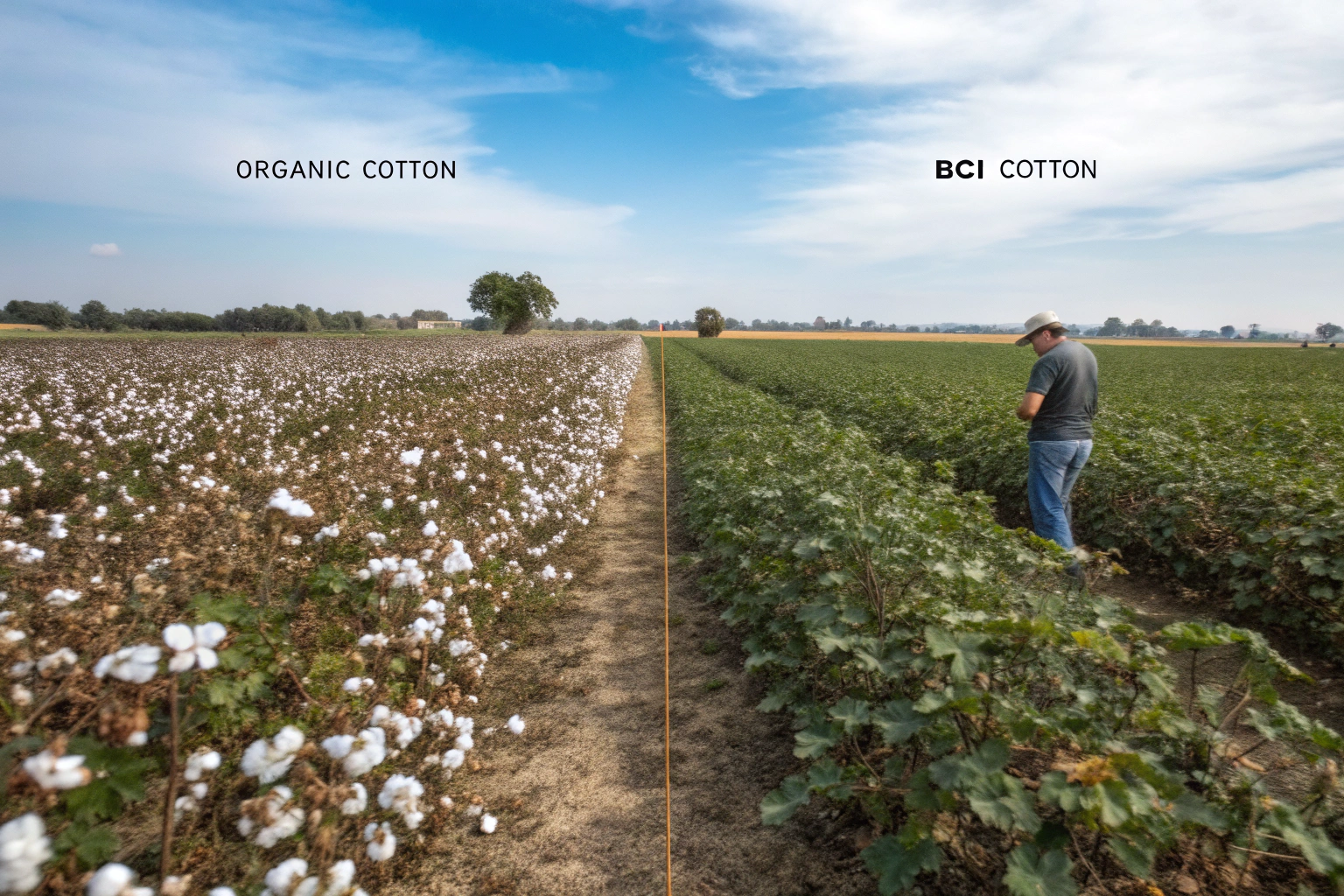
The core difference lies in their fundamental philosophy and approach. Organic Cotton is a product standard focused on prohibition—it defines a strict set of farming and processing rules (no synthetic pesticides, GMOs, etc.) that must be met to earn the certification. BCI (Better Cotton Initiative) is a farming program standard focused on continuous improvement—it trains farmers to adopt more sustainable practices across environmental, social, and economic areas, measuring progress against benchmarks. One is about creating a segregated, premium product; the other is about making mainstream cotton production more sustainable at a massive scale.
Choosing between them isn’t about finding the “winner,” but about identifying the right tool for your specific brand goals, budget, and supply chain capabilities. Understanding this distinction is critical to making an informed sourcing decision that aligns with your values and business reality. Let’s break down the key differences across several dimensions.
Farming Philosophy: Prohibition vs. Continuous Improvement
This is the most fundamental distinction. Organic cotton certification, such as the Global Organic Textile Standard (GOTS), operates on an input-based model. It prescribes a list of substances and practices that are prohibited. The focus is on what you cannot use: synthetic fertilizers and pesticides, genetically modified seeds, and certain processing chemicals. To be certified, a farm must undergo a 3-year transition period and adhere to these rules completely. It’s a binary system: you are either certified organic or you are not.
In stark contrast, BCI operates on a principle-based, performance improvement model. It doesn’t start with a list of bans. Instead, it sets principles and criteria across seven areas: crop protection, water management, soil health, biodiversity, fiber quality, decent work, and farm management. Farmers receive training and are assessed on their journey toward meeting these criteria. A farmer might start by learning to reduce pesticide use and improve water efficiency, then later work on soil health and labor conditions. The goal is to help farmers “get better,” not to immediately reach a fixed, high bar.

Which System is More Accessible to Farmers?
This philosophical difference leads to vastly different adoption scales. The organic model, with its high costs for certification, transition period (where yields often drop), and manual weed management, presents significant financial and operational hurdles for many smallholder farmers. It creates a niche, premium supply.
The BCI model is designed for scalability. By meeting farmers where they are and providing a step-by-step path to improvement, it can engage millions of farmers worldwide, including the large farming systems in regions like Xinjiang, China. This is why BCI is now the world’s largest cotton sustainability program. It aims to improve the environmental footprint of mainstream cotton, not to create a separate, small stream.
How Does This Affect Fiber Traceability?
The models dictate different chain-of-custody systems, which directly impact the claims you can make.
- Organic (GOTS): Requires identity preservation or segregation. Organic cotton must be kept physically separate from conventional cotton throughout the supply chain, from the gin to the final product. This ensures the integrity of the product but adds complexity and cost.
- BCI: Uses a Mass Balance chain of custody. BCI-licensed cotton can be mixed with conventional cotton during processing. However, the volume of “Better Cotton” entering the system is matched by the sale of “Better Cotton Claim Units” (BCCUs). As a brand, you purchase BCCUs equivalent to the volume of cotton in your products. This supports the farmers but means your final fabric is not necessarily physically made only from BCI cotton. The claim is about supporting sustainable farming, not about a pure end-product.
Environmental Impact: A Matter of Focus and Measurement
Both systems aim to reduce environmental harm, but their primary focus areas differ.
Organic farming’s hallmark is the elimination of synthetic inputs. This immediately removes the risk of toxic pesticide runoff into waterways and reduces the energy footprint associated with producing these chemicals. It also promotes soil health through crop rotation and composting. However, critics sometimes point to potentially lower yields per hectare, which could require more land for the same output.
BCI’s environmental impact is measured across a broader dashboard. Its training heavily emphasizes efficient water use (a critical issue in cotton farming), integrated pest management (to reduce, not necessarily eliminate, synthetic pesticides), and soil health. The impact is about aggregate reduction across millions of hectares. For example, BCI reports that farmers in its program use on average 10% less water and 17% less synthetic pesticide than comparison farmers.

Does Organic Mean "Pesticide-Free" and Does BCI Allow Them?
This is a crucial clarification. Organic does not mean pesticide-free. It means the use of synthetic pesticides is prohibited. Organic farmers use approved natural pesticides, which can also have environmental impacts and may require larger volumes to be effective.
BCI does not prohibit synthetic pesticides. Instead, its training focuses on the responsible use of chemicals as part of Integrated Pest Management (IPM). Farmers are trained to identify pest thresholds, use targeted application methods, and explore biological alternatives first. The goal is a significant reduction in overall use and toxicity, moving away from blanket spraying. For a brand, this means BCI addresses pesticide risk through management, not prohibition.
How Do They Address Water and Carbon Footprints?
Water stewardship is a central pillar of BCI, with specific training modules on measurement and efficiency techniques like drip irrigation. This can lead to substantial on-the-ground savings in water-stressed regions.
Organic farming’s ban on synthetic fertilizers can influence its carbon footprint. The production of nitrogen-based synthetic fertilizers is highly energy-intensive. By prohibiting them, organic systems avoid these “embedded” emissions. However, comprehensive lifecycle assessment of textile fibers is complex and depends on many local factors. Both systems aim for a lower footprint than conventional cotton, but through different primary levers.
Cost, Availability & Business Implications for Your Brand
For a fashion brand or wholesaler, this is where the rubber meets the road. The differences in philosophy and traceability lead to direct business implications.
Organic Cotton:
- Cost: Carries a significant price premium (often 20-50%+ above conventional) due to lower yields, higher labor costs (for weeding), and the costs of segregated processing and certification.
- Availability: Supply is limited and can be inconsistent. Scaling up a large order quickly can be challenging.
- Claim: Allows for a strong, product-specific claim: “Made with 100% Certified Organic Cotton.”
BCI Cotton:
- Cost: Carries a modest premium (typically 2-8% above conventional) to cover the cost of the BCCUs and farmer training.
- Availability: Highly scalable. It is integrated into the mainstream cotton supply chain, making large-volume sourcing more straightforward.
- Claim: Supports a system-level claim: “We source cotton through the Better Cotton Initiative.” It’s about supporting better practices, not guaranteeing the physical contents of the final product.

Which is Better for a Startup or Scaling Brand?
For a brand with limited budget or one that needs to produce large volumes at an accessible price point, BCI often presents a more viable entry point into responsible sourcing. It allows you to make a meaningful impact and a credible claim without pricing your product out of your target market. It’s a pragmatic first step on the sustainability journey.
For a brand whose entire identity is built on premium, natural purity and whose customer base is willing to pay a significant premium, organic cotton (especially under GOTS) is the unequivocal choice. It delivers a product that matches a stringent brand promise.
Can You Use Both in Your Sourcing Strategy?
Absolutely, and many sophisticated brands do. This is known as a portfolio approach. You might use GOTS-certified organic cotton for your core, signature collection where price sensitivity is lower. Simultaneously, you could use BCI cotton for your high-volume, more affordable diffusion lines or basics. This strategy allows you to drive change at multiple levels of the market. At Shanghai Fumao, we help clients manage this blended strategy, ensuring the right certification and paperwork flow for each product line.
Verification and Labeling: What Can You Actually Say?
This is critical for legal compliance and avoiding greenwashing. The labeling rules are strict and different.
Organic (GOTS): You can use the GOTS logo and make a “made with organic cotton” claim only if the final product contains at least 70% certified organic fibers and has been manufactured in a GOTS-certified facility all along the chain. The label will specify the percentage (e.g., “95% organic cotton, 5% elastane”).
BCI: You cannot label a product as “made with Better Cotton.” The correct claim is that your company “sources cotton via the Better Cotton Initiative” or that you are a “BCI Member.” You can use the BCI logo on hangtags or marketing materials alongside this explanatory claim. The claim is about your sourcing choice, not a product attribute.

How Do You Verify Your Supplier’s Claims?
For Organic (GOTS): You must request and file the GOTS Transaction Certificate (TC) for your specific order, issued by the certified processor. This is a non-negotiable document that traces the organic content to your goods.
For BCI: You should request the BCI Transaction Certificate that shows the volume of BCCUs purchased on behalf of your order. While not a physical trace to the bale, it is the proof of your financial support for the system. A reliable supplier like Shanghai Fumao will provide this as a standard part of the documentation package for any BCI-sourced order.
Conclusion
So, is BCI or Organic Cotton “better”? The answer is that they are different tools designed for different jobs. Organic cotton is the gold standard for a purified, input-controlled product, ideal for brands built on a philosophy of natural purity and supported by a willing customer. BCI is the large-scale, continuous improvement engine, designed to reduce the overall environmental and social footprint of global cotton production, making sustainable sourcing accessible and scalable.
Your choice should be guided by your brand’s specific story, operational scale, and customer expectations. For many brands, the most powerful and realistic strategy is not to choose one over the other, but to understand both and deploy them strategically across their collections.
Need help navigating this decision and integrating the right cotton into your supply chain? At Shanghai Fumao, with our deep roots in the world’s largest textile cluster, we provide more than just fabric—we provide sourcing intelligence. We can guide you on the nuances of BCI, Organic (GOTS), and recycled options to build a responsible and commercially smart materials strategy. Contact our Business Director, Elaine, at elaine@fumaoclothing.com to develop a cotton sourcing plan that truly supports your brand’s story.