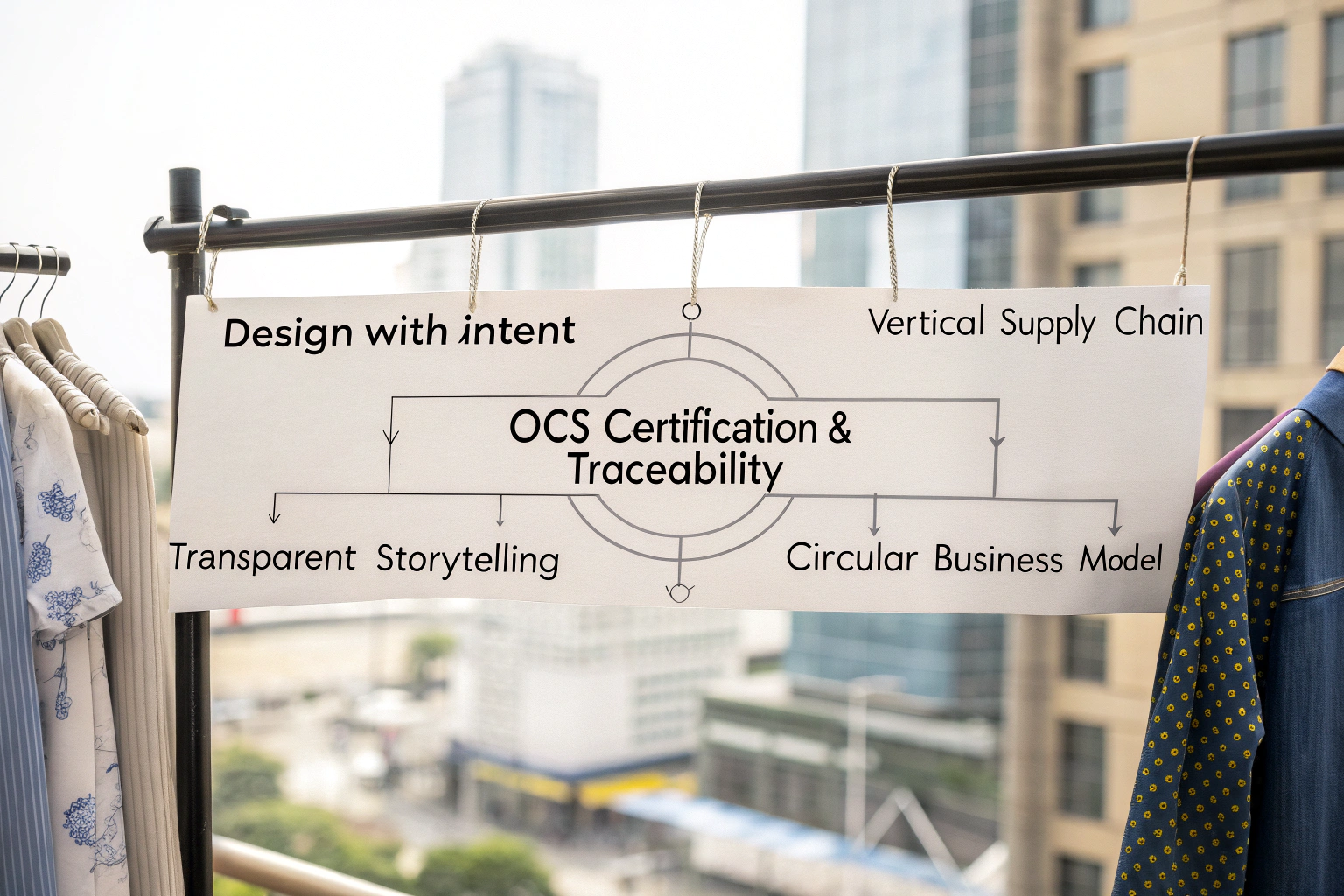
Let’s start with a hard truth: launching a "sustainable" clothing line today is one of the riskiest ventures in fashion. Not because of design or demand, but because of credibility. The market is saturated with brands whose sustainability is a veneer—a beautiful website and vague claims that dissolve under the first audit. I’ve watched passionate founders pour their life savings into collections they can’t legally call "organic" because their supplier’s paperwork was fiction. Building a truly sustainable line isn’t about marketing first; it’s about building your supply chain backwards, starting with the irrefutable proof of your materials. OCS certification isn’t just a badge you add later; it’s the architectural blueprint for your entire brand’s integrity.
To build a sustainable clothing line with OCS certification, you must integrate the certification’s requirements into every foundational decision: business model, design philosophy, supplier selection, and customer communication. This is a proof-first approach where the OCS Transaction Certificate (TC) is treated as a core product component, as important as the stitch or the seam. The process is meticulous, but it creates an unassailable brand rooted in verifiable fact, not fashionable fiction.
This guide is your blueprint. We’ll move step-by-step from concept to customer, ensuring your sustainability is built in, not bolted on.
Phase 1: Laying the Foundation – The OCS-Centric Business Model
Before you sketch a single design, you must define what "sustainable" means for your business in operational terms. For an OCS-based line, sustainability is primarily about material integrity and transparency. Your business model must be designed to support the costs, lead times, and storytelling that this commitment requires.
This means rejecting the fast-fashion playbook of endless micro-seasons and deep discounts. Your model is built on value, not volume, and proof, not persuasion.
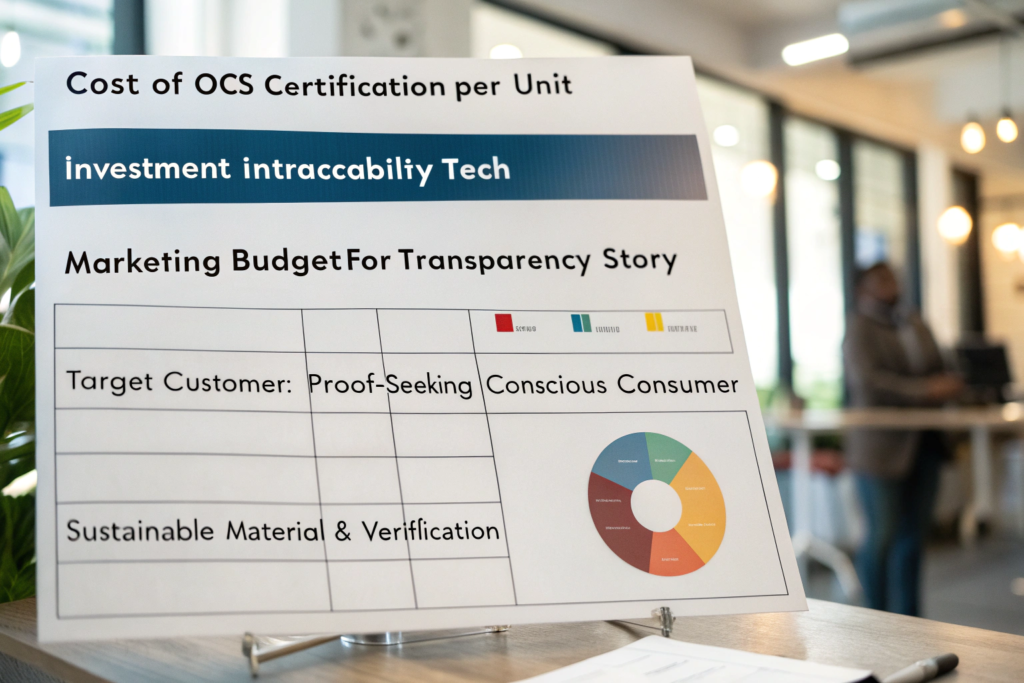
How to structure your brand around verifiable value?
Your value proposition must be crystal clear: "We sell clothing made with verified organic materials." This influences everything:
- Pricing Strategy: You will have a higher Cost of Goods Sold (COGS). Your price must reflect the true cost of certified materials, ethical manufacturing, and the documentation system. Your customer is paying for certainty.
- Product Assortment: Start focused. Launch with a capsule collection of 5-8 timeless styles in 2-3 OCS-certified fabrics. This allows you to manage complexity, secure better fabric MOQs, and tell a cohesive story. Think "a perfect OCS organic cotton shirt" before "200 SKUs."
- Sales Channels: Prioritize channels where you can tell the full story. Direct-to-Consumer (DTC) websites are ideal. If using wholesale, choose partners with a genuine sustainability ethos (like independent boutiques or curated marketplaces) who will value your OCS proof.
A successful brand we partnered with, "Aurea Basics," launched in 2022 with just three styles of OCS-certified tops. They built their entire site around an interactive map showing the journey of their cotton, with uploaded TCs. Their premium price point was fully justified, and they achieved profitability in their first year by building a loyal community, not just moving units.
What are the legal and financial implications of OCS claims?
You are making a legal claim. You must:
- Register Your Brand as an OCS License Holder: You or your manufacturer must hold an OCS license to apply for Transaction Certificates in your brand’s name. This involves an audit of your supply chain. We guide our clients through this process, often serving as the licensed manufacturer on their behalf initially.
- Budget for Certification Costs: Factor in the cost of the TC for every production run, any brand license fees, and potential third-party verification testing.
- Insurance: Consider product liability insurance that covers claims related to certification. If your OCS claim is false, even unintentionally, you could be liable.
This upfront work separates serious founders from hobbyists. It’s the unglamorous backbone of a credible brand.
Phase 2: Design & Development – Where Creativity Meets Compliance
This is where your vision takes physical form. Designing with OCS means your creativity is channeled through a filter of traceability. Every material choice must have a certified or documented origin. This constraint, paradoxically, fuels innovation.
Your tech pack is no longer just a instruction manual; it’s a compliance document.

How to create a tech pack for an OCS-certified garment?
Your tech pack must include a Sustainability & Compliance Annex:
- Bill of Materials (BOM) with Certification Status:
- Main Fabric: 100% OCS Organic Cotton Jersey, 220gsm. Supplier: Fumao. OCS TC Required.
- Thread: 100% Polyester, OEKO-TEX 100 certified. Supplier: [Name]. Certification document required.
- Label: Woven, 100% Polyester. Non-certified component.
- Care Label Copy: "94% Organic Cotton, 6% Other Materials. OCS Certified. License #: XYZ123."
- Approval Workflow: Specify that the Pre-Production (PP) sample will not be approved without verification of all OCS documentation for the bulk fabric.
- Packaging Instructions: Specify recycled, FSC-certified paper hangtags and bags. The OCS logo usage must comply with your certifier’s guidelines.
This level of detail prevents costly mistakes. It forces you and your factory to source correctly from day one.
Can you design complex garments with OCS certification?
Absolutely, but you must plan for blends and trims.
- Blended Fabrics: If you use an OCS organic cotton/linen blend, ensure the mill provides a TC for the blended fabric, stating the exact percentage of certified content.
- Non-Fabric Components: Buttons, zippers, and elastics are rarely organic. This is fine. Your care label must accurately state the final composition (e.g., 85% Organic Cotton, 15% Other Materials). The key is to document the source and weight of these "other materials" for your own mass balance.
- Embellishments: If you use embroidery, the thread is likely polyester. Its weight is part of the "other materials." Its chemical safety (OEKO-TEX) is a separate but important concern.
Designing for OCS means embracing honest labeling as a design principle. The label is part of the product’s truth.
Phase 3: Supplier Selection & Production – The Integrity Engine
This is the most critical phase. Your factory is not a vendor; it is the guardian of your brand’s promise. Choosing the right partner—one with vertically integrated OCS capabilities like Shanghai Fumao—is the single most important decision you will make.
The production process must be transparent and monitored. You are not just buying garments; you are buying a documented chain of custody.
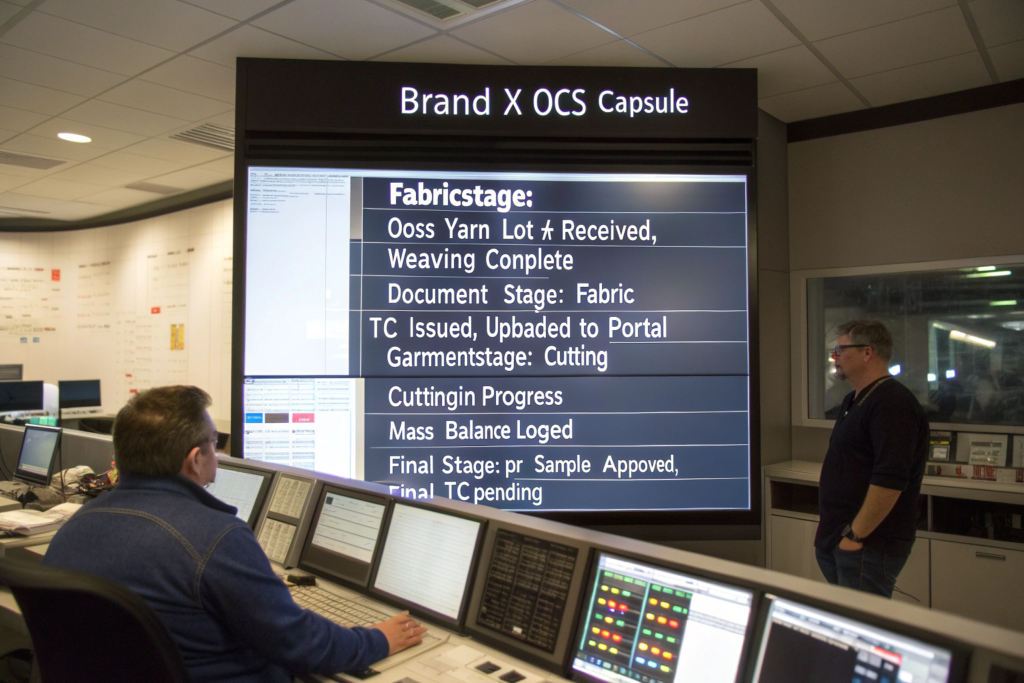
What are the non-negotiable criteria for an OCS production partner?
- Vertical Control or Strategic Partnerships: They must control or have deeply audited relationships with their fabric sources. Ask: "Can you show me the OCS TC from your fabric mill for a recent order?"
- In-House QC & Testing: They should have a lab or partnership for testing shrinkage, colorfastness, and composition. Ask for sample reports.
- Transparent Communication: They should provide a single point of contact who understands both production and certification.
- Technology for Traceability: They should use software to track material lots and generate TCs, not paper ledgers.
- Willingness to be Audited: They should welcome your or a third-party’s audit of their OCS processes.
A partner that ticks these boxes is a strategic asset. We invest in these systems so our brand partners don’t have to build them from scratch.
How to manage the first production run and certification?
- Pre-Production Meeting: Align on every detail in the tech pack’s compliance annex. Review draft documents.
- Fabric and TC Approval: Do not approve bulk cutting until you have received and verified the OCS TC for the bulk fabric. This is your proof of input.
- PP Sample Approval: The PP sample must be made with the actual OCS fabric and trims. Approve it as the standard for quality and material compliance.
- In-Production Monitoring: Request photos/videos of the cutting floor, ensuring OCS fabric is segregated. Ask for updates on the mass balance.
- Final TC Receipt: Before making final payment, you must receive the final OCS Transaction Certificate for the shipment. Verify every detail matches your order.
This rigorous process ensures your first collection is born certified. The extra weeks of diligence prevent years of reputational damage.
Phase 4: Launch & Storytelling – Marketing the Proof
Now you have a beautiful, certified collection. This is where you reap the reward of your diligence. Your marketing isn’t about convincing people you’re sustainable; it’s about showing them the evidence. In a world of greenwashing, proof is your superpower.
Your communication should be confident, detailed, and educational. You are not just selling clothes; you are selling trust.
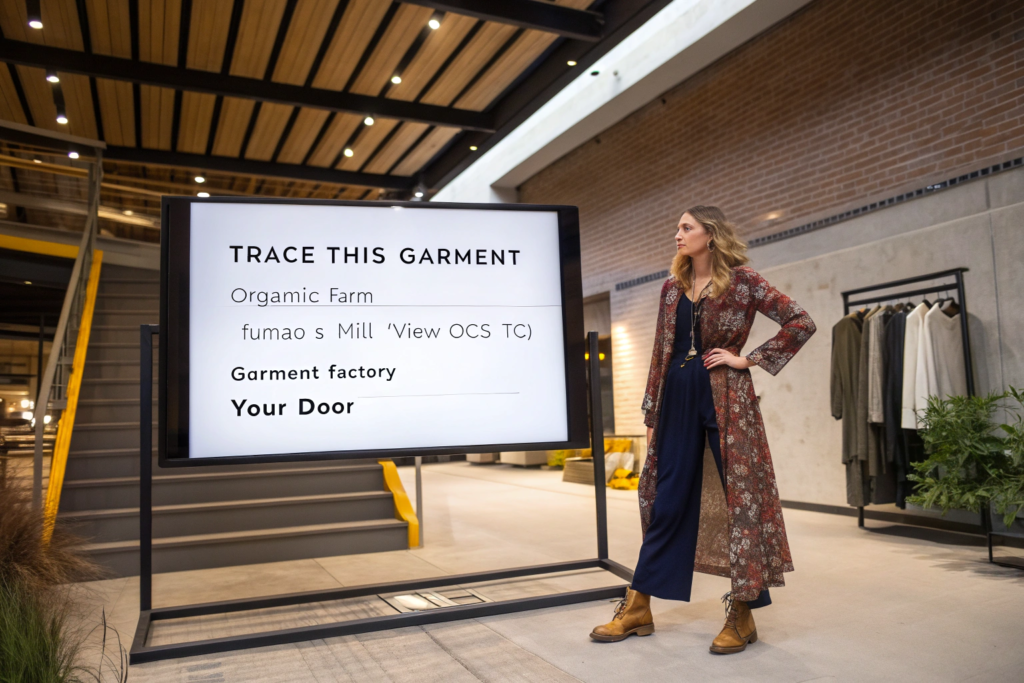
How to build a marketing strategy around OCS certification?
Center your narrative on transparency and education:
- Website: Dedicate a page to "Our Materials" or "Our Proof." Explain OCS in simple terms. Display redacted TCs from your production runs.
- Product Pages: For each item, list the OCS-certified fabric and provide a link to its TC. State the accurate composition breakdown.
- Packaging: Include a QR code on the hangtag that links directly to the TC for that garment’s batch.
- Social Media & Content: Don’t just post photos. Post short videos explaining what a TC is, why mass balance matters, or a tour of your supplier’s facility (with their permission). Educate your audience.
This approach builds a community of informed advocates. They become defenders of your brand because they understand the work behind it.
How to scale and evolve your OCS-certified line?
Sustainability is a journey. With a solid OCS foundation, you can expand responsibly:
- Expand the Collection: Introduce new OCS fabrics (linen, wool) or blends, following the same rigorous sourcing protocol.
- Deepen the Impact: Pair OCS with other initiatives: carbon-neutral shipping, circular take-back programs, or social projects in your supply chain regions.
- Pursue Higher Certifications: Use OCS as a stepping stone to GOTS (Global Organic Textile Standard), which adds stringent environmental and social criteria for processing.
- Report on Impact: Use the quantifiable data from your OCS purchases (kg of organic cotton, hectares of farmland supported) in an annual impact report.
This shows that your commitment is growing, not static. It gives your brand a long-term narrative.
Conclusion
Building a sustainable clothing line with OCS certification is a deliberate, proof-based methodology that turns the immense challenge of credibility into your greatest competitive advantage. It requires a foundational commitment to transparency that influences your business model, design process, supplier partnerships, and customer relationships. While more demanding than a conventional launch, this approach builds a brand with unshakeable integrity, loyal customers, and resilience in a skeptical market.
The brands that will lead the next decade of fashion are being built this way today—not on slogans, but on systems of verification.
If you are ready to build your brand on this foundation of verifiable integrity, you need a manufacturing partner architected for this purpose. At Shanghai Fumao, we are that partner. Our vertical OCS systems are designed to be the reliable, transparent engine for ambitious sustainable brands. Contact our Business Director, Elaine, to begin building your line the right way, from the first fiber: elaine@fumaoclothing.com. Let’s build a brand that’s truly worth believing in.