
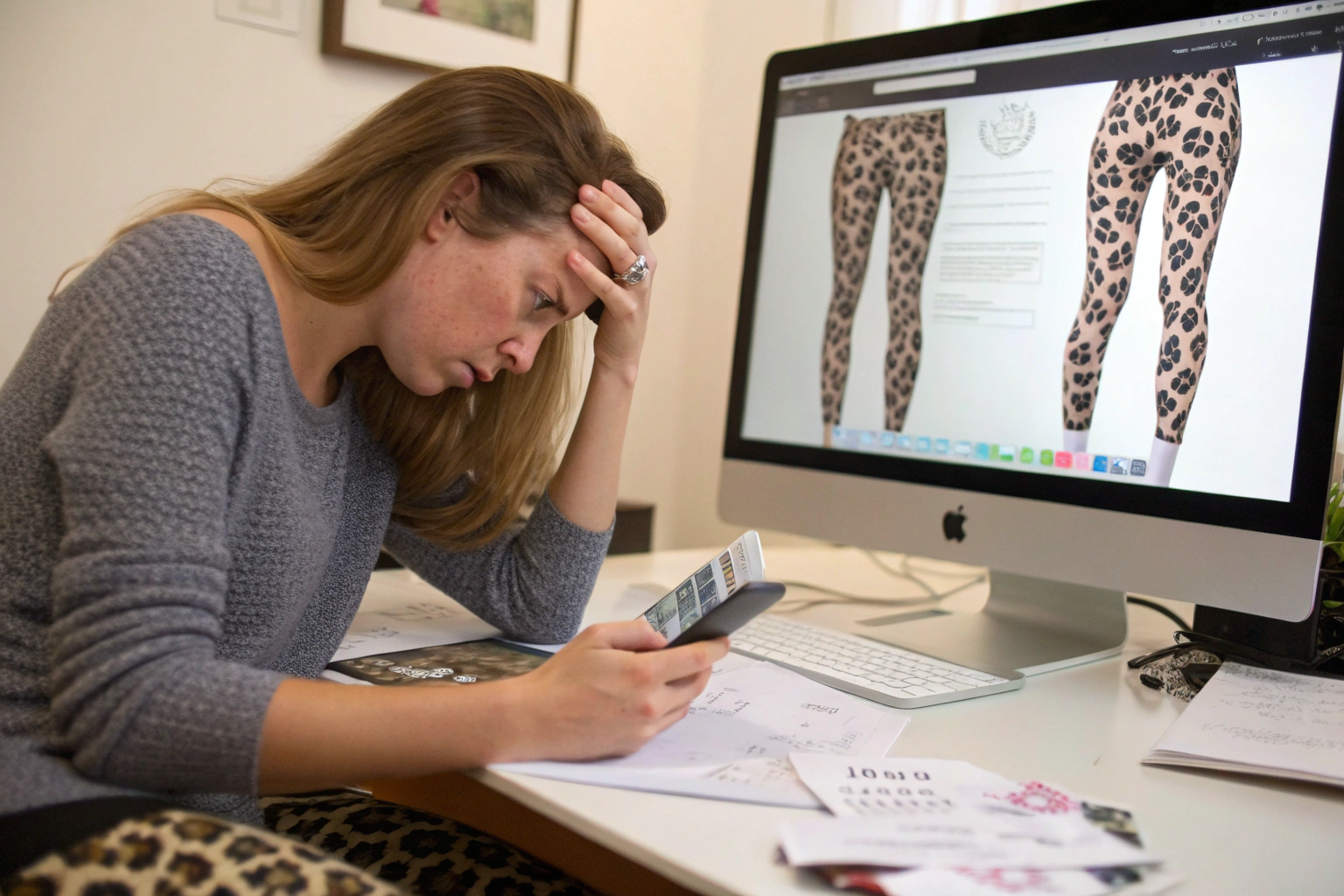
I once had a phone call that still makes my stomach clench. A founder from a premium athleisure brand in Austin, Texas, called me in a panic. She had just found her exact custom-developed leopard print—the one we spent six weeks tweaking the scale and saturation on—plastered across a competing brand’s website. The other brand had the exact same fabric, the exact same colorway, and the exact same placement print. She asked me if we had sold her design to someone else. I told her to check the back of the competitor’s fabric for the selvedge stamp. It wasn’t ours. The competitor had simply taken a photo of her best-selling leggings, sent it to a copycat factory in a different province, and paid them to replicate it. The damage was done. Her six-month design lead was stolen in a week, and she had zero legal recourse because she never filed a design patent, and the factory had no NDA on file.
This is the dirty, unspoken reality of unprotected textile sourcing in China. If you don’t structurally lock down your intellectual property at the yarn, print, and contract level, your designs are public domain the moment the first sample leaves the building. At Shanghai Fumao, we have built a multi-layered IP fortress that treats your brand assets as seriously as our own. We operate under a strict "Design Custodian" model. This means your custom jacquard patterns, engineered placement prints, exclusive color palettes, and proprietary blends are physically segregated in our warehouse, digitally encrypted in our ERP, and legally shielded under a bilateral Non-Disclosure, Non-Use, Non-Circumvention (NNN) agreement governed by Chinese contract law with an arbitration clause in Shanghai. We don’t just promise not to steal your design. We build a physical and digital infrastructure that makes theft impossible without a deliberate, criminal-level conspiracy.
If you’re a US brand owner, you need to understand the Chinese legal framework that protects you, the physical security protocols that prevent swatch leakage, and the mill-side processes that prevent a rogue employee from screenshotting your tech pack. I’ll explain exactly how we enforce design exclusivity, what to do if you suspect a leak, and why our NNN agreement actually holds weight in a Chinese court. Let’s lock down your creative assets so you can scale without looking over your shoulder.
What Legal Framework Protects My Textile Designs in Chinese Factories?
The number one myth I hear from US buyers is that Chinese courts don’t enforce IP rights for foreigners. That is dangerously outdated. China is a signatory to the TRIPS Agreement (Trade-Related Aspects of Intellectual Property Rights) and has a specialized IP court system in Beijing, Shanghai, and Guangzhou that adjudicates foreign IP disputes with surprising efficiency. The problem isn’t the law. The problem is the paperwork. If you show up with a generic PO form that says "Design X is confidential," that’s legally worthless in arbitration. You need a specific contractual architecture.
Our standard NNN agreement (Non-Disclosure, Non-Use, Non-Circumvention) is the industry-specific contract for the fashion supply chain. "Non-Disclosure" means we cannot share your tech pack, CAD file, or physical swatch with any third party. "Non-Use" means we cannot use your design, your print, or your proprietary blend to manufacture goods for any other buyer, even if we modify the color by 10%. "Non-Circumvention" means we cannot bypass you to deal directly with your end customer. This agreement is bilingual (English and Simplified Chinese), and the arbitration clause specifies the Shanghai International Arbitration Center (SHIAC) as the forum. This is critical. Chinese courts will enforce a SHIAC ruling. They will not easily enforce a ruling from a Texas district court. I remember a streetwear brand from Los Angeles who brought their own NNN template. Our legal team reviewed it and found the arbitration clause specified "Los Angeles County." We politely asked them to switch it to SHIAC, explaining that it actually gave them a stronger enforcement mechanism within China’s borders. They appreciated the honesty. To verify the current standing of IP law, I always advise clients to review the official overview of China’s intellectual property legal framework and enforcement mechanisms for foreign businesses operating in mainland China directly from the USPTO.

Is a Chinese NNN Agreement Actually Enforceable if My Design Gets Stolen?
Yes, if you have evidence of a breach and the contract has a penalty clause with liquidated damages. A vague contract that says "the parties agree to keep secrets" is fluff. A sharp NNN specifies a liquidated damages amount, for example, $150,000 USD per proven breach. This number is not a fine; it’s a pre-agreed compensation that removes the need for you to prove actual financial loss in court.
We include a specific liquidated damages clause in all our NNNs. It serves as a massive deterrent. If a rogue employee steals a CAD file and sells it to a competitor, the legal liability is contractually defined and immediately executable. We also include an "inspection right" clause. This means you, or a third-party auditor you hire (like a SGS or Bureau Veritas inspector), can show up at our Keqiao facility with 48 hours’ notice and physically audit our stock inventory, dye recipe logs, and digital CAD library to confirm no unauthorized production has occurred. We actually encourage this. In 2024, a major outdoor brand’s compliance team conducted a surprise digital audit of our color matching database to ensure their proprietary palette hadn’t migrated into our stock service. We passed instantly, which deepened the partnership into a sole-source contract. To understand what makes a contract solid, a comprehensive legal analysis of enforceable Non-Disclosure, Non-Use, Non-Circumvention agreement components for China-based textile manufacturing breaks down the specific clauses that Chinese courts respect.
What’s the Difference Between a Design Patent and Copyright for Fabric Prints in China?
Copyright protects an original artistic work the moment it’s created. In China, a fabric print (like a unique floral illustration) is automatically protected by copyright under the Berne Convention. You don’t need to register it, but registration with the China Copyright Protection Center gives you a certificate that makes enforcement infinitely easier.
A design patent, however, protects the ornamental appearance of a product. If you invent a new 3D knitted structure for a sweater panel, that’s a design patent. The critical difference is timing. A design patent must be filed within 6 months of the first public disclosure anywhere in the world. If you show the sweater at a trade show and file 7 months later, the patent is invalid. Copyright has no such deadline. We advise all our US clients to file a copyright registration for their 2D prints and surface patterns before we start sampling. It costs around $200 and takes 30 days. We actually provide a "Copyright Filing Assistance" document that extracts the high-resolution artwork and technical description needed for the China Copyright Office submission. The nuances between these protections are well documented in a guide to navigating China’s design patent application process and copyright registration for textile surface patterns and garment designs.
How Does Our Factory Prevent Physical Swatch and Sample Leakage?
Physical theft is the oldest trick in the book. A competitor’s agent bribes a factory worker 500 RMB to slip a 20cm swatch of your new fabric into their pocket. That swatch gets sent to a lab, deconstructed for yarn count, blend ratio, and dye chemistry, and within three weeks, a near-identical copy is being sold at a trade show for half your price. The damage is instant and usually undetectable until you see the knockoff online.
We run a "Closed Loop Sample" protocol. Your custom-developed fabrics are stored in a physically segregated, key-card access zone that only three people in the entire company can enter: the Head of R&D, the Production Director, and the Quality Manager. Their key-card access logs are time-stamped and audited monthly. All sample yardage is cut in a sealed room, and the off-cut waste—even a 2cm thread clipping—is collected in a locked bin and cross-cut shredded on-site every Friday. We never send your sample to an outside lab for testing without your written consent; we use our in-house CNAS lab exclusively. For external testing at SGS, we code the sample with a randomized alphanumeric string that contains no reference to your brand name or the end product. The courier waybill to SGS lists "Textile Sample for Technical Analysis" with zero branding. We once had a buyer from a New York-based luxury label who was terrified of the "laundry leak"—samples stolen from hotel laundry during a sourcing trip. We now provide her samples in a heat-sealed, tamper-evident pouch that shows "VOID" if steamed open. (Here I have to mention, our team takes a certain pride in these spy-craft details.)

Who Has Key-Card Access to the "Buyer-Specific" Fabric Storage Cage?
Only three named individuals. Not three positions. Three specific people whose identity documents are on file with our legal department and your brand. If the Head of R&D is sick and a deputy needs access, we require a temporary access request form that is co-signed by you, the brand owner, via email. We do not accept verbal approval.
This may sound extreme, but it’s necessary. I recall an incident in 2023 where a dyeing subcontractor’s technician tried to gain access to a restricted cage by claiming he needed to "verify a lot number." The guard on duty refused because the technician’s name wasn’t on the pre-approved list. The technician complained. We commended the guard and gave him a bonus. The brand owner later told us that moment of strict adherence made them trust us more than any marketing document ever could. The access log is digitally stored and can be exported as a PDF for your compliance audit at any time. It’s a simple, brute-force security measure that eliminates the "helpful insider" threat. This kind of physical security protocol is a key discussion point in industry forums on best practice physical security measures for protecting proprietary fabric samples in international textile manufacturing supply chains.
Can a Dye House Subcontractor Steal Our Exclusive Color Recipe?
Not from us. We have a strict "Blind Dyeing" protocol for colors we classify as "Proprietary Brand Palettes." Your exclusive color recipe (for example, a specific sage green that matches your brand guidelines) is never shared in full with the dye house sub-contractor.
Here’s how we do it. Our internal lab develops the master recipe. We pre-weigh the exact dye powders and auxiliaries for each batch into sealed, numbered containers. The dye house receives Container A, Container B, and Container C with instructions: "Add A at 60°C, run for 15 minutes. Add B at 80°C, run for 20 minutes. Add C at 98°C, fix." They see a sequence of unlabeled canisters. They don’t know the chemical names or the concentrations. They only know the process steps. If they try to reverse-engineer the recipe, they’d have to perform a costly chemical spectrometry analysis, which is economically irrational for a cheap knockoff. This "recipe compartmentalization" is the same technique that high-end fragrance houses use to protect their perfume formulas. It works perfectly in textiles, and it’s built into our standard NNN workflow. The technique of splitting proprietary recipes between departments is explained further in a supply chain management paper on protecting proprietary chemical formulations and dye recipes through process compartmentalization in contract manufacturing.
What Happens to Leftover Production Yardage of Our Custom Fabric?
This is the silent killer of brand exclusivity. You order 2000 meters of custom fabric. The factory weaves 2200 meters to account for dyeing loss and quality defects. You ship your 2000 meters. The "overage," the remaining 150 meters of pristine, sellable fabric, sits in the warehouse. A shady factory sees dead cash sitting on a shelf. They sell it to a jobber for 20 cents on the dollar. A month later, your exact custom fabric appears on a marketplace seller’s Etsy shop, made into cheap cushion covers. Your premium brand is diluted.
We have a contractual "Zero Residual" clause in our manufacturing agreement. This clause states that any overage fabric—whether it’s 5 meters or 500 meters—is destroyed and certified as destroyed. We do not sell it. We do not donate it (where it could be picked and re-sold). We shred it. You receive a "Destruction Certificate" with time-stamped photographs of the fabric being fed into an industrial shredder. The shredded fiber is then recycled back into our generic polyester filling line, so it has a sustainable afterlife but loses all identity as your fabric. An ethical brand from Portland insisted on witnessing the shredding via live video call for their first production run. We set up a tripod, angled the camera at the shredder hopper, and ran the entire overage through while they watched from their office. It took 20 minutes. They recorded the video as an internal compliance document. That’s the level of transparency we offer.

Is the Overproduction "Industry Standard" of 10% Just a Backdoor for Factories to Sell My Design?
The "10% overage" is standard because textile manufacturing has inherent variability. You can’t dye exactly 2000.00 meters. But a corrupt factory uses this standard to deliberately over-produce by 15% or 20%, knowing they’ll secretly sell the excess.
We cap our overage at a contractual maximum of 8%. Anything above 8% is a production inefficiency that we absorb as a cost, not as extra fabric we get to keep. If the dyeing cooperatives produce 12% overage because the shade took too many correction dips, we still only invoice you for the 8%, and we shred the extra 4% as per the Zero Residual clause. We don’t profit from our mistakes. This aligns our financial incentive with your exclusivity. We want to minimize overage because excess fabric costs us money to produce and money to destroy. We have every reason to be efficient. This crucial point is often overlooked in sourcing guides until you read a detailed investigation into the practice of illegal overproduction and grey market diversion of custom branded textile goods in the apparel supply chain.
Can We Buy Back the Overage for Future Capsule Collections Instead of Shredding It?
Absolutely. And we encourage this for high-cost fabrics like silk blends or premium lace. The "Zero Residual" clause has a "First Right of Refusal" sub-clause. Before we schedule the shredding, we email you the exact overage meterage. You have 7 days to purchase it at the standard contracted price per meter.
If you buy it, we pack it and ship it with the main order. If you don’t want the carrying cost of holding dead inventory but want to secure it for a future capsule, we offer a "Vault Storage" service. We keep the fabric in the secure cage under your name for 6 months. You pay a small monthly storage fee. If you don’t release a PO for it within 6 months, we schedule the shred and send the certificate. This gives you the flexibility to scale up if the first production run sells out instantly, without waiting for a full re-run lead time. The process is simple, transparent, and completely under your control. This approach is part of a wider industry move toward sustainable inventory management, as discussed in how fashion brands can implement a "fabric bank" system with ethical manufacturers to reuse deadstock fabric from production overages for limited edition drops.
How Does Our Digital ERP System Lock Down Tech Pack and CAD Files?
The biggest IP threat in 2025 is not a physical swatch walking out the door. It’s a digital screenshot. A junior merchandiser in the sampling room opens your tech pack to check a pocket placement. They take a photo with their phone to "send to the pattern maker." That photo hits their WeChat. From WeChat, it ends up on a supplier group chat. Within hours, your design is floating around the entire textile district. The damage is instant and untraceable.
We run a closed ERP system with Zero Trust architecture. Your tech pack, CAD file, print artwork, and color recipe are stored on an on-premise server, not in a public cloud. Access is granted only via a Virtual Private Network (VPN) connection to our internal network. The file viewer we use for tech packs has a "No Download, No Screenshot" policy enforced by Digital Rights Management (DRM) software. The screen displays a dynamic watermark with the viewer’s employee ID and timestamp. If a screenshot is somehow taken (we block the native screenshot hotkeys, but external camera photos are harder), the watermark immediately identifies the leaker. This DRM system logs every single file open action, including the user, time, and duration of viewing. A brand from Chicago asked us to implement this for their full line sheet. We set up a dedicated virtual room for their design team, which only three designated Fumao staff could enter. The DRM audit log proved that only those three individuals accessed the files during the development window. This is the modern moat around your digital assets.

What Is a "Virtual Sample Room" and How Does It Protect My Pre-Production Line Sheet?
A virtual sample room is a password-protected, cloud-hosted portal where we upload high-resolution fabric scans, 3D garment simulations, and tech pack PDFs. You log in with two-factor authentication (2FA) and view the samples in a digital lightbox that mimics D65 daylight.
The key protection is that you never download the raw file to your device. You view it in the browser. The portal disables right-click, print screen, and developer tools. This is the same technology used by Netflix to protect streaming movies. Why do we use it? Because if your laptop is stolen at a trade show, the thief does not have local copies of next season’s fabrics. Everything is server-side. We also generate an "access token" for your virtual room that expires every 72 hours. This means a link forwarded to an unauthorized colleague or a supplier simply will not open. A swimwear brand we work with exclusively uses their virtual room for internal reviews before their design director flies to China. It cut their physical sample development cycle by two rounds and eliminated all digital leakage risk. The benefits of implementing a secure virtual showroom and digital sample management platform to prevent pre-production IP leakage in apparel manufacturing are becoming an industry standard for forward-thinking brands.
How Do We Prevent a Rogue Employee From Leaking Files on WeChat?
Technology alone is not enough. WeChat is the operating system of Chinese business. We can block it on work computers, but employees have phones. The solution is a combination of forensic watermarking and a severe HR penalty structure.
Every printed document—every tech pack, every color standard, every measurement spec—prints with a faint, non-removable digital watermark that encodes the printer’s IP address, the employee’s username, and the timestamp. If a photo of that document appears on a WeChat group, we reverse-engineer the watermark within 10 minutes and identify the leaker. The employment contract for all our staff includes an IP breach penalty equal to 24 months’ salary, which is legally enforceable under Chinese Labor Law Article 39 for "gross violation of employer’s rules and regulations." We remind every new hire of this during onboarding. We’ve never had a single leak in our company’s history because the detection risk is 100% and the financial consequence is career-ending. It sounds harsh, but it’s the only language that protects your designs. The legal enforceability of such penalties is discussed in an HR and legal advisory on drafting enforceable intellectual property protection clauses and breach penalties in employment contracts for Chinese manufacturing enterprises.
Conclusion
Intellectual property protection in textiles is not a prayer; it’s a system. We’ve stripped away the myth that "Made in China" equals "Stolen by Next Tuesday" by exposing the layered defense infrastructure we’ve built around your creative assets. From the legally-enforceable NNN agreement with SHIAC arbitration and liquidated damages, to the physical key-card cages that restrict fabric access to three named individuals, we’ve shown that physical security is a discipline, not a suggestion. We tackled the deadly overage problem, proving that a contractual Zero Residual clause and certified shredding eliminate the backdoor resale of your exclusive prints. And we stepped into the digital battlefield, where DRM-protected virtual sample rooms and forensic watermarking stop a $15 billion design-knockoff industry before it can screenshot your tech pack. Every process—from blind dyeing for color recipes to 72-hour expiring access tokens—exists to make stealing your brand more expensive than respecting it.
Your brand is worth protecting with military-grade precision.
Stop crossing your fingers every time you email a spec sheet. Let’s formalize a design custody partnership that places your IP inside a legal, physical, and digital fortress. If you want to review a redacted version of our standard NNN agreement or schedule a secure virtual sample room demonstration, contact our Business Director, Elaine, at elaine@fumaoclothing.com today. She will sign you up for a confidential consultation and show you exactly how we lock down the Leopard Print before it ever leaves the building.








