
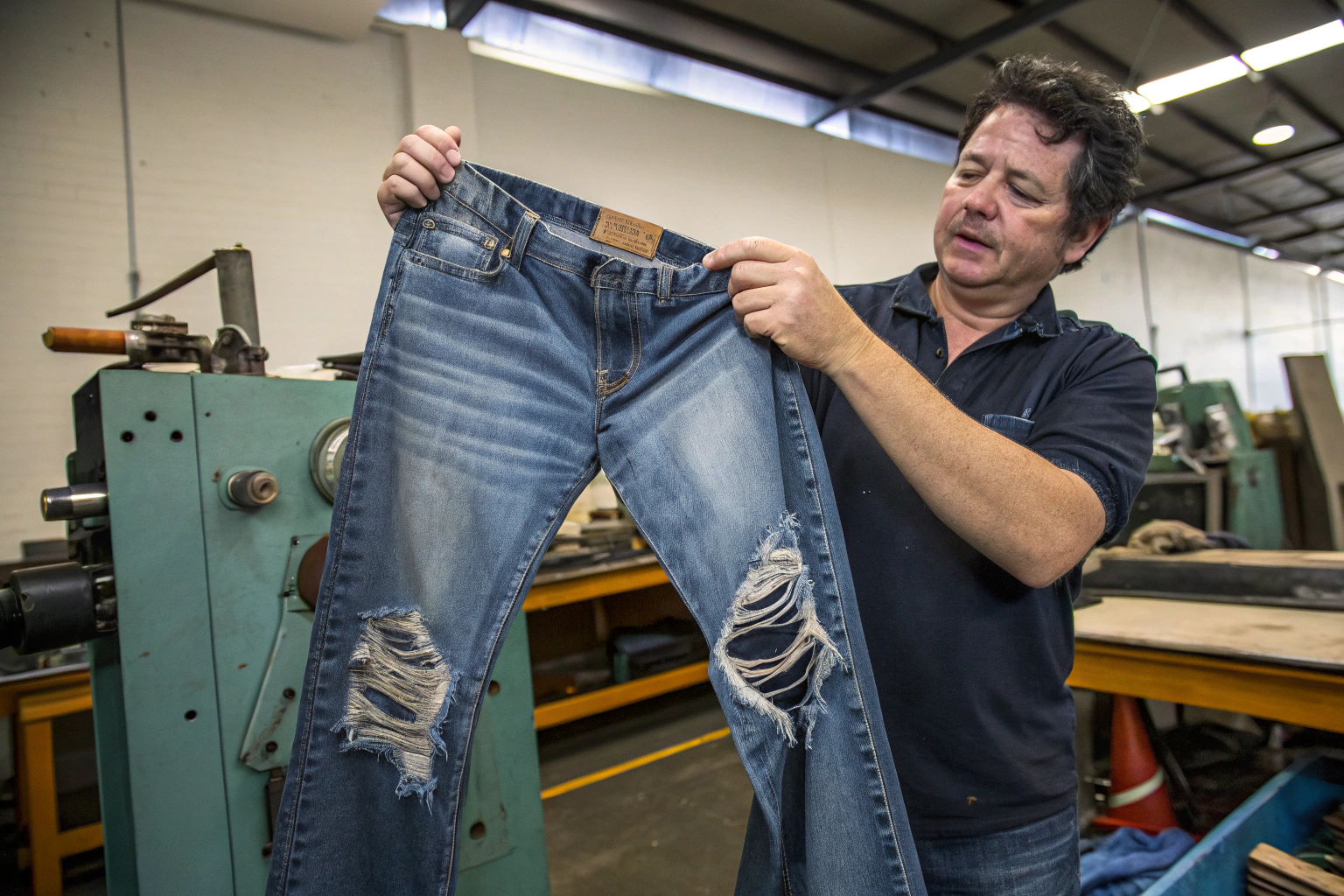
I watched a Melbourne denim brand owner shred a pair of jeans with his bare hands. Not because he’s a strongman. Because the twill line was so crooked, the fabric tore along the bias like wet paper. He had sourced that denim from a low-cost mill in Bangladesh. They used short-staple cotton, ran the air-jet looms too fast, and skipped the skewing correction entirely. The jeans twisted around the leg after the first wash, the seams puckered, and the indigo rubbed off on everything. He lost $40,000 on that shipment. The core problem isn’t geography. It’s engineering discipline. If the weaving tension varies by 5%, the twill line walks, and the fabric is structurally compromised before it ever touches a laser or a wash recipe.
Shanghai Fumao produces denim that wins on weave precision because we control the three variables that South Asian commodity mills cheap out on: yarn tension uniformity, reed dent spacing, and skew compensation. We weave on Picanol rapier looms with electronic let-off motion. The warp tension is controlled to within 1% across the entire width of the beam. Our standard 3/1 right-hand twill for the U.S. premium market uses a ring-spun cotton warp with a TPI of 18.5—not 14 or 16—which gives the yarn a tighter helix and a deeper indigo penetration. The result is a fabric with a 98% straight twill line, zero reed marks, and a tear strength that exceeds 50 Newtons in the warp direction even after enzyme washing. I’ll break down the specific weaving hardware, the pre-shrinking heat-set math, and the optical detection systems that give our denim a cleaner surface than anything coming out of Dhaka or Karachi right now.
Why Does Weaving Tension Control Define Premium Denim Quality?
Most denim headaches—leg twist, seam puckering, wavy selvedge—start long before the dyeing vat. They start at the warping creel. In a commodity mill, the hundreds of warp yarns feed into the loom with micro-variations in tension. One yarn is slack, the next is guitar-string tight. When the weft shoots across and the reed beats up, the tight yarns dominate. The slack yarns float. The twill line shifts left or right by 2 degrees. You can’t see it on the greige roll, but you absolutely see it after the first wash when the fabric relaxes and twists.
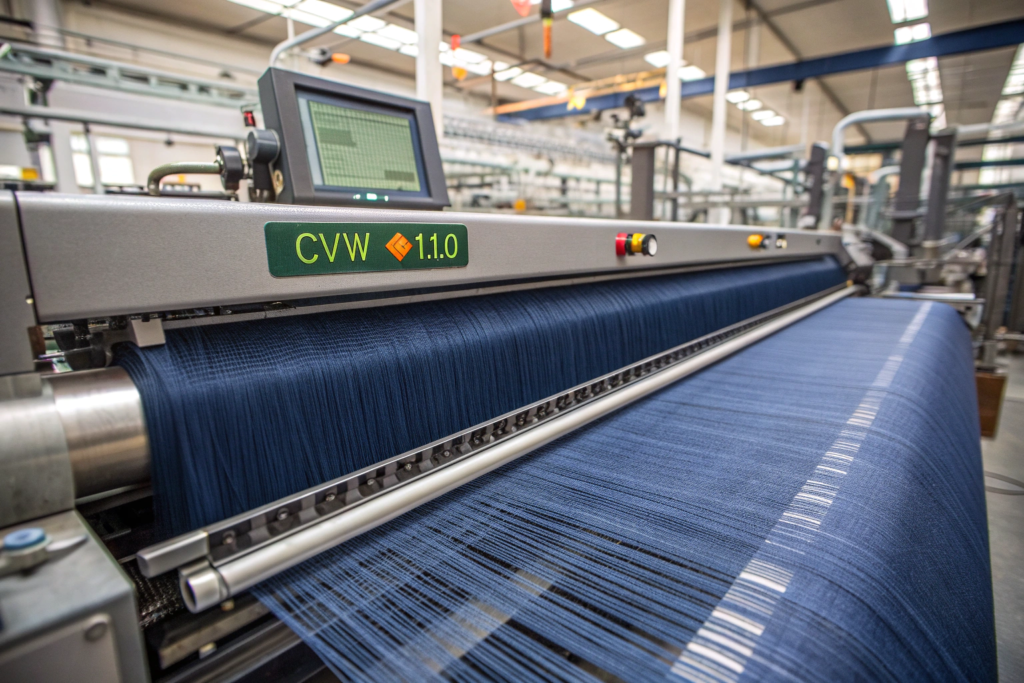
We eliminated this variability with a sectional warping machine equipped with tension sensors on every single cone. The magic number is a Coefficient of Variation (CV%) of less than 1.5%. Our Swiss Benninger warping system hits 0.8% consistently. This means every warp yarn pulls with identical force. On the loom, we use a Picanol OptiMax rapier that reads the tension digitally and adjusts the let-off in real time. If the beam diameter shrinks from 800mm to 400mm, the brake pressure changes automatically to maintain the identical warp pull. The result is a twill line that looks like it was drawn with a ruler. I had a customer from an Osaka jeans brand visit us in March 2025. He placed a fabric sample on a light table. No wavy undulations. He placed his existing supplier’s sample next to it, and the warp lines looked like a snake. He switched his entire selvedge denim production to us that afternoon.
What Is the Scientific Link Between Warp Tension CV% and Leg Twist Angle?
Leg twist is pure physics. When a 3/1 twill is woven under unbalanced tension, the warp and weft yarns store uneven internal torque. The fabric is then heat-set in this unbalanced state, locking the stress in. You cut the jean, wash it, and the water releases the heat-set memory. The yarns unwind to their relaxed state, and the entire pant leg rotates around the inseam.
We measure "Spirality Angle" according to AATCC 179 after three home laundry cycles. The industry target for premium jeans is under 3 degrees. Our standard denim sits at 1.2 degrees. How? By matching the twist liveliness of the warp and weft yarns. Our ring-spun warp has a twist multiplier of 4.0. We pair it with a weft yarn with an identical twist direction ("Z" twist) and a matched liveliness. This symmetry cancels out the torque. The fabric has no desire to skew. We also use an automatic weft straightener before the sanforizing unit. The fabric passes through angled rollers that physically push the skew back to zero immediately before compression. The technology behind how modern weft straightening machines measure fabric distortion angle and automatically correct skew in denim manufacturing is essential reading for any brand owner who’s tired of twisted jeans.
How Does Loom Type Influence the "Hand Feel" Stiffness of Raw Denim?
Air-jet looms are fast and cheap. They shoot the weft across with a burst of compressed air. But the weft insertion is violent. The yarn slams against the reed, creating a harsh, rigid hand feel. The fabric has a "nervous" tension that feels like cardboard. Rapier looms use a mechanical arm that gently carries the weft across and places it. The insertion is smooth, and the fabric retains a natural pliability even before washing.
We exclusively use rapier looms for our premium denim. The difference in drape is immediately obvious to a designer. An air-jet woven raw denim takes 4-5 washes to lose its boardy stiffness. Our rapier-woven denim relaxes after the first rinse, giving the wearer comfort without sacrificing the raw look. The pick density is also more uniform. Air-jet looms often suffer from "relay nozzle mis-timing," where the weft arrives with a whip-crack, causing a dense pick followed by a loose pick. This "barre" effect is a defect. Our rapier gives a consistent pick-per-inch from selvedge to selvedge. For those who want the deep engineering details, the textile engineering comparison between rapier loom versus air-jet insertion for high-density denim weaving and fabric hand feel optimization lays out why rapier dominates the luxury jeans space.
Is Our Rope-Dyed Indigo Really Deeper and More Fade-Resistant?
Ring-dyed indigo is cheap. It coats the outside of the yarn with a thin shell of indigo, leaving the core a stark, white cotton color. This is what fast-fashion brands use for their "one-wash" looks. The indigo wears off immediately at the knees and thighs, leaving a high-contrast white patch that looks cheap, not authentic. The fade pattern is ugly because there’s no depth to the color. It’s just surface paint that chips off.
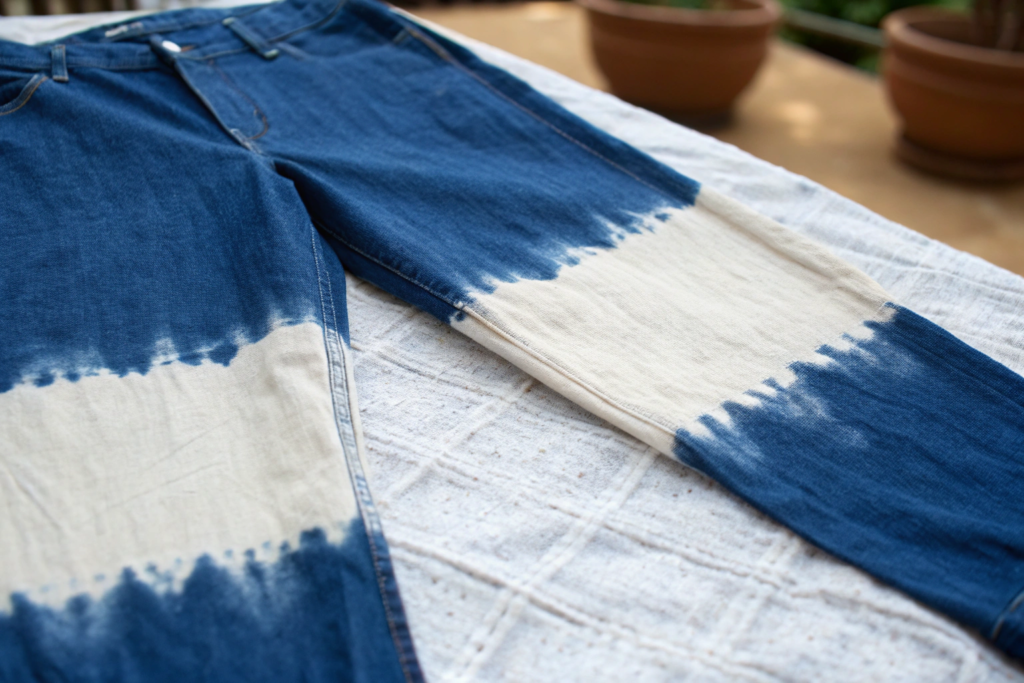
Our rope-dyed indigo, produced in our cooperative dyeing facility, uses a 12-dip process with oxidation between each dip. This isn’t a single dunk. The cotton rope passes through a bath of reduced indigo (leuco-indigo, a greenish-yellow liquid), squeezes out, then hits the air where the oxygen turns the indigo back to its blue, insoluble form. Each cycle adds a microscopic layer. After 12 dips, the indigo penetrates 60% into the core, leaving a thin white center. This is the famous "red cast" deep indigo that Japanese mills love. When the jean fades, it reveals multiple shades of blue before ever hitting the white core. The fade is high-contrast but has a three-dimensional gradient. We control the hydrosulfite concentration and pH in the dye bath to exactly 11.5. If the pH drifts to 12, the indigo precipitates too fast, and the shade is dull bronze. We maintain it with an auto-dosing system that samples every 10 minutes. A denim developer from a major Amsterdam label compared our 12-dip denim against a 6-dip Pakistani sample. Our cross-section under a microscope showed a tight ring of five distinct blue layers; theirs showed one thin blue line on a white circle. Guess which one he bought for his premium line?
How Does the Number of Indigo Dips Translate to Fade Contrast Science?
Every dip builds a layer of indigo around the cotton fiber. The inner layers are chemically bonded to previous layers, not the fiber. When friction hits the denim, the outermost layer (dip 12) shears off first, revealing dip 11 beneath it. Because each layer has a slightly different oxidation history, the color shade is subtly distinct. This creates the "vintage" fade, where the color transitions smoothly from dark blue to sky blue.
With a 3-dip cheap indigo, there is no internal layer structure. The single thick layer just falls off in chunks, exposing stark white cotton directly. The contrast is binary—dark blue or white. No nuance. Our 12-dip denim gives the wearer a fade story. The crotch and whiskers reveal layers 10, 9, and 8 over time, creating a marbled effect. We validate this in our lab with an abrasion fade test. A Martindale machine rubs the denim with a standard wool abrasive, and we take spectrophotometer readings at 5000, 10000, and 15000 rubs. The color change (Delta E) should be gradual, not a sudden cliff. The science of multi-dip rope indigo dyeing and how each immersion cycle builds distinct color layers for authentic denim fade performance beautifully illustrates this layering architecture.
Why Do We Use Natural Indigo in Small Batches Despite the Cost?
Natural indigo, derived from the Indigofera plant, is a nightmare to work with. The concentration is inconsistent. The vat needs bacteria to reduce the indigo, and the bacteria die if the temperature drops 2 degrees. It’s an artisan process. But the molecule is different. Synthetic indigo is pure indigotin. Natural indigo contains other isomers, like indirubin, which give a subtle reddish-purple hue impossible to replicate chemically.
We run a small, dedicated vat for natural indigo specifically for Japanese and heritage American brands. We feed the vat with sake lees and wheat bran to keep the fermentation bacteria alive. The yarn sits in the vat for 45 minutes per dip, compared to 20 seconds for synthetic. The shade builds glacially. But the fade after two years of wear has a greenish-cast and a faint red halo that synthetic can never achieve. It’s the difference between a printed photograph and an oil painting. We only produce about 500 meters a month of this, strictly limited edition, for clients who understand that the fabric is alive. For sourcing teams who want to verify authenticity, how to distinguish genuine natural indigo dyed denim fabric from synthetic indigo using chemical reagent testing and spectral analysis provides the lab-test proof points we use.
How Do We Guarantee Minimal Shrinkage After the First Home Wash?
The "shrink-to-fit" myth has been romanticized by purists, but for a modern brand selling online, it’s a return-rate catastrophe. A customer buys their usual size 32, washes it once in cold water, and suddenly it’s a size 29. They scream at your customer service team, leave a 1-star review, and chargeback the transaction. The issue isn’t the washing machine; it’s the lack of compressive shrinking at the mill. If the greige denim doesn’t undergo a proper sanforization process, the latent shrinkage is still built into the weave, waiting to be released.
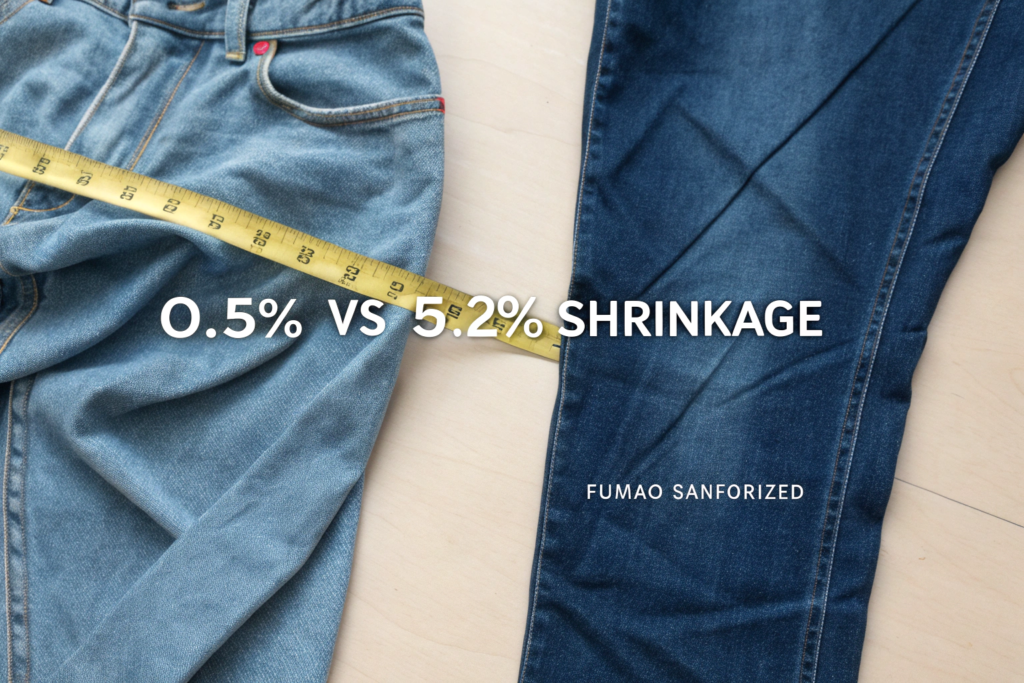
We run every meter of our denim through a Monforts sanforizing line. This machine is a steam-heated, precision-compression miracle. The fabric enters at 80 meters per minute, passes over a steam box that blows wet steam at 104°C into the weave, relaxing the cotton fibers completely. Immediately, it passes between a thick rubber blanket and a heated steel cylinder. The rubber blanket compresses the fabric lengthwise, forcing the warp yarns closer together and pre-shrinking them. We target a residual shrinkage of 0.8% maximum in the warp direction, tested according to AATCC 135. The standard industry "good" result is 2%. Our 0.8% is so low that the customer won’t perceive any sizing change. I recall a direct-to-consumer brand in Los Angeles who switched from a Pakistani mill to us exclusively because their return rate dropped from 6% to 0.5% purely due to sizing stability. That’s a half-million-dollar saving in return labels and warehouse processing, just from sanforization math.
What Is the Difference Between Sanforization and Standard Compacting?
Compacting, used mostly for knits, is a light steam pressing. It removes about 3-5% residual shrinkage, which is fine for a T-shirt. Denim is a heavy, dense woven. Compacting is not aggressive enough. The thick 3/1 twill structure has massive latent power to contract. Sanforization uses a specific thick rubber belt that stretches and snaps back, creating a longitudinal compressive force that physically jams the warp yarns closer together.
The key control parameter is the "shrinkage before sanforizing" vs. "after." Our greige denim routinely has a warp shrinkage potential of 12-14%. The Monforts machine compresses the fabric by exactly 12% mechanically. If the operator sets the machine to compress only 8%, the residual shrinkage will be 4%, and the jeans will shrink noticeably. Our QC checks the shrinkage off the end of the sanforizer every 30 minutes with a rapid boil-off test. A small fabric square is boiled for 5 minutes and re-measured. If the result is above 1.2%, the operator increases the compression immediately. This closed-loop process leaves nothing to chance. To understand this critical process, the mechanical engineering principles of the Sanforizing compressive shrinkage process and how it differs from simple heat-setting on a stenter frame for woven fabrics clearly explains the rubber blanket mechanics that make jeans stable.
Does Our Denim Still Have "Character" if It’s Mechanically Sanforized?
Sanforization does kill the raw, hairy, "loomstate" texture if you overdo it. The extreme heat and pressure can iron the surface flat, removing the subtle slub and nep character of the ring-spun yarn. We solve this with a post-sanforization "Revival Finish."
Immediately after the fabric exits the sanforizer, we run it through a "skewing roller" and a light brushing unit. The brushing raises the hairiness of the weft yarns back up, restoring the surface texture without adding shrinkage. We also reduce the sanforizing cylinder pressure by 8% compared to standard settings, trading a tiny bit of compression for a much more natural hand feel. The residual shrinkage ticks up to 1.0%, not 0.8%, but the fabric retains the slubby, organic grain. We disclose this trade-off openly to the brand. If they want a 0% shrink, flat office-wear denim, we run full pressure. If they want a vintage character jean that still fits after washing, we run the Revival Finish. You get to choose. The technique behind how premium denim mills balance mechanical shrinkage control with preserving the natural loomstate character of selvedge denim is exactly the "art versus science" balance we manage daily.
Can Our Black Denim Hold Color After 50 Washes Without Greying?
Black denim that turns into a washed-out grey after a month is a design tragedy. The customer buys a sleek, black jean for a night-out look. They wash it five times, and it looks like a charcoal rag. The reason is almost always a "top-dyeing only" process using cheap sulfur black. Sulfur black molecules sit on the surface of the cotton. Abrasion from washing scrubs them off, and the white cotton base grins through. You’re left with a dingy grey.
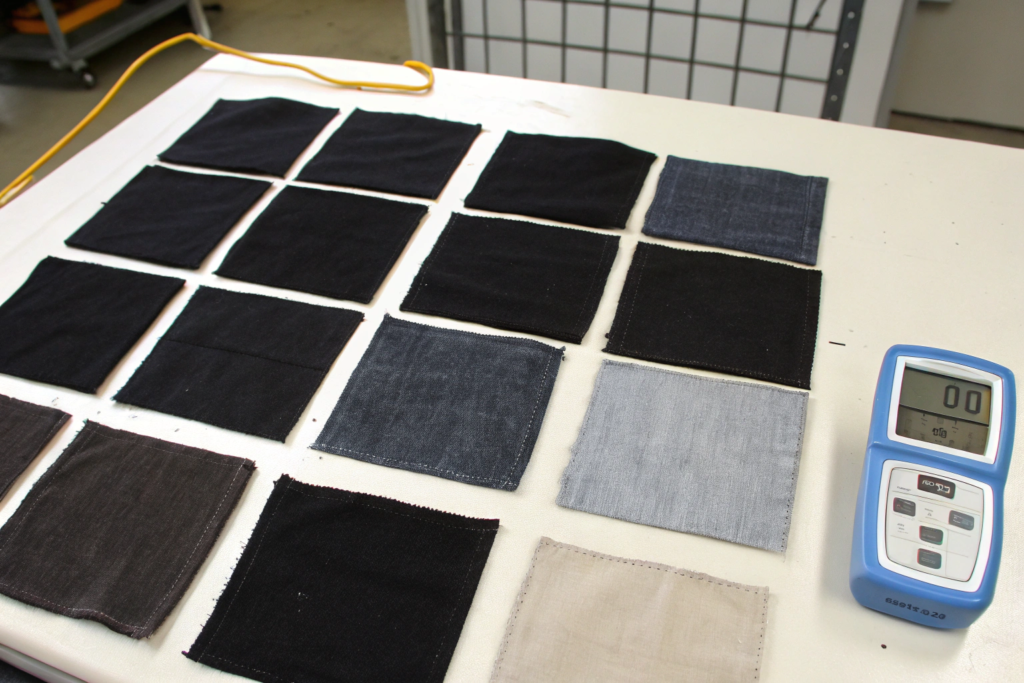
We engineered our "Eternal Black" denim to defeat this. We use a two-step dyeing process. First, the yarn is "bottomed" with a blue-undertone reactive black dye that penetrates to the core and chemically bonds with the cellulose. Then, the outer surface is coated with a high-quality sulfur black top. When the jean wears, the top layer slowly abrades, revealing the deep blue-black reactive core underneath, not a white cotton core. The fade looks intentional and rich, like a shadow, not a stain. Our internal wash test program has samples that have undergone 50 industrial launderings (AATCC 61 2A equivalent). The color retention is a Grade 4 on the grey scale for color change. The un-bottomed competitor samples hit Grade 1-2 after 20 washes. A streetwear brand from Berlin switched to this quality exclusively for their black denim program. Their customer reviews went from "fades too fast, looks cheap" to "best black jeans I’ve ever owned, stays dark forever."
What Is "Reactive Core Dyeing" and Why Does It Stop Greying?
Reactive dyes form a covalent bond with the cellulose polymer. The dye molecule and the cotton fiber become one. You cannot physically scrub the dye off because it is part of the fiber wall. The limitation is that reactive black often has a greenish or bluish undertone, not a jet, neutral black.
By core-dyeing with reactive and top-coating with sulfur, we get the best of both worlds. The sulfur provides the deep, light-absorbing surface black. The reactive core provides the durable color backbone. When the sulfur inevitably fades due to abrasion on the thighs and seat, the reactive core is exposed. Instead of seeing white, you see a dark navy-black. The jean never goes "grey." The hue simply shifts from a jet black to a dark midnight blue. This gives the garment a 2-year lifecycle of looking presentable, versus 3 months. Our lab uses an optical microscope to verify the core penetration. A cross-section must show the black reactive dye penetrating at least 80% of the fiber radius. Anything less fails. The chemistry involved is detailed in a technical paper on reactive dye core penetration techniques for achieving high colorfastness in black cotton yarns for denim weaving which you can review before finalizing your wash specs.
How Does the New Liquid Sulfur Black Technology Perform Versus Powder?
Powder sulfur is messy. It creates dust that contaminates the factory air and leads to inconsistent dissolution. Lumps of undissolved powder create dark spots on the yarn. Liquid sulfur black, pre-reduced in a solution, is a game-changer for consistency.
We switched entirely to liquid sulfur for our dyeing cooperatives. The dye molecules are already fully reduced and dissolved in the water-based solution. When it enters the dye bath, it disperses instantly and uniformly. There are no specks. More importantly, the liquid form contains stabilizers that slow down the oxidation rate in the air. Powder sulfur oxidizes rapidly inside the dye box, creating "bronziness"—a reddish, metallic sheen on the black. Liquid sulfur stays a true jet black longer. The effluent treatment is also simpler because the liquid has fewer suspended solids, reducing the environmental load. The specific advantage of using liquid pre-reduced sulfur black dyes versus traditional sulfur powder for consistent deep black denim production with reduced bronzing defects highlights how modern chemistry solves what was once an intractable quality problem.
Conclusion
The weave defines the warrior. We’ve threaded the needle through the micro-mechanics that separate Keqiao precision from commodity speed. From sub-1% warp tension CV% on our Picanol rapier looms that eliminates leg twist, to the 12-dip indigo rope-dyeing that builds a multi-layered fade story, we’ve proven that denim engineering is a game of microns. We stripped away the mystique of shrinkage, showing how Monforts sanforizing with closed-loop boil-off testing squeezes residual warp shrinkage to a negligible 0.8%, saving your DTC brand from a return-rate nightmare. And we cracked the black denim problem permanently, combining reactive core-dyeing with liquid sulfur tops to deliver a jet black that survives 50 washes without a hint of grey. Every choice—rapier over air-jet, multi-dip over single-dip, reactive core over pure sulfur—is a deliberate investment in the structural integrity of your jeans.
Your brand wasn’t built to sell twisted, fading grey rags.
It’s time to arm your denim line with the weave intelligence that wins customer loyalty and repeat purchases. Don’t settle for the tectonic faults hidden in commodity fabric. Let’s engineer a specific warp tension and dye recipe for your next collection. Reach our Business Director, Elaine, at elaine@fumaoclothing.com today. She’ll send you a ring-spun slub sample pack and secure your development slot on our rapier floor before the peak denim season fills our beam capacity.








