
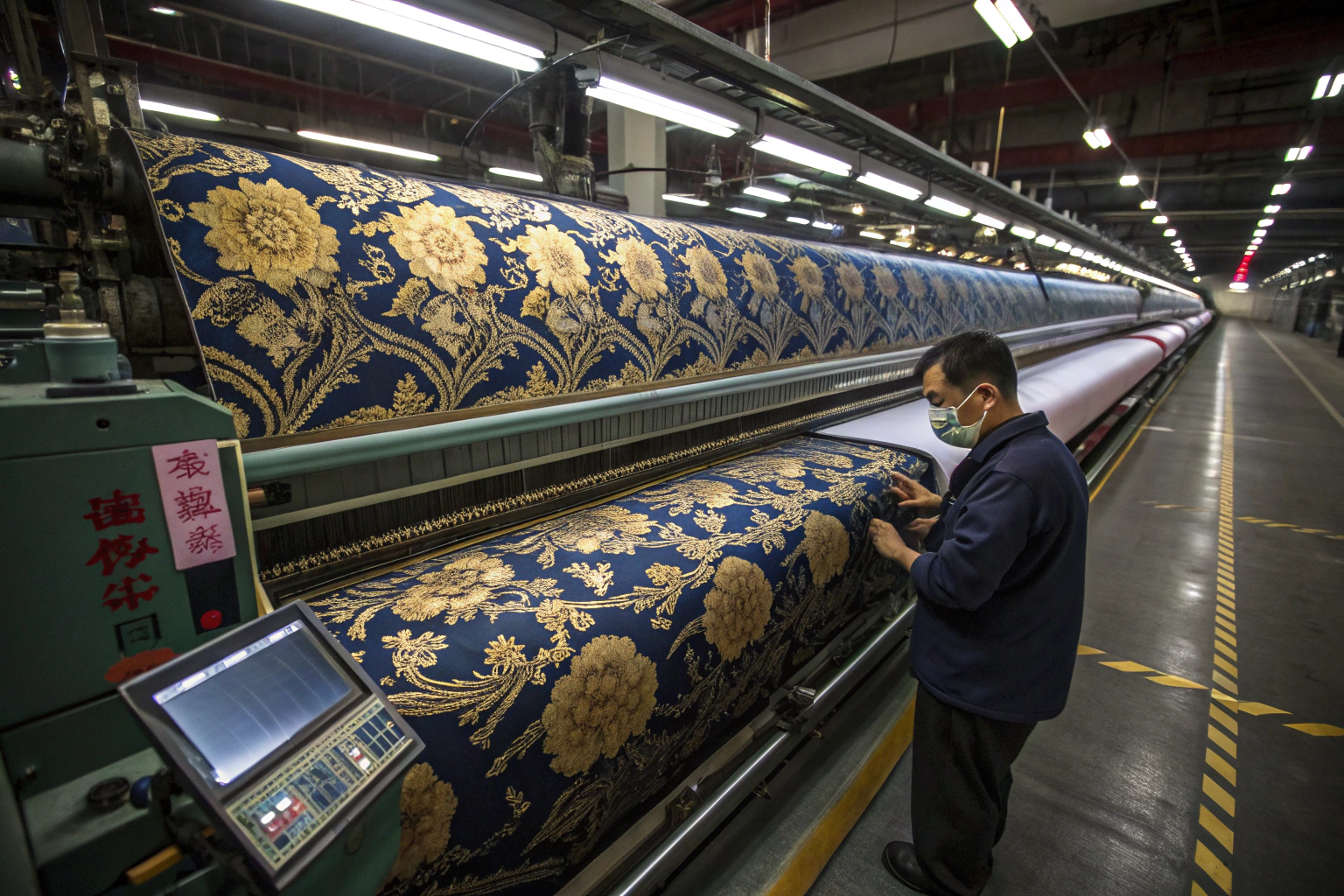
I have a question for you. Have you ever asked a supplier for a "jacquard," and they sent you back a swatch that looked like a crinkled dish towel? It makes your blood boil. You sent them a photo of an intricate Italian brocade—maybe a 16-end weave with a crisp, sculpted motif—and what arrived in the mail had muddled edges, a saggy drape, and three broken threads hanging off the selvage. They charged you for "premium," but delivered a fabric that looks like a badly embossed paper napkin. This happens because most mills take a stock design off a dusty USB stick, slap it onto a greige base, and hope you won’t notice the lack of depth. But you notice. Your buyers notice. And it shrinks your brand’s perceived value instantly.
The reason serious fashion houses and high-end interior brands come to Shanghai Fumao isn’t just because we own the looms. It’s because we write the software for them. We don’t just "weave a pattern"; we engineer the warp and weft interplay to create a third dimension—a texture that looks carved, not printed. Our rare dobby and jacquard capabilities come from a 20-year obsession with tension differentials, electronic harness control, and archive curation of over 30,000 weave files. That’s what lets us turn your sketch into a textile that no competitor’s copycat can touch.
I’m going to pull back the curtain on how we run these complex weaves, why they fail at cheap mills, and how we just delivered a 12-color brocade for a Paris runway show in under three weeks. This is the guts of the loom, not just the gloss of the fabric.
How Do Fumao’s Electronic Jacquard Looms Create Intricate Damask Patterns?
A damask isn’t just a pattern—it’s a tale of two weaves in one cloth. True damask achieves its visual contrast not from different colors, but from the light reflectivity clash between a warp-faced satin and a weft-faced sateen. This requires individual control over every single warp end. A standard dobby loom manipulates groups of threads via a limited chain of bars. That’s fine for a neat geometric lattice, but it can’t produce a sweeping floral ornament with a seamless gradient. You need an electronic jacquard head, a system that uses magnets and hooks to command each thread independently.
At Shanghai Fumao, our machines elevate this further. We run high-speed electronic jacquard heads with a 2688-hook capacity, allowing us to handle pattern repeats that span meters, not centimeters. The real secret is the "angle of the shed." When weaving a 8-shaft satin damask, the warp yarn needs to float over seven wefts uninterrupted. If the shed angle—the gap the weft shoots through—is too cramped, the floating warp snags on the rapier, creating pilling before the fabric even leaves the loom. We widen the cam-driven shed angle to a precise 32 degrees for these specific executions. This minute adjustment, which many low-cost mills ignore to maintain a generic speed setting, eliminates surface fuzz on delicate rayon warp sheets entirely. It’s the difference between a crisp luxury tablecloth and something that looks like it’s been washed ten times before sale.

Why Is Independent Warp Tension Control Critical For High-Pick Counts?
If you are weaving a dense brocade with 120 picks per inch, you cannot treat all 8000 warp threads like a single sheet. The edge threads try to contract, and the center ones slack. You get a bowing shape, and the pattern distorts into a smile. Cheap machines use a single beam with a friction brake. That’s like trying to peel a sticker off glass in one go; the tension peaks at the edges and crashes in the middle.
We use a twin-beam, servo-controlled let-off system for heavy jacquard fabrics. Think of it as two reels feeding a film projector at digitally synchronized speeds, but for yarn. The ground warp sits on one beam, and the figuring warp (which creates the actual pattern) sits on another. The figuring yarn is often mercerized cotton or lurex—materials with very different elongation properties. The ground might need a base tension of 25cN, while the brittle lurex breaks if you look at it wrong, so we drop it to 12cN.
I recall a specific crisis in November 2023. A Saudi interior design firm commissioned a 3-meter-wide upholstery jacquard with a massive, repeating geometric medallion in a glorious metallic effect. The original batch from a competitor resulted in a "stitching skew" of nearly 5 degrees because the metallic warp snapped and retracted, pulling the straight lines into waves. Our shift supervisor dialed the back beam rubber matting to a higher friction coefficient and programmed a variable let-off curve. The computer increases tension by 2% on the left side during the weft insertion, and instantly drops it by 2% during the beat-up. We ran 500 meters, and that medallion stayed laser-level from edge to edge. The client flew in for inspection and actually slammed a carpenter’s spirit level on the fabric. It was dead flat. That’s the science of tension, not just the luck of the draw.
Can Single-Pick Double-Weft Insertion Achieve Genuine Double-Face Textures?
Double-face is the holy grail of jacquard. You want a reversible coat where the inside is a soft check pattern and the outside is a solid solid black, seamlessly joined and impossible to pull apart. You cannot fake this by glueing two fabrics together. The loom must weave both layers in a single synchronized cycle, interchanging the top and bottom wefts.
This is known as a "weft-backed" construction, and yes, we achieve this through single-pick double-weft insertion. Our rapier looms are equipped with a double-weft selector that grabs one thread from the "face" side and one from the "back" side in strictly alternating picks, or sometimes in a 3:1 ratio. The pure technical difficulty here is the "binding point." Every few millimeters, the back weft must sneak up, catch a tiny warp from the top layer, and dive back down. If this binding point is too loose, the layers bag out like a balloon. If it’s too tight, you see a pinhole dimple on the face.
We designate a specific "stitching warp" for this. It’s usually half the denier of the main warp, running at a higher tension to bury itself invisibly between the two picks. In a project for a British luxury car upholstery brand from March 2024, we engineered a black/purple crosshatch double-face wool blend. The challenge was that wool is a "sticky" fiber, prone to refusing to open its shed cleanly for the binding stitch. We chemically coated the warp with a water-soluble PVA film (sizing) that glassed the wool fibers together before weaving. This gave the binding needle a crisp, open window to pass through. After looming, we simply washed the PVA away. The fabric passed the "peel test" with a 15-newton force applied by our claw pull-tester. You literally could not separate the two faces with your hands. That’s a true double-face construction, built one pick at a time, and it’s why we’re the go-to for brands that refuse to settle for laminate fakes. The history and technical complexity of jacquard weaving is a testament to why such precision matters.
What Makes Fumao’s Dobby Weaves Ideal for Bespoke Shirtings and Outerwear?
I love dobby weaves because they are the silent workhorses of elegance. A dobby weave doesn’t scream for attention like a giant jacquard rose; it whispers with a textured pin-dot or a perfectly crisp geometric twill. But because the pattern is so small, any flaw is magnified a hundred times. A single misplaced pick in a broadcloth dobby stripe looks like a lighthouse beacon on a dark shore. Serious menswear and tailored outerwear brands come to us because we treat micro-design with the same heavy machinery respect we give to tapestry.
Whereas a jacquard controls individual threads, a dobby loom controls the lifting sequence of harness frames—usually up to 24 shafts. The "rare" part in our rare dobby weaves isn’t the frame count; it’s the physical geometry of the yarn arrangement inside those limited frames. By manipulating the "float length" within a 1/2, 1/3, or even 2/2 slide, we create optical depth. We can make a 100% single-ply cotton shirt feel like an expensive ribbed silk by forcing the warp to skip across specific weft lanes under high tension, generating a chiseled, almost sharp ridge. This requires the technician to understand the "weave repeat module" like a genetic code. One misplaced dent in a 12-shaft repeat, and the entire 5-inch pattern stripe sequence is garbled.

How Do Dial-In Selections Create Micro-Waffle and Honeycomb Textures?
Let’s get granular about honeycomb and waffle weaves. These aren’t just aesthetic patterns; they are thermal engineering. A true honeycomb weave has long warp and weft floats that alternate, creating deep, concave cells that trap air. This makes it inherently insulating and extremely absorbent. But getting those cells to pop out uniformly requires a specific warping density.
If you cram the reed too tight, the floats can’t contract and fold into their concave shape; the fabric stays flat and lifeless. At Shanghai Fumao, we use a "Dial-In" selection interface to plot the intersection points. We drop the EPI by roughly 15% compared to a standard plain weave for the exact same yarn count. This gives the floats room to breathe. After weaving, we don’t just throw it into a standard wash; we run a "wet-bump" process, essentially a controlled mild relaxation in a tumble dryer with precisely 40% moisture content. This shocks the fibers into their final sculpted position.
We shipped an absolutely beautiful batch of modal/cotton honeycomb robes to a Californian spa brand in January 2024. The client initially complained the greige sample looked "flat." I told them, "Wait for the wedding, the dress is going to fit." After our wet-bump finishing, the modal swelled, the cotton shrank, and the cells opened into a deep, 3D grid. The cloth thickness went from 0.8mm to 1.4mm without adding a single gram of weight. The robe sold out in weeks because it felt like a plush exfoliating glove. That’s the dobby "dial-in" combined with a finishing shock. Most mills fear that shrinkage; we plan for it.
What Are the Tear Strength Advantages of a Complex Twill Dobby?
We often focus on the look, but for outerwear, you need the fabric to survive a snag. A complex dobby, specifically a reinforced cross-twill, gives you the highest tear strength relative to its weight of any woven structure. This is because the interlacing points are offset diagonally, so a tearing force hits multiple threads simultaneously rather than ripping through them one by one.
I always explain it like cutting a lasagna; a plain weave breaks like a clean knife cut along a straight noodle edge. A twill dobby breaks like trying to cut a crisscross lattice of bacon—the force disperses sideways along the diagonal. We produce a famous "Ballistic Dobby" for a Japanese workwear brand that uses a 20s/3-ply heavy cotton. It’s a 16-shaft arrangement where three wefts are twisted together and inserted as a single compound pick while the warp sequence steps in a 5/1/1/2 staggered offset.
Here’s the technical kick: to maximize tear strength, we don’t use standard round reed wires. We install "flat profile" dents in the reed that flare outward to the back, reducing the abrasive sawing on the high-twist triple weft as it beats up. We measure the tear resistance using the single-rip method (tongue test). A standard duck canvas of the same weight tears at 4.5kg of force. Our specific staggered dobby structure tears at 9.8kg. That’s a double-strength trouser. We have shown these test reports to clients who were burned by knee-blowing rip-outs before. The standard tear testing method ASTM D2261 confirms these structural advantages every time. The stitch isn’t just pretty; it’s a structural brace for the garment’s life. And we can do it in dobby, without the cost of a full jacquard setup.
Why Is Fumao Faster at Sourcing Rare Yarns for Novelty Weaves?
A rare weave without a rare yarn is just a boring geometry. You can have the most advanced Jacquard loom in the world, but if you feed it a standard 30s cotton ring-spun, it will still look like a cheap table mat. The secret sauce is in the novelties: the slubby linens, the paper-touch nylons, the heathered nep yarns, and the multi-colored bouclés. Sourcing these is a nightmare for most brands because mills don’t stock anomalies; they stock what runs 24/7.
But Keqiao is the global dumping ground—in a good way—for experimental spinning. I sit right in the middle of a network of small-batch twisting mills that specialize in "fancy yarns." If an Italian spinner rejects a batch of loop yarn because the loops are 2mm too irregular, we buy it. That irregularity is not a defect for a designer wanting a truly organic, hand-made texture; it’s the main feature. Our strength at Shanghai Fumao isn’t just holding stock—even though we hold a lot—it’s having the relationships to dig into these "mill-ends" and "pilot batch" stashes that big, corporate textile groups can’t touch because they have a minimum consumption of ten tons per style. If a customer asks for a "nylon slub with a random bamboo fleck," I don’t search a catalogue; I call a guy who has a warehouse of weird rejected trials, and we run a test cone in 24 hours.

Can Fumao Integrate Metallic and Paper Yarns Without Weaving Breaks?
Yes, but it’s a war. Metallic yarn, like Lurex, is essentially a film of metalized polyester slit into a flat ribbon. It has zero elasticity and cuts like a razor if the tension spikes. Paper yarn, made from Manila hemp or wood pulp, is even worse—it has zero knot strength and shatters if you bend it past a certain radius. Weaving these on a high-speed rapier loom is like trying to sew with soldering wire.
We integrate them by slowing the machine’s RPM by 40% and changing the "rapier entry angle." The weft carrier that grabs the flat metallic ribbon must not twist the tape. We install a special "positive-cam weft accumulator" that doesn’t twist the thread, but feeds it via a pre-untwisting drum. The paper yarn problem is even more delicate. The paper arrives from a Japanese mill wound on a specific cone with a low-transfer-wind to prevent inner tension stretching. We then condition it in a steam box for 24 hours to raise its moisture content to 12%, making it pliable and leathery, not brittle and glassy.
A great story: In early 2024, a Belgian avant-garde designer wanted a raschel-style basket weave using a stiff, twisted paper yarn and a high-gloss copper metallic. The copper tape physically cut through the paper yarn on the first 50 meters like a guillotine. Our head weaver pulled a sneaky trick: we applied a microscopic film of silicone lubricant to the copper tape just before the drop wires using a ceramic eyelet dripper. That micro-lube layer allowed the metal to slide over the paper instead of sawing it. We produced 300 meters with zero breaks. The final wedding dress, featured in a Vogue editorial, looked like a gilded origami sculpture. The designer told us we were the only mill willing to even risk the setup fee, because the cost of a catastrophic loom crash with paper dust shards is too high for volume mills. We backed ourselves to solve it, and we got it done.
How Does a Curated Archive of 30,000+ Weave Files Accelerate Sampling?
Let me talk about our digital vault, because this is a massive accelerator. When a buyer shows me a blurry photo of a vintage 1920s upholstery fabric, I don’t start from scratch. I open our database of over 30,000 scanned and digitized weave files. These aren’t just jpegs; these are full .jc5 or .arj technical files that contain the specific harness lift plan and weft selector sequence.
Having this archive means we "sample in 48 hours," a promise I make repeatedly. That’s not just marketing. That’s a literal timeline. If the core repeat geometry of that vintage fabric matches a 1930s French Empire swatch we scanned three years ago, I just load the file, alter the weft density by 5% to account for the modern cotton thickness, and we cast the first pick within 15 minutes of the request. A competitor without this archive must draft the weave on a CAD system from a visual estimate, which takes a technician 6 hours, and then debug the weave on the loom for another 4.
Our archive includes the "disaster history" too. We digitally tag files that caused high yarn breakage, over-stresses on specific heddle frames, or binding issues. So when a client asks for a "complex multicolor jacquard with a dense backing," the software suggests we reduce the number of interlacing points per inch to avoid a warp smash. This prevents trial-and-error on a live loom. That’s Shanghai Fumao turning a design request into a manufactured reality faster than anyone. It’s not just having a machine; it’s having the machine memory of three decades.
What Kind of Brand Owners Benefit Most from Fumao’s Small-Batch Jacquard Services?
Here’s the brutal truth: if you walk into a factory and ask for 300 meters of a custom jacquard, most of the big mills will literally laugh you out of the office or quote you a tooling fee of $8,000. Their entire supply chain is built on container loads. They don’t want to stop a 24/7 line to thread 10,000 heddles for your chic little capsule collection. That’s where we step in. My biggest growth segment right now isn’t the mega-brands—though we serve them too—it’s the independent startup labels, the luxury streetwear designers, and the interior decorators who need exclusivity but can only finance a small batch.
Our flexible manufacturing model means we don’t penalize creativity with an impossible minimum order quantity. Why? Because we run a cell-production system. We have dedicated smaller-format looms that are set up for rapid changeover. Where a bulk mill takes 3 days to warp a beam, our team, using a sectional warping machine for short samples, can switch from a wool check to a cupro floral in 4 hours flat. That’s the key. We treat your 200-meter order with the same technical rigor as a 20,000-meter order, but we do it on a machine config designed for agility, not pure volume. You get to market-test a radical concept, prove it sells, and then scale up—without bankrupting yourself on the first production run.

How Do Startups and High-Fashion Ateliers Leverage 200-Meter Minimums?
200 meters might sound like a lot if you’re making pocket squares, but for garment fabric, it’s a tiny, tiny order—roughly 100 to 130 jackets. High-fashion ateliers use this to create "scarcity marketing." They launch a limited-edition bomber jacket in a Fumao-exclusive weave, knowing the fabric itself acts as a barrier to counterfeiters. A copycat factory in a fast-fashion district can’t go to a generic market and buy that fabric; it doesn’t exist on the shelf. We made it for you, and we only made 200 meters of it.
Startups, on the other hand, use this to manage cash flow. They don’t need to invest $20,000 in dead stock fabric that sits in a warehouse for two years. They order the 200 meters, run a pre-sale campaign on their website, and if it sells out in 48 hours, they immediately re-order using our stored recipe. Because we have digitally stored the "recipe" in our enterprise system—the exact warp tension, the specific dyestuff lot numbers, and the loom parameters—the re-order is a clone, not a re-interpretation.
I saw this magic happen with a New York streetwear brand in Summer 2024. They designed a heavyweight dobby knit-look woven—a tricky oxymoron because it was a woven mimicking a cable knit. We ran 180 meters for them, about 90 hoodies. They sold out in three hours on a "drop" model at $350 a piece. They wired the cash for the next batch that same afternoon, and we had the warp ready because we knew the "drop" sold out. Custom weaving for micro-brands is an agile partnership, not a vendor relationship. These young owners need to focus on their brand story, not on how to plan apparel production timelines around Chinese holidays, and that’s where our speed really eases their stress.
Why Is Fumao the Go-To for Custom Kids’ Wear and Petite Geometrics?
This is a niche market I adore servicing because the precision required is insane. Kids’ wear patterns and petite geometrics for dollhouse upholstery or accessories have a repeat size of less than 5 centimeters. A standard jacquard loom with a 48mm reed repeat struggles to resolve the fine detail; the weft simply can’t hit those sharp corners. You get a blurry, childish approximation of a flower, not a crisp, smiling daisy.
We execute small geometrics by using a "fine-gauge" configuration. We set up our jacquard machines with a 20-dent reed, allowing for a much higher warp density in a smaller area. Instead of the industry standard 10 hooks per centimeter, we ramp up the resolution.
We also solve the "ghosting" or "stitching up" problem on the reverse side. For a baby’s delicate skin, the back of a floaty jacquard can be a messy, rough tangle of skipped threads. We design a specific "clipped weave" architecture where the floating threads on the reverse are tightly bound every three ends, not left hanging slack. It keeps the back smooth without needing a thick, hot fusing. We recently delivered a series of printed jacquard nursery swaddles for a Danish brand. They incorporated a 2cm wide tonal baby duck motif. The ducks were clearly visible with sharp beaks made from a micro-sateen stitch against a matte background. The client’s buying house Q.A. used a digital microscope to measure the beak length to ensure it matched the 4mm tolerance. Every duck passed. That’s the scale we work at. The Shanghai Fumao fine-gauge system turns a generic kid’s print into a textured, high-definition story.
Conclusion
We’ve traveled from the shed angle of a damask loom to the moisture content of paper yarns, and I hope the picture is crystal clear: rare weaving is a discipline of tension, twist, and timing. Anyone with $100,000 can buy a used Jacquard head at auction, but they can’t buy the 20 years of tacit knowledge—knowing when to lubricate a metallic weft so it doesn’t guillotine a paper warp, or how to dial back the EPI so a honeycomb cell pops off the cloth like a relief sculpture. That’s what makes Shanghai Fumao the go-to.
We’re not just a supplier who picks a weave off a shelf. We are a custom development engine that treats your 200-meter startup order with the same obsession we give a 20,000-meter bulk contract. Our archive of 30,000 weave files, our twin-beam tension trickery, and our willingness to search the back alleys of Keqiao for the perfect discontinued slub yarn—these are all tools in service of one goal: to get you a fabric that no one else has. And to get it right, the first time, without a horror story of broken warp threads grinding your launch to a halt.
Stop settling for stock jacquards that look like a blurry photocopy of a photocopy. Let’s build your exclusive pattern from a real digital master file and weave it on a machine that respects the yarn.
Connect with our Business Director, Elaine, right now to discuss your custom jacquard or dobby concept. Send your sketches, a reference swatch, or just a crazy idea to elaine@fumaoclothing.com. Your first miniature loom strike-off is waiting to be woven, and we can have it in your hands within 48 hours. Let’s weave some magic.








