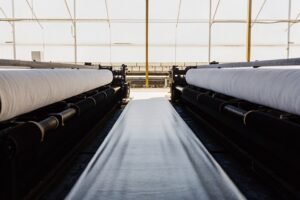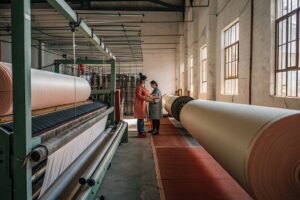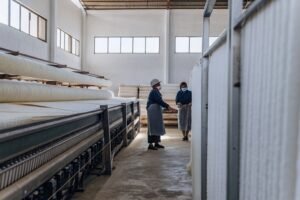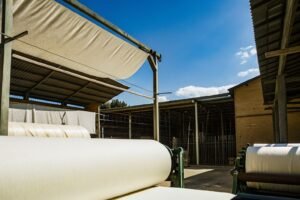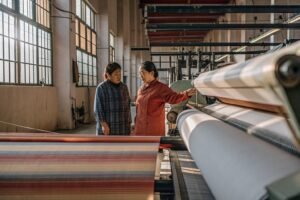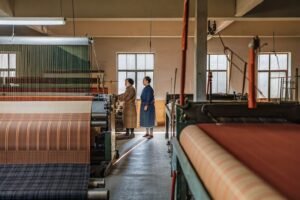
You’re scrolling through Instagram or Alibaba and you see it. A stunning reel of a massive factory floor. Rows of gleaming looms. Workers in crisp uniforms. The profile says "Manufacturer Since 1995." The prices are 30% lower than everyone else. You think you’ve hit the jackpot. You send an inquiry. They reply in perfect English within 2 minutes. They accept your small MOQ of 200 yards. They send you a PayPal invoice. You pay. Then the fabric arrives. It’s garbage. Or worse, nothing arrives at all. The profile vanishes. The website goes dark. You’ve just been scammed by a Fake Fabric Mill. I’ve been in this industry for 20 years, and I’ve watched this exact scenario steal millions of dollars from well-intentioned brands and designers. It makes my blood boil.
A fake fabric mill is usually a Trading Company or a Scam Operation that has Zero Ownership of Production Assets. They steal photos and videos from real factories (sometimes even from our Shanghai Fumao website). They create a glossy digital storefront. Their entire business model is Arbitrage and Deception. They source from the absolute cheapest, lowest-quality back-alley workshops and pocket the difference. Or they simply take your deposit and disappear. The damage goes beyond lost money. It’s lost time. Missed seasons. A brand reputation tarnished by shoddy product. Spotting these fakes is a survival skill for anyone sourcing fabric from China or anywhere else in Asia. You need to think like a detective, not a shopper.
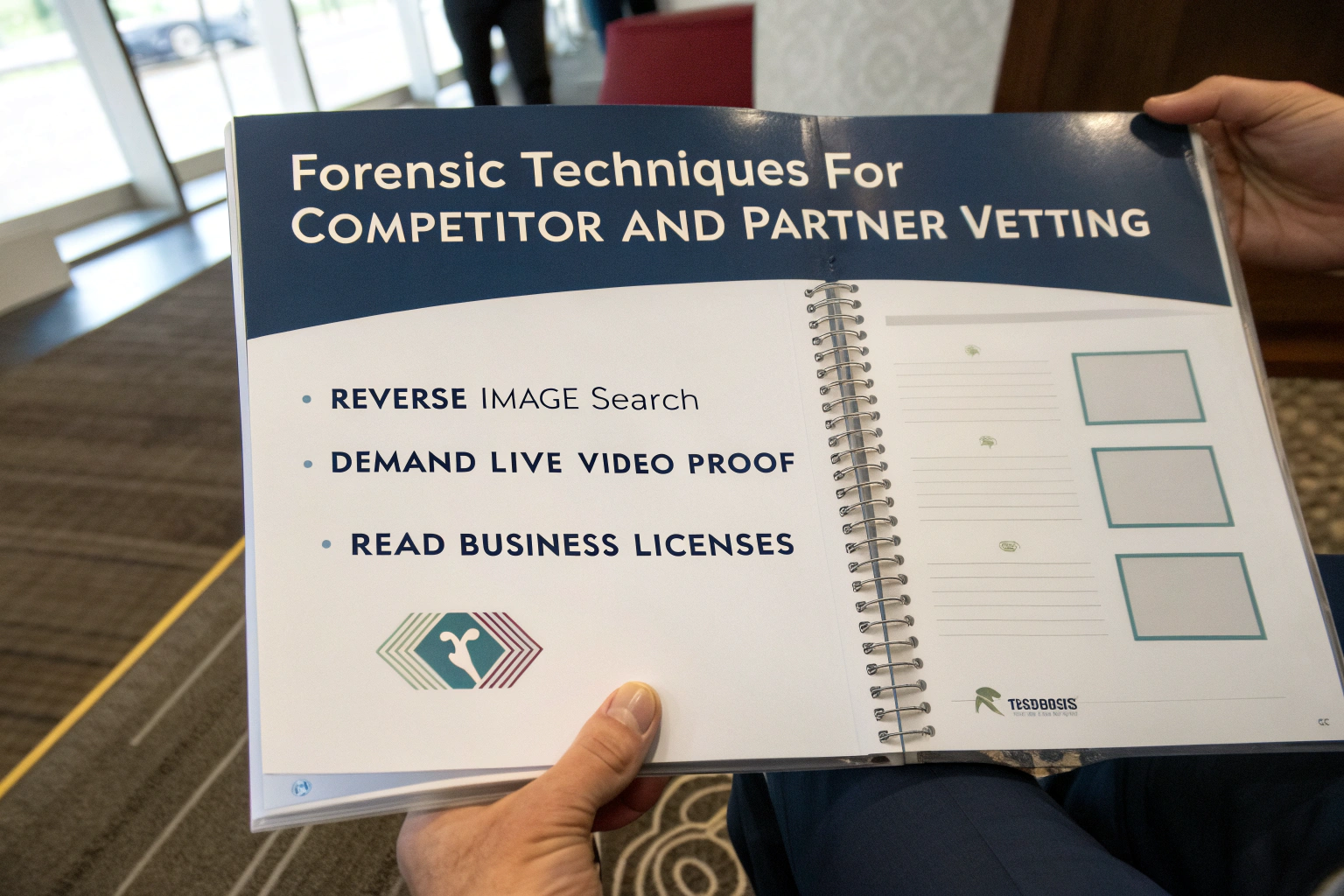
I’m going to teach you the forensic techniques we use internally to vet our own competitors and partners. This isn’t a generic "check reviews" guide. This is a field manual from someone who walks these factory floors every single day. I’ll show you how to Reverse Image Search like a pro, how to demand Live Video Proof that can’t be faked, and how to read a Business License to see who really owns the company. By the end of this, you’ll be able to spot a fake mill in under 10 minutes and protect your business from a catastrophic sourcing mistake.
What Are the Red Flags of a Fake Textile Manufacturer Website?
The website is the first line of deception. Fake mills invest heavily in Web Design and SEO because they have no investment in Looms. Their website is their only asset. Here are the specific red flags I look for immediately.
First, Stock Photography Overload. Look closely at the photos of the "factory." Are the workers wearing hard hats of five different colors, none of which match? Are the machines clean, brightly colored, and look like they’re from a trade show brochure? Real factories are dirty. They have lint on the floor. They have boxes stacked in corners. They look used. If every photo looks like it could be a banner ad for Siemens or Toyota Industries, it’s stolen. Right-click on the image and select "Search Image with Google." If that same image appears on Alibaba listings from five different "companies" or on a machinery manufacturer’s website, Run.
Second, Vague Product Descriptions. A real mill specializes. We have 300 looms, but they weave specific categories. A fake mill’s website will list Every Fabric Known to Man. Cotton, Silk, Linen, Polyester, Nylon, Denim, Lace, Velvet, Tulle, Neoprene, Kevlar. They claim to do it all. That’s impossible. No single factory has the equipment for both heavy denim and delicate silk organza. This is a clear sign they are a trader who just Google-searches for a supplier after you send the inquiry.
Third, No Physical Address, or a Virtual Office Address. Scroll to the "Contact Us" page. Copy the address. Paste it into Baidu Maps (for China) or Google Maps. Use Street View. Is it a massive industrial complex with a smokestack? Or is it a WeWork shared office space, a residential apartment building, or a PO Box at a mail forwarding service? In 2024, a client almost sent \$20,000 to a "mill" whose address was a KFC restaurant in Guangzhou. Street View saved him.

Does the Factory Registration Number Match the Physical Location?
This is a killer technique. In China, every legitimate business has a Unified Social Credit Code (USCC) . It’s an 18-digit number. It’s like a corporate social security number. Fake mills often steal the USCC from a real, dormant company. Or they just make one up.
Here is the process. Ask the supplier for their Business License . A real factory will send this without hesitation. It’s public record anyway. Look at the Legal Representative and the Registered Address . Now, go to the National Enterprise Credit Information Publicity System** website (it’s a .gov.cn site, use Google Translate). Input the company name or USCC. The official government record will show you:
- Registration Status: Is it "Active" or "Revoked"?
- Registered Capital: Is it \$10,000 USD (fake trading co) or \$5,000,000 USD (real factory)?
- Business Scope: Does it include "Manufacturing" or only "Trading" ? This is the Smoking Gun. If the business scope says "Wholesale and Retail of Textiles" but not "Manufacture of Textiles," they are legally registered as a Trader. They cannot legally own a factory. If they claim to be a factory and the license says "Trading," they are lying.
At Shanghai Fumao, our business license clearly states "Manufacture of Woven and Knitted Fabrics" . We encourage clients to verify this on the government database. A trader who is honest about being a trader is fine—you can still work with them. A trader who lies about being a factory is a snake. Avoid them. You can read more about this on the China Checkup guide to verifying Chinese companies.
Why Do Fake Mills Always Have Perfect English and Fast Replies?
This sounds counterintuitive. Shouldn’t a good supplier have good English? Yes. But there’s a difference between Functional Business English and Native-Level Marketing Fluff.
A real factory sales manager (like our Elaine) speaks excellent English, but she’s Busy. She’s on the production floor. She’s in meetings. She answers emails within 12-24 hours. A fake mill "sales rep" is sitting in a call center or a shared apartment with nothing to do but stare at Alibaba TradeManager. They reply to your 3:00 AM EST inquiry in 47 seconds with a perfectly formatted PDF quote and a string of emojis. They use phrases like "My dear friend," and "We assure you the most premium quality."
Why? Because their job is Conversion, not Production. They are professional sales closers. They have scripts. They are trained to overcome objections. A real mill salesperson might say, "Let me check with the dye house and get back to you tomorrow." A fake mill says, "Yes, we can do that! No problem!" immediately, to anything you ask. (Here I have to jump in—I sometimes test suspicious competitors by asking for a 20D nylon woven on a water jet loom but with a knitted backing. A real mill says, "That makes no sense." A fake mill says, "Yes, we have that in stock!")
How Can a Live Video Call Expose a Fake Factory?
This is your Nuclear Option. It is almost impossible to fake a live, interactive video walkthrough of a factory. If a supplier refuses a live video call, or only offers a pre-recorded "virtual tour" video file, the conversation is over. They are a fake.
But scammers are getting smarter. They will do video calls. But they will do them from a Rented Office or a Friend’s Factory. So you need to be smart about what you ask to see.
The Spontaneous Request Test: During the video call, ask the sales rep to walk Outside. Not down a hallway. Outside. Then ask them to pan the camera up to show the Building Exterior and Street Sign. Does the sign match the company name? Does the building look like a factory (loading docks, trucks, chimneys)? Then, ask them to walk back inside and go to a Specific Machine. "Show me the Stenter Frame. I want to see the control panel." If they hesitate, or if the video suddenly "freezes" or "has bad connection," it’s because they can’t access that machine. They’re in a showroom, not the factory floor.
The Sound Test: A real weaving mill is Loud. Deafening. 80-90 decibels of clanking metal. If the person is walking through the "factory" and you can hear their footsteps clearly and they aren’t wearing earplugs, they are not in a working weaving shed. They might be in a quiet warehouse or a yarn storage area. At Shanghai Fumao, we have to step into a soundproof office to take a video call. The background noise of a real mill is a Verification Signal that cannot be faked with stock audio.

Can You Trust Factory Photos with Workers in Uniforms?
Be skeptical. Very skeptical. Uniforms are Cheap. A scammer can buy 10 blue polo shirts and print a fake logo on them for \$50. They dress up their cousins and take photos in a rented industrial space. It looks legit. It’s not.
Look at the Details of the uniform. Are the clothes Worn and Stained? A real textile worker’s uniform has grease stains, dye spots, and frayed cuffs. A fake photo shows Crisp, Brand New Uniforms on people who look like models, not factory workers. Look at their Shoes. Real factory workers wear sturdy, closed-toe shoes (often provided by the factory) that are scuffed and dirty. Fake photos show people wearing clean white sneakers or dress shoes on the "factory floor."
Also, look at Safety Compliance. A real mill requires Hairnets, Ear Plugs, and No Loose Clothing near machinery. If the photo shows a worker with long flowing hair leaning seductively over a high-speed loom (yes, I’ve seen this on Alibaba), that is a Massive Safety Violation. It’s a staged photo. A real factory would never allow it for insurance reasons. Look for the Little Things: Are there fire extinguishers on the wall? Are the exit signs lit? Are the aisles clear of clutter? Real factories have real safety protocols. Fake photos look like a fashion shoot.
What Should You Ask Them to Write on a Piece of Paper?
This is a classic verification technique from online marketplaces like eBay and Reddit. It still works for factories. You want to prove that the person on the video call is actually in the specific factory right now.
The Instruction: During the live video call, say, "I need to verify this location for our internal compliance team. Could you please take a piece of printer paper, write ‘For [Your Name] – [Today’s Date] – Shanghai Fumao Verification’ on it with a marker, and hold it up in front of the Stenter Frame control panel?"
Then watch. A real factory will do this in 60 seconds. They’ll grab a scrap of cardboard or a piece of paper from the office, scribble it, and hold it up. The Handwriting will be messy. The Paper will be crumpled. The Lighting will match the ambient factory light. A fake operation will:
- Delay and Prevaricate: "The manager is not here." "The camera battery is low."
- Photoshop It Later: They will say, "Okay, I will send photo after call." Then they send a badly photoshopped image with the text floating unnaturally over a stock photo.
This test proves Temporal and Physical Presence. It proves they are standing in front of the machine at that moment. It’s simple, and it exposes fakes instantly. You can find more community-driven verification tips in threads on the r/Entrepreneur subreddit where people discuss sourcing scams.
Why Do Fake Mills Offer Unrealistic MOQs and Prices?
Let’s talk about the economics of real manufacturing. Setting up a dye machine for a custom color costs \$500 – \$1,500 in lab work, machine cleaning, and setup waste. If I sell you 100 yards of custom-dyed fabric for \$3.00/yard, my revenue is \$300. I just lost \$200 on the transaction. A real factory cannot survive doing that. We go bankrupt.
Fake mills don’t care. They offer 100 yard MOQs and Rock-Bottom Prices because:
- They Never Intend to Deliver. They take your \$300 deposit and disappear. \$300 x 100 victims = \$30,000. That’s their business model.
- They Will Bait-and-Switch. They take your 100-yard order. They find a cheap, off-spec deadstock roll in a warehouse that is close to your spec. They ship that. When you complain, they ghost you.
A real mill has a Minimum Order Quantity (MOQ) based on Economic Viability. Our MOQs are higher than a trader’s because we actually make the stuff. If you see a "factory" offering 50-yard MOQs on custom dyed nylon, they are either a trader with access to stock lots, or a scammer. There is no third option.
At Shanghai Fumao, we are transparent about our MOQs. For custom dyed wovens, it’s usually 800-1,500 yards. For greige stock dyeing, it might be 500 yards. If you only need 100 yards, we will honestly tell you, "We are not the right fit for this small quantity, but we can recommend a reliable stock house." A fake mill will never turn down an order, no matter how small or unprofitable. That’s the red flag.

Is a PayPal or Western Union Request a Scam Indicator?
Yes. 100%. This is the single biggest red flag in B2B sourcing. Real factories do Not use PayPal for bulk production orders. We use Telegraphic Transfer (T/T) Wire Transfers to a Corporate Bank Account or Letter of Credit (L/C) .
Why? Banking Regulations and Fraud Protection. A wire transfer goes to a verified corporate account at a major bank (Bank of China, HSBC, etc.). That account is tied to the business license and the legal representative’s ID. It leaves a permanent, traceable paper trail. If we scam you, you can sue us, and the Chinese police can freeze that bank account. PayPal offers Buyer Protection and Chargebacks. A real factory cannot afford the risk of a fraudulent buyer receiving 5,000 yards of fabric and then filing a false "Item Not Received" claim with PayPal and getting their money back. We would lose the fabric and the money.
Scammers love PayPal and Western Union because they can use Fake or Hacked Accounts. They take your payment, withdraw the cash immediately, and close the account. The money is gone forever. Western Union is especially dangerous because it’s Untraceable Cash. Legitimate B2B trade does not use Western Union. Period. If a "factory" asks for PayPal Friends & Family or Western Union, Cease Contact Immediately. You are dealing with a criminal. You can read more about these scams on the Federal Trade Commission’s business scam guide.
How Do They Source Samples If They Don’t Own Looms?
This is a great question, and it explains how they hook you initially. You request a sample. They send you a beautiful, perfect little swatch. You think, "Wow, the quality is amazing! And the price is so low!"
Here is the secret: They Buy the Sample from a Real Mill. Specifically, they buy a Sample Yardage or a Stock Cutting from a high-quality mill (sometimes even from Shanghai Fumao, without our knowledge). They pay the retail sample price (maybe \$20 for a yard). They send it to you. The sample is genuinely good quality. It has to be, or you won’t place the bulk order.
But they Cannot Produce That Quality in Bulk. They don’t have the looms. They don’t have the dye house. When the 5,000-yard PO comes in, they go to the Absolute Cheapest Back-Alley Dye House they can find. They say, "Make something that looks kinda like this." The bulk fabric is a pale, flawed imitation of the sample.
This is why Sample Approval is Not Bulk Approval. You must do a Pre-Production Sample (PP Sample) taken from the Actual Bulk Production Run. A fake mill will never be able to provide a PP sample that matches the initial swatch. They will make excuses. "The machine is broken." "The color is slightly different but okay." That’s your cue to walk away.
How Does Company Age and Physical Assets Verify Legitimacy?
Textile manufacturing is a Heavy Asset Industry. You can’t be a "factory" if you started the company 6 months ago and operate out of a laptop bag. Real mills have History and Stuff.
Company Age: Check the business license registration date. Has the company existed for 5+ years? 10+ years? A scam operation has a shelf life of 12-18 months before the Alibaba account gets banned and the bad reviews pile up. They constantly create new LLCs. Shanghai Fumao has been in business for Over 20 Years. That longevity is a Survival Badge. It means we’ve weathered global financial crises, cotton price spikes, and pandemics. We’ve paid our suppliers and our workers consistently for two decades. A 2-year-old "factory" offering prices 30% below market is almost certainly a fly-by-night operation.
Physical Assets: Ask for Photos of the Machine Nameplates. Every industrial loom has a metal plate with the Serial Number, Model, and Year of Manufacture. Ask for a photo of the nameplate on a Staubli Jacquard Head or a Toyota Air Jet Loom. A real factory can provide this in 5 minutes. A fake factory has no idea what you’re talking about. They’ll send you a blurry photo of a "machine" from a distance. Also, ask about Utility Bills. A real factory’s electricity bill is \$50,000 – \$100,000 per month. They can show you a redacted copy. A trading company’s bill is \$200. The scale of operations is visible in the data.

What Is the Difference Between a Trader and a Scammer?
This is an important distinction. Not every trader is a scammer. The industry runs on both mills and traders. But you need to know the difference so you can Price and Manage Risk Accordingly.
| Feature | Real Manufacturer (Mill) | Legitimate Trader/Agent | Fake Mill / Scammer |
|---|---|---|---|
| Owns Machinery | Yes | No | No |
| Admits Status | "We are a factory." | "We are a sourcing agent." | Lies. "We are a factory." |
| Pricing | Stable, market rate. | Slightly higher (markup). | Unrealistically low. |
| MOQ | Higher (economic viability). | Can be lower (consolidation). | Unrealistically low (bait). |
| Quality Control | In-house lab and QC team. | Relies on factory QC or 3rd party. | None. Relies on luck. |
| Payment Terms | T/T to Corporate Account. | T/T or L/C. | PayPal, Western Union. |
| Value Add | Production capacity, R&D. | Market knowledge, language, logistics. | None. Pure extraction. |
A legitimate trader can be a useful partner if you have small quantities or complex multi-category orders. They consolidate shipments and handle communication. But you Pay a Premium for that service. The problem is the Fake Mill—the trader who lies about being a factory to command a higher price without providing any of the factory’s stability. Always verify the business license scope. If it says "Trading," and they say "Factory," Terminate the Relationship. Honesty is the foundation of supply chain trust.
Can a Virtual Tour of the Weaving Floor Be Faked?
With AI video generation getting scarily good, a pre-recorded "virtual tour" video is Absolutely Fakeable. I’ve seen deepfake-style videos of factory tours that look 90% real. That’s why the Live Video Call is the gold standard.
But even a live video can be spoofed if the scammer has access to a real factory floor (e.g., they know someone who works there, or they bribe a security guard). That’s why you need Interactive Elements.
The Specific Machine Request: "Walk over to Loom #17. Read me the serial number off the nameplate." If the video conveniently "loses signal" near Loom #17, it’s because Loom #17 belongs to a different company, and they can’t get close.
The Lighting Check: Ask them to Turn Off the Overhead Lights for a second. Real factories have emergency lights and exit signs that stay on. The ambient light changes. A video loop or a virtual background cannot respond to this request. It will glitch or stay perfectly lit.
The People Test: Ask them to Introduce You to a Random Worker. "Can I say hello to the lady operating the inspection table?" In a real factory, the sales manager knows the workers. They can walk over, and the worker will wave and smile (usually shyly). In a fake scenario, the "workers" are either actors who won’t break character or the sales rep can’t get close to them. These interactive tests are your best defense against sophisticated visual deception.
Conclusion
The internet has democratized access to global manufacturing, but it has also democratized fraud. The barrier to entry for creating a "Fake Fabric Mill" online is a \$500 Alibaba Gold Supplier membership and a stolen photo album. The barrier to entry for building a real fabric mill is \$20 million in machinery and 20 years of hard-earned reputation. That asymmetry is why you must be vigilant.
Spotting a fake is a skill you develop through skepticism and verification. You’ve learned the red flags: Perfect English, Instant Replies, PayPal Requests, Absurdly Low MOQs, and Vague Addresses. You’ve learned the verification tools: Reverse Image Search, Business License Check, Live Interactive Video Calls, and the Handwritten Note Test. These tools don’t just protect your deposit. They protect your Brand Timeline, Your Sanity, and Your Customer Relationships.
At Shanghai Fumao, we are what we say we are. We invite the scrutiny. Check our license. Google our address and look at the satellite view of our Keqiao weaving complex. Ask for a live video walkthrough where we show you the CNAS lab and the nameplates on the looms. We have nothing to hide because we actually make the fabric. We want you to be confident, not just in our quality, but in our Existence.
If you’ve been burned by a fake mill before, or if you’re just starting your sourcing journey and want to deal with a verified, transparent partner, let’s connect. We can walk you through our facility virtually and show you what a real textile manufacturing operation looks like.
Reach out to our Business Director, Elaine. She can schedule a video call and provide our official business license and bank details for your due diligence. Her email is elaine@fumaoclothing.com. Don’t let the scammers win. Verify, then trust.