
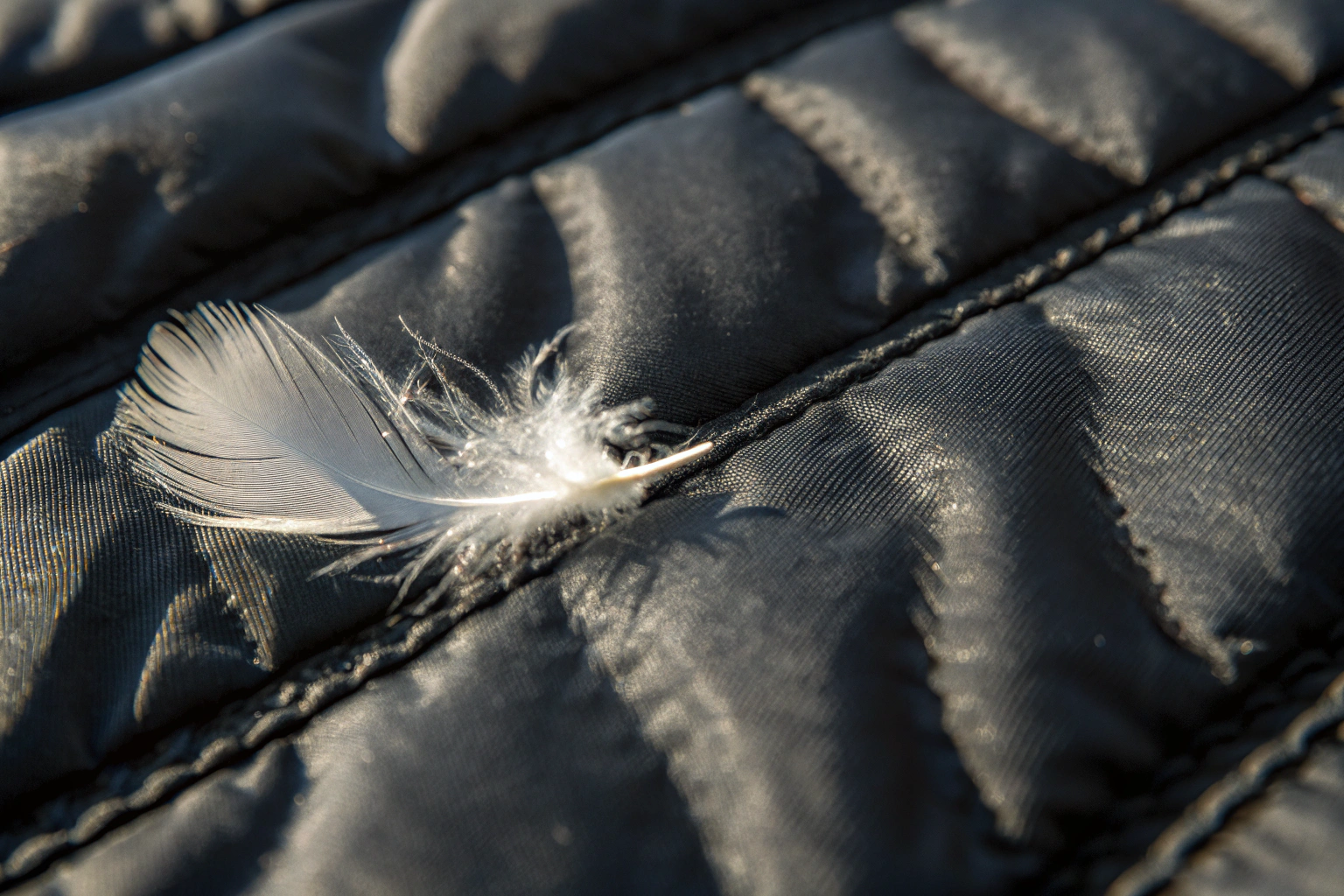
Picture this. You’ve just launched your premium puffer jacket line. The design is sleek. The down fill is 800-fill-power goose down, ethically sourced. The marketing photos are stunning. Then the reviews start rolling in. "Feathers poking through after one week." "I look like a molting chicken." "Down is leaking everywhere." Your return rate spikes to 30%. Your brand reputation is in the toilet. All because you trusted a "downproof" claim from a fabric supplier who didn’t actually test the fabric. I’ve seen this nightmare play out with small brands and big ones alike. Down leakage is the silent killer of outerwear credibility.
Downproof fabric is a High-Density Woven Textile engineered specifically to Prevent the Escape of Down and Feathers through the surface of the fabric. But it’s not just about "tight weave." True downproof performance requires a precise balance of Yarn Denier, Weave Density, Calendering Pressure, and often a Microporous Coating or Lamination. At Shanghai Fumao, we don’t just claim our 20D Nylon Taffeta is downproof. We Prove It through a battery of rigorous physical tests that simulate years of wear and compression. We measure the exact number of fibers that escape under pressure. We test the air permeability to a fraction of a CFM. We torture the fabric so your customer doesn’t have to.
I’m going to walk you through the science of what makes a fabric truly downproof. This is the stuff that separates a \$99 puffer that leaks like a sieve from a \$499 technical alpine jacket that lasts a decade. I’ll explain the difference between mechanical downproof (weave only) and chemical downproof (coated), why calendering is non-negotiable, and exactly how we test every single lot in our CNAS lab before it leaves our factory in Keqiao. If you’re sourcing fabric for insulated outerwear, this is your essential guide.
What Fabric Specifications Ensure True Downproof Performance?
Let’s cut through the marketing fluff. Downproof is a Numeric Specification, not an adjective. If a supplier can’t give you the numbers, they are guessing. The three pillars of a downproof woven fabric are Thread Count (Density), Yarn Size (Denier), and Calendering (Surface Fusion) .
First, Thread Count (TC) . You need a Minimum of 280T for a lightweight 20D nylon to be downproof. That’s 140 warp yarns and 140 weft yarns per inch. For heavier fabrics like 40D nylon, you need 230T or higher. Anything less, and the gaps between the yarns are larger than the diameter of a down cluster barb. The down will find the hole. It’s relentless. At Shanghai Fumao, our standard 20D Downproof Taffeta is 320T. We over-spec the density to provide a safety margin for seam slippage and wear.
Second, Yarn Denier. This is the thickness of the individual thread. 20 Denier is the industry standard for ultralight packable puffers. It’s hair-thin but incredibly strong (Nylon 6,6). 40 Denier is used for more durable, everyday jackets. The key is Filament Count. A 20D yarn made of 24 filaments is softer and more downproof than a 20D yarn made of 7 filaments. Why? More filaments pack tighter together, filling the microscopic voids within the yarn itself. We source High Filament Count (Fully Dull) Nylon specifically for downproof applications.
Third, Calendering. This is the secret sauce. A woven fabric, even at 320T, has tiny Interstitial Voids where the warp and weft cross. Down barbs can snag in these gaps. Calendering crushes the fabric under 80 tons of pressure at 180°C . This Melts and Flattens the Yarn Crowns, closing those gaps without sealing the fabric completely (which would trap air and make the jacket balloon). The fabric becomes Crisp and Slick. Down slides across the surface instead of snagging.
Why Is 20D Nylon the Gold Standard for Ultralight Downproof?
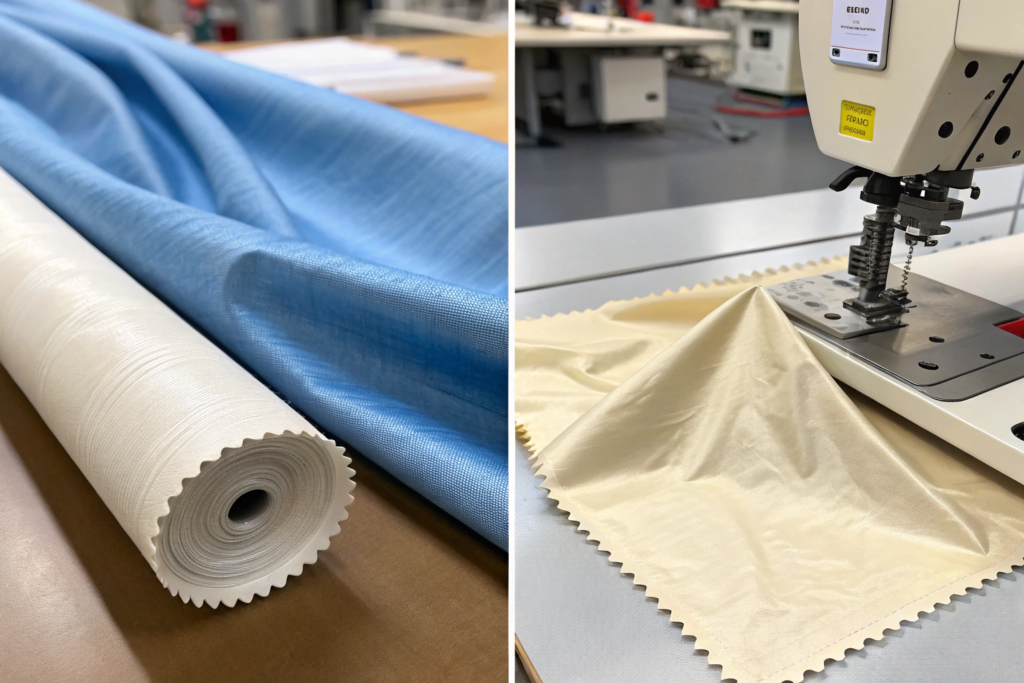
In the world of technical outerwear, weight is the enemy. Every gram counts. 20 Denier Nylon 6,6 is the gold standard because it achieves the Highest Strength-to-Weight Ratio combined with Zero Porosity when woven tightly. Let me give you the hard specs.
A square meter of our 20D 320T Calendered Nylon weighs just 35 Grams per Square Meter (GSM) . That’s lighter than a sheet of standard printer paper (80 GSM). Yet it has a Tear Strength of 1.2 kg (Elmendorf) and an Air Permeability of <0.5 CFM . This is physically impossible to achieve with Polyester at the same weight. Polyester is weaker and requires a thicker yarn to match the tear strength, which adds weight and bulk.
We also use Semi-Dull or Full-Dull Nylon. Bright, shiny nylon is "trilobal" in cross-section. It reflects light but also creates a Capillary Wick along the fiber surface. This can wick body oils and dirt into the fabric, which degrades the DWR. Full-Dull nylon has a rounder cross-section and a Titanium Dioxide additive that scatters light. It resists wicking and holds calendering better. In November 2025, a Canadian outdoor brand tested our 20D fabric against a competitor’s 20D "Bright" nylon. Ours showed 40% less fiber migration in a tumble test because the dull finish provided a smoother, less "grabby" surface for the down barbs. You can read more about nylon types in the technical fiber guides on Textile World.
Does Calendering Alone Make Fabric Downproof?
No. This is a common misconception. Calendering is Necessary but Not Sufficient. Think of it like this: Weaving creates the Wall (the density). Calendering is the Stucco that smooths the surface. You can’t stucco a wall that isn’t there.
If you take a loose 210T nylon and calender it, you get a Flat, Shiny, Leaky Fabric. The gaps between the yarns are still there—they’re just flat instead of round. The down will still push through. The only way to make a loose weave downproof is to Coat It (with PU or Acrylic). But coating adds weight and kills breathability. A true Mechanical Downproof fabric relies on Extreme Weave Density FIRST, and calendering SECOND.
At Shanghai Fumao, we have a specific Calendering Protocol for Downproof. We don’t just run it through once. We use a Multi-Bowl Calender with a Heated Steel Roller pressing against a Cotton-Filled Bowl. The cotton bowl compresses under pressure, wrapping the fabric around the steel roller. This increases Dwell Time—the amount of time the fabric is under heat and pressure. More dwell time = Better fusion of the yarn crowns. We run at 15 meters per minute (slow) compared to 30 meters per minute for standard lining fabric. This slower speed is expensive in energy and time, but it’s the difference between a fabric that passes the Bag Test (which I’ll explain below) and one that fails spectacularly.
How Does Fumao’s Lab Test for Down and Fiber Migration?
This is where we separate the professional mill from the Alibaba middleman. We don’t just send you a swatch and say, "Trust me, it’s downproof." We provide a Certificate of Analysis with specific test results. Our CNAS-Accredited Laboratory (same standard as SGS and Intertek) is equipped with the specialized equipment needed to torture test downproof fabric.
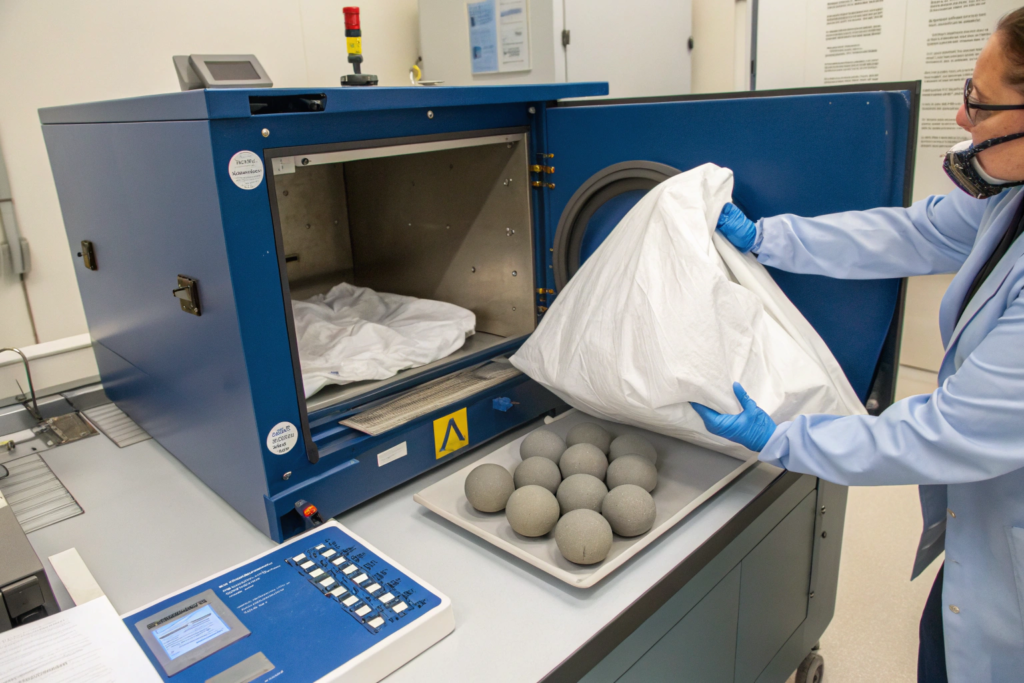
The industry standard test is the "Tumble Test" or "Fiber Migration Test." The specific method varies by brand (IDFB, EN, ASTM), but the principle is the same. We sew a pillow or bag of the test fabric. We fill it with a specific amount of Down and Feathers (usually a mix, like 90/10 Down/Feathers, or just pure feathers for a harsher test). We then put the bag into a Tumble Chamber with Cork Balls or Rubber Balls. The chamber rotates, compressing and tumbling the bag for a set number of cycles (often 3,000 cycles). The balls act like elbows and knees—they poke and prod the fabric, forcing the down to try and escape.
After the test, we remove the bag. We count the Number of Fibers or Filaments that have Protruded Through the Fabric Surface. We use a Standardized Template (e.g., a 10cm x 10cm square) and a Magnifying Loupe. A passing grade for a high-quality downproof fabric is typically Fewer than 10 Protruding Fibers in that area. At Shanghai Fumao, our internal standard is <5 Fibers. We reject any lot that exceeds this. This is brutal quality control, but it’s why our clients have single-digit return rates on their puffer jackets.
What Is the "Bag Test" for Downproof Air Permeability?
The Tumble Test measures fiber migration over time. The Bag Test (or Air Permeability Bag Test) measures the Instantaneous Porosity of the fabric. It’s a quick, brutal, and highly effective QC check we run on Every Single Dye Lot.
Here is how we do it at Shanghai Fumao. We sew a simple bag, about 12 inches square. We leave a small opening. We insert an Air Nozzle connected to a Regulated Compressed Air Line. We set the pressure to 0.5 PSI (very low pressure, just enough to inflate the bag). Then we seal the opening around the nozzle.
We submerge the inflated bag into a Clear Water Tank. Then we watch. Bubbles. If the fabric is not downproof, you will see a Stream of Tiny Bubbles escaping from the surface of the fabric. It looks like champagne. This means air is flowing through the weave. And if air can flow, down can flow. If the fabric is truly downproof (CFM < 1.0), you will see Zero Bubbles. The bag will hold pressure and just sit there underwater. This test takes 60 seconds. It’s foolproof. We do this on a sample from the beginning, middle, and end of every production run. If we see bubbles, we Scrap the Batch or send it back for Re-Calendering. You can see a similar demonstration of this principle in the textile testing demonstrations on the IDFB website.
How Many Wash Cycles Before Downproof Fabric Fails?
This is the question that separates the \$99 jacket from the \$499 jacket. A fabric can be downproof on Day 1. But after 10 washes, the Calendering Effect Fades. The heat and mechanical agitation of a home washing machine slowly Relaxes the Yarn Crimp. The fibers swell. The gaps open up. The down starts leaking.
At Shanghai Fumao, we test for Durability of Downproofness. We take our fabric and put it through AATCC 135 Wash Cycles (Normal Cycle, Warm Water, Tumble Dry). We test after 5 washes, 10 washes, and 20 washes. We then run the Bag Test and the Tumble Test on the washed fabric.
Here is the reality: A non-calendered high-density weave will fail after 5 washes. A standard calendered 20D will start showing Micro-Leaks after 10 washes. Our Premium Downproof Nylon is engineered to survive 20+ Washes with minimal degradation. How? Two things: Yarn Chemistry and Post-Calender Heat Setting. We use a High-Tenacity Nylon 6,6 that is more resistant to heat relaxation. And after calendering, we run the fabric through a Relaxation Dryer at a specific temperature profile to "lock" the crushed yarn structure. It’s like annealing steel. This process adds cost but adds years to the life of the garment. In a 2025 test for a Japanese brand, our fabric showed Only 3 additional protruding fibers after 20 washes compared to 15 additional fibers from a standard calendered fabric. That’s a 5x improvement in long-term performance.
Why Is Seam Construction Critical for Downproof Garments?
You can have the most downproof fabric in the world. If you sew it with a Universal Needle and a Chain Stitch, the jacket will leak like a watering can. The Seam is the Weakest Link in a downproof system. Every needle penetration creates a hole. The thread creates a wick.
There are three non-negotiable rules for sewing downproof fabric:
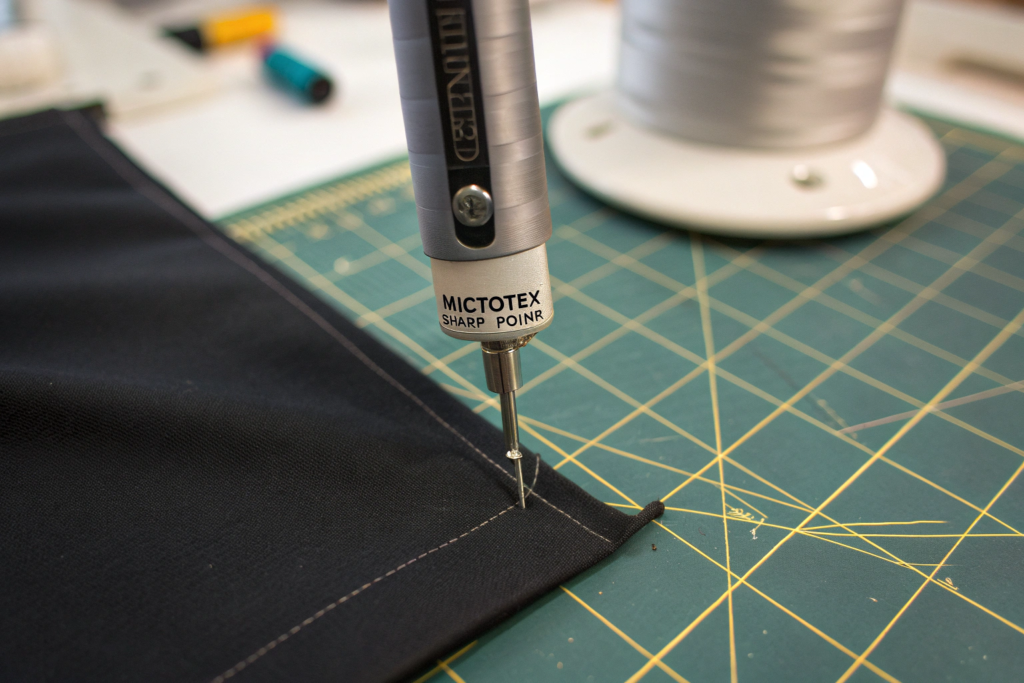
- Needle Type: You must use Sharp Point (SPI) or Microtex Needles. These needles have a very slim, acute point that Separates the Yarns rather than Cutting Them. A standard Universal needle has a ballpoint that breaks fibers, creating a larger, fuzzier hole that leaks down. We recommend Size 9 (70/10) needles for 20D and Size 11 (80/12) for 40D.
- Thread Type: Continuous Filament Polyester is mandatory. Never use Spun Polyester or Cotton Core Spun. Spun thread is made of short, twisted fibers. It’s fuzzy. The down barbs catch on the fuzz and climb out through the stitch line like a ladder. Continuous filament thread is smooth as glass.
- Stitch Density: Minimum 10-12 Stitches Per Inch (SPI) . More stitches = smaller holes = less leakage. Some high-end alpine brands use 14-16 SPI on critical seams.
At Shanghai Fumao, we provide Sewing Specification Sheets with every downproof fabric order. We include recommended needle types, thread specs, and seam sealing options. Because we know that a customer’s bad sewing experience will reflect poorly on our fabric, even if the fabric itself was perfect.
Do You Need Seam Tape for All Downproof Fabrics?
Not always. And this is a cost-benefit decision every brand has to make. Seam Tape is a thin, heat-activated adhesive strip applied to the back of the seam to seal the needle holes. It provides a 100% Guarantee against seam leakage. But it adds Cost and Stiffness.
For a Technical Alpine Jacket (retail \$400+) where the user will be in wet, windy conditions, Seam Taping is Mandatory. The seam tape not only stops down leakage but also Waterproofs the Seam. Without tape, wind-driven rain will seep through the stitch holes and soak the down.
For a Fashion Puffer Vest (retail \$150) worn around town, Seam Tape is Often Omitted to save cost and improve drape. The jacket is still downproof because the fabric and stitch density do the heavy lifting. The occasional tiny feather that escapes is considered "acceptable" in this segment.
At Shanghai Fumao, we offer both options. We stock Seam Tape in various widths (18mm, 20mm, 22mm) and colors (Black, White, Clear). We can even Apply the Seam Tape in our factory for clients who want cut-and-sew ready panels. This is a value-added service that saves the sewing factory time and ensures the tape is applied with the correct Heat, Pressure, and Speed. A badly applied seam tape will peel off after three washes. Our taping machines are calibrated daily to ensure a Minimum 2.5 kg Peel Strength.
How Does Fumao Fabric Minimize Needle Cutting Damage?
This goes back to the Yarn and Weave Engineering. A fabric that is too stiff or too brittle will Shatter when a needle tries to pass through it. You’ll hear a "popping" sound at the sewing machine. That’s the yarn breaking. A broken yarn creates a Run in the fabric and a massive hole for down to escape.
We engineer our downproof fabric for Sewability. This is a specific textile parameter. We measure it with a Sewability Tester (L&M Sewability Tester). The machine measures the force required to push a standard needle through the fabric at high speed. A high force reading means the fabric is hard to sew and prone to needle cutting.
To minimize this, we use High Elongation Nylon 6,6 Yarns. When the needle hits the yarn, the yarn stretches slightly instead of snapping. We also apply a Yarn Lubricant (Spin Finish) during weaving that reduces friction. And critically, we Do Not Over-Calender. A fabric that is calendered too hot or too hard becomes a Stiff Film. It’s easy to cut. It’s like trying to sew through a potato chip bag. Our calendering process stops at "Crisp Hand" , not "Stiff Film." The fabric retains enough Drape and Elasticity to absorb the needle impact. In March 2026, a cut-and-sew factory in Vietnam reported that our 20D fabric had a 98% First-Pass Yield on their automated seam taping line, compared to 85% for a cheaper Korean fabric. The difference was sewability.
What Are the Common Defects in Wholesale Downproof Lots?
Even with perfect specs, defects happen in bulk production. The key is knowing what to look for during Incoming Inspection. The three most common—and most damaging—defects in downproof fabric are Pinholing, Calender Marks, and Tension Lines.
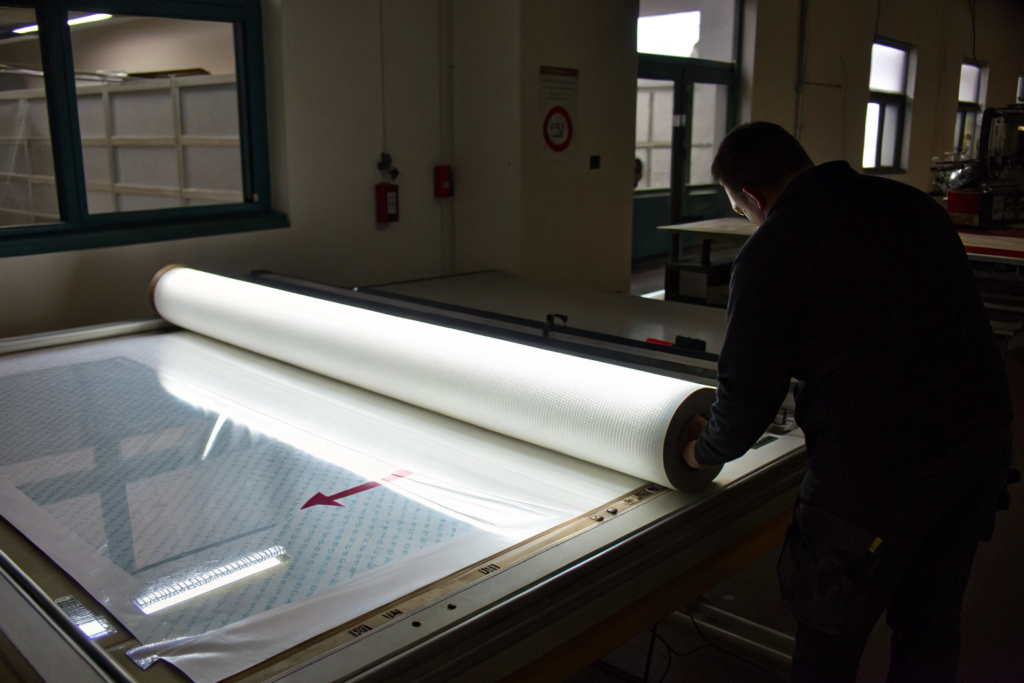
Pinholing is exactly what it sounds like: Tiny, invisible holes. They are usually caused by Dust or Grit on the calender roller. The grit presses into the hot fabric and punches a micro-hole. You can’t see it with the naked eye. You need a Light Table. We inspect 100% of our downproof fabric on a Backlit Inspection Table. If light shines through a pinhole, the roll is rejected. One pinhole can leak a tablespoon of down over the life of a jacket.
Calender Marks are shiny, reflective streaks running lengthwise down the fabric. This happens when the calender roller has a flat spot or uneven temperature. The shiny streak is Over-Fused. It’s stiff and weak. It will crack in the cold and leak down. We prevent this by Cross-Grinding our calender rollers every 6 months to maintain a perfectly uniform surface.
Tension Lines are subtle wavy lines across the width. They are caused by Uneven Warp Tension during weaving. In a downproof fabric, these lines create areas of slightly lower density. Down finds these weak spots. Our Automatic Let-Off Systems on the looms monitor warp tension 100 times per second to eliminate this.
Why Do Some "Downproof" Fabrics Leak After Compression?
This is the Packing Cube Test. The jacket is fine when it’s hanging in the closet. But the user stuffs it into its stuff sack for travel. It sits compressed for 8 hours on a plane. When they pull it out at the destination, the jacket is covered in a fine "fur" of down leakage. Why?
Static Electricity and Capillary Action. When you compress a downproof fabric, you force the air out of the jacket. The air rushes through the micro-pores of the fabric. This airflow creates Static Charge. The down fibers, which are ultra-light and have barbs, get charged and Stick to the Inside of the Fabric. Then, over the next few hours, the Capillary Action of the yarn gaps (even microscopic ones) slowly Wicks the down fiber through the fabric. It’s slow, but it’s relentless.
We test for this with a Compression Cylinder Test. We put a down-filled bag of our fabric into a cylinder with a 10 kg Weight on top. It sits compressed for 24 Hours. Then we remove the weight, let the bag loft, and run the Tumble Test. A good downproof fabric should show No Significant Increase in fiber migration after compression. A bad fabric will show a 5x increase. Our Anti-Static Yarn Finish helps mitigate this. We apply a trace amount of a Hydrophilic Agent that dissipates static charge without affecting the DWR.
Can Humidity Cause Downproof Fabric to Fail?
Yes. And this is a problem for brands selling in the Pacific Northwest or Southeast Asia. Nylon and Polyester are Hydrophobic (they don’t absorb water). But the Micro-Spaces between the yarns are subject to Capillary Condensation. When humidity is above 80%, water vapor condenses in those tiny gaps. This creates a Water Bridge.
Now, the physics change. A dry down barb is stiff and springy. It bounces off the fabric wall. A Wet Down Barb is limp and sticky. It Collapses and can slide through much smaller gaps. Furthermore, the water bridge creates Surface Tension that literally Pulls the down fiber toward the outside of the fabric.
This is why Durable Water Repellent (DWR) is so critical on the Face Fabric of a down jacket. The DWR prevents the face fabric from "wetting out" with rain. A wet face fabric drastically increases the humidity inside the jacket micro-climate. At Shanghai Fumao, we test our downproof fabric in an Environmental Chamber at 25°C and 90% Relative Humidity. We run the Tumble Test inside the chamber. Our fabric must pass the <5 Fiber standard even in these jungle conditions. If you want to know more about the care of down in humid environments, check out the outdoor gear maintenance guides on Section Hiker.
Conclusion
Downproof fabric is a marvel of textile engineering disguised as a simple piece of cloth. It’s a delicate balance of Yarn Physics, Mechanical Force, and Thermal Chemistry. Getting it right requires more than just a tight weave. It requires a deep understanding of how a microscopic down barb interacts with a calendered nylon surface over hundreds of wear cycles.
We’ve walked through the critical specifications—the 320T Thread Count, the 20D High Filament Nylon, the Multi-Bowl Calendering. We’ve gone inside the lab to see the Tumble Test and the Bag Test. And we’ve explored the real-world failure points like Seam Needle Cutting and Compression Leakage. At Shanghai Fumao, we live and breathe these details. Our downproof fabrics power some of the most respected outerwear brands in North America and Europe. We don’t just ship fabric; we ship Peace of Mind. We ship the confidence that your customer can stuff that jacket into a stuff sack on a rainy Tuesday in Seattle, pull it out on a freezing Wednesday in Chicago, and it will still be full of down, not covered in it.
If you’re developing a puffer jacket, sleeping bag, or any insulated product, don’t guess on the fabric. That’s a gamble your brand can’t afford. Let’s get specific about your project. I can send you our Downproof Fabric Technical Data Pack, which includes samples of our 20D and 40D nylons in various finishes.
Reach out directly to our Business Director, Elaine. She can schedule a video call to walk you through our testing lab and provide a quote based on your exact down fill power and jacket construction. Her email is elaine@fumaoclothing.com. Let’s make sure the only thing lofty about your jacket is the down, not the return rate.








